
Let’s clear up a common misconception right away. There is no program where you can directly purchase a Costa Rican passport. Instead, the country offers a structured residency-to-citizenship pathway that begins with an investment.
This journey starts by qualifying for temporary residency. You typically do this through one of three categories: Pensionado (retiree), Rentista (passive income earner), or Inversionista (investor). Each has specific financial requirements in US dollars.
After maintaining temporary status, you can apply for permanent residency. Full naturalization and the chance to obtain a Costa Rican passport come later, following several years of legal residence. The process involves multiple steps with immigration authorities.
We are here to guide you through this residency and immigration process. Our role is to provide clear, realistic information and help you prepare your application thoroughly. This guide will walk you through each phase.
Understanding Costa Rica Residency Options (Residencia en Costa Rica)
Your first decision involves choosing between the Pensionado, Rentista, or Inversionista residency categories. These are the three main pathways to a legal residency permit in Costa Rica.
The Pensionado (Pensionado) route is for retirees with a stable foreign pension. The Rentista (Rentista) category suits those with verified passive income. The Inversionista (Investor) pathway requires a qualifying capital investment.
Each option leads to an initial temporary residence permit. This permit is valid for two years and is renewable. It’s crucial to understand this is the first step, not the final goal.
After maintaining temporary status and physically living in the country for three consecutive years, you become eligible for permanent residency. This is a mandatory phase in the immigration process.
We provide guidance on this residency framework. Costa Rica does not have a direct passport program. For official regulations, always refer to migracion.go.cr.
Who Qualifies for Costa Rica Residency and Citizenship
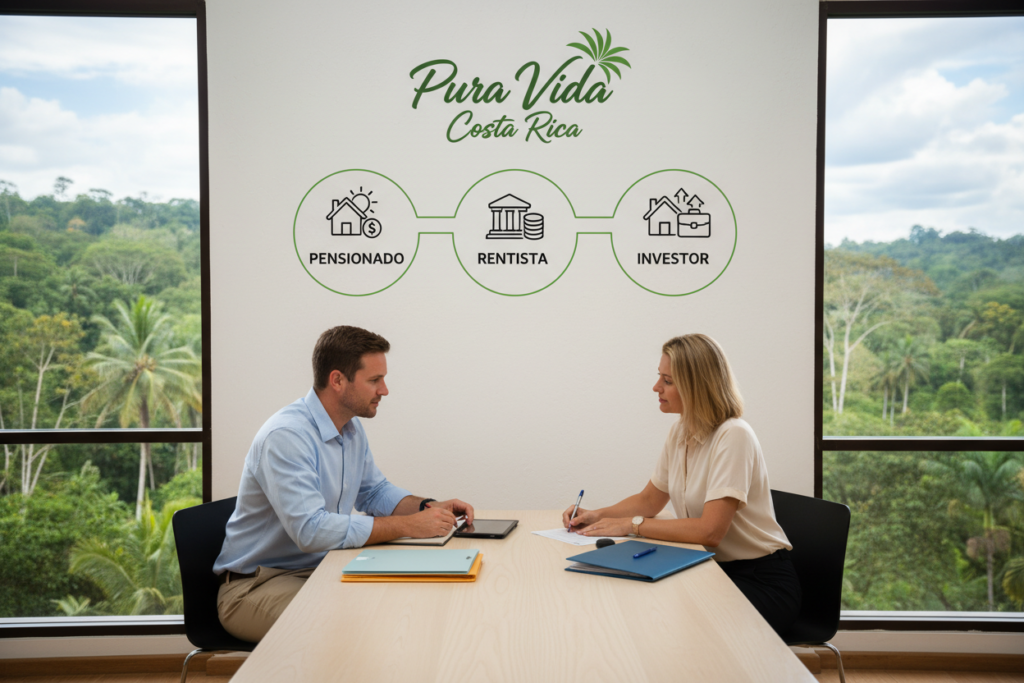
Qualifying for residency in Costa Rica is not a one-size-fits-all process. It requires aligning your finances with one of three official categories.
The Pensionado pathway is for retirees. Applicants must prove a permanent, stable pension of at least US$1,000 per month. An official Social Security authority certificate is mandatory.
Rentista applicants need verified passive income. This must be at least US$2,500 monthly, proven over two years. A Costa Rican bank must confirm this income with a formal letter.
The Inversionista route demands a minimum investment of US$150,000. This can be in real estate or a business. A critical rule—property must be registered in your personal name at the Registro Nacional, not through a corporation.
All pathways require a clean immigration and criminal record. You must provide apostilled police clearance certificates from relevant countries.
After three years of actual residence, temporary residents can apply for permanent status. Costa Rican citizenship through naturalization generally requires seven total years of legal residency. For Central American, Ibero-American, or Spanish nationals, it’s five years.
Applicants under age 65 must pass Spanish and history exams. We help you understand these criteria and prepare your documents thoroughly. Final approval rests solely with Costa Rica’s immigration authorities.
Preparing Your Documentation Before Arrival
Proper paperwork is the single most critical factor for a smooth immigration journey. The time to start is now, from your home country. A complete and correctly prepared file is the best way to avoid unnecessary delays in your Costa Rica application process.
Essential Documents and Apostilles
You will need several core documents. These include birth and marriage certificates, police clearances, and proof of income or pension. Every single one must be apostilled in its country of origin.
After apostille, official Spanish translation by an authorized translator is required. Police certificates are typically valid for only six months. Time this step carefully to meet immigration requirements.
Mistakes to Avoid During Preparation
Common errors cause major setbacks. Missing an apostille, using a non-certified translator, or submitting an expired police clearance will delay your application. Ensure every document matches your legal name exactly.
We help clients navigate this complex preparation phase. For a detailed document checklist tailored to your residency pathway, professional guidance is key. Thoroughness from the start protects your timeline.
Step-by-Step Guidance for the Pensionado (Pensionado) Pathway
For retirees seeking a life in Costa Rica, the Pensionado pathway offers a clear, structured route to legal residency. We guide you through each required action.
Eligibility and Pension Income Requirements
This category is for retirees with a stable pension. You must prove a minimum income of US$1,000 per month. This pension must be permanent, stable, and irrevocable.
Government or private pensions qualify. The issuing authority must confirm these terms in writing.
Securing the Appropriate Income Certificate
Step one is obtaining the official income certificate. It must come from your Social Security or pension administrator. The document needs an apostille and a certified Spanish translation.
We help ensure your certificate meets all standards. Then, we submit your complete application to DGME.
Processing typically takes 3 to 9 months. Approval grants a two-year temporary residency permit. Remember, we prepare your case thoroughly, but final approval rests with immigration authorities.
Ready to start? Contact us via WhatsApp at +506 8706 3888 or email info@crie.cr.
Step-by-Step Guidance for the Rentista (Rentista) Pathway
Establishing residency through passive income involves a distinct verification process centered on bank confirmation. This pathway is for individuals with stable earnings from rentals, dividends, or annuities.
Income Verification Process and Requirements
You must prove a passive income of at least US$2,500 per month for two years. Gather documents like lease agreements or brokerage statements showing this history.
These papers need an apostille and official Spanish translation. The unique step is obtaining a verification letter from a Costa Rican bank.
Opening a local account and demonstrating the income stream allows the bank to issue this critical letter to immigration authorities.
We compile your full application—including the bank letter, translated documents, and police clearances—for submission. Processing by DGME typically takes 3 to 9 months.
Approval grants a two-year temporary residency permit. This permit is renewable if you maintain the income and live in Costa Rica for at least six months each year.
After three consecutive years of actual residence, you become eligible for permanent residency. We guide you through each phase, though we cannot guarantee approval or exact timelines.
Ready to verify your income? Contact us via WhatsApp at +506 8706 3888 or email info@crie.cr for step-by-step assistance.
Step-by-Step Guidance for the Inversionista (Investor) Pathway
Securing residency through investment demands more than just capital. It requires navigating specific property registration laws and a detailed verification process. We guide you through each phase of this investor pathway.
Meeting the Investment Threshold and Property Standards
The Inversionista category requires a minimum investment of US$150,000 in the country. Qualifying assets include real estate, business ventures, shares, or productive projects.
A critical rule, changed under Law 9996, mandates that property must be registered in your personal name at the Registro Nacional. Holding it through a corporation is no longer valid for this residency.
Documenting Your Qualifying Investment
First, identify and complete your investment. For real estate, this means ensuring a clean title is in your name. For a business, secure legal proof of your ownership stake and capital contribution.
Next, obtain an official appraisal to confirm the value meets the threshold. You must then gather the property deed, proof of payment, and a certificate from the National Registry.
We compile these documents with your apostilled personal papers into a full application. Submission kicks off a review process that typically takes 3 to 9 months. Approval grants a two-year temporary permit, allowing you to live in Costa Rica and manage your asset.
For a detailed step-by-step process for Costa Rica investor, professional guidance is essential. We prepare your case thoroughly, though final approval rests with immigration authorities.
Ready to begin? Contact us on WhatsApp at +506 8706 3888 or email info@crie.cr.
Digital Nomad Versus Residency: Clarifying Common Misconceptions
A frequent point of confusion among newcomers is the distinction between a Digital Nomad visa and formal residency status. We often meet clients who believe their time in Costa Rica on this visa counts toward permanent residency or citizenship. It does not.
The Digital Nomad visa is a temporary remote work authorization. It allows you to live and work in Costa Rica for up to one year, often renewable for a second. This is perfect for short-term travel and remote employment from other countries.
However, it is not a residency category. If you wish to build a long-term future here, you must transition to a legal residency pathway. For those with passive income, the Rentista category is often the closest fit. For others, the Inversionista route with a qualifying investment may be suitable.
Only time spent under Pensionado, Rentista, or Inversionista status counts toward the three-year requirement for permanent residency. It also counts toward the seven-year requirement for Costa Rican citizenship. For applicants from certain other countries, this may be five years.
We help Digital Nomads assess their options for a proper residency application. Our guidance is realistic—we prepare your case, but final approval rests with immigration authorities. Contact us to discuss transitioning from a temporary visa to a lasting legal status.
Navigating Timelines and Processing Expectations
Planning your move to Costa Rica requires a clear map of the timeline ahead. We want to provide realistic expectations for each phase of your journey.
Typical Timeframes from Application to Approval
Once you submit a complete file, the initial processing time typically ranges from three to nine months. This period depends on the immigration authority’s workload and your specific case.
Approval grants a two-year temporary residency permit. You must renew this before it expires, which involves a similar processing window.
After three consecutive years of actual residence, you become eligible for permanent status. This is a significant milestone that removes ongoing financial requirements.
The pathway to citizenship requires at least seven years of legal residency for most applicants. A critical detail is that every month spent outside the country is deducted from your total time count.
Extended absences can significantly delay your eligibility. We cannot guarantee exact timelines, as final decisions rest with official authorities. For the most current information, always verify details at migracion.go.cr.
How to Avoid Common Pitfalls in the Immigration Process
The path to legal residency is often delayed not by complex rules, but by avoidable administrative errors. We see the same few mistakes trip up applicants in Costa Rica, leading to frustrating delays and extra costs.
Missing apostilles or using an unauthorized translator will get your application rejected outright. Police clearances expire in six months—if they lapse during review, you must obtain new ones.
Name discrepancies between your documents can halt the entire process. For investors, property must be in your personal name, not a corporation’s. Gaps in physical presence or lapsed CCSS (Caja) payments jeopardize renewals.
Thorough preparation is your best defense against these pitfalls. We guide clients to navigate these details meticulously, though final approval always rests with immigration authorities.
Integrating Family Members into Your Application
One of the most significant advantages of Costa Rica’s immigration system is its family-inclusive approach. You can include your immediate family in your primary residency application. This allows your entire household to obtain legal status together under a single process.
Eligible family members include your legally married spouse and all children under 18 years old. Unmarried, financially dependent adult children between 18 and 25 can also be included. Typical examples are full-time students or those not yet employed.
Each included member receives the same residency status as the main applicant. If you are approved for temporary residency, your spouse and children get the same permit. The core additional documents are your apostilled marriage certificate and the birth certificates for all children.
These must be officially translated into Spanish. If you later become a Costa Rican citizen, children born afterward may be eligible. We help families prepare complete applications for a smooth transition.
Getting Started with costa-rica-citizenship-by-investment: Your Next Steps
To turn your goal of living in Costa Rica into reality, actionable next steps are essential. Remember, this is a residency pathway, not a direct passport purchase. Your journey involves securing temporary status, then permanent residency, and finally citizenship after several years.
Your first concrete step is document preparation. Gather apostilled and translated papers for your chosen category: Pensionado, Rentista, or Inversionista. Starting this from your home country is crucial for a smooth application.
We guide you through this entire immigration process. For a personalized assessment and step-by-step support, contact us today. Reach us on WhatsApp at +506 8706 3888 or email info@crie.cr. Always verify official rules at migracion.go.cr and learn more at crie.cr.
FAQ
What is the main difference between obtaining residency and becoming a citizen in Costa Rica?
Residency is a legal permit to live here, which we can help you secure through programs like Pensionado, Rentista, or Inversionista. Citizenship, which grants a passport, is a separate process that typically requires seven years of legal residence before you can apply for naturalization. Think of residency as the essential first step on a longer path.
Can my spouse and children be included in my residency application?
Absolutely. Your spouse and dependent children under 25 can be integrated as dependents on your primary application. This is a standard part of the process, and we ensure all required documentation for your family members is prepared correctly to avoid delays.
How long does the residency application process typically take?
Processing times vary, but you should generally plan for a timeline of several months from submission to approval. Government processing is meticulous, and having your documents perfectly in order—with apostilles and official translations—is the best way to prevent unnecessary extensions to this period.
Is the Digital Nomad Visa a shortcut to permanent residency or citizenship?
No, it’s a common misconception. The Digital Nomad Visa is a temporary permit for remote workers. It does not count toward the years required for permanent residency or citizenship. For a permanent solution, the established residency pathways like Rentista or Inversionista are the appropriate routes.
What is the minimum guaranteed income required for the Pensionado pathway?
For the Pensionado (Pensioner) program, you must prove a lifetime pension income of at least
FAQ
What is the main difference between obtaining residency and becoming a citizen in Costa Rica?
Residency is a legal permit to live here, which we can help you secure through programs like Pensionado, Rentista, or Inversionista. Citizenship, which grants a passport, is a separate process that typically requires seven years of legal residence before you can apply for naturalization. Think of residency as the essential first step on a longer path.
Can my spouse and children be included in my residency application?
Absolutely. Your spouse and dependent children under 25 can be integrated as dependents on your primary application. This is a standard part of the process, and we ensure all required documentation for your family members is prepared correctly to avoid delays.
How long does the residency application process typically take?
Processing times vary, but you should generally plan for a timeline of several months from submission to approval. Government processing is meticulous, and having your documents perfectly in order—with apostilles and official translations—is the best way to prevent unnecessary extensions to this period.
Is the Digital Nomad Visa a shortcut to permanent residency or citizenship?
No, it’s a common misconception. The Digital Nomad Visa is a temporary permit for remote workers. It does not count toward the years required for permanent residency or citizenship. For a permanent solution, the established residency pathways like Rentista or Inversionista are the appropriate routes.
What is the minimum guaranteed income required for the Pensionado pathway?
For the Pensionado (Pensioner) program, you must prove a lifetime pension income of at least $1,000 per month. For a couple, this requirement increases to $1,500 per month. We assist in securing the proper income certification from your pension provider to meet this standard.
What are the most common mistakes people make during the application process?
The most frequent pitfalls involve documentation: submitting documents without the required apostille or official Spanish translation, or providing insufficient proof of income for financial pathways. We guide you through each requirement to ensure your application is complete and compliant from the start.
What kind of investment qualifies for the Inversionista (Investor) residency?
To qualify, you must make a minimum investment of $150,000 USD in approved assets within Costa Rica. This most commonly involves real estate, but certain business ventures or securities can also qualify. The key is thorough documentation proving the investment’s value and that the funds originated from abroad.
,000 per month. For a couple, this requirement increases to
FAQ
What is the main difference between obtaining residency and becoming a citizen in Costa Rica?
Residency is a legal permit to live here, which we can help you secure through programs like Pensionado, Rentista, or Inversionista. Citizenship, which grants a passport, is a separate process that typically requires seven years of legal residence before you can apply for naturalization. Think of residency as the essential first step on a longer path.
Can my spouse and children be included in my residency application?
Absolutely. Your spouse and dependent children under 25 can be integrated as dependents on your primary application. This is a standard part of the process, and we ensure all required documentation for your family members is prepared correctly to avoid delays.
How long does the residency application process typically take?
Processing times vary, but you should generally plan for a timeline of several months from submission to approval. Government processing is meticulous, and having your documents perfectly in order—with apostilles and official translations—is the best way to prevent unnecessary extensions to this period.
Is the Digital Nomad Visa a shortcut to permanent residency or citizenship?
No, it’s a common misconception. The Digital Nomad Visa is a temporary permit for remote workers. It does not count toward the years required for permanent residency or citizenship. For a permanent solution, the established residency pathways like Rentista or Inversionista are the appropriate routes.
What is the minimum guaranteed income required for the Pensionado pathway?
For the Pensionado (Pensioner) program, you must prove a lifetime pension income of at least $1,000 per month. For a couple, this requirement increases to $1,500 per month. We assist in securing the proper income certification from your pension provider to meet this standard.
What are the most common mistakes people make during the application process?
The most frequent pitfalls involve documentation: submitting documents without the required apostille or official Spanish translation, or providing insufficient proof of income for financial pathways. We guide you through each requirement to ensure your application is complete and compliant from the start.
What kind of investment qualifies for the Inversionista (Investor) residency?
To qualify, you must make a minimum investment of $150,000 USD in approved assets within Costa Rica. This most commonly involves real estate, but certain business ventures or securities can also qualify. The key is thorough documentation proving the investment’s value and that the funds originated from abroad.
,500 per month. We assist in securing the proper income certification from your pension provider to meet this standard.
What are the most common mistakes people make during the application process?
The most frequent pitfalls involve documentation: submitting documents without the required apostille or official Spanish translation, or providing insufficient proof of income for financial pathways. We guide you through each requirement to ensure your application is complete and compliant from the start.
What kind of investment qualifies for the Inversionista (Investor) residency?
To qualify, you must make a minimum investment of 0,000 USD in approved assets within Costa Rica. This most commonly involves real estate, but certain business ventures or securities can also qualify. The key is thorough documentation proving the investment’s value and that the funds originated from abroad.
Article by Glenn Tellier (Founder of CRIE and Grupo Gap)
Don't wait, contact us right now!
Call or WhatsApp Costa Rica +506 8373 2085 or +506 8706 3888
Call USA/Canada +1 305-906-6784