
Playas del Coco is the beach town people actually live in, rather than the one they photograph. That distinction explains almost everything about it — the convenience, the expat community, and the criticism.
Here is the honest picture, including the parts the tourism copy leaves out.
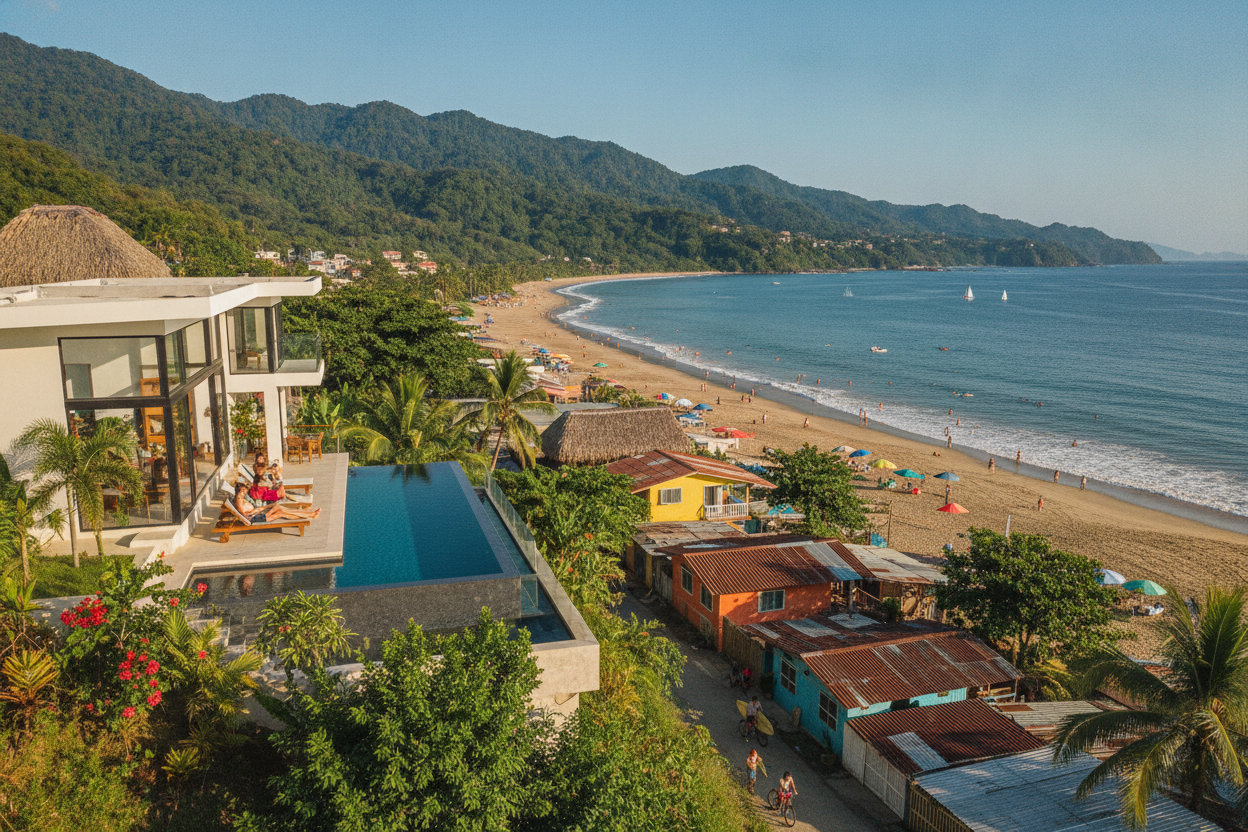
Where it is, and why that matters
Coco sits on the Gulf of Papagayo in the canton of Carrillo, Guanacaste — roughly 32 km from Liberia and 25 to 35 minutes from Daniel Oduber International Airport (LIR).
It is the closest beach town to an international airport anywhere in Costa Rica. That single fact shapes the place: it is the arrival-day town, the last-night town, and the one people buy in when they want to land and be swimming within the hour.

What the town is actually like
Coco is not a resort development. It grew around a working fishing village and still functions as a real Costa Rican town — sodas, hardware stores, banks, supermarkets, dentists, mechanics, schools, and a permanent Tico population — with a heavy tourist and expat overlay on top.
The result is convenient and unpretentious rather than pretty. Strip-mall commercial buildings, a lot of concrete, overhead wiring, no zoning-driven charm. If you want polish, that is Flamingo or the Papagayo Peninsula resorts. If you want a town where ordinary life happens and you can buy a drill bit and see a dentist, that is Coco.
The beach — the honest part
This is Coco’s weak point and the source of its mixed reputation.
It is a sheltered crescent bay with dark grey-brown volcanic sand, calm water and no surf. Good for families, good for swimming, good for launching boats. But it ranks below Playa Hermosa, Ocotal, Conchal and Flamingo on beach quality, and local guides say so openly.
Water clarity is seasonal: roughly 15–20 metres visibility in the dry season from December to May, dropping to 8–12 metres from June to November as rainy-season runoff and river sediment enter the bay. October and November are the worst of it. There is also constant boat traffic anchored in the swimming zone.
One thing we will not repeat: claims about sewage contamination circulate online and we could not verify them, nor could we find current official water-quality testing data. What the evidence actually supports is sediment, runoff and boat traffic — not pollution. If clean water is your priority, drive ten minutes to Ocotal or Hermosa.
Coco is a base, not a beach destination. Understand that going in and it is a good town. Expect a postcard and you will be disappointed.
The strip
One main road runs perpendicular from the highway down to the beachfront plaza. Along it: supermarkets, banks and ATMs, pharmacies, souvenir shops, tour operators, dive shops, real estate offices, bars and restaurants. Pacífico and Coco Bay are the main commercial and condo complexes. You can walk it end to end in about fifteen minutes.
Eating and nightlife
Over thirty restaurants for a town this size. Costa Rican sodas serving casados for $5–8, plus Italian, Asian, Indian, Mexican, Mediterranean and seafood from $15 up.
Coco has the most active nightlife on the northern Guanacaste coast — busy beachfront and strip bars, live music in high season, a couple of dance clubs, a casino. That is a genuine differentiator, since Hermosa and Ocotal go quiet by nine.
It also means noise, and it means Coco draws a bachelor-party and bar-crawl crowd. The town has a reputation as the party town of northern Guanacaste, with the late-night scene that implies. Some residents love it and some find it degrading. Weekends, holidays and December through April are loud; low season is genuinely sleepy.
Fishing and diving — the real draws
Sportfishing. Coco is a major hub — sailfish, marlin, roosterfish, tuna, dorado — with a large charter fleet. A precision worth knowing: boats mostly launch from the beach by panga or tender in Coco itself. The full-service Marina Papagayo is on the Papagayo Peninsula a short drive north, not in Coco town. Peak billfish season is broadly May to September, with fishing year-round.
Diving is Coco’s strongest genuine asset. It is the main dive-boat departure point for the region. Sites are rocky pinnacles, walls and caves — not coral reef — so expect big animals and schooling fish rather than colour.
- Catalina Islands — best September to March. Multi-level sites suiting a range of experience. Famous as a Pacific giant manta ray cleaning station, peaking January to March, plus eagle rays, devil rays, turtles and reef sharks.
- Bat Islands (Islas Murciélago) — roughly 23 miles out at the north end of Santa Rosa National Park. Advanced divers only, best May to November when the Papagayo winds drop. The draw is the “Big Scare” site and its resident bull sharks.
Water runs 78–86°F; visibility swings between 20 and 60 feet. Both are long boat rides and both are weather-dependent.
The expat community
Large, established and unusually well organised — active groups, meetups, and an informal support network for newcomers working through residency, banking and healthcare. It skews North American with a significant Canadian contingent, mixing retirees, remote workers and small business owners.
Because Coco is a working town rather than a gated enclave, genuine integration with the Tico community is more feasible than in resort developments — though an expat bubble is available if you want one.
Cost of living
Coco is mid-range for Guanacaste — noticeably cheaper than Tamarindo, Flamingo, Nosara or the Papagayo Peninsula; more expensive than inland towns like Sardinal or Filadelfia.
Published expat budgets put a modest lifestyle around $1,600–2,400 a month and a comfortable one at $3,200–4,800 — roughly 40 to 60 percent of equivalent North American costs.
Two real-world caveats. Electricity is the budget killer: air conditioning in a Guanacaste dry-season house runs $200–400 a month and up. And imported groceries and cars are expensive.
Property
Condos run roughly $120,000–350,000; single-family homes from about $300,000. The character is condo-heavy and rental-yield-driven — airport proximity produces strong short-term rental occupancy, which is the main investment thesis.
The downsides are real. Construction quality varies enormously. There is a lot of speculative inventory. And the market is dollarised and driven by foreign buyers, so prices do not track local incomes at all.
Do not buy without an independent inspection and a Costa Rican attorney checking title. Be especially careful with anything in the zona marítimo terrestre — the maritime zone is concession land, not fee-simple ownership, and it is where foreign buyers most often get hurt.
The downsides, stated plainly
- The beach is mediocre — grey sand, variable clarity, boat traffic, litter complaints.
- The town is functional, not attractive.
- Heat. Guanacaste is the hottest region in the country and the dry season is punishing.
- Dust in the dry season, mud on unpaved side streets in the wet.
- Petty crime is a genuine, ongoing issue — beach thefts while people swim, car break-ins, and resident reports of higher property-crime rates than nearby quieter towns. Violent crime against foreigners is rare but not zero. Standard precautions here are not theatre; they are necessary.
- Timeshare and real-estate hard-sell targeting tourists on the strip.
- Nightlife noise, and the party-town element.
- Green season is quiet to the point of businesses closing, roughly September to November, and the water is at its murkiest then.
- Water supply and infrastructure have struggled to keep pace with development in the Coco and Sardinal area — a Guanacaste-wide problem. We could not verify the current status for Coco specifically, so check it directly before buying or building.
- Hora tica applies to contractors, permits and utilities, which is real friction if you are building or renovating.
Who it suits
Good fit: divers, sportfishermen, people who want walkable amenities and actual nightlife, retirees who want a real town with services rather than an isolated resort, and anyone whose priority is being half an hour from an international airport.
Bad fit: anyone whose main goal is a beautiful beach.
Coco is chosen for convenience and community, and the people who are happy there chose it for those reasons with their eyes open.
Thinking of relocating to Guanacaste?
Choosing the town is the easy part. CRIE — Costa Rica Immigration Experts handles residency applications, renewals and citizenship for people moving to Costa Rica.
See the residency options in Costa Rica, or get in touch.
Thinking About Making Costa Rica Home?
Thousands of expats, retirees, and investors have made Costa Rica their permanent home. If you are considering residency, CRIE’s licensed immigration attorneys can walk you through your options — Pensionado, Rentista, Investor, or family-based — and handle every step of the process.