How to Survive a Rip Current in Costa Rica

Rip currents kill more visitors to Costa Rica than every animal in the country combined. The Costa Rican Red Cross recorded 140 deaths from water accidents in 2024 — a four-year record — and between 2019 and May 2025 there were 770 drowning deaths, with Jacó, Cahuita and Parrita the worst districts.

Most of what people think they know about escaping one is either out of date or actively wrong. Start with the name.

Beach scene in Costa Rica

It is not a riptide, and it is not undertow

A tide is a slow, predictable, twice-daily change in sea level and has nothing to do with this. “Undertow” implies being pulled downward, which is not what happens.

A rip current is a narrow channel of water flowing away from shore, at the surface, through the breaking-wave zone. In Spanish, corriente de resaca.

This matters more than pedantry. Both wrong names imply the wrong mental model — being dragged under, fighting the sea downward — and the wrong mental model is what kills people. A rip current does not pull you under. It carries you out. You can float in one indefinitely.

Retired couple enjoying a peaceful Costa Rica terrace with mountain and ocean views

Why Costa Rica’s Pacific coast is full of them

The Pacific side receives long-period swell from the Southern Ocean between April and October and from the North Pacific from November to March — powerful wave energy year-round. The coast is dominated by steep, exposed beaches with rapid drop-offs rather than gently shelving shallows.

The peer-reviewed research on Costa Rica found that the majority of drownings occur on beaches with a “transverse bar and rip” morphology — a sandbar configuration producing persistent rip channels close to shore. That structure is extremely common here. Add numerous river and estuary mouths and large Pacific tidal ranges, and you have ideal conditions.

The finding that should change how you look at a beach

This is the most important paragraph on this page.

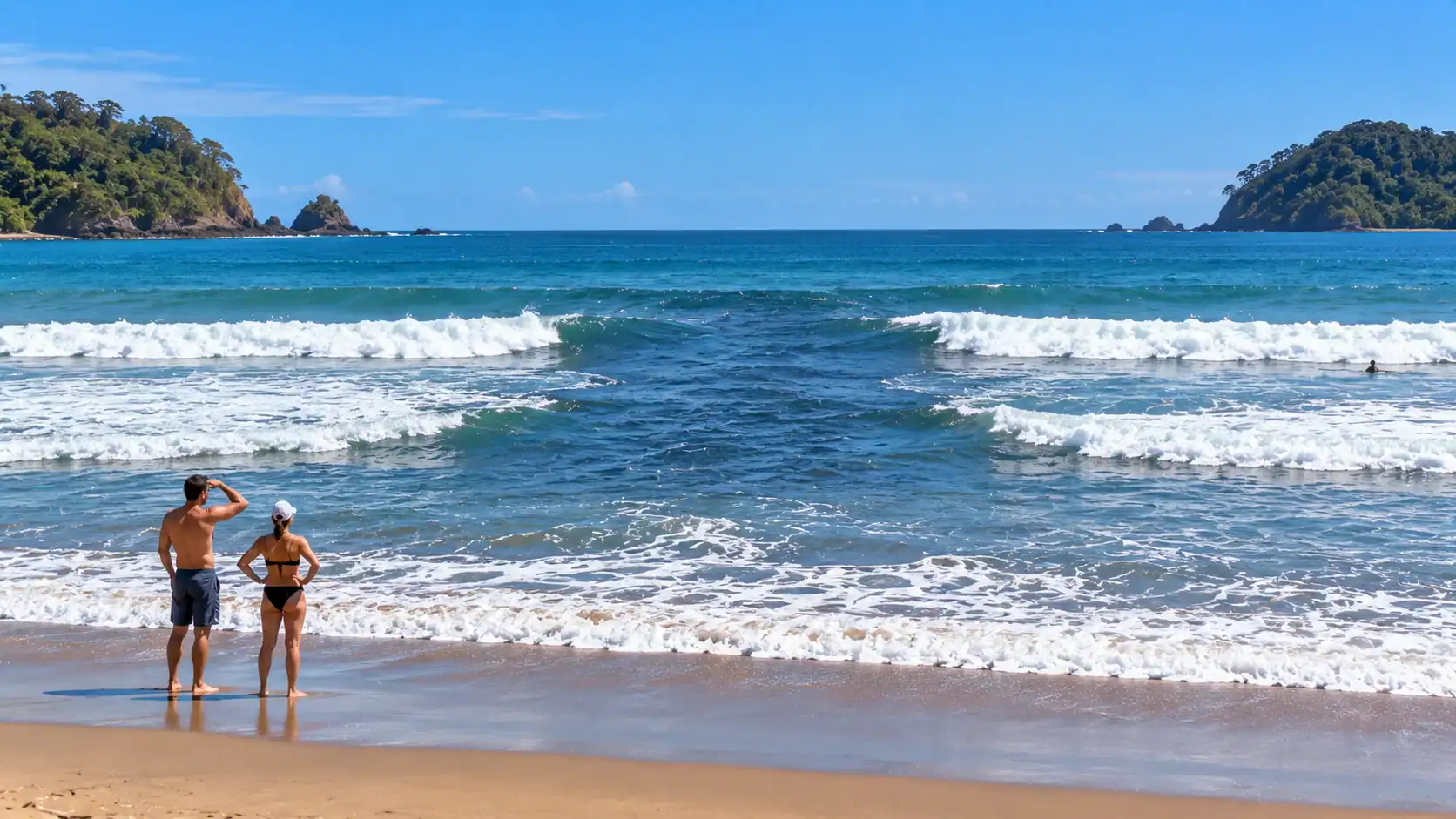
The Costa Rica research found that drownings peak when wave heights are smaller, not bigger.

The reason is behavioural. When the surf looks small and calm, people go in. But the sandbar-and-rip structure is still there — and the rip channel is precisely the flat, calm-looking gap between the breaking waves.

So: a calm patch between two areas of breaking surf is not the safe place to swim. It is the rip. People drown because they deliberately choose it.

How to spot a rip current and how to escape oneTop panel: a beach seen from above. Lines of white breaking surf run parallel to the shore, but there is a gap where the water is darker, calmer and choppier. That gap is the rip current, and it flows straight out to sea. Bottom panel: a swimmer caught in the rip should not swim back against it. Float first, then swim parallel to the beach until out of the narrow channel, then angle in on the breaking waves.Rip currents: the calm-looking gap is the danger1. HOW TO SPOT ONE FROM THE BEACHbeachThe rip runs OUT to seaFast, narrow, and it will not pull you under.Waves break hereWhite water means shallower sand.Look for the gap in the surf line: darker, choppier, no waves breaking. That gap is the rip.2. IF IT HAS YOU — DO NOT SWIM STRAIGHT BACKNever swim straightback at the beachswim parallelthen ride thebreaking waves inbeachFLOAT FIRSTLie back, breathe, let it carry you.Panic and exhaustion are what drownpeople — not the current itself.A rip pulls you out, never down. It weakens past the breakers — swim across it, not against it.
Most Costa Rican beaches have no lifeguard. Learning to read the surf line from the sand is the part that actually saves people.

How to spot one from the beach

Stand somewhere elevated if you can — a dune, a rock, a balcony — and watch for a few minutes before going in. Polarised sunglasses help a great deal. Look for:

  • A gap in the line of breaking waves. A channel where waves are not breaking, or breaking much less, while they break on either side.
  • Discoloured water — a brownish, sandy plume extending seaward, because the current is carrying sediment out.
  • Foam, seaweed or debris moving steadily offshore in a defined line past the breakers.
  • A rippled, choppy strip surrounded by smoother water.
  • Anything beside a fixed structure — a headland, rocky point, jetty, pier or river mouth. Rips form there reliably.

An honest caveat: research consistently finds that ordinary beachgoers are bad at spotting rips, even right after being shown what to look for. Do not rely on your own judgement alone. Ask a local, a lifeguard or a surf instructor. Surfers know exactly where the rips are, because they use them to paddle out.

What to do if you are caught — the current guidance

You have probably been told: swim parallel to the beach until you are out of the current, then angle in.

That advice came from early twentieth-century research that modelled rips as straight offshore jets. A 2010 GPS-drifter study overturned that picture. Many rips are not straight jets but circulating eddies that curve back toward shore, and a significant proportion of floating objects released into them returned to the surf zone on their own within minutes.

Swimming parallel in a circulating rip can mean swimming into the returning limb — and from in the water you cannot tell which type you are in, or which direction to go. Beach-safety researchers now state openly that there is no single piece of advice guaranteed to work in every rip current.

Here is the defensible sequence, in order:

  1. Do not swim against the current toward shore. This is what kills people. The rip is faster than you are. You will exhaust yourself within a minute or two and drown in sight of the beach. Exhaustion is the cause of death, not the current.
  2. Float first. Get your breathing under control. Roll onto your back, spread your arms and legs, keep your face clear of the water. This is the “flip, float and follow” doctrine now taught by lifesaving bodies. Floating costs nothing, buys time, and works in every type of rip.
  3. Signal. One arm raised and waved, and shout, so anyone on the beach knows.
  4. Assess. Rips typically weaken just past the line of breaking waves. Once you have stopped moving offshore, you have options.
  5. Then swim — parallel to the beach, or toward the breaking waves, whichever is easier. The goal is to get out of the channel and into the zone where waves are breaking, because breaking waves push you shoreward. Aim for the whitewater, then let the waves carry you in.
  6. If you cannot escape, keep floating. Ride it out. Many circulating rips will bring you back toward the surf zone within minutes. A person floating calmly 100 metres out is alive and rescuable. A person thrashing 20 metres out may not be.

Helping someone else without becoming the second victim

A very large share of drowning deaths are would-be rescuers — frequently parents going in after a child.

  1. Do not swim out empty-handed. This is the classic fatal error.
  2. Shout for help, send someone for a lifeguard, or call 911.
  3. Throw or extend anything that floats — a surfboard, boogie board, cooler, inflatable, an empty sealed jug. Buoyancy transforms the situation, because someone holding flotation can float indefinitely.
  4. Shout instructions: “Float on your back! Don’t swim against it! Help is coming!” A calm voice from shore is a real intervention.
  5. Look for a surfer. In Costa Rica, informal rescues by surfers are extremely common and are the reason many people survive.
  6. If you must enter, take flotation with you — and understand you are accepting real risk.

Who actually drowns in Costa Rica

The demographics are worth knowing because they may not describe who you expect.

Among Costa Rican nationals, the highest-risk group is men aged 15 to 30, typically drowning at weekends on beaches near San José.

Among foreign visitors, the highest-risk group is men aged 45 to 60 — and their drownings show no weekday pattern, because on holiday every day is a beach day. Contributing factors are consistent: overconfidence, alcohol, unfamiliarity with the beach, and no lifeguard.

If you are a middle-aged man who swam competently thirty years ago, the statistics are describing you. Drownings cluster around the year-end holidays, Semana Santa and July.

The most dangerous beaches

Pacific: Jacó is the worst in the country, with 77 deaths between 2001 and 2015. Also Playa Hermosa de Garabito (adjacent to Jacó, not the Guanacaste beach of the same name), Esterillos, Playa Bandera, Bejuco, Palo Seco and Parrita, Puntarenas, Dominical, Playa Negra, Tamarindo, Playa Grande, Avellanas, Manuel Antonio, Uvita and Junquillal.

Caribbean: Cocles is considered the most dangerous on that coast, with Playa Chiquita and the Cahuita area also appearing high in recent Red Cross data.

Worth stating plainly: the deadliest beaches are the most popular ones. Jacó, Tamarindo, Dominical and Manuel Antonio are dangerous because thousands of inexperienced swimmers enter the water there — not because those stretches of coast are uniquely violent.

Do not count on a lifeguard

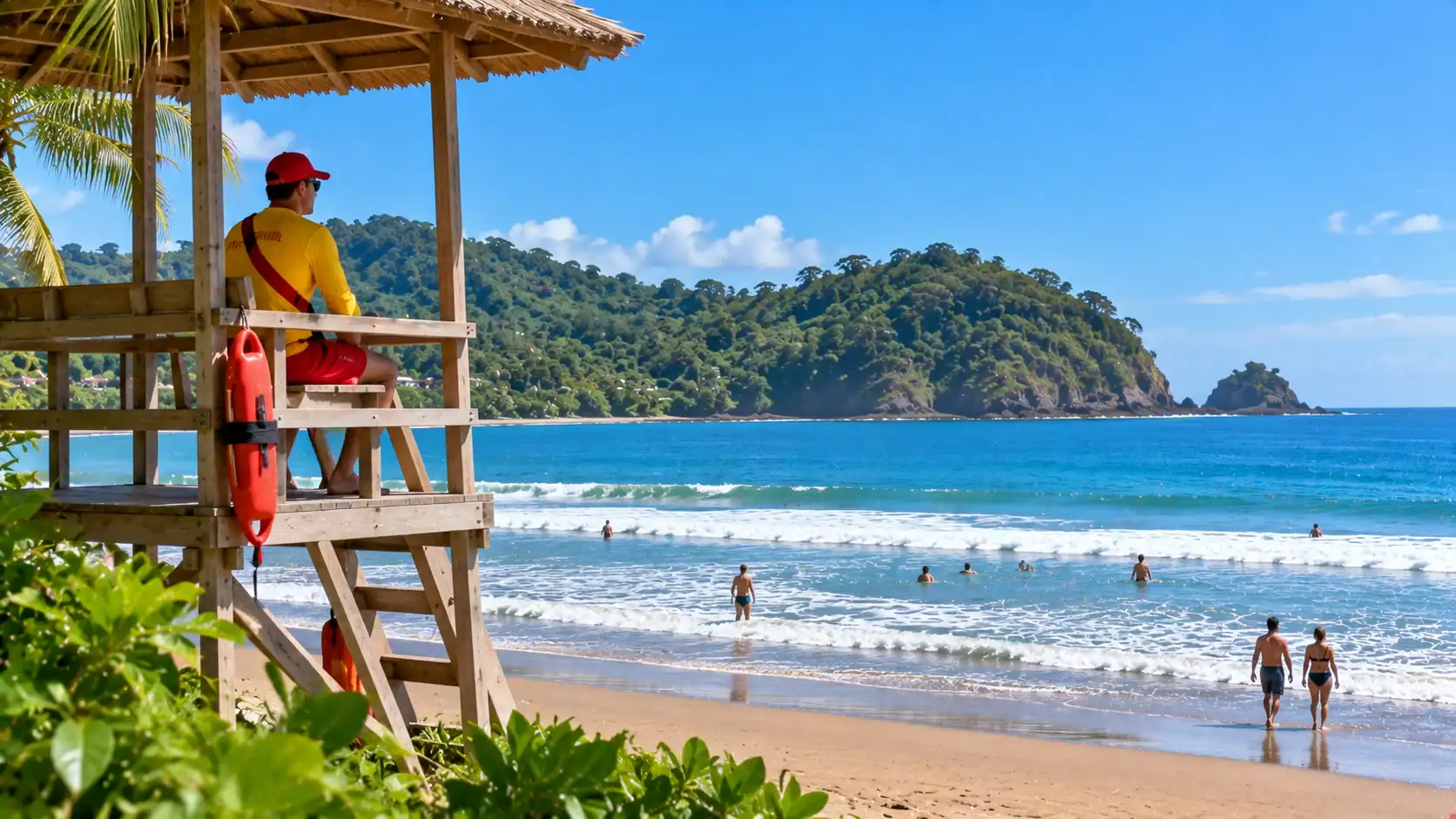
Costa Rica has no national lifeguard service. Most beaches have no lifeguard at all. Where coverage exists it is the product of local initiative and precarious funding.

The proof of what coverage achieves is Playa Dominical. California surfers established Costa Rica’s first professional lifeguard programme there in December 1996, after the beach had been averaging roughly twenty drownings a year. In the twenty-nine years since, the programme has recorded zero preventable drownings in its patrol area.

A national movement is building — a 2025 gathering in Escazú drew over 200 participants from emerging programmes, and the Federación Costarricense de Guardavidas now coordinates training. The ICT and Universidad Nacional also published a free beach hazard atlas in 2024 mapping conditions at hundreds of beaches, which is worth consulting before you go.

But today, the practical assumption is: there is no lifeguard.

The short version

  • Assume no lifeguard. Ask at your hotel which end of the beach is safe.
  • Watch the water for several minutes before entering.
  • The calm gap between breaking waves is the rip, not the safe spot.
  • Never swim alone, at dusk, at night, or after drinking.
  • Keep children within arm’s reach.
  • Stay out of the water near river mouths and rocky points entirely — rips form there, and on the Pacific some river mouths also have crocodiles.
  • If caught: do not fight it. Float, breathe, signal, then swim toward the whitewater.

Making Costa Rica home?

Learning to read a beach is part of living on a coast. CRIE — Costa Rica Immigration Experts handles the other part: residency applications, renewals and citizenship for people relocating to Costa Rica.

See the residency options in Costa Rica, or get in touch.

Thinking About Making Costa Rica Home?

Thousands of expats, retirees, and investors have made Costa Rica their permanent home. If you are considering residency, CRIE’s licensed immigration attorneys can walk you through your options — Pensionado, Rentista, Investor, or family-based — and handle every step of the process.

Schedule a free consultation with CRIE today.

Scroll to Top