

Navigating the residency process in a new country can feel overwhelming. For many expatriates, establishing a long-term home in Costa Rica is a dream. The reality, however, involves a complex immigration framework where documentation is key.
Since the COVID-19 pandemic, authorities have noted an uptick in fraud cases. This has led to more rigorous verification procedures for all applicants. Understanding this evolving landscape is essential for a successful application.
We provide this comprehensive guide to help you move forward with confidence. Our team at CRIE acts as your experienced guide through every step. We explain how the national immigration system functions and what you can expect.
Every verification must be handled with precision to prevent unnecessary processing hurdles. A single oversight can stall your entire residency goal. We emphasize a structured approach to manage the various requirements.
By focusing on proper documentation and transparent process management, you can secure your future in this welcoming nation. Let’s explore how to effectively navigate this important journey together.
Understanding Costa Rica Residency Options: Pensionado (Pensionado), Rentista (Rentista), and Inversionista (Inversionista)
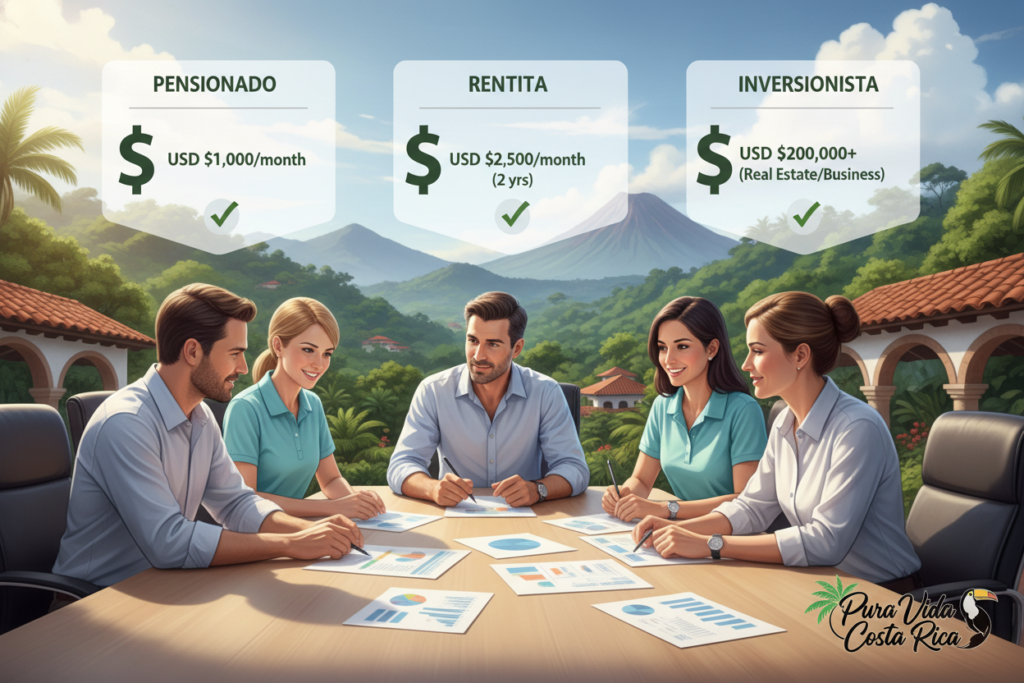
Before diving into the documentation process, it’s crucial to select the correct residency category for your situation. Costa Rica offers three primary pathways, each with strict financial requirements. Your choice between Pensionado, Rentista, and Inversionista sets the stage for your entire application.
Eligibility Criteria and Financial Thresholds
The Pensionado program is for retirees with a guaranteed lifetime pension. You must prove an income of at least US$1,000 per month.
Rentista applicants need to show a stable income of US$2,500 monthly. This income must be verifiable for a two-year period.
The Inversionista category requires a minimum investment of US$150,000. This investment must be in personal property, not held through a corporate entity.
Clarifying Why Digital Nomad Status Doesn’t Qualify
It is vital to understand that the Digital Nomad visa is not a residency category. This legal status does not count toward permanent residency or citizenship.
We suggest remote workers look toward the Rentista category. It is the closest available option if you can meet the stable income requirements.
Knowing your category upfront helps streamline gathering documents like background checks. This foundational step prevents confusion later in the process.
Navigating the Role of Background Checks in Your Residency Application

Your application’s success hinges on a thorough verification of your personal history. This step is not merely a formality—it’s a foundational review by Costa Rican authorities.
We treat this as a critical legal requirement that validates your eligibility. The Organismo de Investigación Judicial (OIJ) manages the national criminal background check process.
The Importance of a Clean Criminal Record
A clean criminal record is a non-negotiable pillar for any residency application. It proves your good moral character to the officials reviewing your file.
Proper verification of your history confirms you have no past issues. These checks are mandated by local law to maintain integrity in the immigration system.
Legal Requirements and Spanish Documentation Standards
All foreign documents must be translated into Spanish by a certified professional. Authorities will not accept paperwork submitted in English or any other language.
We advise starting this translation early to avoid delays. Meeting these documentation standards is essential for a smooth application journey in Costa Rica.
Step-by-Step Preparation: Gathering Your Documents at Home
The foundation for a smooth transition to life in Costa Rica is laid not upon arrival, but in the careful preparation you undertake at home. A successful application hinges on having properly authenticated documents ready long before you move.
Where to Start with Your Application
We recommend beginning with a master checklist. This simple tool tracks every paper required by immigration authorities and its submission status. Organizing paperwork from your home country is the single most important step to prevent delays.
Start this entire process several months before your planned move. This timeline allows you to handle unexpected issues with your background checks efficiently. Authentication and translation services can take time.
Keeping every document in a dedicated, organized file prepares you for the rigorous verification process. This proactive approach is your best guide through the complex requirements. It turns a daunting task into a manageable, step-by-step journey.
Key Documents to Prepare Before Arrival
The final assembly of your application package is a decisive phase where meticulous attention to detail pays off. Your core personal records form the undeniable proof of your identity and history required by authorities.
Essential Records: Birth, Marriage, and Criminal Background Checks
You must gather your birth certificate, marriage certificate (if applicable), and a federal criminal background check. These are the foundational documents that establish your personal timeline.
An FBI report is typically required for U.S. citizens. Processing takes about one week from within the U.S. or two to three weeks from abroad. This check verifies your clean legal history.
Ensuring Apostilles and Certified Translations are Ready
Every U.S. document needs an apostille from the U.S. Department of State. This stamp certifies the document’s authenticity for use in Costa Rica.
All documents must then be translated into Spanish by a certified professional. We advise starting this step immediately after receiving your apostilled originals.
Proactive planning for these validations prevents major delays. If this process seems complex, our team can assist through our additional services for authentication and translation.
Timelines for Background Checks and Document Authentication
A clear understanding of processing times helps you build a realistic schedule for your move. This verification phase involves several official steps, each with a standard duration.
Estimated Timeframes for FBI and Apostille Services
For a U.S. citizen, the federal criminal history review is a primary step. You can complete fingerprinting at a U.S. Post Office. The FBI typically sends the results via email within about one week.
If you are outside the United States, allow two to three weeks for this stage. This initial report is just the beginning of the authentication journey.
You must then obtain an apostille from the U.S. Department of State. Following that, a certified Spanish translation is required. Each of these steps can add several more weeks to your timeline.
We strongly advise initiating this multi-step process several months before your planned relocation. This realistic approach is the best guide to preventing unnecessary hold-ups in your Costa Rica application.
Meeting the Residency Financial Thresholds: Detailed Guidance
Your chosen residency pathway carries specific monetary requirements that must be validated with official proof. We see this as a fundamental checkpoint in your application.
Each category has non-negotiable financial criteria. Understanding and preparing for these thresholds prevents costly errors and aligns your file with legal standards.
Pensionado – Minimum US$1,000/Month Pension
The Pensionado category is designed for retirees. You must prove a guaranteed lifetime pension of at least US$1,000 per month.
This income serves as your primary financial qualification for residency status.
Rentista – Proof of US$2,500/Month Income for Two Years
Rentista applicants need to demonstrate stable passive income. The requirement is US$2,500 per month, verifiable for a full two-year period.
This proof assures authorities of your ongoing financial stability.
Inversionista – Minimum Investment of US$150,000 in Personal Property
The Inversionista option requires a significant capital commitment. A minimum investment of US$150,000 in the country is mandatory.
This asset must be held in your personal name, not through a company. You can learn more about the required proof for the investor category on our site.
Meeting these financial criteria is just the first step. Complete and accurate documentation is equally vital for final approval from Costa Rica’s immigration authorities.
background-check-delays-costa-rica: Identifying and Resolving Processing Delays
Processing delays often stem from simple oversights in document authentication. We see many applicants encounter hold-ups that could have been avoided with clearer guidance.
Understanding these common pitfalls is your first step toward a smoother application journey. Let’s examine the typical causes and practical solutions.
Common Causes of Background Check Delays
A frequent error is submitting an FBI report without the mandatory U.S. Department of State apostille. This missing stamp invalidates the document for immigration authorities.
Many face delays by incorrectly assuming procedures from their home country apply directly. The system here has distinct legalization steps you must follow.
We advise completing your background verification early in the preparation phase. Discovering issues late can derail your entire timeline.
Tips to Expedite Your Application Submission
Ensuring every document follows the correct legalization path is the best strategy. This proactive approach prevents bureaucratic slowdowns.
If you are unsure about any part of the process, verify the latest requirements directly. The official immigration website, migracion.go.cr, provides current guidelines.
Starting early and double-checking each step builds a strong, delay-resistant application. We are here to help you navigate this final verification stage with confidence.
Avoiding Critical Mistakes in Your Residency Application
The most effective way to protect your Costa Rica residency timeline is to sidestep common filing errors from the start. We guide our clients to focus on precision over speed.
Documentation Errors to Watch Out For
A frequent and critical error is forgetting the mandatory certified Spanish translation for all paperwork. This is a non-negotiable requirement under the law of Costa Rica.
Compliance with local data privacy standards is another key area. Your sensitive personal data from background checks must be used only for legitimate residency evaluation. This aligns with the nation’s strict 2011 Data Protection Law.
Strategies to Prevent Common Processing Pitfalls
Initiate your background verification process several months in advance. Discovering issues late is a major source of delays for your application.
We always recommend full transparency with authorities. You cannot be automatically denied based solely on a past criminal record. Concealing information, however, will certainly cause problems.
Adopting this proactive and honest approach is your best strategy for a smooth process.
Understanding Legal Considerations and Data Privacy in Costa Rica
Costa Rica’s commitment to privacy protections forms a key part of the residency verification framework. We guide clients through these legal requirements to ensure full compliance with local standards.
Overview of Costa Rican Data Privacy Laws and PRODHAB Guidelines
The nation’s approach is enshrined in Law No. 8968, the Personal Data Protection Act. This 2011 statute establishes strict rules for handling your sensitive information during background checks.
The Agencia de Protección de Datos de los Habitantes (PRODHAB) enforces these rules. This authority monitors both public and private entities that process private information for residency evaluations.
Employers and immigration officials must obtain your express written consent before initiating any verification. This ensures transparency and legal compliance throughout the application process.
You retain the right to cancel the use of your sensitive details under this legal framework. We emphasize understanding these protections as a fundamental aspect of your application journey in Costa Rica.
Preparing Your Application for Family Reunification
Expanding your residency plan to include family members introduces a new layer of documentation and verification. The family reunification pathway allows spouses and children of citizens or residents to obtain legal status.
This process requires the same rigorous standards as an individual application. You must prepare a complete dossier for each person included in the filing.
Required Documentation for Spouses and Children
Adult family members must provide a certified criminal background check. This official report proves their good moral character to immigration authorities.
Meeting the minimum financial criteria is just the starting point. Complete and accurate paperwork is mandatory for every individual on the application.
We advise preparing the same level of authenticated documents for your spouse and children as you do for yourself. This includes apostilles and certified Spanish translations.
Proper preparation of this collective paperwork significantly boosts your approval chances. It demonstrates full compliance with the immigration laws of Costa Rica.
Effective Communication with Immigration Authorities
Clear and proactive communication with Costa Rican immigration officials is a cornerstone of a successful residency application. We see this as the final layer that brings your meticulously prepared file to life. A complete, authenticated dossier builds immediate trust and facilitates smoother interactions.
How to Interact with migracion.go.cr
You should always verify the latest requirements directly at the official immigration website, migracion.go.cr, before finalizing your application package. This site provides current forms, fees, and procedural updates. It is your primary source for accurate information.
Using this resource helps prevent issues based on outdated guidance. We advise checking it regularly throughout your process.
Making the Most of CRIE’s Expert Guidance
Our team at CRIE provides step-by-step support tailored to your specific residency category. We help transform complex legal and financial requirements into a manageable journey based on our extensive experience.
For personalized guidance, you can contact us via WhatsApp at +506 8706 3888 or email info@crie.cr. We offer transparent advice on the entire verification process, including privacy and consent matters under Costa Rican law.
Final Steps to Secure Your Costa Rican Residency Success
Your path to legal residency culminates with the confident submission of a complete application package. A flawless file, including your authenticated background checks, builds immediate trust with officials and streamlines their review.
Always double-check the latest requirements directly at migracion.go.cr before you submit. Policies in this country can update without notice.
We are here to guide you through these final steps. Our team transforms complex requirements into a manageable journey. For expert assistance, reach out via WhatsApp at +506 8706 3888 or email info@crie.cr.
FAQ
How long does a criminal background check take for residency?
Processing times vary. For U.S. citizens, an FBI Identity History Summary can take 3-5 weeks, plus additional time for the apostille and certified translation. Delays often happen if documents are incomplete or not translated by a Costa Rican official. We advise starting this process 2-3 months before your application submission to avoid hold-ups.
What are the main reasons for application delays?
The most common causes are missing apostilles, uncertified translations, or incomplete forms. Using a non-approved translator or submitting a background check without the proper chain of authentication will stop your process. Ensuring every document meets Migración’s exact Spanish-language standards from the start is key to preventing these setbacks.
Can I use a local police report instead of an FBI check?
No. Costa Rican immigration law requires a federal-level criminal history report from your country of citizenship or legal residence for the past three years. A local or state police report is not sufficient. You must obtain the official document, like the FBI check for U.S. citizens, and follow the apostille and translation process.
What financial proof is required for the Rentista category?
You must demonstrate a guaranteed monthly income of at least US,500 for two years. This is typically proven with a notarized letter from a bank or financial institution. The funds must be deposited in a Costa Rican bank. We help clients structure this proof correctly to meet the strict compliance and verification requirements.
How does Costa Rican data privacy law affect my application?
Your personal data is protected under Law No. 8968. Immigration authorities can only process your information for your residency case with your written consent. We ensure all handling of your sensitive records—from your criminal history to employment documents—follows these PRODHAB guidelines, safeguarding your privacy throughout the process.
Article by Glenn Tellier (Founder of CRIE and Grupo Gap)
Don't wait, contact us right now!
Call or WhatsApp Costa Rica +506 8373 2085 or +506 8706 3888
Call USA/Canada +1 305-906-6784