
Have you discovered your family’s roots lead to this beautiful Central American nation? Many people born abroad can claim their nationality through a parent. This pathway, known as citizenship by descent, is a way to legally reconnect with your heritage.
We specialize in residency and immigration services for the country. It’s important to understand that securing your status through lineage involves a separate legal procedure. The process is managed by the Civil Registry, not through standard immigration channels.
This journey requires navigating specific legal requirements and document authentication. We provide clear guidance on the steps, but we don’t make promises about outcomes or processing times. Setting realistic expectations from the start is crucial.
Eligibility hinges on having at least one Costa Rican parent at the time of your birth. You must also register with the Civil Registry before turning 25. Gathering the correct paperwork—like birth certificates and apostilled translations—is your first essential task.
Starting your document preparation from home is the most efficient approach. It streamlines your application and helps you build a strong case for your ancestral claim. Let’s explore what this process entails and how to begin.
Understanding Costa Rica’s Citizenship and Residency Process
Before exploring citizenship options, it’s crucial to grasp the fundamental difference between residency and nationality. We provide services focused on helping you establish legal residency. This is the essential first step for most people seeking to become a naturalized citizen later.
Citizenship by Descent and the Role of Parental Nationality
If you have a Costa Rican parent, you may claim nationality by descent. This process, governed by Law N°7514, is separate from residency. You must register with the Civil Registry before age 25.
Residency as the First Step Before Citizenship
For those without a parental claim, citizenship requires naturalization. This follows years of legal residency. Most need seven years. Central American or Spanish citizens qualify after five. Spouses of nationals need just two. You can learn more about this path in our guide to Costa Rica citizenship by naturalization for US.
Alternative Residency Options: Pensionado, Rentista, and Inversionista
We help clients secure residency under categories like Pensionado (Pensionado) for retirees with a $1,000+ monthly pension. The Rentista (Rentista) category requires proof of $2,500 monthly income for two years.
The Inversionista (Inversionista) option demands a minimum $150,000 investment. A critical rule: the asset must be in your personal name, not a corporation. Note that a Digital Nomad visa does not grant residency status or count toward citizenship years.
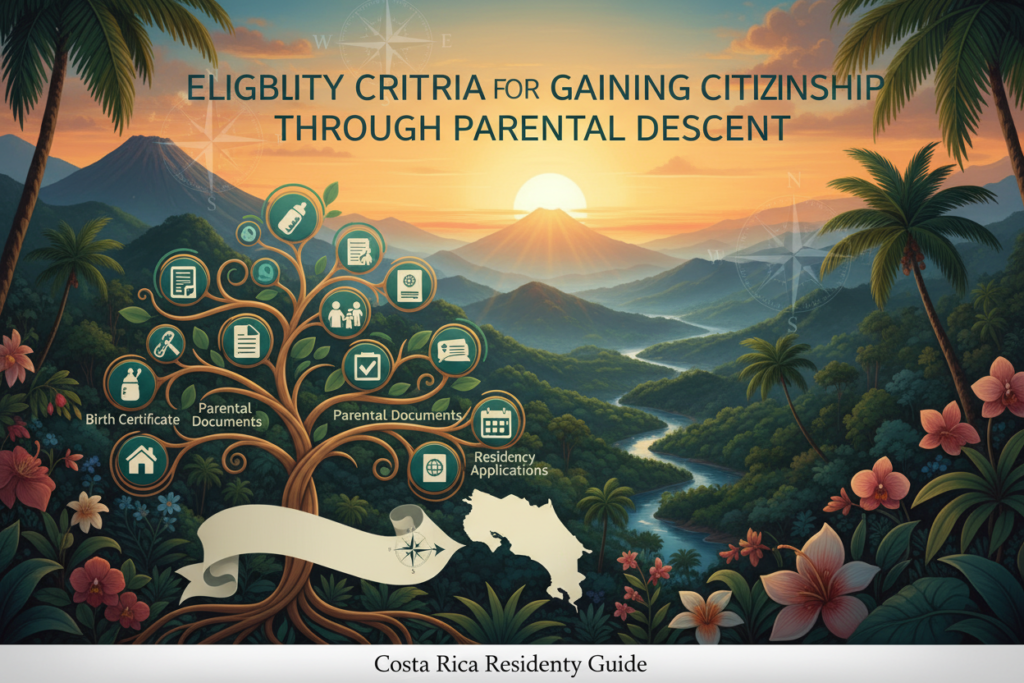
Eligibility Criteria for Gaining Citizenship Through Parental Descent
The path to claiming your birthright status hinges on meeting clear legal conditions tied to your family history. This process is governed by the principle of jus sanguinis, or right of blood.
Qualifying Through Costa Rican Parent(s) and Registration Requirements
You qualify if you were born outside the country to at least one parent who was a citizen at your birth. Having both parents with this nationality strengthens your case, but one is sufficient.
A critical rule involves your age. If you are under 18, your parent can register you. Individuals between 18 and 25 must register themselves. After turning 25 without registration, this specific pathway is no longer available.
Legal Considerations and Civil Registry Procedures
This is not an immigration process. Applications are handled by the Civil Registry, a separate government body. The legal basis is Law N°7514.
You must prove your lineage with specific documents. These include your birth certificate and your parent’s proof of nationality. If your parents are married, their marriage certificate is also needed.
All foreign documents require an apostille or consular legalization. They must also have a certified Spanish translation. We help you prepare this paperwork correctly.
We provide guidance on these steps. For the most current procedures, we recommend consulting official resources or a legal specialist.
Gaining Costa Rica citizenship through parents expert guidance
Expert assistance focuses on the meticulous preparation phase, which you can initiate from your current location. While the final citizenship by descent application is filed with the Civil Registry, we provide structured guidance on the documentation and authentication steps required beforehand.
Our step-by-step approach begins with confirming your eligibility. You must verify your parent’s nationality status at your birth. Next, compile all personal and ancestral records.
The third step involves obtaining apostilles or consular legalization for foreign documents. Following that, you need certified Spanish translations. Finally, understanding the Civil Registry’s submission procedures is crucial.
Key Eligibility Thresholds and Financial Requirements
If you are under 25 and qualify through lineage, this is your direct route. For those over this age or without a Costa Rican parent, legal residency is the first step.
Residency categories have specific financial thresholds. The Pensionado option requires proven pension income of at least $1,000 monthly. Rentista applicants must show $2,500 monthly income for two years.
The Inversionista pathway demands a minimum $150,000 investment in qualifying assets. This investment must be in your personal name, not a corporate entity.
Common mistakes can derail an application. These include missing apostilles, using non-certified translators, or providing incomplete ancestral documentation. Missing the age 25 deadline is another critical error.
We help you avoid these pitfalls by focusing on proper document preparation from home. This foundational work is where most applications succeed or fail. We provide practical guidance based on extensive experience with local systems.
We cannot guarantee approval outcomes or specific timelines. Our value lies in helping you navigate the process correctly from the start.
Preparing Your Documents and Steps Before Arrival
Before you set foot in the country, assembling and authenticating your documents is paramount. This preparation phase is the most critical step for any application. Properly prepared paperwork saves months of delay and avoids stress.
Essential Personal and Ancestral Documents
Every applicant needs core personal records. These include your current passport, a certified birth certificate showing parent details, and a police clearance. For immigration-related residency, check requirements at migracion.go.cr.
Claiming Costa Rican nationality by descent requires ancestral proof. You must provide your parent’s birth certificate or cédula (national ID). If your parents were married, their marriage certificate is also needed.
This establishes the unbroken chain for the Civil Registry. Residency applications have different document lists. Starting this collection from home is efficient.
Ensuring Apostilles and Certified Translations Are Ready
Documents from countries in the Hague Convention need an apostille. This special certification authenticates them for international use. It typically takes one to four weeks to obtain.
Papers from non-Hague countries require consular legalization. This is a more complex, multi-step process. All foreign-language documents must be translated by a traductor oficial (official translator).
Using a certified professional is non-negotiable. Translations usually take one to two weeks. Plan for two to three months of total preparation time before your arrival. Completing these steps from your home country streamlines everything.
Timelines, Processing, and Avoiding Common Pitfalls
Two major factors influence how quickly you can obtain your status: government processing speeds and your own preparation. We set realistic expectations from the start. You cannot control agency timelines, but meticulous work prevents avoidable delays.
Understanding Processing Durations and Expected Timelines
For lineage-based claims, the Civil Registry typically takes 6 to 18 months. This is after submitting a complete application. For those without this eligibility, the path is longer.
First, secure temporary residency, which processes in 3 to 6 months. After three years, apply for permanent status, another 3 to 6 months. Only then does the countdown for naturalization begin, adding 10 to 18 more months.
Identifying and Avoiding Administrative Mistakes
Incomplete document sets are the top cause of rejection. Missing a single apostille or using an uncertified translator can set you back months.
For residency, errors are costly. Extended absences can reset your required years. Missing a renewal deadline risks losing your status entirely. Investor applicants must own assets personally, not through a corporation.
We cannot guarantee specific timelines. Official procedures change. Always verify current requirements at migracion.go.cr for immigration and the Civil Registry for citizenship matters. Proper preparation is your best strategy.
How CRIE Streamlines the Immigration Journey
We help you build a solid foundation for your residency application from your home country. Our focus is on providing clear, practical support for establishing legal status. This is the essential first step for most individuals aiming to live in Costa Rica long-term.
Practical, Step-by-Step Guidance from CRIE Experts
Our process begins with a detailed consultation. We assess your eligibility for pathways like Pensionado, Rentista, or Inversionista residency. We explain the specific financial requirements and help you choose the best category.
Once your path is clear, we manage the application filing with immigration authorities. We track its status and handle your DIMEX card processing. Our goal is to turn a complex procedure into a manageable, step-by-step plan.
Starting from Home: Get Your Documents Ready and Initiate the Process
The most critical work happens before you travel. We guide you through gathering and authenticating all necessary paperwork from abroad. This includes coordinating apostilles and connecting you with certified translators.
Proper preparation prevents the common mistakes that cause delays. By starting remotely, you arrive with a complete, compliant dossier. This meticulous approach significantly increases your chances of a smooth approval.
Ready to begin your journey? Contact our team for a personalized assessment. Reach us on WhatsApp at +506 8706 3888, email info@crie.cr, or visit www.crie.cr to discuss your situation.
Final Thoughts on Achieving Dual Citizenship in Costa Rica
Costa Rica’s welcoming stance on dual nationality makes it a uniquely attractive destination for global citizens. You can hold a Costa Rican passport without renouncing your original one. This provides visa-free access to about 150 countries and full rights to live and work here.
The benefits extend beyond travel. You gain access to the national healthcare system and can pass this status to your children. It represents a permanent connection to a stable, democratic nation.
We provide the residency and immigration services needed to build your legal foundation. Starting with proper guidance is key to a smooth process. Reach out for an honest assessment of your path forward.
Contact us via WhatsApp at +506 8706 3888, email info@crie.cr, or visit www.crie.cr. We offer practical expertise, not promises, to help you navigate this journey correctly.
FAQ
Who qualifies for Costa Rican citizenship through a parent?
You qualify if at least one of your parents is a Costa Rican citizen at the time of your birth. The process involves registering your foreign birth with the Civil Registry here. We help clients navigate this proof of descent and the specific registration requirements to establish their claim.
What are the main documents I need to start the process?
You’ll need your original birth certificate (with an apostille and official Spanish translation), your parent’s Costa Rican ID or passport, and their birth certificate. Marriage or divorce decrees may also be required. We guide you on obtaining every document with the proper certifications before you submit anything.
How long does it take to obtain a passport this way?
The timeline can vary significantly based on document readiness and government processing. Once a complete application is submitted, it typically takes several months for the Civil Registry to review and approve. We manage expectations with realistic timelines and proactive follow-up to avoid unnecessary delays.
Will I lose my original nationality?
No, Costa Rica generally allows dual nationality. Gaining your Costa Rican status does not require you to renounce your current passport. You can hold both citizenships, enjoying the rights and privileges of each country.
Can CRIE assist if my documents are from another country?
A> Absolutely. A core part of our service is managing the international document chain. We ensure your foreign-issued birth certificates and other papers receive the necessary apostilles and certified translations, making them legally valid for the immigration authorities here.
What happens after my citizenship is approved?
Upon approval, you are registered as a citizen and can apply for your cédula (national ID card) and passport. This grants you full rights, including the ability to live, work, and vote in Costa Rica indefinitely, without any residency renewals.
Article by Glenn Tellier (Founder of CRIE and Grupo Gap)
Don't wait, contact us right now!
Call or WhatsApp Costa Rica +506 8373 2085 or +506 8706 3888
Call USA/Canada +1 305-906-6784