
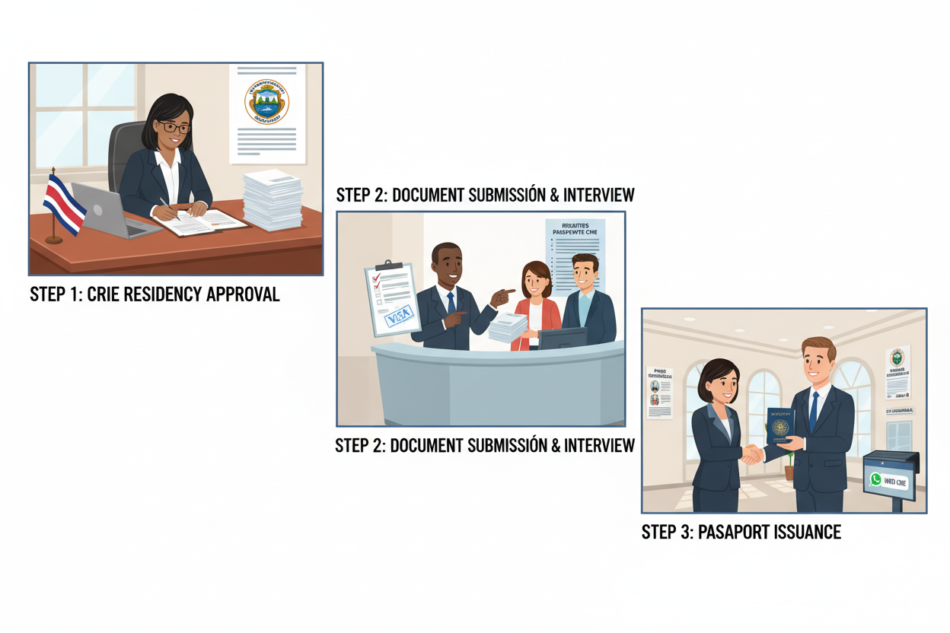
This guide explains the residency-first path that normally leads to a Costa Rican passport. It frames the long view: legal residency, then citizenship, then passport. Timelines vary and applicants should confirm rules with Migración and the Tribunal Supremo de Elecciones (TSE).
U.S.-based readers will benefit by starting at home. Gather U.S. documents, obtain apostilles, and plan certified translations before travel. Early prep shortens delays and avoids common mistakes.
At a glance, the main residency routes are Residencia de Pensionado (pension $1,000+/month), Residencia de Rentista (stable income $2,500/month for two years), and Residencia de Inversionista (investment $150,000 in qualifying property in the applicant’s name). Note: the Digital Nomad program is not residency and does not count toward naturalization.
CRIE offers residency and immigration services only and does not decide citizenship or issue passports. For next steps and document support contact WhatsApp +506 8706 3888 | info@crie.cr | www.crie.cr
Why a Costa Rican Passport Starts With Legal Residency in Costa Rica
Residency creates the legal foundation that later permits naturalization and issuance of a travel document.
Residency, citizenship, and the travel document
Residency is permission to live and work under immigration rules (DIMEX or residency card). Citizenship is membership under national law. The passport is the travel document issued after the government completes naturalization.
Who handles each stage
Migración (Dirección General de Migración y Extranjería) manages residency applications and status. Registro Civil maintains civil records used in citizenship files. The Tribunal Supremo de Elecciones (TSE) commonly oversees naturalization steps.
Dual citizenship and document consistency
Dual citizenship is widely described as permitted, but applicants should confirm rules with costa rican authorities and U.S. authorities before filing. Name order, middle names, and maiden names often cause identification mismatches. Double-check apostilles, certified translations, and original documents before arrival.
For a practical next step, read this citizenship guide and contact CRIE for residency support: WhatsApp +506 8706 3888 | info@crie.cr | www.crie.cr. The remainder of the guide follows the residency-first sequence most applicants must complete before a passport is possible.
How to get a Costa Rican passport by completing the residency-first path
Starting with the right residency category and clean records makes later naturalization and the travel document process far smoother.
1) Select the qualifying residency (Residencia de Pensionado, Residencia de Rentista, Residencia de Inversionista).
2) Gather U.S. documents, apostilles, and certified Spanish translations before arrival.
3) File the residency application with Migración and submit a complete file (verify current checklist with Migración).
4) Maintain legal resident status, meet renewals, and track entry/exit stamps as proof of presence.
5) After the required years of residency and continuous presence, apply for naturalization; only after citizenship is granted may they apply for the costa rican passport.
Practical notes: keep scans of passport bio pages, entry stamps, and a travel log. Digital Nomad status does not count; consider Pensionado, Rentista, or Inversionista instead. Common mistakes include applying for citizenship too early and failing to document presence.
CRIE provides residency and immigration services only. For case support confirm current rules with Migración or contact CRIE: WhatsApp +506 8706 3888 | info@crie.cr | www.crie.cr
Choosing the Right Residency Category and Required Thresholds
A practical residency choice flows from which income or investment documents an applicant can reliably produce from the U.S.
Pensionado (Residencia de Pensionado)
Threshold: pension of $1,000+/month. Typical evidence: benefit letter, pension deposit history, and translated bank statements. Confirm exact formats with Migración before filing.
Rentista (Residencia de Rentista)
Threshold: $2,500/month for two years. Plan to show stable, recurring income with official statements, contracts, or an income certification from a CPA. Consistent records matter more than lifestyle claims.
Inversionista (Residencia de Inversionista)
Threshold: $150,000 investment. The qualifying property or investment must be in the applicant’s personal name. Purchases under an LLC or another person create common delays; verify ownership structure with Migración.
Common Pitfalls
Mismatched names, incomplete apostilles, outdated statements, incorrect proof format, and missing pages often stall cases. Start from home: authenticate civil records, prepare certified translations, and assemble financial documents before travel.
Digital Nomad status is not residency and will not count toward naturalization. Choose the option that matches verifiable documents, and confirm requirements with Migración when unsure.
CRIE provides Costa Rica residency and immigration services only. For case support: WhatsApp +506 8706 3888 | info@crie.cr | www.crie.cr
Digital Nomad Visa in Costa Rica: What It Is and Why It Doesn’t Lead to Residency
Living in costa rica under a remote-worker permit gives many U.S. workers an easy way to spend months in country. The program called the digital nomad visa in Costa Rica is an immigration category for remote employment, not legal residencia that counts toward citizenship.
Remote status does not add time toward naturalization. Applicants who assume physical presence equals residency often learn later that the clock did not run. Confirm current practice with Migración and the TSE before relying on that time.
For those seeking citizenship, the practical options are Pensionado (Residencia de Pensionado), Rentista (Residencia de Rentista), or Inversionista (Residencia de Inversionista). Key thresholds: Pensionado $1,000+/month; Rentista $2,500/month for two years; Investor $150,000 in qualifying property held in the applicant’s name.
Remote workers commonly combine verifiable income and planned investment as an alternate pathway rather than depending on non-residency status. Start document prep in the U.S.: apostilles, certified Spanish translations, and clear financial records.
CRIE provides Costa Rica residency and immigration services only. Confirm requirements with Migración and contact CRIE for case support: WhatsApp +506 8706 3888 | info@crie.cr | www.crie.cr.
Documents to Prepare in the United States Before Arrival (Smartest Way to Start)
Preparing key documents in the United States shortens timelines and prevents common filing errors. Applicants should gather certified copies, obtain required apostilles or legalization, and order translations before travel.
Birth certificate and Registro Civil facts
U.S. birth certificates normally need a certified copy plus an apostille for Costa Rica filings. Later civil records come from Registro Civil in San José. Physical Costa Rican certificates require stamps; digital versions include a verifying code and do not need stamps.
Online ordering is available at https://www.consulta.tse.go.cr/appcdi#/ . The minimum signer level is “Certificador/a.” For very old births, a Fe de Bautismo may substitute, and some cases ask for a certificado de nacimiento literal.
Criminal record and authentication
Most applications expect a recent criminal record check. Confirm the current issuance window with Migración. Have the document apostilled or legalized as required well before filing so it does not expire during the process.
Translations, passport validity, and proof of presence
Official Spanish translations should match names, dates, and parents’ names exactly. Inconsistent formatting causes delays.
Keep a valid passport and clear entry stamps as proof of presence. Scan passport pages and entry stamps after each trip and store copies securely.
Common mistakes: apostilling the wrong copy, translating before apostille, inconsistent name formats, and arriving with little passport validity left. Digital Nomad status does not count as residency; consider Pensionado ($1,000+/month), Rentista ($2,500/month for two years), or Inversionista ($150,000 investment) when planning. For case support and updated requirements contact CRIE: WhatsApp +506 8706 3888 | info@crie.cr | www.crie.cr.
What the Residency Application Process Typically Looks Like in Costa Rica
The residency application process in Costa Rica moves through clear stages that applicants should plan for well before travel.
Pre-file review and document audit
Start with a thorough audit of documents at home. Confirm apostilles, certified Spanish translations, and that financial proof matches the chosen category: Pensionado (pension $1,000+/month), Rentista (income $2,500/month for two years), or Inversionista (investment $150,000 in qualifying property held in the applicant’s personal name).
Filing, acknowledgments, and responding to requests
Submit the packet to Migración and note any file number or acknowledgment. Expect requests for additional information; these commonly mean missing pages, expired certificates, unclear translations, or name mismatches.
Respond quickly and completely. Applicants should treat requests as normal and meet deadlines to avoid delays in processing.
Temporary residency versus permanent residency in practice
Temporary residency categories often require renewals and ongoing proof of eligibility during each renewal period. Permanent residency usually relaxes some renewal rules but has its own eligibility criteria and timing—confirm current criteria with Migración.
Keep a digital folder with every submission, translation, receipt, and communication. Track entry/exit stamps and store scanned receipts. This practice supports renewals and the record needed for later naturalization.
Common mistakes that trigger delays include incomplete packets, inconsistent names, wrong format financial evidence, and investments recorded under entities rather than the applicant’s personal name. Digital Nomad status does not count toward naturalization; consider Pensionado, Rentista, or Inversionista instead.
For case support and current immigration requirements contact CRIE: WhatsApp +506 8706 3888 | info@crie.cr | residency for spouses. Always confirm checklists and timelines directly with Migración before filing.
After Residency Approval: Maintaining Status Until Citizenship Eligibility
After residency approval, preserving legal status during the qualifying years is the practical priority for anyone aiming at later naturalization.
Keeping proof of legal stay: entry/exit history and local compliance
Approval is not the finish line. Individuals must document continuous presence across the required period using passport entry stamps and official records.
Keep a travel spreadsheet that logs dates and purpose of each trip. Request the official record of immigration entries and exits when needed for filings.
Retain evidence that supports the residency category: ongoing pension statements for Pensionado ($1,000+/month), income proof for Rentista ($2,500/month for two years), or the Investor threshold ($150,000 investment in the applicant’s personal name).
Staying in good standing: avoiding criminal issues in Costa Rica and abroad
Naturalization reviews often consider criminal history. Maintain clean records at home and abroad and be prepared to present recent criminal-background certificates if requested.
Comply with local requirements: timely renewals, updated contact details, and copies of all approval letters and translations. Store apostilles and certified Spanish documents in one secure archive.
Common mistake: losing track of travel days and lacking proof of accumulated residence later. Start from home: gather documents, apostilles, and translations early and confirm current rules with Migración when unsure.
CRIE provides Costa Rica residency and immigration services only. For case support contact WhatsApp +506 8706 3888 | info@crie.cr | www.crie.cr.
How Costa Rican Citizenship Works After Residency (Naturalization and Marriage Pathways)
Citizenship is a separate legal status that applicants reach only after meeting residency and documentary tests.
.
Naturalization by residency (Naturalización por residencia)
Many foreign residents commonly cite roughly seven years of legal residence before they may apply for naturalization. The Tribunal Supremo de Elecciones (TSE) manages the review and requires proof of continuous presence via entry/exit records held by Migración.
Naturalization by marriage (Naturalización por matrimonio)
Marriage to a national often shortens the path. Typical guidance notes two years of marriage and residence in country before applying. Time away from the country can pause the residency clock; applicants should confirm current interpretation with authorities.
Tests, documents, and common steps
Applicants usually face Spanish and social studies exams. There is a commonly referenced exemption for applicants age 65 and older; confirm current testing rules with TSE.
Core documents include an apostilled birth certificate, a recent criminal record check, certified Spanish translations, witness statements, proof of ongoing financial means (if relevant), and passport pages with entry stamps. Prepare these documents at home well before travel.
Processing time after a complete application often varies; practitioners sometimes reference roughly 10–12 months. This is not guaranteed. After approval, the new citizen may then apply for the national travel document through the proper issuing authority.
CRIE provides Costa Rica residency and immigration services only. For case support confirm requirements with Migración or contact WhatsApp +506 8706 3888 | info@crie.cr | www.crie.cr.
Conclusion
For U.S.-based applicants, careful preparation at home and a residency-first plan cut delays and reduce common filing errors.
.
Summary steps: pick the right residency (Pensionado $1,000+/month; Rentista $2,500/month for two years; Inversionista $150,000 in qualifying property in the applicant’s personal name), prepare apostilled documents and certified Spanish translations, file with Migración, keep entry stamps and proof of presence, then apply for naturalization through the TSE and request the national travel document after approval.
Digital Nomad status is not residency and does not count toward citizenship time. Avoid missing apostilles, inconsistent name formats, weak proof formats, and lost entry records. Confirm current requirements with Migración, TSE, and Registro Civil. CRIE provides Costa Rica residency and immigration services only. For help organizing documents and strategy contact WhatsApp +506 8706 3888 | info@crie.cr | www.crie.cr
FAQ
What is the first step toward obtaining a Costa Rican passport?
How do residency, citizenship, and the passport differ in Costa Rica?
Which agencies handle residency, civil records, and passports?
Can U.S. citizens hold dual nationality with Costa Rica?
What residency categories qualify someone for eventual citizenship?
What are the income or investment thresholds for main residency routes?
Do digital nomad visas count toward the residency time required for citizenship?
What documents should U.S. residents prepare before moving to Costa Rica?
How important are passport validity and entry stamps when applying later for citizenship?
What does the typical residency application process look like with Migración?
What’s the difference between temporary and permanent residency in practice?
How should residents maintain status while waiting for citizenship eligibility?
What are the main naturalization pathways after residency?
Are there language or civics tests for naturalization?
What core documents are needed when filing for citizenship?
What common pitfalls delay residency or naturalization cases?
Article by Glenn Tellier (Founder of CRIE and Grupo Gap)
Don't wait, contact us right now!
Call or WhatsApp Costa Rica +506 8373 2085 or +506 8706 3888
Call USA/Canada +1 305-906-6784