
Moving your family to a new country is a major life step. When children are involved, finding the right school becomes a top priority. We understand that navigating this process from afar can feel overwhelming.
Costa Rica consistently ranks in the global top 20% for education quality. This offers a strong foundation for your family’s future. Our goal is to be your trusted guide through the available choices.
This landscape includes international schools, private institutions, and the public system. Each option has distinct curricula and enrollment processes. Early research is key to securing a spot that matches your child’s needs.
We help you understand these nuances while managing immigration logistics. A smooth academic transition supports your entire family’s long-term success in Costa Rica. Let’s explore how to make an informed decision together.
Understanding Costa Rica’s Education Landscape
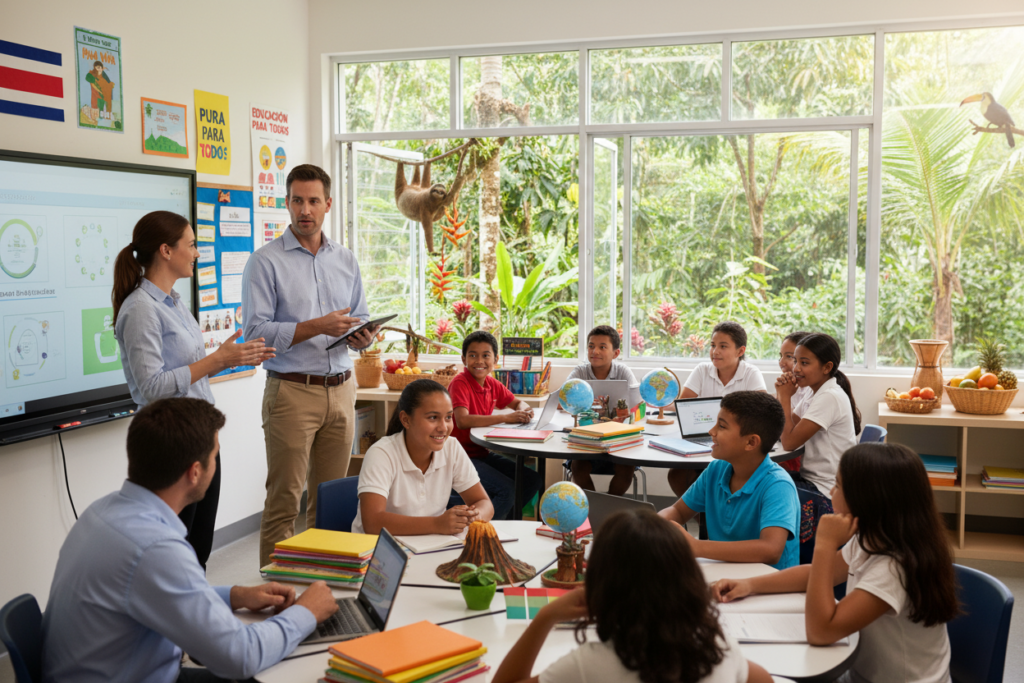
Costa Rica’s commitment to learning is a cornerstone of its national identity, a fact reflected in its impressive outcomes. This focus stems from a historic pivot in 1948 when the government abolished its military. Those funds were redirected to build a robust national education system, a decision that still shapes its high quality today.
The results speak for themselves. The country boasts a literacy rate exceeding 97%, one of the highest in the Western Hemisphere. This achievement supports its reputation for having the best education system in Latin America. Families can expect a consistent standard of quality across many schools.
The Costa Rican approach places a strong emphasis on social interaction and developmental skills from an early age. The curriculum is designed to nurture well-rounded individuals, not just academic achievers. Understanding this holistic philosophy is key for integration.
Grasping the structure of these institutions is vital for parents aiming to weave their children into the local culture effectively. The landscape includes distinct types of schools, each with its own character. We guide you through these differences to find the best fit for your family’s unique needs.
Navigating Costa Rican Residency for Expat Families (Residencia)
Establishing legal residency is the foundational step for expat families planning a long-term future in Costa Rica. This status is more than a formality—it’s your legal key to full integration. It unlocks access to essential services, with enrollment in the public school system being a primary benefit for many.
We help families understand the specific legal pathways available. Navigating the immigration process demands patience and meticulous attention to your documentation. Every form and apostilled certificate must meet strict government standards to avoid unnecessary delays.
Our expertise is designed to steer you clear of common pitfalls that can stall an application. These errors often relate to incomplete paperwork or misunderstood financial requirements. A smooth approval process allows you to move forward with confidence.
Securing your legal status early is a strategic advantage. It lets you shift your focus from bureaucracy to what truly matters: your children’s education and your family’s seamless transition into the community. Proper planning here sets the tone for your entire experience.
Who Qualifies for Residency in Costa Rica?
Your eligibility for residency hinges on demonstrating stable financial means through one of three primary programs. These are the Pensionado, Rentista, and Inversionista categories. Each has distinct requirements tailored to different financial profiles.
Pensionado (Pensionado) Eligibility
The Pensionado program is designed for retirees or individuals with a guaranteed lifetime pension. You must prove a minimum monthly income of US$1,000 from a qualified pension source. This is a popular choice for those with stable retirement funds.
Rentista and Inversionista Criteria
The Rentista category suits those with stable investment income. It requires proof of US$2,500 in monthly income, guaranteed for at least two years.
For the Inversionista (Investor) option, a minimum investment of US$150,000 in Costa Rican assets is required. A key rule: the investment property must be held in the applicant’s personal name.
These pathways provide a clear legal framework for families establishing themselves in Costa Rica. We always advise confirming the latest financial thresholds directly with official sources as part of your immigration interview preparation.
Essential Document Preparation Before Arrival
The most critical administrative task for your family’s move begins long before you board the plane. We see this proactive work as the single best way to prevent frustrating delays in your residency application. Getting your paperwork in order from your current home sets a calm, organized tone for your entire transition.
Apostilles & Translations Guidelines
Every vital record from your home country requires specific certification. This includes birth certificates, marriage licenses, and criminal background checks. Each document must carry an apostille, a special authentication seal you obtain before leaving.
Once you arrive in Costa Rica, the process continues. All foreign documents must be translated into Spanish by an official translator recognized by the government. We guide you through finding qualified professionals to handle this mandatory step correctly.
Required Proof of Residency and Identity
Parents must ensure all identification for themselves and their child is current and valid. Immigration authorities will require these as proof of your family’s identity and relationship. Having them ready for immediate submission avoids last-minute scrambles.
This disciplined approach to document preparation significantly reduces the stress of your family’s initial settling-in period. When your paperwork is complete, you can focus on more important things—like helping your child feel at home.
Step-by-Step Immigration Guidance via CRIE (crie.cr)
Professional guidance can transform the complex immigration process from a daunting obstacle into a manageable series of steps. At CRIE (crie.cr), we specialize in providing this clarity for families moving to Costa Rica.
Our team offers structured, step-by-step support for your residency application. We handle the intricate details of forms and filings with immigration authorities. This allows you to redirect your energy toward researching the best schools for your children.
Securing legal residency is often a prerequisite for long-term enrollment in many local schools in Costa Rica. We navigate these specific requirements so your family’s legal and educational transitions are aligned from the start.
You can begin this process with confidence. Reach out to our experienced team directly via WhatsApp at +506 8373 2085 or email us at info@crie.cr. Let us manage the paperwork while you prepare for your new life.
Timelines and Expected Processing Durations
Setting realistic expectations for the immigration timeline is a practical necessity for any family’s relocation plan. In Costa Rica, processing durations are inherently variable—they are not fixed schedules.
We build your plan around this fluid reality from the start. Understanding the expected range helps you coordinate school searches, housing, and your move more effectively.
Overview of Application Durations
Processing times depend heavily on your specific residency category and the government’s current caseload. While some straightforward filings conclude in a few months, others extend well beyond that.
The complexity of your documentation directly influences this timeline. A complete, error-free application moves through the queue faster than one requiring corrections.
We always advise families to plan for a flexible timeline. Official processing durations can change without notice, so building buffer time into your schedule is wise.
A key part of our guidance focuses on maintaining your legal status during the wait. This ensures your family’s transition remains smooth and uninterrupted while approval is pending.
By preparing your documents thoroughly with our help, you actively work to minimize your time in the application queue. This proactive step is one of the best ways to manage the waiting period.
Common Pitfalls and Mistakes to Avoid
Avoiding common administrative errors can save your family significant time and stress in the residency process. We guide expat families around these frequent obstacles every day. Understanding what typically goes wrong is your first defense against delays.
Document Errors and Oversights
The most consistent issue we encounter involves incomplete paperwork. Many families forget to obtain apostilles for vital documents before leaving their home country. This oversight alone can add months to your application timeline.
Always verify income requirements match your chosen residency category. Miscalculating these financial thresholds is another common reason for rejection. We provide clear checklists to prevent these oversights.
Timeline Miscalculations
Another major pitfall involves unrealistic expectations about processing durations. Government timelines in Costa Rica are estimates, not guarantees. Relying on outdated information compounds this problem.
We help you build flexible schedules that account for variability. Double-checking all requirements through official channels is vital. This proactive approach keeps your family’s transition on track.
Education Options: Public, Private, and International Schools in Costa Rica
The Costa Rican education system presents families with three primary pathways: public, private, and international schools. Each type offers distinct features you must weigh carefully.
Your choice will shape your child’s daily routine and academic journey. We guide you through the core differences to find the right fit.
Public schools in Costa Rica are tuition-free. They require students to wear specific uniforms. This policy helps minimize visible wealth disparity in the classroom.
Private schools operate on a different model. Monthly fees typically range from $500 to $1,000. They offer smaller class sizes, often around 25 students.
These private institutions also provide a higher level of English instruction. This can be a significant advantage for integration.
International schools are popular among expat families. They follow foreign curricula like the IB or American systems. A key benefit is their flexibility regarding residency status during enrollment.
Families should always visit potential schools. Assess the quality of facilities and the specific educational philosophy in practice.
Whether you choose a public or private school, ensure it meets your family’s specific needs. Your decision should support your child’s long-term academic goals in Costa Rica.
Curriculum and Language: Bilingual and Immersion Programs
For families relocating abroad, the choice between bilingual and immersion programs can define a child’s educational experience. We guide you through these distinct approaches to language learning. Understanding each model helps you select the right academic environment.
Bilingual Education Advantages
Bilingual schools often use a balanced mix of local and foreign teachers. This team approach provides authentic exposure to both English and Spanish. It creates a classroom where both languages are valued equally.
These programs aim for full academic proficiency in two languages. Students learn subject matter in both English and Spanish throughout their day. This dual-language model is a significant benefit in international settings.
The curriculum supports overall cognitive and social development. Immersion programs are particularly effective for younger children. Their natural ability to absorb new languages can lead to fluency within months.
Consistent exposure in a supportive school environment is key. We recommend assessing a school’s language separation methodology. Ensure their approach aligns with your child’s current proficiency level.
This careful match supports a smoother academic transition. Bilingual education prepares these students for global opportunities. It also allows for deep integration into the local Costa Rican culture.
School Enrollment Process for Expat Children
The procedure to secure a school spot for your children involves distinct steps depending on the type of institution you choose. We guide you through this essential phase to ensure a smooth start to the academic year in Costa Rica.
Public vs. Private Enrollment Essentials
Public school enrollment legally requires proof of residency. This is why we emphasize starting your immigration process early—it directly enables this option.
Private schools are generally more flexible. They may accept students while their residency application is still in progress, offering a valuable bridge.
All institutions require universal documents for new students. You must provide academic transcripts from your child’s previous school for proper grade placement.
Vaccination records and valid identification are mandatory for entry into the Costa Rican system. We suggest contacting your preferred schools directly.
Understanding their specific enrollment deadlines and documentation requirements is a proactive step that prevents last-minute hurdles.
Academic Calendar and School Year in Costa Rica
The rhythm of the school year in Costa Rica follows a calendar distinct from what many North American families expect. The academic year typically begins in February and concludes in December. This schedule is a fundamental detail for planning your family’s relocation timeline.
Students enjoy a significant two-week break during the month of July. This mid-year pause provides a perfect opportunity for families to travel or simply rest and recharge together. It’s a built-in feature of the local academic cycle.
Understanding this February-to-December framework is essential if you are accustomed to an August-through-June school year. Aligning your move with these dates helps your children integrate without missing critical orientation periods. We help families coordinate this timing as part of a smooth transition.
It’s also wise to verify specific calendars with your chosen institution. Private schools may finish their terms a week or two earlier than public schools. A quick check ensures your plans remain perfectly synchronized.
Planning around the local academic calendar is a strategic step. It allows your child to start the school year with their new classmates. This simple foresight supports a confident and positive beginning to their educational journey in Costa Rica.
Choosing the Right Neighborhood for Family Living and Education
Your family’s new neighborhood will shape your daily routine and your children’s access to quality education. In Costa Rica, many top-tier international schools are heavily concentrated in the Central Valley region surrounding San José. This makes areas like Escazú and Santa Ana popular for families prioritizing academic choice.
Other regions offer a distinct lifestyle. Guanacaste, for example, attracts families drawn to a surf-oriented and outdoor-focused community. Your choice here directly impacts the daily commute and the extracurricular activities available to your children.
We strongly recommend visiting potential neighborhoods. This allows you to see if the local community aligns with your family’s values and pace of life. Proximity to amenities and quality schools is a major factor for a happy transition.
Your selection should balance educational needs with your desired lifestyle. Finding the right fit supports your entire family’s long-term success in Costa Rica.
Income, Work, and Residency Options for Expat Families
For expat families settling in Costa Rica, understanding the link between income sources and legal residency is crucial for long-term stability. Many families support themselves through remote work for companies abroad. It’s vital to know the Digital Nomad visa does not count toward permanent residency or citizenship.
If your plan is to stay for years, you must pursue a formal residency category. Options like Pensionado or Inversionista provide a secure legal future. These pathways are distinct from temporary digital status.
We advise all families to create a solid financial plan. Living in Costa Rica can be expensive, especially when raising children. Starting a local business is an option, but your role may be limited without permanent residency status.
Our team helps you evaluate your income and work situation. We determine the best residency path for your family’s stability. Begin your formal residency application with confidence and clear guidance.
Preparing Your Family for Cultural and Educational Transition
The emotional and social adjustment for your children is a critical component often overlooked in the relocation checklist. We believe preparing your family for this shift is just as vital as handling legal and school logistics. A thoughtful approach to cultural integration sets the stage for long-term happiness.
Encourage your child to join local sports teams or music lessons soon after arrival. These activities provide a natural way to make friends and learn the language. Building a new social circle helps combat feelings of isolation.
We suggest engaging in activities like virtual tours of national parks to build excitement as a family. Exploring Costa Rica’s unique wildlife and geography together fosters a positive connection to your new home.
Maintaining regular video calls with relatives back home offers comfort during the transition. It allows children to process the change without losing their support network. This balance between old and new connections is key.
Ultimately, thriving in Costa Rica depends on building a local community. Seek out family-friendly events and connect with other families. A strong support system helps each child feel included and turns a new house into a true home.
Integrating Residency with Educational Goals
Long-term success for expat students depends on a strategy that treats immigration status and school placement as interconnected priorities. We help you build a single, cohesive plan where legal stability supports academic opportunity from day one.
Managing your residency application is the definitive step to securing your children’s access to quality education in Costa Rica. A misaligned timeline can lead to stressful school changes mid-year. Proper integration prevents this disruption, giving your family a stable foundation.
Our role is to align your immigration strategy with your core educational goals. We handle the complex details of legal status so you can focus on finding the perfect school for your students. This comprehensive approach ensures every aspect of your move is coordinated.
We are committed to providing the expert guidance needed for this seamless experience. Our transparent process helps your family achieve lasting stability and realize your dreams in Costa Rica.
Starting Your Journey in Costa Rica with Confidence
We understand that starting a new life in a different country requires careful planning and reliable support. This guide was created to help your family navigate the education and residency landscape with total confidence.
Remember, every family’s path is unique. We are here as your partner for each step, ready to provide answers to common questions and tailored guidance.
Contact our team today to discuss your specific needs. We look forward to helping you and your students thrive as you begin this exciting new chapter in Costa Rica’s vibrant community.

FAQ
How does our residency status affect our child’s school options in Costa Rica?
Your residency status directly impacts your options. With temporary or permanent residency, your child can enroll in the public system. For private or international schools, enrollment is typically open regardless of status, but proof of legal stay and financial stability is required. We always advise securing residency to access the full spectrum of educational institutions.
What is the main difference between public, private, and international schools for our family?
Public schools are government-funded, Spanish-only, and follow the national curriculum. Private schools are fee-based, often bilingual, and may offer international elements. Fully accredited international schools provide globally recognized curricula (like IB or U.S. standards) entirely in English. The choice depends on your budget, language goals, and long-term academic plans for your child.
What documents are essential for enrolling our child in a Costa Rican school?
A>You will need your child’s birth certificate and academic transcripts, both apostilled and officially translated into Spanish. Proof of your address in Costa Rica, the child’s passport, and vaccination records are also mandatory. For private institutions, be prepared to show proof of income or financial means. Starting this document preparation months in advance is crucial.
Can our children enroll in school while our residency application is still processing?
Yes, this is common. Most private and international schools will accept students whose families have applications in process, provided you can show proof of application submission and legal entry stamps. You’ll need to communicate openly with the school’s administration about your timeline. It’s a practical step many expat families take during the transition.
What should we know about the school calendar and academic year?
The Costa Rican school year runs from February to December, with a long break in December and January and a shorter mid-year break in July. This differs significantly from Northern Hemisphere schedules. Enrollment periods are typically in the preceding October-November. Planning your move to align with this calendar minimizes disruption to your child’s academic progress.
How do bilingual or immersion programs work, and which is better for our child?
Bilingual programs split instruction between Spanish and English, aiming for fluency in both. Full immersion places your child in a Spanish-language environment to achieve rapid proficiency. The “better” option depends on your child’s age, prior language skills, and your family’s long-term plans. Younger children often adapt well to immersion, while older students may benefit from a supportive bilingual setting.
What are common mistakes families make during this education and residency process?
The most frequent pitfalls are underestimating document processing times and missing proper apostilles or translations. Another is choosing a school based solely on location without vetting its curriculum fit. We also see families not budgeting for additional costs like uniforms, fees, and activities. Thorough research and building a realistic timeline with professional guidance can prevent these issues.