
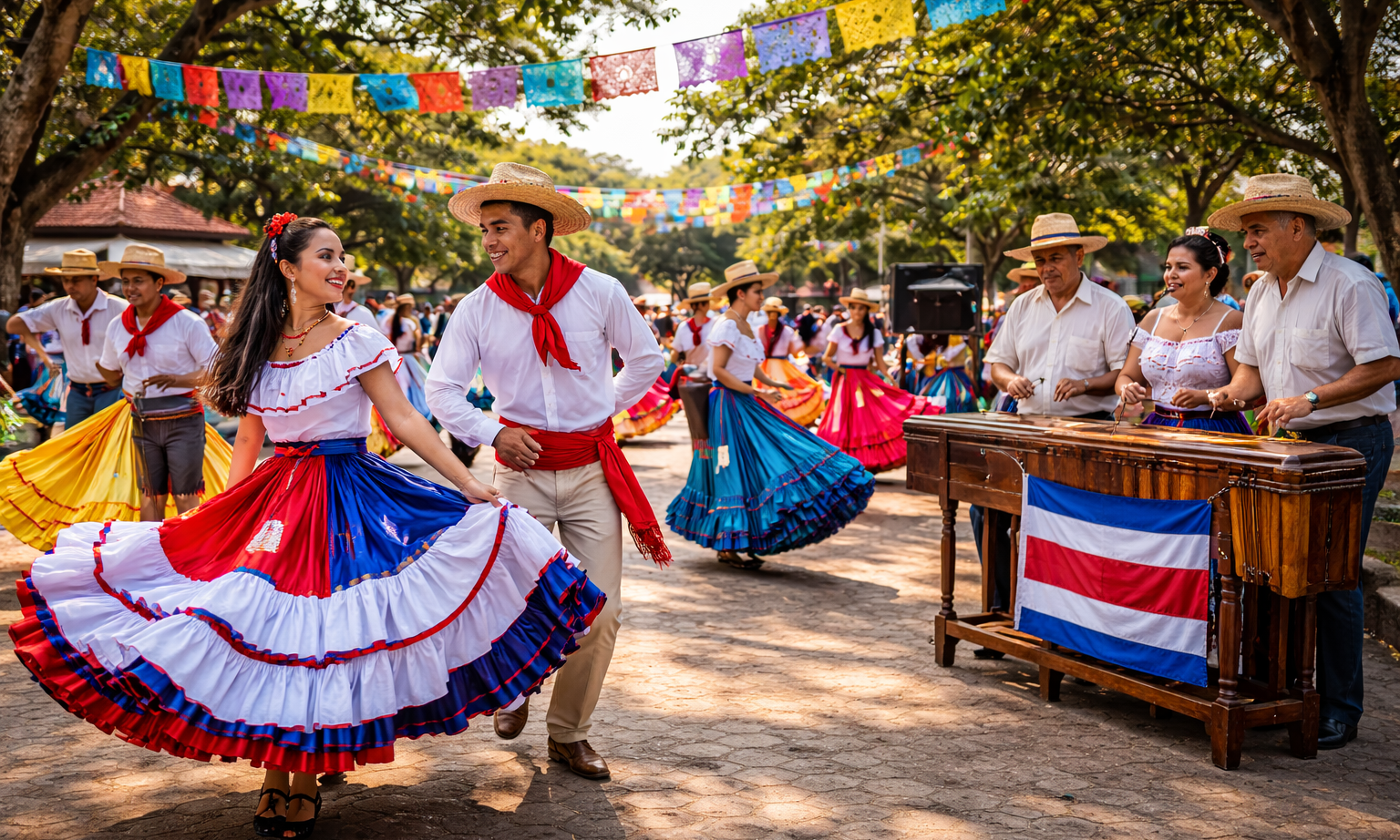
If you are moving to Costa Rica and thinking about dance classes, there is one thing worth knowing before you pick a style, because most guides get it exactly backwards.
Salsa and bachata are what the schools advertise. They are also Cuban, Colombian and Dominican. The dance that is actually Costa Rican is swing criollo — and learning it will do more for you socially here than three years of competent salsa.
Swing criollo, and why it matters
It began in the 1950s, among workers in the banana zone who heard American big-band swing on records and took the movement somewhere new with it. When those families moved to the southern neighbourhoods of San José — San Sebastián, los Hatillos, Sagrada Familia — the dance travelled with them and became a city dance.
Then it spent decades being looked down on. Not because of how it was danced, but because of who was dancing it: working people from the southern barrios, and others the respectable salons preferred to keep out. That history is not a footnote; Costa Ricans who dance it will tell you about it.
What turned it around was television. In the 1980s a national programme put swing criollo into a broadcast dance competition, a mass audience saw it properly for the first time, and the country changed its mind.
On 3 May 2012 it was declared intangible cultural heritage of Costa Rica. It has since been put forward for UNESCO’s representative list.
What it feels like to dance
Swing criollo is danced mostly to cumbia, not to swing music, which surprises people who come to it from the name. The rhythm underneath is Latin; the shapes on top are what the banana-zone dancers took from swing.
Three things mark it out:
- A bounce. There is a constant marked rise and fall on the beat. It is the first thing that gives away a foreigner who has learned salsa — salsa glides, swing criollo bounces.
- The arms do the talking. The connection through the hands and arms is how the lead is communicated, and it is far more conversational than the frame-driven lead of ballroom styles.
- Turns, and a certain amount of nerve. Spins, hops and recoveries that look like they should not work.
It is not a difficult dance to begin. It is a very difficult dance to do well, which is roughly the ideal combination for a beginner who wants a hobby rather than a certificate.
The rest of the room
A typical Costa Rican social dance night is not a salsa night. It moves through several rhythms, and a school here will usually teach them together rather than as separate disciplines:
- Cumbia — the backbone. If you learn one thing, learn to move to cumbia; it is what actually gets played.
- Salsa — danced widely, taught everywhere, Cuban in origin.
- Merengue — Dominican, the simplest to pick up, and the one that will get you through a wedding.
- Bachata — also Dominican, and the most popular thing in Latin dance schools worldwide for the last decade.
- Bolero — slow, close, and the reason many of the swing associations here are called swing y bolero. The two live together.
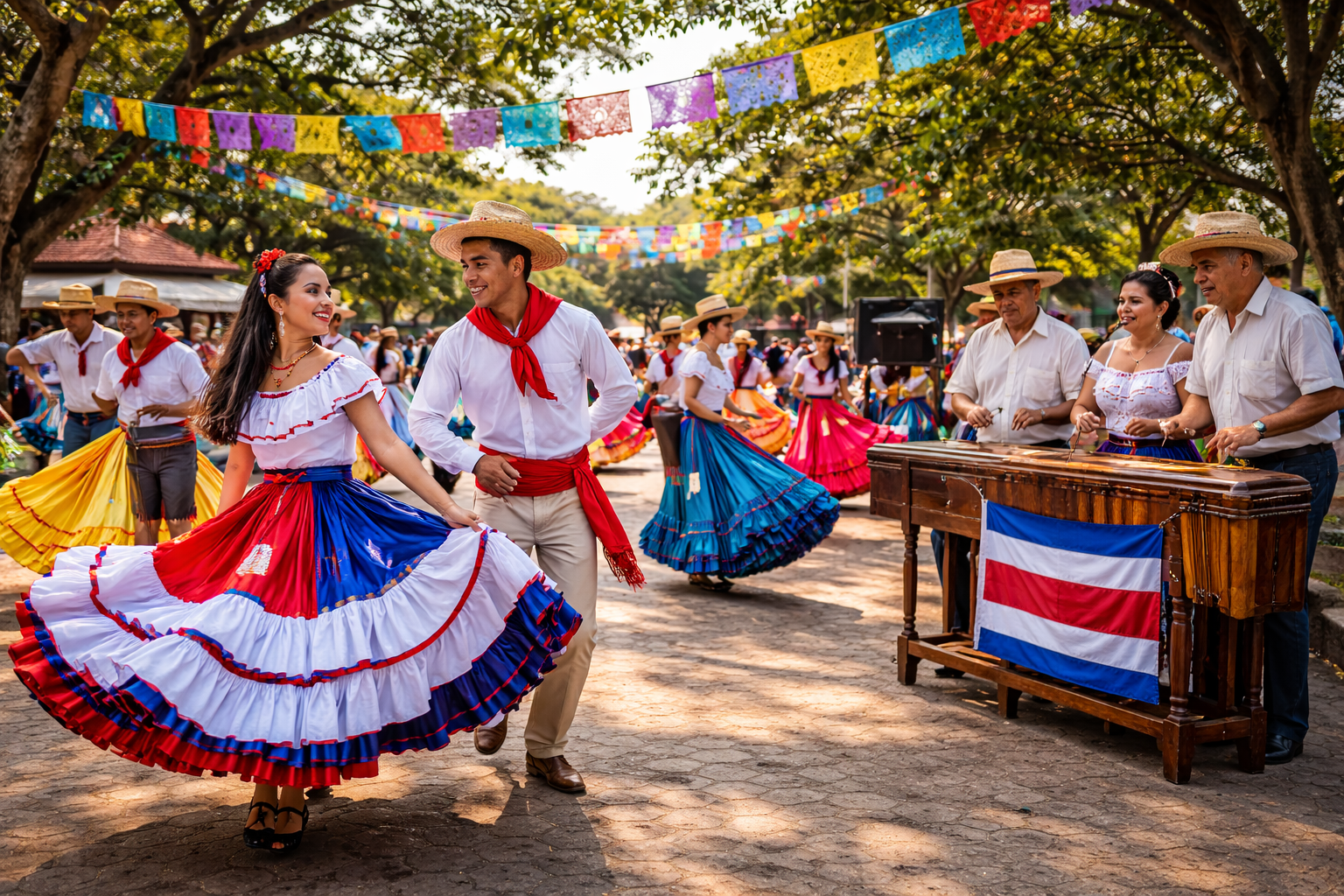
And the folkloric side, which is a separate thing
Folklórico is not social dancing. It is costume, choreography and performance — long skirts, groups, festivals and school presentations — and it is taught in its own schools and municipal programmes.
Its centrepiece is the punto guanacasteco, generally treated as Costa Rica’s national dance. Its signature is the bomba: the music stops on a dancer’s call, and someone shouts a short rhyming verse — usually funny, often a little rude about their partner — and then the music picks up again.
Worth knowing honestly: even the national dance has a contested history, with researchers tracing the punto form to the Caribbean and to Panama before it settled in Guanacaste. Nobody in Santa Cruz will thank you for raising it at a fiesta.
Practical notes for a newcomer
You do not need Spanish to start. Dance instruction is mostly counting and demonstration, and a class is one of the few social settings where being unable to talk much is genuinely not a problem. It is also a low-pressure way to acquire the everyday Spanish you will actually use.
Group classes are the point. The value is the room, not the instruction. A weekly group class in your own town will do more than private lessons with a better teacher an hour away.
Go where the locals go, not where the tourists go. Beach-town classes aimed at visitors teach a simplified salsa and a good time. A neighbourhood academy or a municipal culture programme teaches what people here actually dance, to people who actually live here.
Ask specifically for swing criollo. Many schools lead with salsa and bachata because that is what sells to foreigners, and will only mention swing if you ask. Asking also tells everyone in the room something about you.
Expect to be the worst dancer there for a while. Costa Ricans start young. This is fine, and cheerfully tolerated.
Why this is worth more than it sounds
A national survey published in January 2025 by the Universidad Nacional found that the most common criticism Costa Ricans make of residents from the United States, Canada and Europe is that they do not speak Spanish well — and that the goodwill towards them attaches to people rather than to the category.
A dance class is one of the cheapest and least self-conscious ways to be a person rather than a category. You turn up weekly, you are bad at something in public, people help you, and within a few months you know forty people in your town by name.
Nothing on any relocation checklist does that.
More on what Costa Ricans actually think of foreign residents.
Staying long enough to get good
CRIE — Costa Rica Immigration Experts handles residency applications, renewals, permanent residency and citizenship for people settling in Costa Rica.
See the types of residency in Costa Rica, or get in touch.
Historical detail on swing criollo from Costa Rican press coverage of its heritage designation and from the Asociación de Swing y Bolero. Survey findings from IDESPO, Universidad Nacional, January 2025.
Article by Glenn Tellier (Founder of CRIE and Grupo Gap)
Don't wait, contact us right now!
Call or WhatsApp Costa Rica +506 8373 2085 or +506 8706 3888
Call USA/Canada +1 305-906-6784