
Costa Rica immigration law is shorter and more specific than most of the advice written about it. Two official texts decide almost every case, and a handful of their articles decide most of the outcomes. This guide explains what those rules say in plain English, what has changed recently, and where people most often get caught out.
Legal provisions checked 6 October 2026 against the current official text on SINALEVI, Costa Rica’s national legislation database. Rules can change, so always confirm with the Dirección General de Migración y Extranjería (DGME) before acting.
The two texts that make up Costa Rica immigration law
The Ley General de Migración y Extranjería, Law 8764 of 19 August 2009, is the main immigration law. Its first article says it regulates the entry, stay and exit of foreign nationals, based on the Constitution and the international treaties Costa Rica has signed, with special reference to human rights.
The Reglamento de Extranjería is the regulation that sits underneath the law. It fills in the mechanics: which documents are accepted, how long they stay valid, and how long the DGME has to answer. The law tells you who may stay. The Reglamento tells you how to prove it.
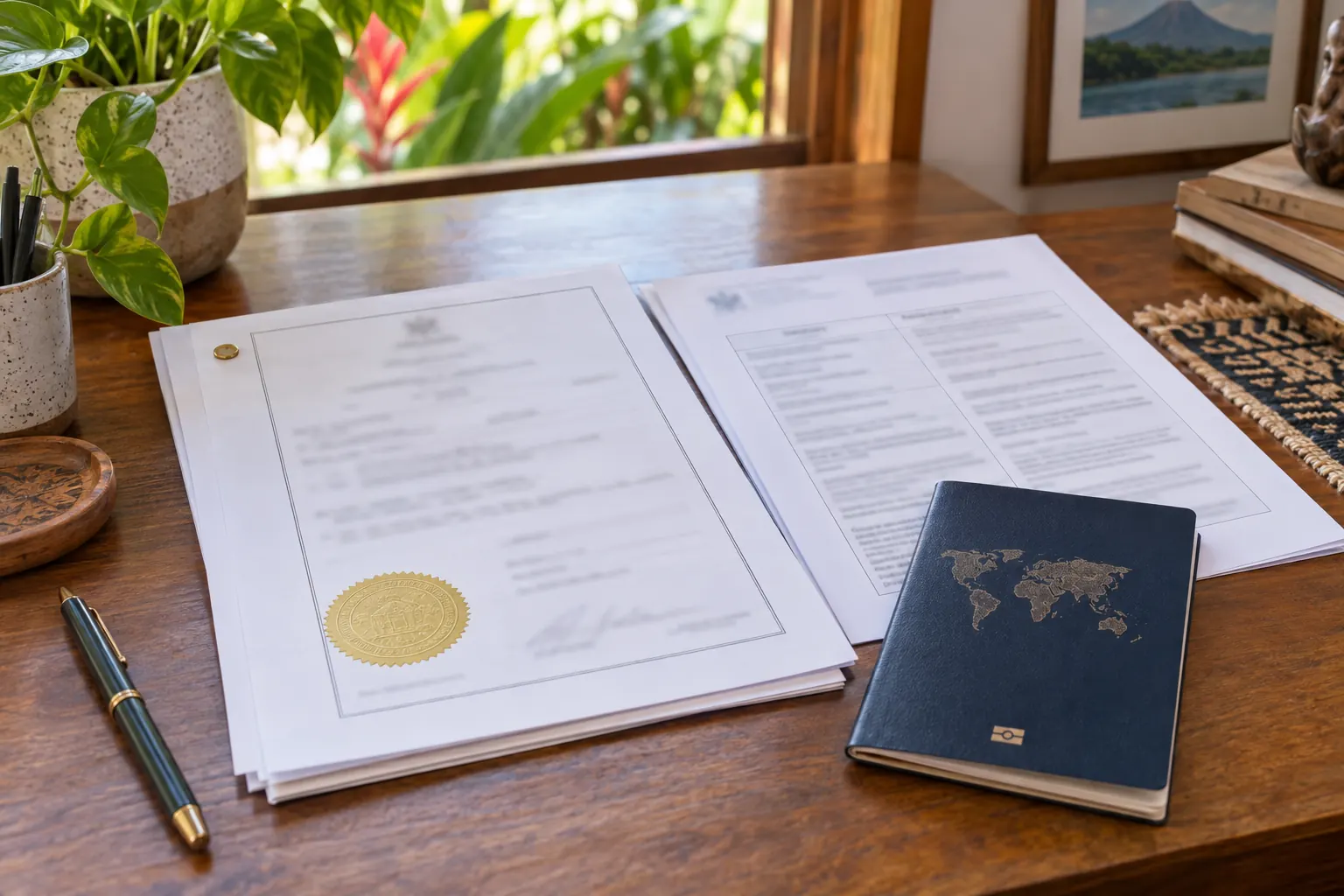
Is there a new immigration law in Costa Rica?
No. Law 8764 is still the immigration law in force. What changes is the detail, through amendments and official resolutions.
The most recent amendment to the law itself is Law 10493 of 5 June 2024. It changed the annual immigration payment in article 33. Minors, refugees, asylum holders, stateless people, adults with disabilities, cross-border workers, cross-border indigenous people and tourists are now exempt from it, and seasonal farm workers on stays of nine months or less pay a reduced amount. It also updated the charge for issuing residence documents.
The DGME also changes procedure by resolution. In 2026 it announced that DIMEX procedures left stalled for more than six months after an ignored notice would be declared expired. We explain what that means for applicants in our Costa Rica residency timeline.
Reform bills are presented in the Legislative Assembly from time to time. A bill is not law until it is approved and published, so treat news of a “new immigration law” as a proposal until it appears in the official texts.
The four groups the law sorts you into
The law places every foreign national in a group, and the group decides what you may do here, not how long you have been in the country.
- Non-residents, which includes tourists. Stays are short and, as a rule, work is not allowed.
- Special categories, for situations the DGME regulates separately.
- Temporary residents. Article 79 grants a stay of more than ninety days and up to two years, renewable, to groups such as spouses of Costa Ricans, company executives and specialists, and the other subcategories it lists.
- Permanent residents. Article 77 defines permanent residence as permission to stay for an indefinite time. Under article 78 you can qualify after three consecutive years of temporary residence, or as a first-degree relative of a Costa Rican citizen.
This is why years of tourist visits build nothing towards residency. They are simply repeated non-residence. See the types of residency in Costa Rica for the routes in.
Overstaying: article 33
Article 33 says foreign nationals must leave when their authorised stay ends, unless they have asked to change category or been given an extension. Anyone who stays irregularly owes an immigration fine for each month of irregular stay. If it is not paid, they can be barred from entering Costa Rica for three times as long as they overstayed.
Two things are worth noticing. The fine runs by the month, not by the day. And the entry ban is the alternative to paying, not an extra punishment. A year overstayed can become three years locked out.

Applying after your tourist stay has ended: article 91
A tourist whose permitted stay has run out can still ask for a residency category, if the DGME finds them suitable and the overstay fine from article 33 is paid. But the article adds a condition few people mention: the person then has ninety days to conclude the process, after which they fall back into irregular status.
Filing is not shelter. It is a fixed window, and it keeps running even when a government office abroad is slow with your papers.
Working: articles 92 and 80
Under article 92, non-residents may not work, except in the few cases the law lists. Under article 80, temporary residents may only do the paid work the DGME authorises, taking into account the Ministry of Labour’s recommendations.
No article turns a pending application into permission to work. Working without authorisation is also one of the grounds for cancelling residency later, so it can damage a case that would otherwise have been approved. Our guide to work rights by residency category shows what each category allows.
When an application is refused at the door: articles 69 and 70
Article 69 makes an application inadmissible when the person entered or stayed in the country against the law, with an exception for minors and a power for the DGME to admit cases on humanitarian grounds.
Article 70 says legal residence will not be granted to someone who has served a sentence for an intentional crime in the last ten years, in Costa Rica or abroad, where the act is also a crime here. If this applies to you, read can a felon visit or move to Costa Rica before you spend money on documents.
The document rules in the Reglamento
More applications fail on paperwork than on eligibility. Documents issued abroad must be apostilled, or legalised by the Costa Rican consulate and then authenticated by the Ministry of Foreign Affairs. Where a document states no validity period, it generally must have been issued within the last six months when you present it. Anything not in Spanish needs an official translation.
The Reglamento also sets the clock. The DGME has up to three months to decide, counted from the moment the file is complete, not from the day you filed. An incomplete file gets ten working days to be completed, or it is declared inadmissible and archived.
Put those two rules together and the most common failure appears on its own. Documents ordered too early pass six months. The file becomes incomplete. Ten working days is not enough to get new apostilled papers from another country. Nobody in that story was ineligible; the order of the steps was wrong.
How residency can be lost: article 129
Article 129 lists when the DGME cancels residency. The ones that catch ordinary people are:
- A permanent resident is out of Costa Rica for more than four consecutive years, or a temporary resident for more than two, without a proven reason such as health, study or family.
- Working without authorisation.
- Not renewing the residence document within three months after it expires, unless you can prove it was impossible.
- No longer meeting the conditions the residency was granted on.
- False documents or statements, or a marriage to a Costa Rican made only to obtain residency.
The renewal rule is the quiet one. The date is printed on your DIMEX and nobody will remind you of it. Our guide to renewing residency in Costa Rica explains how to stay ahead of it.

Frequently asked questions
Which law governs immigration in Costa Rica?
The Ley General de Migración y Extranjería, Law 8764 of 2009, together with the Reglamento de Extranjería. The DGME applies both.
Can I apply for residency while I am in Costa Rica as a tourist?
Often yes, but the timing matters. If your tourist stay has already expired, article 91 applies: the overstay fine must be paid and the process must be concluded within ninety days.
Can I work while my residency application is pending?
No. A pending application does not authorise work, and working without permission is a ground for cancelling residency.
What happens if I overstay?
Under article 33 you owe a fine for each month of irregular stay, or you can be barred from returning for three times the length of the overstay.
Where do you stand under these rules?
The articles above are short. Applying them to a real file, with documents from one country, deadlines in another and a category that has to be right from the start, is where cases are won or lost.
CRIE, Costa Rica Immigration Experts, handles residency applications, renewals, permanent residency and citizenship, including files that have already gone wrong. Read more about the laws of Costa Rica that affect daily life, or get in touch.
Provisions cited are from the Ley General de Migración y Extranjería (Law 8764, current version on SINALEVI), Law 10493 of 2024, the Reglamento de Extranjería and the DGME’s published requirements. General information only. Confirm current requirements with the DGME before acting.
Thinking of moving to Costa Rica?
Get a free residency assessment. Tell Johanna, our immigration expert, about your situation, and she will tell you which residency fits you and what you need.
WhatsApp Johanna: +506 8373 2085Free assessment
Or email info@crie.cr