

Moving to Costa Rica is a dream for many. Making it a permanent reality, however, depends on navigating a specific legal process. Residency here is not an automatic right—it’s a privilege granted by the government based on objective criteria.
The entire system is managed by the Dirección General de Migración y Extranjería. Understanding their framework is the first, crucial step for any applicant. We provide this guide to cut through the complexity and set realistic expectations from the start.
Maintaining a legal residency status is the only path to a stable, long-term life in this beautiful country. The process is methodical and demands strict adherence to official procedures. Many applicants underestimate this, which can lead to serious complications.
Our team emphasizes a candid truth: mistakes in your residency application can result in potential deportation or entry bans. By focusing on the reality of the system, we help you avoid these common pitfalls. Think of us as your experienced guide through every necessary step.
Understanding Costa Rica Residency Categories (Pensionado, Rentista, Inversionista)
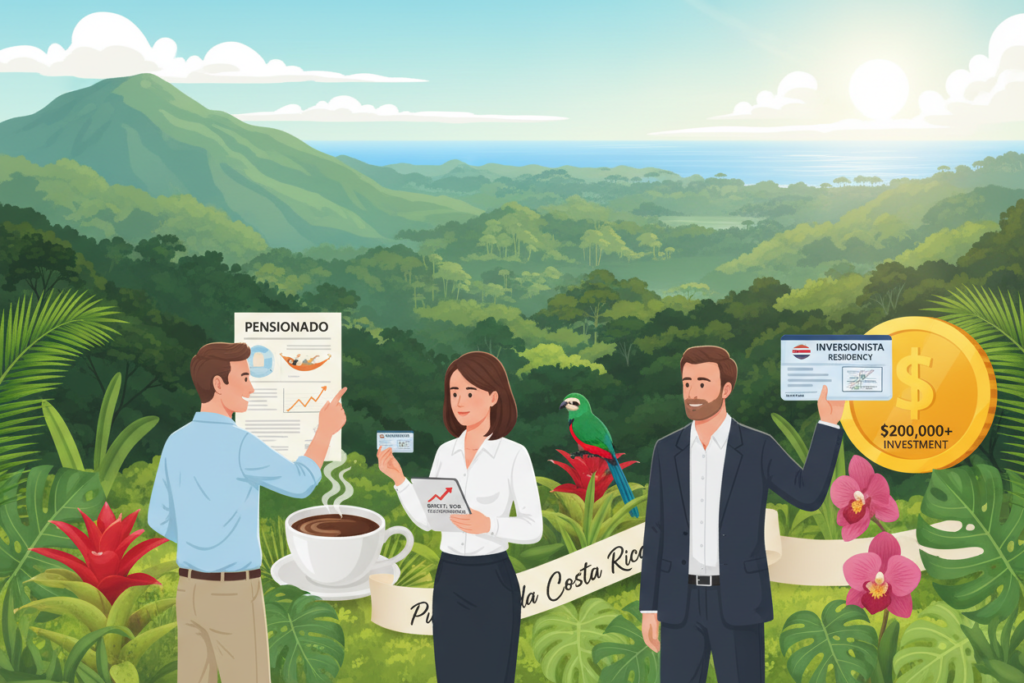
Costa Rica offers several distinct pathways to legal residency, each with specific financial thresholds. These categories—Pensionado, Rentista, and Inversionista—form the basis for obtaining temporary residency status. We help you identify which option aligns with your financial profile and long-term goals.
Overview of Pensionado (Pensionado) Requirements
The Pensionado category is designed for retirees. It requires proof of a stable lifetime pension of at least US$1,000 per month. This income must come from a certified source like social security or a private pension plan.
Essential Criteria for Rentista (Rentista)
For individuals with independent means, the Rentista category is key. You must demonstrate a guaranteed passive income of US$2,500 per month. This income must be verifiable and committed for a minimum of two years.
Key Points for Investor (Inversionista) Option
The Inversionista, or Investor, category requires a minimum capital investment of US$150,000. This investment can be in approved assets like Costa Rican real estate or a national business. It’s a popular route for those looking to contribute to the local economy.
Step-by-Step Guidance for Your Residency Application

Your journey to securing legal status in Costa Rica begins with confirming your eligibility and gathering the right documents. We break this initial phase into two clear actions.
Who Qualifies for Residency
To qualify, you must prove financial solvency for your chosen residency category. You also need a clean criminal record from your home country. These are non-negotiable requirements set by Costa Rican law.
Documentation to Prepare Before Arrival
Start collecting documents like birth and marriage certificates before you leave. Each one issued abroad requires an apostille from your home country.
Every document must then be translated into Spanish by an official translator. This process alone can take several months. Starting early saves valuable time.
Our team at CRIE verifies your paperwork aligns with your residency category. This careful check helps prevent frustrating delays in your application.
Preparing Your Application from Home
Efficient preparation from your home country is the single most effective way to streamline your Costa Rica residency application. Starting this process before you move saves significant time and prevents the need for expensive, stressful return trips later.
Organizing Essential Documents Efficiently
We strongly recommend you begin gathering and authenticating all paperwork from home. Obtaining apostilles for documents like your birth or marriage certificate is far simpler when you are physically present in your home country.
A critical piece is your FBI background check, which can take 8 to 12 weeks to process. Initiating this early is non-negotiable. By preparing your documentation ahead of arrival, you avoid the stress of managing foreign legal requirements while settling into a new country.
This approach gives you the time to correct any errors in your file. You won’t be racing against a ticking tourist visa clock. A well-organized application, built on complete proof of income and other essentials, forms the strongest foundation for your residency status.
Key Financial Thresholds and Requirements for Each Category
The financial commitments for Costa Rican residency are not suggestions—they are strict legal benchmarks you must meet. Each residency category has a specific monetary requirement set by law.
For the Pensionado status, you need a certified lifetime pension of at least US$1,000 per month. The Rentista category requires proof of a guaranteed US$2,500 in monthly income, typically verified through bank statements.
The Investor, or Inversionista, path demands a minimum capital investment of US$150,000. This is often in approved real estate or a business venture within the country.
Meeting these thresholds is a continuous obligation. You must prove you still qualify during every renewal of your temporary residency. We help you structure your financial documents to meet these strict standards from the start.
Navigating Costa Rica’s Immigration Process and Timelines
Navigating the immigration process in Costa Rica requires a clear understanding of its official timelines and procedural milestones. The system is managed by the Dirección General de Migración y Extranjería. You can verify all official updates directly at their website, migracion.go.cr.
We guide you through each phase to set realistic expectations. Patience is essential here. The system operates at its own pace, often influenced by application volumes.
Understanding Processing Milestones
Applicants should expect a standard processing period of 6 to 12 months. This clock starts once your complete application is submitted to the authorities. It covers the review of your financial proof, documents, and background checks.
Maintaining your legal status during this waiting period is a critical rule. You must remain in compliance with all immigration laws while your file is under review. This often means keeping a valid tourist visa or other permissible status.
We help you understand the rules at every stage. Knowing these milestones prevents anxiety and ensures you’re prepared for the next step. A successful residency application in this country is a marathon, not a sprint.
Avoiding Common Mistakes in Residency Applications
The path to securing your legal status in this country is often derailed by common, preventable mistakes in the application process. We help you identify and sidestep these errors to save valuable time and avoid frustration.
Document Errors and Omissions
Incomplete paperwork is the top reason for rejection. Every form must be filled out perfectly. Expired police clearances or missing apostilles will cause major delays.
We see applicants lose months because a single document was outdated. Double-check all your paperwork before submission. This step is non-negotiable.
Process Pitfalls to Watch Out For
Choosing the wrong residency category for your income is a critical error. It can lead to a denied application after months of waiting. You must match your financial proof to the correct status.
Never misrepresent information to the government. The rules are strict, and honesty is your best policy. We review your entire file to ensure full compliance and accuracy.
Avoiding these issues is the best way to ensure a smooth process. For answers to common questions, our team is ready to guide you.
residency-legal-issues-costa-rica: Detailed Legal Considerations
One of the first legal steps for any new arrival is to register with their home country’s consulate. This requirement is often overlooked but highlights a core principle. Residency here is a state-granted privilege, not an automatic right.
Costa Rican law gives the government full authority to set the rules. They can deny any application that fails to meet their strict criteria. Understanding this reality is crucial for a successful process.
You must adhere to all regulatory requirements without exception. This includes every financial proof and authenticated document. We provide realistic, transparent guidance to help you navigate this legal landscape and secure your status.
Maintaining Your Residency: Staying Compliant
Once you obtain residency in Costa Rica, your focus must shift to preserving your legal status through adherence to stay requirements. This is not a passive process. You have active obligations to meet each year.
Minimum Stay Requirements and Renewal Tips
If you hold temporary residency, you must spend at least six months per year in the country. This time can be continuous or spread across multiple visits.
Permanent residents have a simpler rule. They only need to visit Costa Rica once per year for a minimum of 72 hours.
Staying compliant with these rules is essential for renewing your status every two years. We advise clients to keep meticulous records of all entry and exit dates.
Failure to meet the minimum stay requirement can lead to revocation. This is a serious risk you must avoid.
As a resident, you should also ensure your enrollment in the social security system remains active. This is a key part of staying fully compliant with Costa Rican law.
Real Estate Investment Requirements for Investor Residency
Your real estate investment must satisfy both value and legal ownership requirements to support your residency goals. The investor category is a direct path for those committing significant capital to the country.
Ensuring Property is in Your Personal Name
For this residency category, your property investment must meet a minimum of US$150,000. Crucially, the title must be registered in your personal name in the National Registry.
Using a corporation to hold the asset is a common practice. However, it can create complications for your immigration file. We always advise personal ownership to align perfectly with the law.
Managing Rental Properties While Staying Compliant
Generating rental income from your Costa Rican property is permitted. You must declare this income to the local tax authorities to remain fully compliant.
Your qualifying investment must be maintained throughout your temporary residency. This is essential for renewing your status every two years. Understanding your work rights is also part of staying compliant.
We help you navigate these property ownership rules. Our goal is to ensure your investment solidly supports your long-term plans in Costa Rica.
Digital Nomad vs. Legal Residency in Costa Rica
For remote professionals, the allure of Costa Rica’s Digital Nomad visa can obscure a crucial legal reality: it is not a residency category. This distinction is fundamental for anyone planning a long-term future in the country.
Why Digital Nomad Status Doesn’t Equal Residency
The Digital Nomad visa is a temporary work authorization. Under Costa Rican law, it does not grant you formal residency status. It is designed for a specific, limited time frame.
This status does not provide a pathway to permanent residency. The months or years you spend on this visa do not count toward citizenship requirements. It is a separate legal situation entirely.
If you want to live in Costa Rica long-term, you must apply for a formal residency category. Options like the Rentista are designed for this purpose. The Digital Nomad visa is not a substitute.
We help remote workers understand this critical difference. Our team guides the transition from a temporary work arrangement to secure residency. This offers the long-term stability you need in Costa Rica.
Transitioning to Permanent Residency and Citizenship
Securing temporary status is a significant milestone, but for many, the ultimate goal is to establish permanent roots in Costa Rica. The process allows for a clear legal progression toward more stable standing.
We guide clients through each phase of this important transition. Understanding the timeline and requirements is key to successful long-term planning.
Steps to Upgrade from Temporary to Permanent Status
You can apply for permanent residency after three years of temporary status. This change grants you the right to work as a salaried employee—a major benefit for long-term residents.
Citizenship through naturalization generally requires seven years of legal residency. Applicants must demonstrate Spanish language proficiency and pass a test on Costa Rican history.
For citizens of Spain or Latin American countries, the required time is shorter. Each case depends on your specific situation under Costa Rican law.
We help you navigate this transition seamlessly. For family-based applications, review residency options for children of Costa Rican. Our team ensures you meet all criteria for your future in this beautiful country.
Next Steps: Secure Your Costa Rican Residency
Securing your place in Costa Rica means moving from planning to execution with confidence. The journey to legal residency requires a decisive first step. Our team at CRIE is here to guide that action.
We provide personalized support tailored to your specific situation. Whether your path involves real estate investment or the Pensionado program, we help you navigate every requirement. Taking action today builds your future in this beautiful country.
Contact CRIE via WhatsApp: +506 8706 3888
For immediate, personalized residency support, reach out on WhatsApp. This direct line connects you with our experts. We can discuss your financial profile and chosen residency category in real time.
Email Us at info@crie.cr for Personalized Guidance
Send your questions and documents to our dedicated email. This starts your formal application process with a thorough review. We ensure your paperwork meets all legal standards for Costa Rican residency.
Our commitment is to help you build a secure, legal life as a resident. Contact us now to begin your application.
Final Thoughts on Establishing a Life in Costa Rica
The journey to calling Costa Rica home is ultimately about stability and peace of mind. This security comes from a solid legal foundation built through careful planning and compliance.
By following the proper procedures and meeting all requirements, you transition from applicant to resident. A proactive approach to your documentation and financial status is key for maintaining this standing over the years.
Our team at CRIE is dedicated to navigating the complexities for you. This allows you to focus on building your new life and enjoying the country’s many benefits.
With the right preparation and expert guidance, you can successfully secure your place and look forward to a stable future in Costa Rica.
FAQ
What are the main residency categories for foreigners in Costa Rica?
The primary temporary categories are Pensionado (retiree), Rentista (person with stable income), and Inversionista (investor). Each has specific financial requirements—like proving a lifetime pension or making a qualified investment—that you must meet to apply. We help you determine the best fit for your situation.
How long does the residency application process typically take?
Processing times can vary, but you should generally expect the procedure to take several months from submission to approval. The timeline depends on the completeness of your documentation and the current workload at Immigration. We manage your case to navigate these milestones efficiently.
What is the most common mistake people make in their application?
The most frequent errors involve incomplete or incorrectly legalized documents from your home country. This includes missing apostilles or translations. Even small oversights can cause significant delays. Our process focuses on meticulous document preparation to avoid these pitfalls.
Can I work in Costa Rica with temporary residency?
Generally, no. Most temporary residency categories, like Pensionado or Rentista, do not grant automatic work rights. To work legally, you typically need a separate work permit sponsored by an employer. We can advise on your specific legal status and options.
What are the financial requirements for the Investor residency option?
The Inversionista category requires a minimum investment of 0,000 in approved assets, such as real estate, shares in a Costa Rican corporation, or tourism projects. The property or investment must be registered solely in your personal name. We guide investors through this verification process.
How do I maintain my temporary residency status once approved?
You must comply with minimum stay requirements—typically leaving the country for at least 72 hours every year—and renew your cédula (ID card) on schedule. Failing to do so can jeopardize your legal status. We provide reminders and support for all renewal procedures.
What is the difference between the Digital Nomad Visa and legal residency?
The Digital Nomad Visa is a one-year, renewable permit that allows remote work for a foreign employer. It does not lead to permanent residency or citizenship. Legal residency (like Pensionado) is a more permanent immigration status with a path to permanency. We clarify which option aligns with your long-term goals.
How can I transition from temporary to permanent residency?
You can apply for permanent status after maintaining your temporary residency for three consecutive years. The process involves proving continued compliance with all requirements. We manage this upgrade process, ensuring your documentation demonstrates a clean record during your provisional period.
Article by Glenn Tellier (Founder of CRIE and Grupo Gap)
Don't wait, contact us right now!
Call or WhatsApp Costa Rica +506 8373 2085 or +506 8706 3888
Call USA/Canada +1 305-906-6784