

Many remote professionals and entrepreneurs are drawn to the lifestyle and beauty of Costa Rica. A fundamental question arises about managing finances on the ground.
We need to address a common point of confusion from the start. Holding a Digital Nomad Visa is not the same as obtaining legal residency.
This status offers specific benefits but does not count toward permanent residency or citizenship. It also doesn’t automatically qualify you for the same financial services as a legal resident.
Understanding your legal standing is the first step. It saves time and avoids frustration when seeking local financial solutions.
Our role is to provide clear, honest guidance. We help individuals navigate the proper residency pathways—like Pensionado, Rentista, or Inversionista—that do grant full access to the banking system.
We emphasize starting your document preparation from home. For transparent advice on your specific situation, reach out to our team.
Overview of Costa Rica Residency and Banking Requirements

Access to banking services in this Central American nation hinges directly on your official immigration standing. Your status as a legal resident or a non-resident dictates the financial products available to you.
Costa Rica operates a two-tier system. Government-backed banks like Banco Nacional offer deposit guarantees. Private institutions such as BAC Credomatic often provide more English-language support.
Legal residents enjoy full access to all account types. Non-residents and foreigners face strict limits, like a $1,000 monthly deposit cap at some banks.
All financial institutions enforce rigorous Know Your Customer (KYC) checks. This is due to the country’s international agreements to prevent financial crime.
Securing legal residency—through pathways like Pensionado (Pensionado), Rentista (Rentista), or Inversionista (Investor)—is the key to unlocking standard banking. We guide clients through this process to secure a local bank account. For official rules, always consult Migración.
Understanding CRIE’s Residency Options (Residencia en Costa Rica)
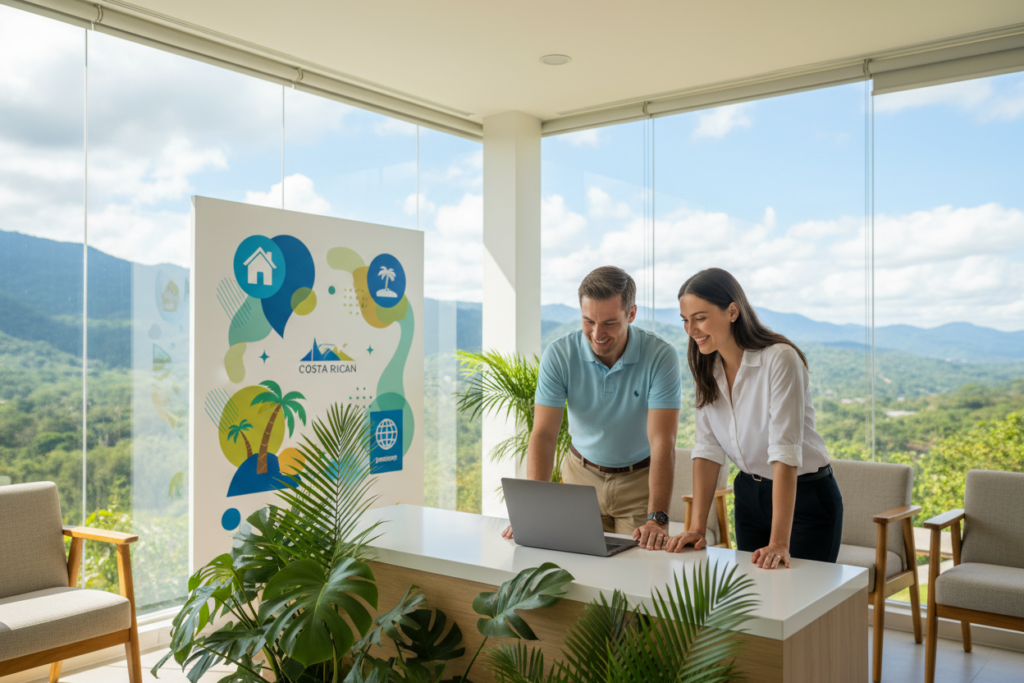
Formal residency pathways here provide the key to unlocking a local bank account. Unlike temporary visas, this legal status grants full access to the financial system.
Pensionado (Pensionado) and Rentista (Rentista) Eligibility
The Pensionado category requires proof of a permanent pension income of at least US$1,000 per month. The Rentista pathway demands documented guaranteed income of US$2,500 monthly for two years.
Investor (Inversionista) Requirements Explained
For the Inversionista option, a minimum investment of US$150,000 in local assets is mandatory. A critical rule: the property must be titled in your personal name, not a corporate entity.
All three routes require thorough document preparation. We advise starting this process from your home country. This legal residency is the foundation for a stable account here. For personalized guidance, contact us via WhatsApp at +506 8706 3888 or email info@crie.cr.
Can Digital Nomads Open a Bank Account in Costa Rica
Technically, individuals on a Digital Nomad Visa can establish a financial presence here, yet the access granted is fundamentally limited. This status is a temporary permit with tax benefits—not a pathway to legal residency.
Clarifying Residency vs. Digital Nomad Status
The Digital Nomad Visa allows a one-year stay and exempts foreign income from local tax. It does not, however, confer residency rights or count toward citizenship. Your standing remains that of a non-resident in the eyes of financial institutions.
Spending over 183 days may trigger tax residency rules. This visa is a convenience, not a foundation for long-term banking integration.
Alternative Banking Options for Remote Workers
Some local banks offer simplified accounts for non-residents. These often come with restrictive caps, like a $1,000 monthly deposit limit.
Many remote professionals use international multi-currency services or maintain their primary accounts abroad. Combining these with a limited local account can manage daily expenses.
For full, unrestricted access to the financial system, pursuing formal residency—typically the Rentista category for stable income—is the definitive solution. We provide honest guidance on this realistic path.
Who Qualifies for Costa Rican Residency?
The path to becoming a legal resident here is not one-size-fits-all. It branches into three primary categories with clear financial criteria. Understanding which pathway fits your profile is the first step toward securing a local account.
For the Pensionado category, you need verifiable permanent pension income. The threshold is at least US$1,000 per month from sources like government or military retirement.
The Rentista pathway requires proof of stable, guaranteed income. You must demonstrate US$2,500 monthly for a minimum of two years from investments or annuities.
Qualifying as an Inversionista demands a minimum investment of US$150,000 in approved local assets. A critical rule: the property title must be in your personal name, not a corporate entity.
All categories share common requirements. These include clean criminal background checks, health certifications, and documented proof of legal income sources.
Meeting these financial thresholds is just the starting point—it does not guarantee approval. We advise starting your document preparation from home and verifying the latest rules at migracion.go.cr.
Preparing Your Documents at Home: Apostilles, Translations & More
We cannot overstate the importance of beginning your document gathering and authentication process while still abroad. A successful application is built on this foundation.
Foreign paperwork requires an apostille for international use. This official seal is obtained from authorities in your home country, like a Secretary of State.
Steps to Obtain Apostilles and Official Translations
Common documents needing this authentication include birth certificates, marriage certificates, and police background checks. Financial statements providing proof of income are also required.
Once apostilled, each document must be translated into Spanish by a certified translator recognized in Costa Rica. This is a non-negotiable step in the process.
Realistic timelines are crucial. Obtaining apostilles can take 2-4 weeks. Background checks may require 4-8 weeks. Plan for translations to add another 1-2 weeks.
We advise getting multiple certified copies. Various offices will demand original certified copies, not photocopies. Proper preparation prevents costly delays and frustration upon arrival.
Step-by-Step Guidance: From Gathering Requirements to Appointments
We break down the entire procedure into a clear, actionable checklist to prevent costly oversights. Following this roadmap turns a complex immigration process into manageable phases.
Creating a Comprehensive Document Checklist
Your first action is confirming your qualifying category. This decision dictates the specific financial proofs you must gather from home.
Assemble personal and financial records next. You need birth certificates, marriage documents, police checks, and income verification. Every paper must be current and accurate.
The apostille stage cannot be rushed. Allow 2-4 weeks for authorities in your home country to authenticate each document. Official Spanish translations follow upon arrival in Costa Rica.
A critical, often missed, step is opening a local bank account. Immigration authorities require proof of this account for your residency file.
Finally, you schedule your appointment, submit the complete package, and begin the official review. Each stage has its own timeline, and patience is essential throughout this process.
Understanding Timelines and Processing Stages
The journey from application submission to holding a local bank account unfolds in distinct, sometimes unpredictable, stages. We set realistic expectations for the entire procedure, acknowledging that bureaucratic processes here move at their own deliberate pace.
What to Expect on Your Journey
Your preparation phase begins abroad. Gathering documents, securing apostilles, and obtaining background checks typically requires 2 to 3 months. For U.S. citizens, an FBI check can take 12 to 14 weeks alone.
Once you submit your residency application in the country, the official review period begins. Initial approval for temporary status averages 3 to 6 months. During this wait, you receive provisional documentation allowing a legal stay.
Residency here is staged. You first obtain temporary status, renewed annually. Permanent residency eligibility comes later. Opening a financial profile typically takes 1 to 3 weeks once your application is in process.
These timelines are estimates, not guarantees. Processing depends on application volume, staffing, and document completeness. Patience and flexibility are essential virtues throughout this process.
Avoiding Common Pitfalls in the Residency and Banking Process
Based on our extensive experience, we consistently observe a handful of specific errors that complicate or derail applications. Knowing these pitfalls in advance is your best defense against costly delays and frustration.
Key Mistakes to Avoid
A major error involves document timing. Police background checks older than six months are typically rejected. You must coordinate your apostille acquisition and arrival in Costa Rica carefully.
For Investor applicants, a critical rule is often misunderstood. The required $150,000 property investment must be titled in your personal name. Using a corporate entity disqualifies the application immediately.
Another costly misconception surrounds the Digital Nomad Visa. This status does not count toward legal residency. Spending a year on it means starting from zero when you apply for formal status later.
Banking-specific mistakes include providing unclear proof of fund sources. This triggers compliance reviews. Also, remember that maintaining a local account is a requirement for the residency process itself.
Finally, temporary residency holders must mark renewal deadlines. Letting your status lapse creates immigration complications. The system here can be unpredictable, which is why seasoned guidance is invaluable for navigation.
Importance of Starting Your Process from Home
Initiating your residency application from your home country is the most strategic move you can make. The most successful cases begin with thorough preparation abroad, not rushed gathering after arrival.
Essential paperwork requires home country processing. For U.S. citizens, FBI background checks take 12-14 weeks and must be obtained through U.S. channels. Apostilles must come from the jurisdiction where documents were issued.
Starting from home allows methodical collection of financial proofs. You can verify pension letters and bank statements to meet local standards before travel.
We have seen many arrive on tourist visas expecting to figure it out locally. They burn through their 90-day stay and face costly returns or overstays.
Proper preparation means arriving with a complete document package. This reduces time in temporary housing and accelerates your path to approved residency and full banking access.
This front-loaded effort is tedious but crucial. It distinguishes a smooth 4-6 month process from a multi-year struggle with expired papers and frustration.
Navigating US Tax Obligations and Compliance
The US is one of the few countries that taxes its citizens on worldwide income, creating unique obligations for those residing in Costa Rica. This isn’t optional—ignoring these rules leads to serious financial penalties.
IRS Reporting Requirements for Americans
American citizens must report all global earnings to the IRS every year. This applies even if you pay taxes locally on income sourced within Costa Rica.
A key requirement is the Foreign Bank Account Report (FBAR). You must file FinCEN Form 114 if your combined foreign financial accounts exceed $10,000 at any time.
For larger holdings, Form 8938 may also be required. This form triggers when specified foreign assets exceed $200,000 for expatriates.
The Foreign Earned Income Exclusion offers a valuable benefit. It can exclude up to $130,000 of qualified income from US taxation, but you must file correctly to claim it.
Costa Rica uses a territorial system. Only income generated locally is subject to local levies. However, spending over 183 days in the country triggers local filing obligations.
Compliance is highly individual and complex. We strongly recommend consulting with a qualified international tax professional. Non-compliance carries severe penalties, including substantial fines for unreported accounts.
The Role of a Local Bank Account in Your Costa Rican Residency
Your Costa Rican bank account serves a dual purpose. It’s a practical tool for daily life and a mandatory piece of your immigration file.
Immigration authorities require proof of a Costa Rican bank account where your income will be deposited. This establishes your financial integration for your residency application.
This creates a timing challenge. You need residency papers to easily open an account, but you need an account for your residency file.
Navigating this situation requires knowing which banks work with applicants holding provisional documentation. We guide clients through this specific step.
Once you receive your DIMEX card, your banking access expands fully. Residents enjoy higher limits, business accounts, and credit products.
A local account integrates you into the economy. SINPE transfers pay for everything. Utilities often require local autopay.
The relationship is symbiotic. Your legal status unlocks banking, and your established account demonstrates commitment to authorities. For comprehensive guidance on establishing residency that includes banking preparation, contact CRIE.
Tips for a Successful Bank Appointment in Costa Rica
Your choice between state-owned and private banks will shape your entire banking experience in Costa Rica. Institutions like Banco Nacional offer stability and wide ATM networks. Private banks, such as Scotiabank, often provide faster service and English support.
Always schedule an appointment instead of walking in. This reduces wait times and ensures staff availability. Bring your DIMEX card or passport, proof of local address, and documents showing your money’s origin.
The mandatory compliance interview will ask about your expected transactions and income sources. Answer honestly to avoid delays. Understand basic fees, like monthly charges and international transfer costs.
Request immediate activation of SINPE Móvil for local payments. Also, set up online banking during your visit. These steps integrate you smoothly into the daily financial life here.
Bridging Residency and Banking: A Seamless Transition
Achieving full financial integration in Costa Rica is a gradual process that evolves alongside your legal residency status. Your banking relationship grows in sophistication as your standing becomes more established.
Integrating Your Financial Life Locally
The initial phase involves opening your first local bank account with provisional residency documentation. This provides basic functionality but may have limits on transaction sizes.
Once you receive your DIMEX card after approval, return to your bank to upgrade your account status. This unlocks higher limits and access to credit products like loans and cards.
We recommend a three-account strategy. Maintain a Costa Rican account for daily expenses and SINPE transfers. Keep an international service for currency conversion. Preserve your home country account for emergencies.
Integrating locally means setting up autopay for utilities. This demonstrates financial stability to providers. As a legal resident, you can eventually access mortgages and business credit lines.
The seamless transition to full financial integration typically takes 6-12 months. Patience is essential—following the structured path leads to comprehensive banking access.
Additional Considerations for Inversionista Applicants
The Inversionista category, while attractive for capital holders, introduces specific banking complexities tied to property ownership. We address the unique financial documentation and compliance steps for this pathway.
Property Ownership Requirements in Your Name
A critical, non-negotiable rule exists. Your investment property must be titled in your personal name, not a corporate entity. Immigration law explicitly requires this, and corporate ownership disqualifies your application.
You must provide detailed proof of your funds’ origin. Documentation like property sale records or investment statements shows legal acquisition. Banks scrutinize large deposits for property purchases under anti-money laundering rules.
We recommend establishing your local account before initiating the purchase. This gives the account history and builds your relationship with the bank. It reduces friction when the large investment sum arrives.
Official property appraisals and National Registry verification are mandatory. They confirm the value meets the $150,000 minimum and clear ownership. You must maintain this investment throughout your temporary residency.
Unlike other categories, this status involves a one-time large deposit. Communicate this purpose to your bank to avoid transaction blocks. This pathway offers a solid foundation for long-term residency in Costa Rica.
Planning Your Move with CRIE: A Quick Recap
We’ve outlined the detailed journey; now, here is a concise summary of the essential framework for your move. Full financial integration requires obtaining legal residency through Pensionado, Rentista, or Inversionista categories.
The temporary Digital Nomad status does not provide equivalent access. CRIE specializes exclusively in Costa Rica residency and immigration services to guide you through this complex process.
The proven pathway begins at home with document gathering and apostilles. Verify you meet the financial thresholds: $1,000+ pension, $2,500+ guaranteed income, or a $150,000+ investment.
Your local bank account serves a dual role. It is required for your application and becomes your daily financial tool. A realistic timeline from preparation to temporary residency approval is typically 4-6 months.
We invite you to contact CRIE for personalized guidance on your residency pathway. Reach us via WhatsApp at +506 8706 3888, email info@crie.cr, or visit crie.cr for detailed information.
Final Steps to Secure Your Residency and Bank Account
Transforming residency plans into reality requires executing clear sequential steps.
First, verify your complete document package is ready. Then, schedule your immigration appointment.
Shortly after arrival, establish a local bank account with your provisional documents. This satisfies the residency requirement for proof of local banking.
Submit your application with all papers, including your new banking details. You’ll receive provisional status during the 3-6 month review.
Once your DIMEX card arrives, return to your financial institution to upgrade your profile. This removes limits and unlocks full features.
Activate SINPE Móvil for local transfers. Set up online access and utility autopay for seamless daily life.
Remember, temporary status requires annual renewal. Keep your profile active and compliant for this process.
Maintain patience throughout. Bureaucratic processes here move at their own pace.
For expert guidance through every stage, contact CRIE via WhatsApp +506 8706 3888 or email info@crie.cr.
FAQ
Do I need residency to open a bank account in Costa Rica?
What documents are essential for opening an account?
How long does the entire banking process take?
Can I manage my account with online banking?
What are the tax implications for U.S. citizens?
What’s the biggest mistake people make?
Is a minimum deposit required?
How does a local account help with residency?
Article by Glenn Tellier (Founder of CRIE and Grupo Gap)
Don't wait, contact us right now!
Call or WhatsApp Costa Rica +506 8373 2085 or +506 8706 3888
Call USA/Canada +1 305-906-6784