
Many people exploring life abroad wonder if the time they spend in a new country can lead to full citizenship. In Costa Rica, the answer involves a clear, legal pathway. The process of naturalization is possible, but it begins with one non-negotiable step: establishing formal legal residency.
We guide you through this journey starting with residency. The first move is to secure legal status under categories like Pensionado, Rentista, or Inversionista. This is where most applicants must begin. Simply visiting or living in the country without proper documentation does not count toward your eligibility.
Understanding this distinction is fundamental. Legal residence is your ticket to eventually applying for naturalized citizenship. The required time in this status is typically five to seven years, depending on your specific situation.
This article provides a factual framework based on Costa Rican law. We’ll explain the steps, document preparation from home, and realistic timelines. Our approach is transparent—we build trust by offering honest guidance without unrealistic promises.
Contact CRIE for expert support: WhatsApp +506 8706 3888 | info@crie.cr. Always verify the latest requirements at the official migration website.
Introduction to Costa Rican Residency and Citizenship

Navigating Costa Rica’s immigration system requires a clear grasp of the difference between two statuses. Many hopeful expatriates mix up the concepts of legal residency and full citizenship. Understanding this separation is your foundational step.
Overview of Residency vs. Citizenship
Residency is the legal permission to live in the country long-term. It is a temporary immigration status granted by the government. Citizenship, or naturalization, is the ultimate outcome—granting a passport and voting rights.
You cannot bypass the residency phase. The law requires you to first obtain and maintain this status for several years. Only then does eligibility for the citizenship process begin.
Starting Your Journey with Proper Documentation
The practical journey begins at home with document preparation. As the U.S. Embassy notes, navigating local laws is essential. They recommend consulting official sources like migracion.go.cr for current requirements.
You must gather critical papers like birth certificates and police checks. These require apostilles and official Spanish translations. This groundwork prevents major delays with the immigration authority.
We help clients understand these requirements from the start. Categories like Pensionado or Rentista have specific thresholds. Proper preparation turns a complex process into a manageable path.
Key Eligibility Criteria for Starting Your Residency Journey
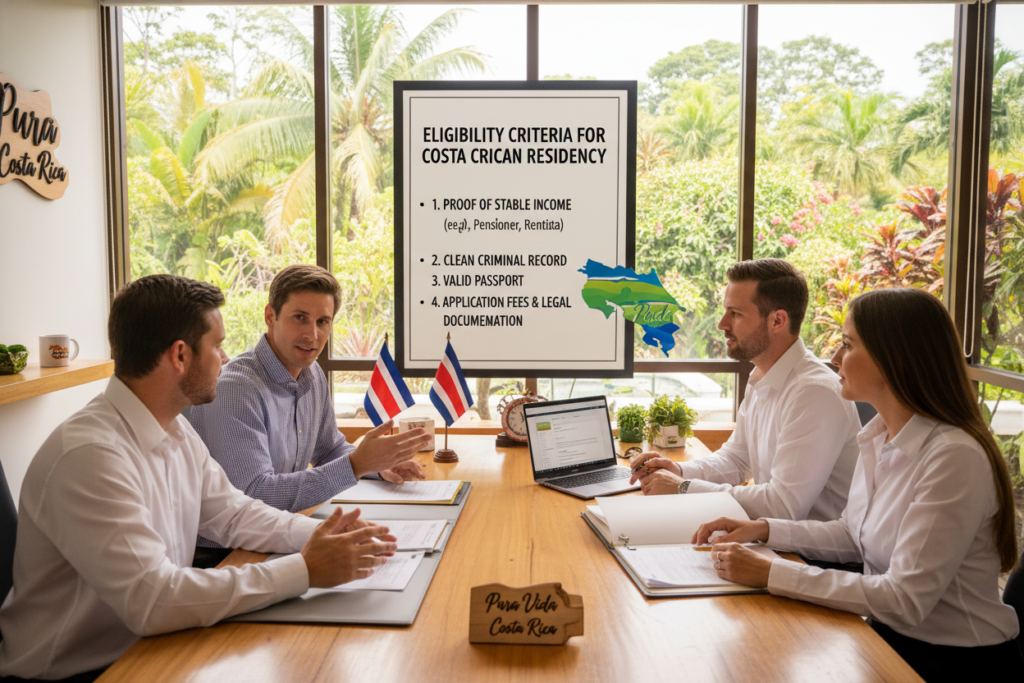
Determining your eligibility for Costa Rican residency begins with understanding three distinct legal pathways. Each category has specific financial and documentation requirements that applicants must meet. We guide you through these options to find the right fit.
Who Qualifies: Pensionado (Pensionado), Rentista (Rentista), Inversionista (Inversionista)
The Pensionado (Pensionado) category is for retirees with a guaranteed pension of at least US$1,000 per month. Rentista (Rentista) applicants need proof of stable income—US$2,500 monthly for 24 months from sources like investments.
Inversionista (Inversionista) requires a minimum US$150,000 investment in real estate or business. If buying property, it must be in the applicant’s personal name, not a corporation.
Understanding Income and Investment Thresholds
These are concrete numbers to plan around. Beyond finances, all applicants must show good conduct and ability to support dependents.
Always verify current requirements at migracion.go.cr before committing. Choosing the correct category is your first critical step.
Detailed Residency Process for Costa Rica
The immigration process for residency follows a logical chain of events, starting with document collection in your home country. Attention to detail in this initial phase is paramount for a smooth journey.
Step-by-Step Guidance on Application Procedures
Your first task is gathering core documents like birth certificates and police checks. These need apostilles and certified Spanish translations before anything else.
U.S. citizens must then complete a consular inscription. This involves STEP registration, a notarial service appointment, and a $50 affidavit for the immigration authorities.
Submit your complete application packet to Costa Rican immigration. You’ll get a case number for tracking. Officials may issue a formal request for additional information, which must be addressed promptly.
After initial approval, you’ll attend a biometric registration appointment. This grants temporary legal status during the final review. We recommend professional guidance to navigate each service touchpoint efficiently.
Essential Documentation to Prepare Before Arrival
Successfully applying for residency begins with meticulous document preparation in your home country. The specific requirements are non-negotiable. We advise starting this groundwork months before you plan to move.
Apostilles and Translations: What You Need
You must gather core civil documents. This includes your birth certificate, marriage certificate if applicable, and an FBI criminal background check. Each one requires an apostille for international use.
An apostille is an official certification under the Hague Convention. You obtain this service from the state or federal authority where the document was issued. The U.S. Embassy does not provide apostilles.
After apostilling, every document needs an official Spanish translation. Costa Rican immigration will not accept English-only paperwork. A certified translator must complete this step.
Financial proof for your residency category is also vital. Prepare pension letters, bank statements, or property deeds. Proper preparation here secures your registration for a residency permit.
Start this entire process 3 to 6 months ahead. Incomplete information is the top cause for delays. It can prevent your final permit approval for many months.
Timelines and What to Expect During the Process
The journey from document gathering to holding your physical residency card unfolds over a series of distinct phases, each with its own waiting period. Setting a realistic expectation is crucial—this is not a quick process.
Initial preparation alone can take 2 to 4 months. This includes obtaining official records, securing apostilles, and arranging certified translations. Each step operates on its own timeline.
After submission, an initial review by immigration takes 1 to 3 months. If officials issue a “prevención”—a request for more information—you typically have 30 days to respond. Missing this deadline can archive your application.
Following a successful review, you’ll complete biometric registration. This grants temporary legal status. The final wait for your permanent residency card often ranges from 2 to 6 additional months.
Patience is essential. The total time from start to finish frequently spans 6 to 12 months, but complex cases can take longer. We help clients plan for this variability.
Common Mistakes to Avoid When Applying for Residency
Documentation errors, rather than complex legal hurdles, are what most frequently stall residency approvals. These are preventable problems that can delay your case for months. The U.S. Embassy notes it cannot intervene, placing responsibility on applicants to meet all requirements.
Recognizing and Preventing Document Errors
Apostille and translation mistakes are common. Submitting a state document with a federal apostille, or using a casual translator, leads to rejection. All papers need the correct certification and a complete, certified Spanish translation.
Inversionista applicants make a critical error by buying property through a corporation. Immigration law requires the US$150,000 investment to be in your personal name to qualify for this status.
Financial proof often causes issues. Pension letters must state the exact monthly amount. Bank statements must cover the full required period. Expired police checks or financial documents will restart your timeline.
Name inconsistency across documents triggers questions. If your middle name is on some papers but not others, officials may request an affidavit. Failing to respond fully to an official request for information can close your case.
We help clients avoid these mistakes through meticulous preparation. For answers to common questions, our resource page provides clear guidance.
Starting From Home: Organizing Your Application Materials
We find that a successful application is built on a foundation of meticulous at-home organization, turning a complex process into a manageable checklist. Beginning this preparation in your home country provides crucial access to original records and familiar legal systems.
Tips for At-Home Preparation
Start by creating a master checklist for your chosen residency category. This list should detail every required document, its apostille source, and translation needs. Establish a simple tracking system for each item’s progress.
Note the date you request, receive, apostille, and translate every paper. This prevents confusion as multiple documents move through the pipeline simultaneously. Make several certified copies of your finalized dossier before you travel.
Cross-Checking Requirements on migracion.go.cr
The final, critical step is verification. Costa Rican immigration policy can update, making the official government website your primary source for current information. Visit migracion.go.cr regularly during your preparation phase.
Scroll to the bottom of the page for instructions in English. Before final submission, cross-check your complete package against the listed requirements one last time. This service to yourself catches missing elements and prevents official requests for more information.
Can I Become a Naturalized Citizen Based on Time Lived in Costa Rica?
Gaining citizenship in this country is a process defined by statute, not simply by duration of stay. The direct answer is yes, but with a critical qualification. Only the time you spend as a formal legal resident counts toward your eligibility.
Years on a tourist visa or a Digital Nomad permit do not apply. You must first secure and maintain a residency status like Pensionado or Inversionista. The clock for naturalization starts only after this official approval.
Costa Rican law establishes different timelines. If you are a native-born citizen of a Central American, Spanish, or other Latin American nation, you need five years of continuous legal residence. For individuals from other countries, the requirement is seven years.
An accelerated pathway exists for spouses of Costa Rican citizens. After two years of marriage and residence, they can apply. All applicants must also demonstrate good conduct, financial self-sufficiency, and proficiency in Spanish.
Citizenship through naturalization is the final step of a long journey. You cannot skip the initial residency phase. Following this proper sequence is essential for a successful outcome.
Comparing Residency Options: Digital Nomad vs. Traditional Residency
Costa Rica’s Digital Nomad permit offers immediate access but carries significant limitations for long-term goals. We must clarify a crucial immigration distinction. This temporary permit differs fundamentally from legal residency status.
Why Digital Nomad Status Does Not Qualify for Residency
The Digital Nomad permit is a temporary authorization for remote workers. It allows a one-year stay, renewable once. This status does not establish legal residence for immigration purposes.
Time spent under this permit does not count toward residency requirements for citizenship. Choosing it delays your goal if you seek permanent integration. It provides temporary presence without pathways to naturalization.
Exploring Alternative Residency Routes
For remote workers planning a long-term future, the Rentista category is typically appropriate. It requires demonstrating stable income of US$2,500 monthly for two years. Many professionals can document this through foreign employment contracts.
Proper residency provides stability and eventual naturalization eligibility. Temporary permits like the Digital Nomad option lack these benefits. Your choice should align with your timeline and ultimate objectives.
Understanding the Role of Apostille and Legal Translations
Before any paperwork reaches immigration officials, it must undergo two critical transformations: authentication and language conversion. An apostille is an official certification under the Hague Convention. It verifies the signatures and seals on your documents for international use.
This authentication process is mandatory. You obtain apostilles from the specific authority where your document was issued. State documents go to the Secretary of State, while federal papers require the U.S. Department of State.
The U.S. Embassy does not provide this service. A common mistake is arriving without proper authentication. This forces applicants to mail documents back home, causing major delays.
After apostille, every document needs a certified Spanish translation. Costa Rican law requires this step. The translation must be complete and accurate, performed by a recognized professional.
This dual requirement means each paper passes through multiple stages. We guide clients through this technical but essential registration process. Proper planning prevents last-minute scrambling and meets all official requirements.
Insights into Costa Rica’s Immigration Law and Its Implications
The legal foundation for acquiring Costa Rican nationality is detailed in a specific piece of legislation known as the Options and Naturalizations Act. Understanding this framework helps you see why certain rules exist for becoming a citizen.
The Impact of the Options and Naturalizations Act (Ley de Opciones y Naturalizaciones)
This law, rooted in the 1949 Constitution, defines who is a national by birth. It includes persons born in the country to Costa Rican parents. It also covers children born abroad to a citizen parent, if registered before age 25.
For naturalization, the law sets different residence timelines. People from Central American countries, Spain, or Latin America need five years of legal residence. Those from other nations typically require seven years.
Family ties matter greatly. A foreign spouse of a Costa Rican citizen can apply after just two years of marriage and residence. Since 1995, dual nationality has been permitted, so you can keep your original passport.
The law also views citizenship as an inalienable right. However, courts allow renunciation if you gain another nationality without becoming stateless. Applicants must show Spanish proficiency and knowledge of local culture.
We help clients navigate this legal landscape. For a detailed guide to Costa Rica citizenship by, explore our dedicated resource. Knowing the statute makes your path clearer.
Resources and Links for Prospective Residents
Having the right resources at your fingertips can make navigating Costa Rica’s immigration process significantly smoother. We guide clients to rely on two authoritative sources for accurate information and practical support.
Official Links: crie.cr and migracion.go.cr
The Costa Rican government’s official immigration website is migracion.go.cr. This is your primary source for verifying current residency requirements, application forms, and any policy updates. Bookmark this site and check it regularly during your preparation.
You can find detailed instructions for each visa category on the site. Scroll to the bottom of the page and select “Visa Instructions in English” for clarity. This government service provides the legal framework you must follow.
CRIE (crie.cr) specializes in residency and immigration services. We help prospective residents understand complex requirements and prepare documentation correctly. Our guidance turns official regulations into actionable steps for your specific case.
You can contact us directly for personalized information: WhatsApp +506 8706 3888 or email info@crie.cr. We assess which residency category fits your circumstances and provide realistic timelines based on current processing conditions.
Use these two resources together. Cross-reference any guidance you receive with the official government website. This approach gives you the best foundation for a successful application.
Final Thoughts on Navigating Your Costa Rican Residency Journey
Achieving citizenship here is the culmination of a carefully planned immigration strategy. Remember, legal residence must come first. Only your years in this official status count toward naturalization eligibility.
Start your preparation from home with thorough document gathering. Verify all current requirements on migracion.go.cr. Temporary permits do not provide a path to citizenship.
We guide you with transparency through each step of the process. Our role is to provide expert support, not promises. Contact us to begin: WhatsApp +506 8706 3888 | info@crie.cr.
FAQ
What are the main residency categories for moving to Costa Rica?
The primary routes are Pensionado, Rentista, and Inversionista. The Pensionado category is for retirees with a guaranteed lifetime pension. Rentista is for those with stable, external income. The Inversionista path requires a significant financial investment in the country, such as in property or a business.
How long does the residency application process typically take?
The timeline can vary significantly, but you should generally plan for a process that takes several months to over a year. Preparation is key—gathering documents with apostilles and official translations from home can prevent lengthy delays once your application is submitted to immigration authorities.
Can my time as a Digital Nomad count toward permanent residency or citizenship?
No, it cannot. The Digital Nomad visa is a special legal status for remote workers, but it is not a residency category under the immigration law. Time spent under this visa does not accrue toward the years of legal residence required for permanent residency or later naturalization as a citizen.
What is the most common mistake people make in their application?
The most frequent and costly errors involve documentation. This includes submitting documents without the required apostille or legal translation, or providing forms that are outdated or incomplete. We always advise cross-referencing the latest requirements on the official Dirección General de Migración y Extranjería website before submission.
Can I become a naturalized citizen based solely on years lived in Costa Rica?
Yes, but with specific conditions. After maintaining legal permanent residency for several years, you may apply for naturalization. The process involves demonstrating integration, which can include factors like family ties, property ownership, and passing language and civics tests. It’s not automatic—it requires a formal application and approval.
Why are apostilles and certified translations so important?
Costa Rican immigration law requires that foreign-issued public documents be authenticated for international use. An apostille certifies the document’s origin, and a sworn translation by an official translator makes it legally valid for local authorities. Without these steps, your application cannot move forward.
Where can I find the official, up-to-date application forms and requirements?
The only reliable sources are the official government portals. We recommend starting with the Dirección General de Migración y Extranjería (migracion.go.cr) for forms and procedures, and the Costa Rican Immigration Experts site (crie.cr) for helpful guides and updates in English. Always verify information directly on the .go.cr sites.
Article by Glenn Tellier (Founder of CRIE and Grupo Gap)
Don't wait, contact us right now!
Call or WhatsApp Costa Rica +506 8373 2085 or +506 8706 3888
Call USA/Canada +1 305-906-6784