
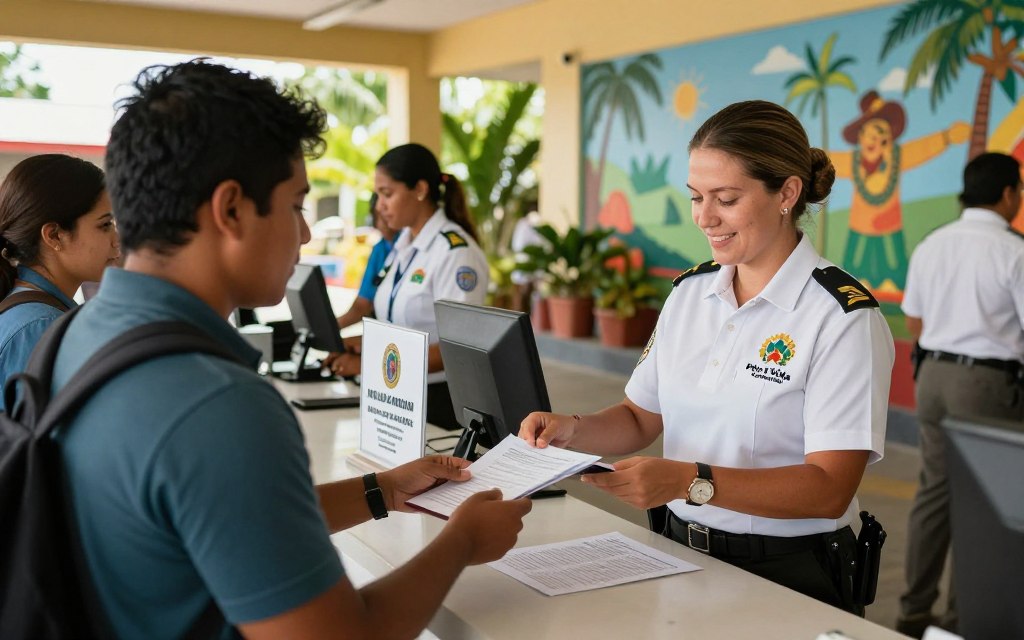
Landing in Costa Rica, whether at San José (SJO) or Guanacaste (LIR) airport, brings a standard procedure. You’ll first clear immigration with your passport, then collect your bags, and finally pass through customs.
This guide answers the common question of what-documents-will-i-need-to-show-customs-when-i-arrive-in-costa-rica. More importantly, we clarify a critical distinction.
The requirements for a tourist visit are simple. However, the documentation needed to apply for legal residency is an entirely different matter.
For those exploring the Pensionado, Rentista, or Inversionista programs, preparation must start in your home country. Apostilles, translations, and authentication can take weeks.
We provide a realistic roadmap. This information sets the foundation for working with Costa Rica’s residency authority, CRIE, to prevent costly delays.
Understanding Costa Rica’s Immigration and Residency Process (CRIE)
The path to residency in Costa Rica begins long before you encounter an immigration officer at the airport. Your first point of contact for any formal residency application is CRIE (crie.cr), the Costa Rican immigration and residency authority.
Overview of Entry Requirements
When you land as a tourist, you clear two separate checkpoints. Immigration officers verify your passport and legal status to enter the country. They grant a tourist visa, often for up to 180 days.
After collecting your bags, you proceed to customs. Here, officers scan your luggage. They focus on the items you are bringing into Costa Rica.
Key Differences Between Customs and Immigration
It’s crucial to understand this distinction. Immigration manages people and entry status. Customs manages goods and luggage.
The tourist visa stamp is not a residency permit. Achieving legal residency under categories like Pensionado (Pensionado) or Rentista (Rentista) requires a separate, formal application to CRIE. This process demands authenticated documents prepared months in advance from your home country.
We guide you through this preparation to meet CRIE’s specific requirements, ensuring a smooth transition from tourist to resident.
Who Qualifies for Residency: Pensionado (Pensionado), Rentista (Rentista), and Inversionista
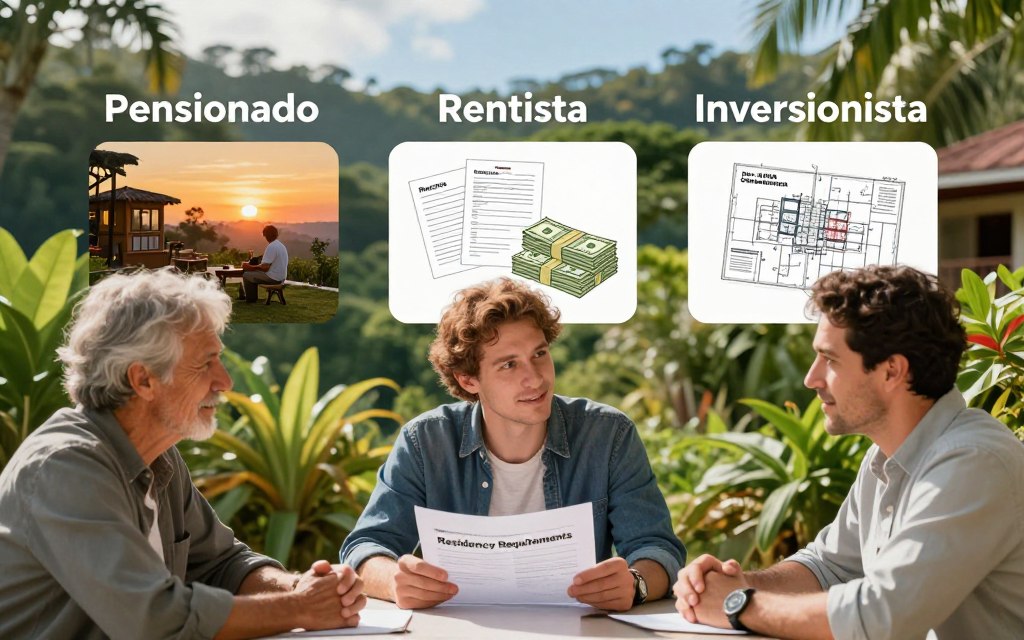
Your journey from tourist to resident hinges on correctly identifying which of CRIE’s main categories you qualify for. We outline the three primary pathways, each with specific financial thresholds you must prove.
Eligibility Criteria for Pensionado (Pensionado)
The Pensionado category is designed for retirees. It requires proof of a permanent pension of at least US$1,000 per month.
This income must come from a government or qualifying private institution. Social Security or a lifetime annuity typically meets this requirement.
Requirements for Rentista (Rentista) and Investor (Inversionista)
The Rentista category suits those with stable income. You must demonstrate a guaranteed monthly income of US$2,500 for a minimum of two years.
The Inversionista (Investor) path requires a minimum investment of US$150,000 in the country. A critical rule: any property purchased must be in the applicant’s personal name, not a corporation.
This is a common pitfall that can disqualify an application.
A key distinction must be made. The Digital Nomad visa allows an extended stay but is not a residency form.
It does not count toward permanent residency or citizenship. For remote workers seeking actual residency, the Rentista category is often the closest fit if you can show the required proof of income.
Choosing the right category is the essential first step before document preparation begins.
Step-by-Step Document Preparation Before Arrival
Proper document preparation is a meticulous process that must be initiated from your home country. We guide you through the essential steps to avoid costly delays.
Gathering Essential Documents and Translations
Start by collecting your core forms. These include birth certificates, police clearances, and financial proofs for your chosen residency category.
Each document must be recent, typically issued within the past six months. After gathering them, you need official Spanish translations.
Only translations by certified professionals recognized by Costa Rican authorities are accepted.
Obtaining Apostilles and Notarizations
The apostille process authenticates your documents in your home country. In the United States, this is done through your Secretary of State’s office.
This certification confirms your documents are genuine under the Hague Convention. Both apostilling and translation take a significant amount of time.
Realistic timelines range from two to four months. Always verify the latest requirements at migracion.go.cr, as rules can change.
Making sure everything is complete before your entry day is crucial. Incomplete paperwork will halt your formal application with Costa Rica’s immigration authority.
Ensuring Your Customs Documents Are in Order: what-documents-will-i-need-to-show-customs-when-i-arrive-in-costa-rica
The question of what to show upon landing has a dual answer, separating entry permission from goods declaration. You will present papers to two different authorities.
Required Passport and Travel Itinerary
At the immigration counter, officers check three key items. Your passport must be valid for your entire intended stay.
You must also show proof of onward travel—a return flight or ticket exiting Costa Rica within 180 days. An electronic confirmation on your phone is acceptable.
Officers have tightened enforcement. Without this proof, your permitted stay may be reduced to 90 days or less.
Finally, have your first night’s accommodation details ready, like a hotel or Airbnb address. The officer will stamp your passport with your tourist visa duration.
Verify this stamp is clear. It serves as your legal driving authorization if you rent a car.
Customs vs. Immigration Documentation Explained
After clearing immigration and collecting bags, you proceed to customs. This checkpoint has a different focus.
Customs officers screen your luggage for what you are bringing into the country. They are not reviewing your entry status.
They look for prohibited agricultural items, large amounts of cash over US$10,000, or commercial goods. Your passport and return ticket are not their primary concern here.
For future residents, your separately prepared CRIE residency file is not part of this airport process. Always verify the latest entry rules at migracion.go.cr.
Key Requirements and Documentation Details for Costa Rica Entry
We break down the essential paperwork into a clear checklist for both airport arrival and future residency filing. Understanding which documents serve which purpose prevents confusion at critical moments.
Checklist of Critical Documents
For a smooth entry into Costa Rica, have these items ready. You need a valid passport for your entire stay and proof of exit within 180 days, like a return ticket.
Also, keep your first night’s accommodation information handy. A yellow fever certificate is only required if you’re arriving from specific countries listed in official travel advisories.
If carrying $10,000 or more in cash or securities, you must declare it. Use the customs declaration form in the baggage area to avoid penalties.
For your residency application with CRIE, prepare different documents. These include apostilled birth certificates, police checks, and certified Spanish translations.
Financial proof for your chosen visa category is also mandatory. For specific eligibility questions, consulting resources like CRIE is wise.
A critical rule for Inversionista applicants: property must be in your personal name, not a corporation. This technicality often disqualifies applications.
We recommend creating a physical checklist. Systematically checking off each item as you complete apostilles and translations prevents costly, months-long delays.
Setting Your Timeline and Understanding Processing Periods
Understanding processing periods separates a smooth transition from a stressful ordeal. Your airport arrival time can vary—San José (SJO) may take 45 minutes to over three hours, while Liberia (LIR) is often 30 to 90 minutes. Yet, the real time investment is in your document preparation, which operates on a scale of months.
When to Start Preparing Your Documents
We strongly advise initiating your residency paperwork at least four months before your intended travel date to Costa Rica. This buffer is crucial. It accommodates unexpected delays in your home country and allows for error correction.
Peak season arrivals from December to April see the longest airport queues. For a faster entry, aim for flights before 10 AM or after 6 PM. Your initial tourist trip and your residency application run on separate timelines.
Understanding Timelines for Apostilles and Translations
The apostille authentication process typically requires two to four weeks, depending on your state. After that, certified Spanish translation adds another one to three weeks to your schedule.
Realistically, gathering originals, obtaining apostilles, and securing translations takes a minimum of two months. More often, it spans three to four months of preparation time.
This duration does not include CRIE’s own processing once you submit. Residency processing times vary, with no guaranteed speed. You may want to verify current estimates at migracion.go.cr before finalizing your plans.
Mistakes to Avoid When Prepping Your Documents
Preparing your documents correctly means not just gathering them, but also sidestepping well-known traps. We identify the most common and costly errors that delay applications.
Common Errors and How to Prevent Them
A critical rule for Inversionista applicants involves property ownership. The investment must be in your personal name, not a corporate entity. Discovering this after a purchase forces a costly restructuring.
Document expiration is another frequent pitfall. Police checks and financial statements are typically only valid for six months. Obtaining them too early means you’ll need new copies and apostilles later.
Translation errors also cause major setbacks. Only use certified translators recognized by Costa Rican authorities. Online services or non-certified work will be rejected by immigration, adding weeks to your timeline.
Many underestimate the apostille process. Some states require county certification before state authentication. This two-step procedure can double your preparation time if not planned for.
For entry, your passport must be valid for your entire intended stay. Check its expiration date months before your flight. Also, have proof of exit within 180 days ready for the immigration officer.
At customs, be mindful of prohibited food items and declare any cash over $10,000. Packing new items with tags may raise questions about commercial import.
We recommend creating a detailed tracking spreadsheet for each document. Systematically log issue dates, apostille status, and translations. This prevents the frustration of a nearly complete file failing due to one expired form.
Always verify the latest requirements at migracion.go.cr, as rules can change. Learning from others’ mistakes saves you significant time and money in your Costa Rica journey.
Digital Nomad Versus Residency Options in Costa Rica
A common point of confusion for many remote workers involves the legal status of Costa Rica’s Digital Nomad program. We must clarify a critical distinction between temporary authorization and formal residency pathways.
Why Digital Nomad Status Does Not Qualify for Residency
The Digital Nomad visa is an extended temporary stay permit. It allows remote professionals to live and work in the country longer than a standard tourist entry, which is now up to 180 days.
This status is not a residency category. Time spent in Costa Rica under this visa does not count toward permanent residency or citizenship eligibility. Many travelers mistakenly believe repeated stays will transition into legal residency—this does not happen automatically.
For remote workers seeking actual residency, the Rentista category is typically the closest fit. It requires proof of a guaranteed monthly income. Contacting Costa Rican authorities directly for personalized travel and immigration guidance is always wise.
Navigating Airport Procedures: Customs and Immigration Tips
The moment you deplane, a well-defined procedure guides you from the gate to the arrival hall. We provide practical tips to move through San José (SJO) or Liberia (LIR) airport efficiently.
What to Expect When You Arrive
Follow signs to “Migración.” Use the air-conditioned bathrooms here before joining the lines. At the desk, the immigration officer will scan your passport.
Have your return flight and hotel details ready on your phone. The officer will stamp your passport with your permitted stay. Verify this stamp is clear before you leave.
Proceed to baggage claim and collect all luggage. Then, every bag goes through the customs X-ray scanner. A green light means you can exit to the arrivals area.
Additional Reminders for a Smooth Process
Bring your own pen, as desk pens rarely work. Screenshot your travel documents for offline access. Exchange only $20-$40 at the airport, as rates are poor.
Peak arrival times at SJO are December to April, especially Friday to Monday between 11 AM and 2 PM. Expect longer lines during these periods. For shorter waits, aim for flights before 10 AM or after 6 PM.
Final Steps for a Smooth Entry into Costa Rica
We conclude by reinforcing the core distinction between a tourist visit and a residency application. Smooth entry hinges on a simple checklist: passport, return ticket, and lodging info.
Legal residency demands advanced preparation. Begin gathering apostilled documents and Spanish translations months before your trip.
Upon arrival, check your passport stamp in baggage claim. Ensure it clearly shows your permitted stay. Declare cash over $10,000 and avoid prohibited items.
Remember, residency processing with CRIE is separate and takes additional time. Verify all rules at migracion.go.cr. For expert assistance, contact CRIE at info@crie.cr or WhatsApp +506 8706 3888.
FAQ
What are the most important documents I need to show when I land in Costa Rica?
How long does my passport need to be valid to enter the country?
What exactly is proof of onward travel, and how can I show it?
What’s the difference between Immigration and Customs at the airport?
Do I need to fill out any forms on the plane or at the airport?
Should I carry cash when I arrive?
What common mistakes do travelers make with their entry documents?
Article by Glenn Tellier (Founder of CRIE and Grupo Gap)
Don't wait, contact us right now!
Call or WhatsApp Costa Rica +506 8373 2085 or +506 8706 3888
Call USA/Canada +1 305-906-6784