
We understand the pressing question for many individuals. You need a clear answer about entering this country with a past felony conviction.
The reality is more nuanced than a simple yes or no. Tourist entry and applying for legal residency are two very different processes within Costa Rica’s immigration system, known as CRIE.
For short-term travel, most U.S. citizens are not subject to routine criminal background checks at passport control. The rules for residency, however, involve a completely different level of official scrutiny.
This guide provides candid information. We will walk you through what CRIE actually requires for people in your circumstances.
Our approach is transparent. We offer realistic guidance so you can make informed decisions based on facts, not assumptions.
Overview of Costa Rica Immigration and Residency (CRIE)

CRIE represents the dedicated system for foreign nationals seeking long-term status in Costa Rica. It is the formal framework for obtaining legal residency, not for tourist visits.
Understanding CRIE’s Role in the Process
This system is the official pathway governed by Costa Rican immigration law. It is administered by the Dirección General de Migración y Extranjería, which you can verify at migracion.go.cr.
The process has become more rigorous since 2001. It requires substantial preparation and accurate information from the start.
One critical point we need to clarify immediately is about Digital Nomad status. This popular option is not a residency category. It does not count toward permanent residency or citizenship.
Key Considerations for Applicants
Key considerations include understanding which residency category you qualify for under the law. You must also know what your criminal background check will reveal.
The process requires working between your home country and Costa Rican authorities. Advance preparation from home is absolutely essential to manage your time effectively.
We guide you through CRIE’s requirements with honest information. We help set realistic expectations about eligibility and the documented legal pathway.
Step-by-Step Guidance for CRIE Residency Requirements
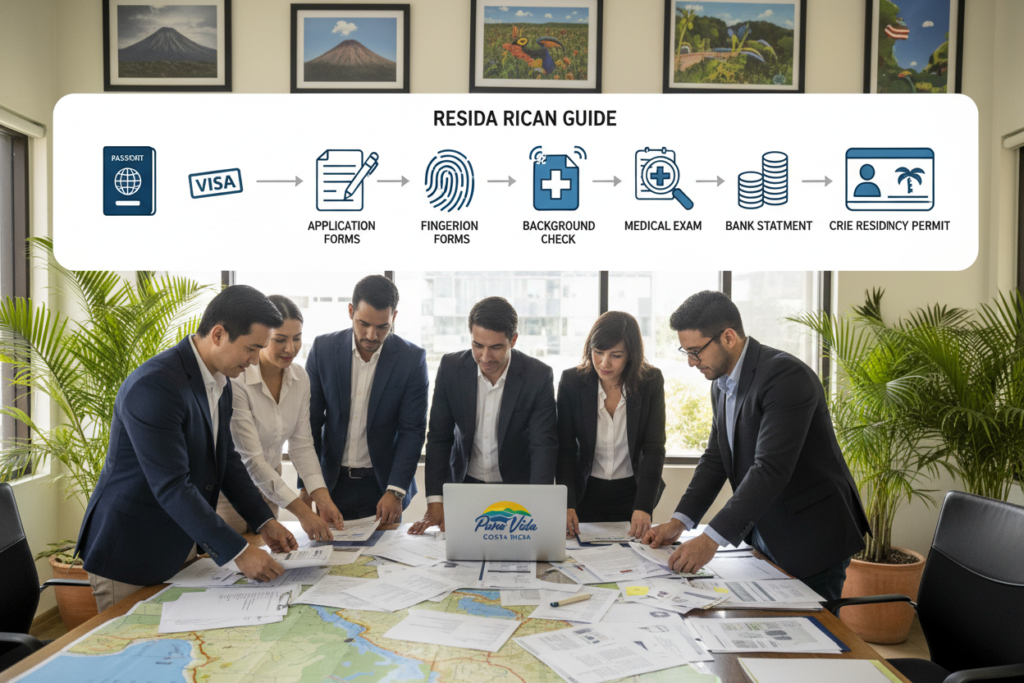
The journey toward Costa Rican residency begins with identifying which specific visa category aligns with your circumstances. This process is defined by immigration law and requires careful planning from the start.
Who Qualifies for Residency?
Not everyone qualifies for every pathway. The three primary categories are Pensionado (Pensionado), Rentista (Rentista), and Inversionista (Inversionista).
Qualification depends on meeting strict financial thresholds. These are legal requirements, not suggestions. CRIE administrators will verify all documentation thoroughly.
Required Documents: Apostilles and Translations
Every document must be apostilled for international use. This is an official certification from your home country’s authority.
Documents not in Spanish need a certified translation. You will submit both the apostilled original and the translation. Critical papers include a police background check, birth certificate, and a valid passport.
For felons, the background check reveals this information. If you are on probation, you may need to wait until completion. Starting this paperwork from home saves significant time. For more details, explore our topics of interest.
Understanding Residency Thresholds: Pensionado, Rentista, and Inversionista
Your financial situation dictates which of the three main residency categories—Pensionado, Rentista, or Inversionista—you can realistically pursue. Each has strict, non-negotiable financial thresholds set by Costa Rican immigration law.
Pensionado Criteria (US$1,000+/Month Pension)
The Pensionado (Pensionado) category requires proof of a guaranteed lifetime pension of at least US$1,000 per month. Acceptable sources include Social Security, military, or government pensions.
The income must be permanent and verifiable. We cannot use temporary payments or one-time distributions.
Rentista and Inversionista Guidelines
The Rentista (Rentista) path demands proof of US$2,500 in monthly income for a minimum of two years. You must show this income is secured for the full period.
The Inversionista (Inversionista) category requires a minimum investment of US$150,000 in Costa Rica. Here, a critical legal requirement applies.
The property or business must be registered in your personal name, not a corporation. This rule is specific to the residency application process.
The answer depends on your documentable finances. If you are on probation, transferring assets can be complex.
Time is a factor. You must demonstrate funds were obtained legally, especially if you completed probation in recent years.
Timelines and Key Milestones in the Application Process
The application process for Costa Rican residency unfolds across several distinct phases, each with its own duration. We provide realistic estimates to help you plan.
These time frames are based on typical cases. They are not guarantees, as government workloads vary.
Expected Processing Times and Milestones
First, gathering and legalizing your documents often takes two to four months. This includes background checks, apostilles, and translations.
After submission, CRIE review can take three to six months or more. Incomplete paperwork is the top cause for delays.
Key milestones include application submission, background verification, and final approval for your cédula.
A common question is, “Can I speed this up?” The honest answer is no. Complete documents prevent slowdowns, but the legal process cannot be rushed.
For applicants with a past record, evaluation may add time. CRIE will review the offense and the years since your sentence ended.
Always check migracion.go.cr for the most current official processing times before making firm plans.
Common Mistakes to Avoid During Your Application
Accuracy and completeness are not merely suggestions for your residency file. They are absolute requirements enforced by immigration authorities. Even small errors can lead to significant delays or a denied application.
Incomplete Documentation and Misinterpretations
Incomplete documentation is the top cause for rejection. Submitting documents without proper apostilles, using non-certified translations, or providing expired police checks creates serious trouble. Financial statements must clearly prove you meet the required monthly thresholds.
A frequent misinterpretation involves tourist entry versus residency. Entering the country without questions about your background does not mean the residency application will be lenient. This is a critical issue. Withholding information about a past conviction is ineffective and guarantees denial.
Questions about legal help and timing often arise. The answer is that professional guidance is valuable given the complexity. Starting the process before probation ends or documents are ready wastes time and money. Our answer for avoiding these mistakes is straightforward: be honest, prepare thoroughly, and verify every document meets CRIE’s exact specifications before submitting.
Preparing Your Application from Home: Essential Tips
The most successful residency applications begin long before you set foot in Costa Rica. We cannot overstate the value of starting your document preparation from home. This approach saves significant time and money while increasing your chances of approval.
Organizing Your Paperwork Before Arrival
Begin by creating a detailed checklist. Include every required item for your chosen residency category. Your passport must have at least six months of validity remaining. Renew it early if needed, as processing times can vary.
Obtaining police background checks and criminal records is a key step. You must request these from law enforcement agencies in each relevant jurisdiction. Each office has its own processing schedule and fees.
The apostille process follows. Submit documents to your state’s Secretary of State office for official certification. Budget several weeks for this step. Certified translations are then required by Costa Rican law.
Use a translator recognized by immigration authorities. Keep the apostilled original and the Spanish version together. Organize both physical and digital copies in a logical order.
This upfront investment of time pays off. Travelers who arrive with complete paperwork navigate the process much faster. Always verify the latest information and formats on the official migracion.go.cr website, as immigration law can change.
Visiting Costa Rica with a White Collar Felony Conviction: What Are the Odds?
The likelihood of visiting or moving to Costa Rica with a criminal record hinges on whether you seek tourism or residency. These are two separate legal pathways with different rules.
For tourist entry, the odds are generally favorable. United States citizens enjoy visa-free travel for vacations. Passport control does not routinely ask about criminal history.
Applying for legal residency is a different matter. The CRIE system requires comprehensive background checks. Your felony conviction will be part of this official review.
Several factors influence the evaluation. Officials consider the nature of the crime and the time since you completed probation. Your conduct after the conviction also matters.
There are no absolute guarantees. Each case receives individual scrutiny based on the full circumstances. If your probation ended long ago and your record is clean, your chances are reasonable. For a detailed exploration, learn more about can a felon visit or move to Costa.
How Residency Leads to Future Opportunities (Not Citizenship Yet)
Achieving residency status through CRIE is not the final destination but a crucial gateway to future possibilities. We need to be clear from the start: legal residency and Costa Rican citizenship are two entirely separate statuses under the law.
Understanding the Path from Residency to Citizenship
Residency is the mandatory first step. The answer to when citizenship becomes possible is measured in years, not months. Costa Rican immigration law typically requires seven to ten years of maintained legal residency before eligibility.
Your focus now should be securing and keeping your residency. For individuals who have completed probation, this period of law-abiding residence is valuable. It demonstrates rehabilitation over time.
Residency itself provides substantial rights to live, work, and establish your life. Citizenship is a long-term goal that follows much later. The pathway involves additional language and knowledge tests.
We set realistic expectations. Navigating the CRIE process successfully opens the door to your new life. The future answer regarding citizenship depends on your commitment during these coming years.
Final Thoughts and Next Steps for Your Costa Rica Journey
Your path to Costa Rica residency, even with a past conviction, requires careful planning. The answer to your central question lies in honest assessment and preparation.
Our final answer is that people with records can build a new life here. For those on vacation, it’s a good first step to see if this destination fits your vision for the coming years.
Felons face scrutiny, but the way forward is clear with proper steps. We offer guidance via WhatsApp +506 8706 3888 or info@crie.cr. For broader insights, consider traveling internationally with a record.
Verify current requirements at migracion.go.cr. Your journey to a fresh start is possible with the right preparation.
FAQ
What is the role of Costa Rica’s immigration authority (CRIE) in the residency process?
Who qualifies to apply for residency in Costa Rica?
Why are apostilles and official translations so critical for my documents?
What are the minimum income requirements for Pensionado and Rentista residency?
FAQ
What is the role of Costa Rica’s immigration authority (CRIE) in the residency process?
The Dirección General de Migración y Extranjería (DGME), often called CRIE, is the sole government body that reviews and approves all residency applications. We see them as the ultimate gatekeeper. They assess your financial stability, background, and documentation to ensure you meet the legal requirements for living in the country long-term.
Who qualifies to apply for residency in Costa Rica?
Qualification is primarily based on proving a stable, permanent income from abroad. The main categories are Pensionado (for retirees with a lifetime pension), Rentista (for those with guaranteed income), and Inversionista (for investors). Each has specific financial thresholds you must prove to CRIE.
Why are apostilles and official translations so critical for my documents?
Costa Rican law requires that foreign-issued documents be authenticated for international use. An apostille certifies the document’s origin, and an official Spanish translation makes it legally valid for local authorities. We always advise clients that missing this step is the most common reason for application delays or denial.
What are the minimum income requirements for Pensionado and Rentista residency?
For Pensionado residency, you must prove a lifetime pension of at least US
FAQ
What is the role of Costa Rica’s immigration authority (CRIE) in the residency process?
The Dirección General de Migración y Extranjería (DGME), often called CRIE, is the sole government body that reviews and approves all residency applications. We see them as the ultimate gatekeeper. They assess your financial stability, background, and documentation to ensure you meet the legal requirements for living in the country long-term.
Who qualifies to apply for residency in Costa Rica?
Qualification is primarily based on proving a stable, permanent income from abroad. The main categories are Pensionado (for retirees with a lifetime pension), Rentista (for those with guaranteed income), and Inversionista (for investors). Each has specific financial thresholds you must prove to CRIE.
Why are apostilles and official translations so critical for my documents?
Costa Rican law requires that foreign-issued documents be authenticated for international use. An apostille certifies the document’s origin, and an official Spanish translation makes it legally valid for local authorities. We always advise clients that missing this step is the most common reason for application delays or denial.
What are the minimum income requirements for Pensionado and Rentista residency?
For Pensionado residency, you must prove a lifetime pension of at least US$1,000 per month. For Rentista residency, you must demonstrate a guaranteed income of US$2,500 per month for at least two years. These are non-negotiable minimums set by immigration law and must be documented with bank statements and letters.
How long does the residency application process typically take?
You should plan for a timeline of 6 to 12 months from submission to approval. Key milestones include initial filing, document review, a possible interview, and final resolution. Processing times can vary based on CRIE’s caseload and the completeness of your file.
What is the biggest mistake people make when applying?
The most frequent and costly error is submitting incomplete or incorrectly prepared documentation. This includes documents without apostilles, using non-certified translations, or providing outdated financial statements. We help clients avoid this by meticulously organizing and pre-verifying every page before submission.
Can I start preparing my residency application before moving to Costa Rica?
Absolutely, and we strongly recommend it. You can gather income verification letters, obtain police clearance certificates, and get your documents apostilled and translated from your home country. Having this dossier ready before you travel streamlines the entire process significantly once you arrive.
Will a past white-collar felony conviction prevent me from entering Costa Rica as a tourist?
Not automatically. For short-term tourist visits, entry is at the discretion of the immigration officer at the border. While a serious criminal record can be grounds for denial, many tourists with past convictions enter without issue. The real scrutiny applies during the formal residency application process with CRIE.
Does obtaining residency put me on a path to Costa Rican citizenship?
Residency is the required first step, but it is a separate legal status. You must maintain your residency for several years (typically seven) before you are even eligible to apply for citizenship through naturalization. We guide clients through maintaining their resident status properly to keep that future option open.
What should be my immediate next step if I’m considering this move?
Your first action should be to gather your core financial documents—pension letters, bank statements, and a clean criminal background report from your home country. Review them against the official requirements. This reality check will give you the clearest picture of your eligibility and the work ahead.
,000 per month. For Rentista residency, you must demonstrate a guaranteed income of US,500 per month for at least two years. These are non-negotiable minimums set by immigration law and must be documented with bank statements and letters.
How long does the residency application process typically take?
You should plan for a timeline of 6 to 12 months from submission to approval. Key milestones include initial filing, document review, a possible interview, and final resolution. Processing times can vary based on CRIE’s caseload and the completeness of your file.
What is the biggest mistake people make when applying?
The most frequent and costly error is submitting incomplete or incorrectly prepared documentation. This includes documents without apostilles, using non-certified translations, or providing outdated financial statements. We help clients avoid this by meticulously organizing and pre-verifying every page before submission.
Can I start preparing my residency application before moving to Costa Rica?
Absolutely, and we strongly recommend it. You can gather income verification letters, obtain police clearance certificates, and get your documents apostilled and translated from your home country. Having this dossier ready before you travel streamlines the entire process significantly once you arrive.
Will a past white-collar felony conviction prevent me from entering Costa Rica as a tourist?
Not automatically. For short-term tourist visits, entry is at the discretion of the immigration officer at the border. While a serious criminal record can be grounds for denial, many tourists with past convictions enter without issue. The real scrutiny applies during the formal residency application process with CRIE.
Does obtaining residency put me on a path to Costa Rican citizenship?
Residency is the required first step, but it is a separate legal status. You must maintain your residency for several years (typically seven) before you are even eligible to apply for citizenship through naturalization. We guide clients through maintaining their resident status properly to keep that future option open.
What should be my immediate next step if I’m considering this move?
Your first action should be to gather your core financial documents—pension letters, bank statements, and a clean criminal background report from your home country. Review them against the official requirements. This reality check will give you the clearest picture of your eligibility and the work ahead.
How long does the residency application process typically take?
What is the biggest mistake people make when applying?
Can I start preparing my residency application before moving to Costa Rica?
Will a past white-collar felony conviction prevent me from entering Costa Rica as a tourist?
Does obtaining residency put me on a path to Costa Rican citizenship?
What should be my immediate next step if I’m considering this move?
Article by Glenn Tellier (Founder of CRIE and Grupo Gap)
Don't wait, contact us right now!
Call or WhatsApp Costa Rica +506 8373 2085 or +506 8706 3888
Call USA/Canada +1 305-906-6784