
Navigating the path to legal residency in Costa Rica requires clear, step-by-step guidance. We at CRIE (crie.cr) specialize exclusively in this journey—focusing on residency and immigration matters for serious applicants.
This guide provides reality-based information on who qualifies, what requirements you must meet, and which documents need preparation. We’ll use official Spanish category names—like Pensionado (Pensionado) and Rentista (Rentista)—as these are the terms used by Costa Rican law.
Please note: this article contains no pricing, service quotes, or guarantees of approval. It is informational guidance only.
A successful application starts from home. You must gather, authenticate (apostille), and translate all required documents before arriving in Costa Rica. The immigration authority, the Dirección General de Migración y Extranjería, processes all submissions.
Official resources include migracion.go.cr for government guidelines and crie.cr for specialized support. While the procedure can feel complex, proper preparation leads most qualified applicants to success.
Overview of Costa Rica Residency Options

Foreign nationals seeking to live in Costa Rica can choose from three primary residency categories based on their income or investment capacity. We at CRIE (crie.cr) focus exclusively on these pathways.
Exploring CRIE (crie.cr) and Local Immigration Priorities
Our role is to help applicants understand local immigration priorities. The system favors foreign residents who contribute economically without displacing local workers.
Introducing Residency Categories: Pensionado (Pensionado), Rentista (Rentista), Inversionista (Investor)
The Pensionado (Pensionado) category is for retirement. It requires proof of a lifetime pension of at least US$1,000 per month.
The Rentista (Rentista) option suits those with guaranteed passive income. Applicants must show US$2,500 per month for two years from investments or savings.
The Inversionista (Investor) category demands a minimum US$150,000 investment in Costa Rican real estate or business. A critical rule: the property must be in the applicant’s personal name, not a corporation’s.
Official requirements can change. Always verify current information at migracion.go.cr before starting your application.
Step-by-Step Guidance for a Smooth Application
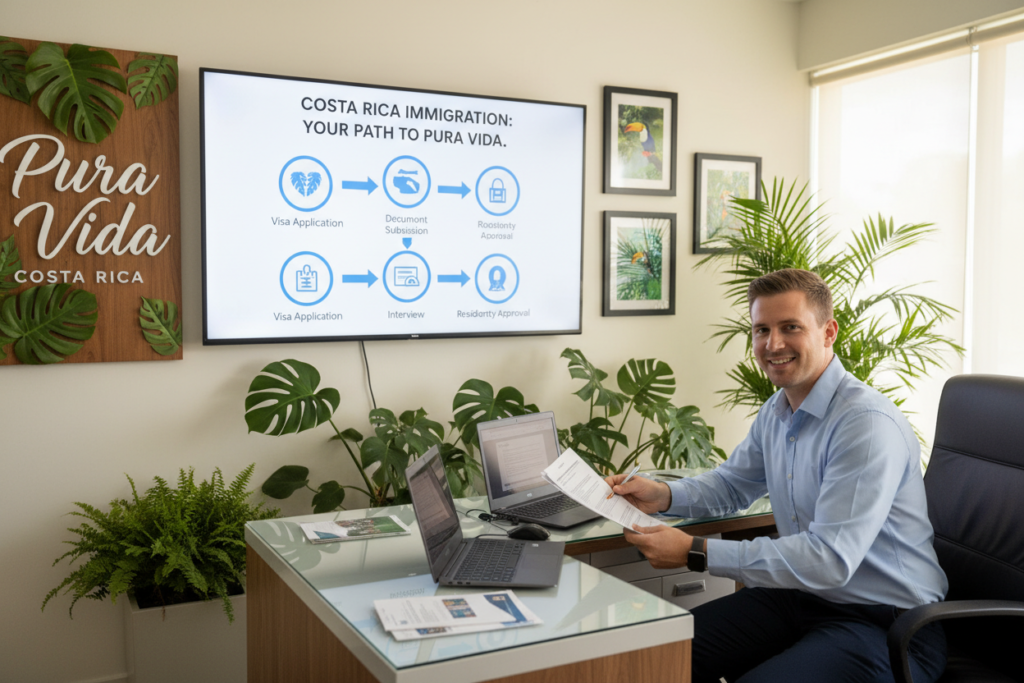
Successful applicants follow a disciplined roadmap, starting with an honest assessment of their financial profile. The first step is choosing the correct residency category. You must match your income or investment to the specific requirements.
Who Qualifies and What to Expect
Pensionado applicants need a lifetime pension of at least $1,000 monthly. Rentista candidates require $2,500 per month in passive income. Inversionista applicants must invest $150,000 in their personal name.
Realistically, the entire procedure takes 3 to 12 months. During this time, you must maintain legal visitor status. Authorities will review your documentation, verify finances, and run background checks.
Mistakes to Avoid During Application
A common error is using an expired police background check. These are typically valid for only six months. Submitting documents without proper apostilles is another major pitfall.
Incorrect translations or missing financial proofs will cause delays. Always start gathering and authenticating all paperwork from your home country. Meeting minimum requirements does not guarantee approval.
We encourage you to verify current rules at migracion.go.cr. Thorough preparation is your best path forward.
Document Preparation: Apostilles and Translations
Properly preparing your documentation—including apostilles and translations—is the non-negotiable first step toward approval. This work must start at home, before you travel. Incomplete paperwork is a primary cause of costly delays.
Essential Documents to Prep at Home
Applicants must gather several key items. These include a valid passport, birth certificate, and a police background check. For U.S. citizens, this is an FBI report. You’ll also need a marriage certificate if applicable and proof of income.
Remember, background checks are typically valid for only six months. Time your application submission carefully. Always verify the latest official requirements at migracion.go.cr.
Ensuring Apostilles and Accurate Spanish Translations
All foreign documents require an apostille. This authentication is done by the U.S. Department of State or your state’s Secretary of State. It confirms the document’s legitimacy for international use.
After apostille, you need accurate Spanish translations. Only a translator officially recognized in Costa Rica (a traductor oficial) can perform this work. Their translations must match the apostilled document exactly, including all names and details.
We advise budgeting for these steps. Authentication can cost $100-$300. Translations may range from $40 to $500. Getting this right from the start builds a strong application foundation.
The Costa Rica Immigration Application Process Framework
The official framework for obtaining residency in Costa Rica is managed by a single government authority. The Dirección General de Migración y Extranjería (DGME) holds sole power to approve or deny all applications.
After you submit your complete file, the DGME begins a multi-stage review. This includes verifying documents, checking finances, and validating background checks.
Receiving confirmation your case is “en trámite” means review has started. This is not approved residency status. You remain a legal visitor until final approval.
The DIMEX card is your official proof of legal residency. It is issued only after full approval and registration steps are complete.
If you are in Costa Rica during this process, you must maintain valid tourist status. Many applicants coordinate from abroad to avoid timeline pressure.
We at CRIE (crie.cr) provide guidance on this government process. Always cross-reference with official procedures at migracion.go.cr.
Income Thresholds and Financial Proofs for Applicants
Meeting the specific income or investment thresholds is mandatory for each residency category. We help applicants navigate these precise financial requirements set by immigration authorities.
Pensionado (Pensionado) and Rentista (Rentista) Income Requirements
Pensionado applicants must prove a lifetime pension of at least US$1,000 per month. Acceptable proof includes an official letter from a pension administrator, along with recent bank statements.
The Rentista category requires proof of US$2,500 in guaranteed monthly income for two years. A common method is a bank letter confirming $60,000 in a long-term account.
Once approved, Rentista residents must deposit that monthly income into a Costa Rican bank account. For detailed guidance on obtaining a Rentista visa, specialized support is available.
Investor (Inversionista) Investment Guidelines
The Inversionista category demands a minimum US$150,000 investment. This can be in real estate, a business, or approved projects.
A critical rule: if investing in real estate, the property title must be in your personal name. Using a corporation is not permitted for this residency proof.
Investor applicants may also need to show additional passive income. Always verify the latest official requirements for complete accuracy.
Timelines and Processing Stages
A clear timeline helps manage expectations during the multi-phase application procedure. We set realistic expectations for the duration from submission to final approval.
Expected Duration from Application to Approval
From the date you submit a complete file, expect a processing time of 3 to 12 months. This wide range reflects variables like application category and government workload.
Processing speed is not guaranteed. It varies based on factors beyond your control. Thorough preparation is your best strategy for a smooth process.
Transitioning from Temporary to Permanent Residency
Most approved applicants first receive temporary residency. This status is valid for two years and requires renewal.
After maintaining this status for three consecutive years, you become eligible for permanent residency. This offers more stable, long-term status in Costa Rica.
Citizenship becomes a possibility after 7 years of legal residency. This is reduced to 5 years if married to a Costa Rican citizen.
Pursuing citizenship requires additional steps like a Spanish test. For most, the immediate focus should be securing residency first.
Common Pitfalls in the Immigration Process
Many applicants face avoidable delays by overlooking critical details in their Costa Rica residency paperwork. We identify the most frequent errors to help you submit a stronger application.
Document Authentication and Coordination Errors
A common mistake is submitting documents without proper apostilles. For example, a federal FBI check requires a federal apostille, not a state one. Assuming a notarization is enough will cause rejection by Costa Rican authorities.
Coordination is also key. Gather all required documentation as a complete package. Submitting pieces separately risks expiration and mismatches.
Timing and Translation Missteps
Background checks are typically valid for only six months. Obtain them close to your submission date to avoid expiration during review.
Translations must match the apostilled original exactly. Even small discrepancies can trigger delays. Use a Costa Rican authorized translator to meet all requirements.
Special Considerations for Digital Nomads
Remote workers exploring Costa Rica must understand a critical distinction. The Digital Nomad visa is not a residency pathway. This temporary authorization allows legal remote work for foreign employers or clients.
Why the Digital Nomad Visa Is Not a Residency Option
The Digital Nomad visa requires proof of $3,000 in monthly remote income. For family groups, this rises to $4,000 per month. It includes mandatory health insurance and permits a 12-month stay.
This stay is extendable once for a total of 24 months. However, this status does not grant residency rights. It also does not count toward the seven-year timeline required for citizenship.
When your authorization expires, you must leave or revert to standard tourist status. For remote workers seeking actual residency, the closest option is typically the Rentista category.
This requires demonstrating $2,500 per month in guaranteed passive income for two years. A key complication arises here. Rentista requires unearned income from investments or rentals.
Salary from remote employment does not qualify. Many digital nomads with active work income cannot meet this requirement. If you want a path to permanent residency or citizenship, evaluate the Pensionado or Inversionista categories.
The Digital Nomad visa serves as a temporary lifestyle permit. For comprehensive details, explore our guide to the Digital Nomad visa in Costa Rica.
Essential Resources: CRIE and Migracion.go.cr Guidelines
Two key resources form the backbone of a well-prepared residency application: expert guidance and official government data. We emphasize using both for a complete and accurate foundation.
Utilizing Official Information and Legal Support
CRIE (crie.cr) specializes exclusively in Costa Rica residency and immigration guidance. We provide step-by-step support, current threshold information, and help you avoid common pitfalls. This focused expertise interprets the complex system for you.
The official website migracion.go.cr is the source for government regulations and forms. It provides authoritative information directly from the Dirección General de Migración y Extranjería. Always verify details like fee schedules and application versions here.
Cross-reference our practical guidance with these official Costa Rican sources. This combination ensures your application meets today’s requirements. For specialized questions, contact us via WhatsApp at +506 8706 3888 or email info@crie.cr.
Final Steps: Embrace Your Future in Costa Rica
Embracing your future as a legal resident begins by turning knowledge into practical steps. We encourage you to assess your finances honestly against the Pensionado, Rentista, or Inversionista requirements. Your new chapter starts with document preparation at home.
Legal residency status provides stability in Costa Rica. It grants access to quality healthcare and a lower cost of living. Many American couples enjoy a comfortable life here on $2,000 to $3,000 per month.
This country offers diverse lifestyle options from beach towns to mountain communities. After three years of temporary residency, you become eligible for permanent status. For personalized guidance on your journey, contact us via WhatsApp at +506 8706 3888 or email info@crie.cr.
FAQ
What are the main types of residency available in Costa Rica?
The primary pathways are Pensionado, Rentista, and Inversionista (Investor). The Pensionado visa is for retirees with a guaranteed lifetime pension. The Rentista visa is for those with stable passive income. The Investor option requires a significant capital investment in the country, such as in real estate or a business.
How much monthly income do I need to prove for the Pensionado and Rentista visas?
For the Pensionado visa, you must prove a minimum monthly income of
FAQ
What are the main types of residency available in Costa Rica?
The primary pathways are Pensionado, Rentista, and Inversionista (Investor). The Pensionado visa is for retirees with a guaranteed lifetime pension. The Rentista visa is for those with stable passive income. The Investor option requires a significant capital investment in the country, such as in real estate or a business.
How much monthly income do I need to prove for the Pensionado and Rentista visas?
For the Pensionado visa, you must prove a minimum monthly income of $1,000 from a permanent pension or retirement fund. For the Rentista visa, you need to demonstrate a guaranteed monthly income of $2,500 for at least two years, often secured through a deposit in a Costa Rican bank.
What is the first step I should take in the application process?
Your first step is always to gather and authenticate your core documents from your home country. This includes obtaining police clearance, birth certificates, and marriage documents with an apostille and having them translated into Spanish by an official translator. Starting this early prevents major delays.
How long does it typically take to get temporary residency approved?
You should plan for the entire process to take between 6 to 12 months from submission to approval. This timeline accounts for government processing, potential requests for additional documentation, and the current caseload at the immigration department. Patience and precise paperwork are key.
What is the biggest mistake applicants make with their documents?
The most common and costly error is submitting documents without the proper apostille or with an unofficial translation. Costa Rican authorities will not accept documents lacking this authentication. We see many applications stalled or rejected simply because this foundational step was rushed or overlooked.
Can the Digital Nomad Visa lead to permanent residency or citizenship?
No, it cannot. The Digital Nomad Visa is a separate, temporary immigration status designed for remote workers. It does not count toward the years required for permanent residency or citizenship. It’s a great tool for an extended stay, but it is not a stepping stone to long-term legal status.
When can I apply for permanent residency or citizenship?
You can apply for permanent residency after maintaining your temporary residency status for three consecutive years. Eligibility for citizenship through naturalization generally requires seven years of legal residency. Both processes require clean records and continued compliance with all visa conditions.
Where can I find the most reliable information and legal support?
A> The official government sources are Migración (migracion.go.cr) and the CRIE (crie.cr) portal. For personalized guidance, especially with complex financial proofs or legal intricacies, consulting with a reputable Costa Rican immigration attorney is highly recommended to navigate the system correctly.
,000 from a permanent pension or retirement fund. For the Rentista visa, you need to demonstrate a guaranteed monthly income of ,500 for at least two years, often secured through a deposit in a Costa Rican bank.
What is the first step I should take in the application process?
Your first step is always to gather and authenticate your core documents from your home country. This includes obtaining police clearance, birth certificates, and marriage documents with an apostille and having them translated into Spanish by an official translator. Starting this early prevents major delays.
How long does it typically take to get temporary residency approved?
You should plan for the entire process to take between 6 to 12 months from submission to approval. This timeline accounts for government processing, potential requests for additional documentation, and the current caseload at the immigration department. Patience and precise paperwork are key.
What is the biggest mistake applicants make with their documents?
The most common and costly error is submitting documents without the proper apostille or with an unofficial translation. Costa Rican authorities will not accept documents lacking this authentication. We see many applications stalled or rejected simply because this foundational step was rushed or overlooked.
Can the Digital Nomad Visa lead to permanent residency or citizenship?
No, it cannot. The Digital Nomad Visa is a separate, temporary immigration status designed for remote workers. It does not count toward the years required for permanent residency or citizenship. It’s a great tool for an extended stay, but it is not a stepping stone to long-term legal status.
When can I apply for permanent residency or citizenship?
You can apply for permanent residency after maintaining your temporary residency status for three consecutive years. Eligibility for citizenship through naturalization generally requires seven years of legal residency. Both processes require clean records and continued compliance with all visa conditions.
Where can I find the most reliable information and legal support?
A> The official government sources are Migración (migracion.go.cr) and the CRIE (crie.cr) portal. For personalized guidance, especially with complex financial proofs or legal intricacies, consulting with a reputable Costa Rican immigration attorney is highly recommended to navigate the system correctly.
Article by Glenn Tellier (Founder of CRIE and Grupo Gap)
Don't wait, contact us right now!
Call or WhatsApp Costa Rica +506 8373 2085 or +506 8706 3888
Call USA/Canada +1 305-906-6784