The kissing bug earns its affectionate name from an unpleasant habit: it feeds on sleeping people, often around the mouth and eyes. In Costa Rica it is chinche picuda or chinche besucona, and it matters because it carries Chagas disease.
The risk is real but narrow, and most of what circulates online about it is wrong — including the part everyone thinks they know about how you actually get infected.
What it is
Kissing bugs are blood-feeding insects of the subfamily Triatominae, part of the assassin bug family. They transmit Trypanosoma cruzi, the protozoan parasite that causes Chagas disease, also called American trypanosomiasis.
In Costa Rica the species that matters is Triatoma dimidiata. It is the one found in and around houses across the Central Valley and much of the country, and it has been documented even in urban parts of Heredia province. Rhodnius pallescens is also present but associates with palms rather than houses.
There is genuinely good news here. Rhodnius prolixus, historically the most dangerous house-dwelling vector in Central America, was certified eliminated as a main vector in Costa Rica by the Pan American Health Organization between 2009 and 2010, along with El Salvador, Honduras, Nicaragua, Guatemala and Mexico. That was a major public health achievement and it substantially changed the picture.
How to recognise one
- Size: roughly 1–3 cm long.
- Head: distinctly cone-shaped — hence the alternative name “conenose bug” — with prominent antennae and a straight segmented proboscis folded under it.
- Body: flattened, pear- or shield-shaped.
- Colour: black or dark brown, and most species carry a band of orange, orange-red or yellow markings around the flattened edge of the abdomen. That banded margin is the giveaway.
Where they live
Outdoors: animal burrows, rodent nests, palm crowns, woodpiles, rock piles, chicken coops, dog kennels, under bark.
Indoors: cracks and crevices in adobe, bahareque and unplastered walls, thatch and palm roofs, behind pictures, in gaps in wooden walls, under mattresses, in cluttered storage, in floor cracks.
Their presence is strongly associated with poor-quality rural housing — cracked walls, dirt floors, thatch roofs — and with domestic animals sleeping close by that provide blood meals. They are nocturnal, hiding by day and emerging at night to feed on sleeping hosts, and they are attracted to lights.

How transmission actually works
This is the part nearly every article gets wrong. The parasite is not injected by the bite.
The bug feeds — a painless bite, often on the face near the mouth or eyes, but also on hands, arms, feet and trunk — and defecates on or near the bite while feeding or immediately after. Infection happens when the sleeping person scratches, rubbing the infected faeces into the wound, or when the faeces reach a mucous membrane such as the eye or mouth.
That single fact changes the practical advice completely. If you find a bug on you, washing rather than scratching is the intervention.
Other transmission routes:
- Congenital — mother to child during pregnancy or birth. This is now the dominant route in many settings.
- Oral — contaminated food or drink, classically unpasteurised sugarcane or fruit juice contaminated with crushed bugs. Oral outbreaks tend to be more acutely severe.
- Blood transfusion and organ transplant — now controlled by donor screening in Costa Rica.
- Laboratory accidents.
Chagas is not spread person to person by casual contact.
What Chagas disease does
Acute phase (roughly the first two months). Most cases are asymptomatic or mild. When symptoms appear: fever, malaise, fatigue, headache, body aches, rash, swollen lymph nodes, enlarged liver or spleen. Two classic signs when present are a chagoma — a hard red swelling at the entry point — and Romaña’s sign, painless one-sided swelling of the eyelids where the parasite entered through the conjunctiva. Rarely, acute heart or brain inflammation, which can be fatal in infants.
Indeterminate phase. Most infected people then enter a decades-long asymptomatic phase and never know they carry it.
Chronic disease. The World Health Organization estimates that up to a third of untreated people eventually develop cardiac complications — cardiomyopathy, arrhythmias, heart failure, sudden cardiac death — and up to one in ten develop digestive complications such as megaoesophagus or megacolon, typically 10 to 30 years after infection.
How common is it in Costa Rica?
Being honest: this is the weakest data point on the page. We could not find a current, authoritative national seroprevalence figure for Costa Rica, and we are not going to invent one.
What is solid: Costa Rica is an endemic country. T. dimidiata is widespread, and a molecular study found 47.3 percent of sampled Costa Rican specimens carried T. cruzi — though that was a small sample from specific localities and should not be read as “half of all kissing bugs in Costa Rica.” Rhodnius prolixus has been eliminated as a main vector. Blood banks screen. Vector transmission is at low and declining levels, and the residual burden is mostly in people infected decades ago plus congenital cases.
For context, the Pan American Health Organization estimates about 6 million infected across the Americas, with roughly 30,000 new cases a year, and notes that fewer than 10 percent of infected people are ever diagnosed.
Reducing the risk in a home
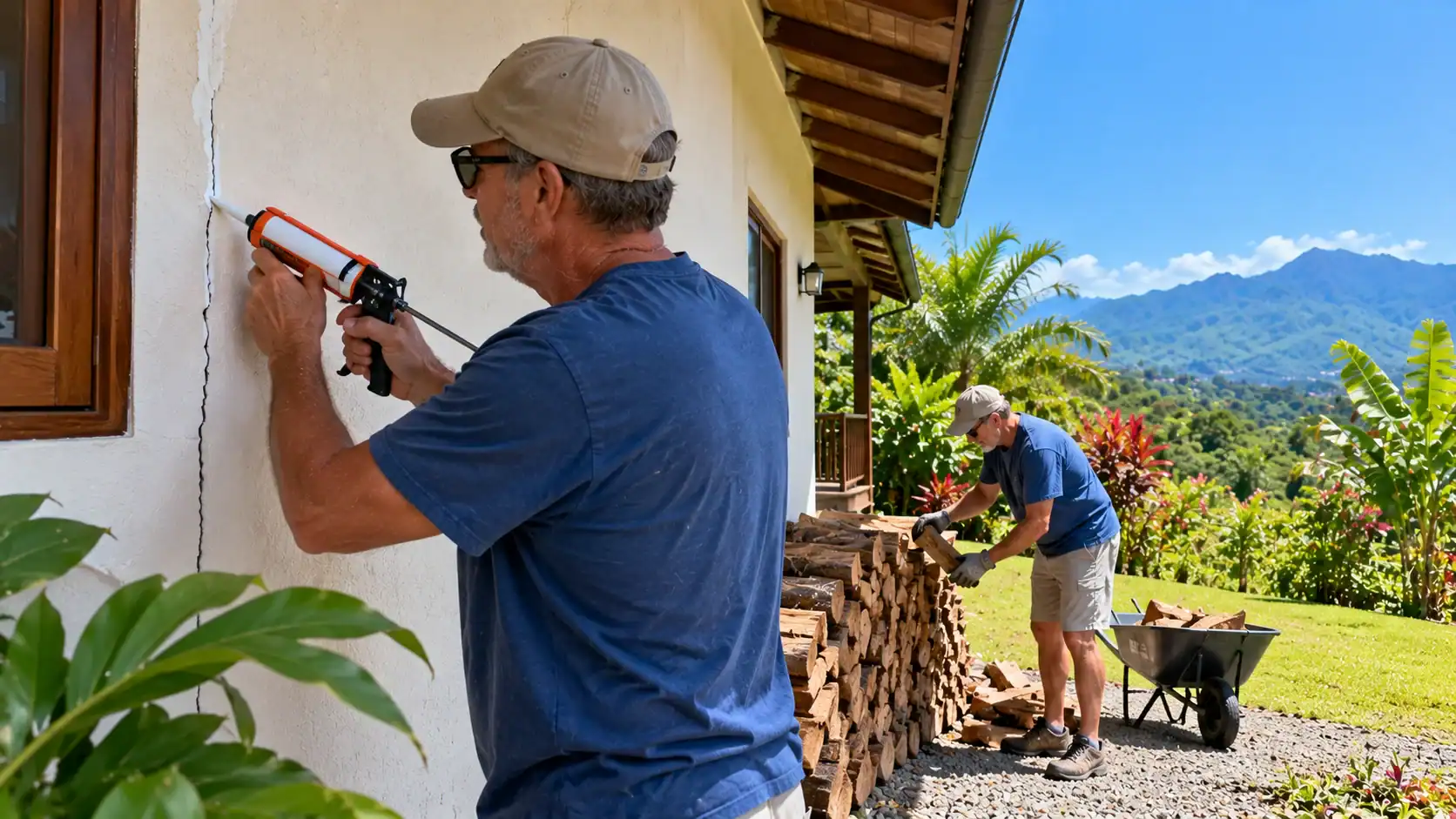
The single most effective measure is structural: plaster and seal wall cracks, replace thatch or palm roofs with metal or tile, and put in concrete floors instead of dirt. Everything else is secondary.
- Seal gaps around windows, doors, eaves and pipe entries.
- Screen windows and doors.
- Clear woodpiles, rubble and rubbish from close to the house — they harbour rodents.
- Move chicken coops, dog kennels and animal pens away from sleeping areas.
- In endemic rural areas, keep dogs and cats out of bedrooms. They are reservoir hosts and they draw bugs.
- Use bed nets if sleeping in a rural adobe or thatch house.
- Turn off outdoor lights near sleeping areas, or switch to yellow bulbs.
- Residual pyrethroid spraying of walls is the standard control method. For an actual infestation, get professional treatment.
- Avoid unpasteurised fresh fruit or sugarcane juice from informal roadside vendors in endemic rural areas.
If you find one, or think you have been bitten
- Do not crush it with bare hands. The gut contents are the infectious material. Capture it in a sealed jar or bag using gloves or a piece of card.
- Wash the bite and your hands thoroughly with soap and water. Do not scratch. Scratching is the actual transmission mechanism.
- If faeces get in your eye, irrigate immediately with clean water.
- Take the specimen to a local health centre or EBAIS. Vector surveillance programmes want it identified and tested.
- Get serological testing. Note that antibodies take weeks to appear, so one immediate test does not rule out infection — follow-up testing is needed.
Treatment is benznidazole or nifurtimox. Both are close to 100 percent curative if given in the acute phase, and effectiveness declines the longer an infection has been present — though treatment can still slow progression in chronic cases. It is standard for all acute and congenital cases and everyone under 18, and increasingly recommended for chronically infected adults up to around 50.
There is no vaccine and no preventive drug.
Should a visitor worry?
No. If you are staying in ordinary hotels, lodges and B&Bs, the risk is very low. This is a disease of substandard rural housing — cracked adobe walls, thatch roofs, animals sleeping alongside people — and the people who bear the burden are those living in it long-term, not travellers.
If you are buying or renting an older rural property in Costa Rica, though, the structural advice above is worth taking seriously as part of any renovation.
Making the move to Costa Rica?
CRIE — Costa Rica Immigration Experts handles residency applications, renewals and citizenship for people relocating here, so you can concentrate on the house rather than the paperwork.
Explore the residency options in Costa Rica, or get in touch.
This article is general information, not medical advice. If you think you may have been exposed, speak to a doctor.
Thinking About Making Costa Rica Home?
Thousands of expats, retirees, and investors have made Costa Rica their permanent home. If you are considering residency, CRIE’s licensed immigration attorneys can walk you through your options — Pensionado, Rentista, Investor, or family-based — and handle every step of the process.