
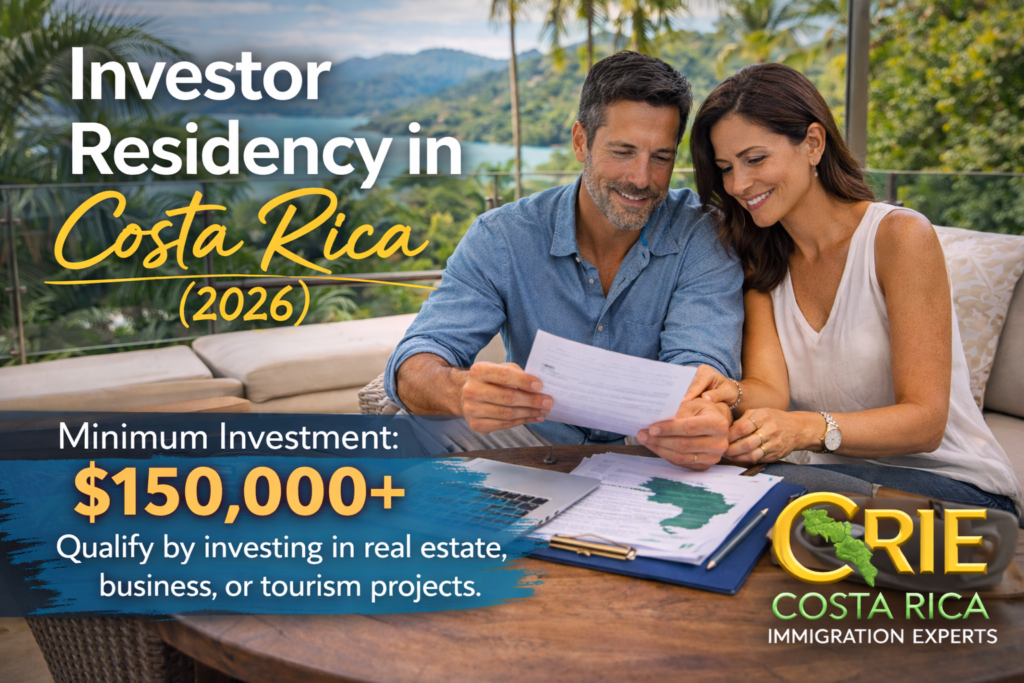
If you want Costa Rica residency through investment, the Investor (Inversionista) category is built for applicants who can document a qualifying investment of at least USD $150,000. It’s a popular option for people who want to establish a long-term base in Costa Rica while keeping their income and business activities primarily abroad.
On this page you’ll learn who qualifies, what documents to prepare before you arrive, what the process typically looks like, and what commonly causes delays. If you want us to confirm whether your investment structure and documentation will be accepted (especially if the asset is held in a company or has complex paperwork), we’ll confirm eligibility on WhatsApp.
Qualification Snapshot
- Minimum investment: USD $150,000 in a qualifying investment
- Best for: applicants who want a residency path connected to a documented investment in Costa Rica
- Common investment types: real estate, business investment, or other qualifying investment formats (documentation rules vary)
- Dependents: spouse + children under 25, and adult children with a disability (with proof)
- Path forward: after 3 consecutive years of temporary residency, many applicants plan their transition to permanent residency
Who This Category Is For
- You can document a qualifying investment of at least USD $150,000.
- You want residency tied to an asset or project in Costa Rica (San José, Escazú, Santa Ana, Heredia, Guanacaste, and other regions).
- You are comfortable proving ownership and investment value using formal Costa Rican documentation.
- You want a structured, compliance-first approach that avoids avoidable delays.
- You want a residency plan that can include eligible family dependents.
- You prefer a path that is built around documentation and structure, not employment.
Not a Fit If…
- Your investment is below USD $150,000 or cannot be documented cleanly.
- Your investment is structured in a way that creates documentation gaps (unclear ownership, missing registration, incomplete corporate records).
- You need to work as an employee in Costa Rica immediately (that is a separate legal strategy).
- You want a “fast filing” without verifying that the asset and ownership structure will actually be accepted under the current standards.
Requirements at a Glance
Investor residency is primarily about proving a qualifying USD $150,000 investment and submitting standard immigration documents correctly. What makes this category different is that “proof of investment” must match the asset type and the ownership structure—especially for real estate or business-related assets.
- Investment proof: documents that clearly demonstrate an investment of at least USD $150,000 in a qualifying format.
- Ownership structure: your name and ownership pathway must be documented correctly (this is where many delays happen).
- Birth certificate: properly authenticated for use in Costa Rica.
- Police clearance: from your country of origin or where you legally lived during the last 3 years, properly authenticated.
- Passport copies: identity page and other required pages prepared in the accepted format.
- Forms, photos, and government fees: required at filing and post-approval stages.
- Dependents (if included): marriage certificate for spouse; birth certificates for children; disability proof where applicable.
Documents to Prepare Before You Arrive
If you prepare documents before traveling, your investor residency process is usually smoother. Most applicants should collect the core civil documents and the investment documentation early, then confirm validity windows and Costa Rica formatting requirements before finalizing anything. If you are already in Costa Rica, we adjust the strategy to fit your current status and what you already have.
- Birth certificate (official certified copy from the issuing authority)
- Police clearance / criminal background certificate (country of origin or legal residence for the last 3 years)
- Passport scan (identity page and other pages we request for the filing package)
- Marriage certificate (if including a spouse)
- Children’s birth certificates (if including dependents)
- Investment documentation specific to your investment type (see below)
Important: foreign documents generally require authentication (apostille or consular legalization, depending on the issuing country) and official Spanish handling in Costa Rica. Validity windows can apply, so we confirm timing before you order anything new.
Investment documentation: what “proof” typically means
We keep this section high-level because acceptable evidence depends on the investment type and the structure. In general, investor residency proof must clearly show: (1) what the investment is, (2) who owns it, and (3) that the value meets the minimum threshold.
- Real estate: proof of ownership as recorded in Costa Rica’s public registry and supporting valuation/transaction evidence as needed.
- Business investment: corporate records that show ownership/investment and the qualifying amount, plus supporting documentation that matches the legal structure.
- Other qualifying investment formats: documentation must match the specific format and be verifiable under Costa Rican standards.
Process Overview
Investor residency is straightforward when the investment structure is correct and the documentation is clean. Most delays happen when property or corporate structures don’t match the current requirements, or when applicants try to prove investment value using documents that are not accepted for this category.
- Confirm category fit: we verify the investment type, ownership structure, and whether your documentation will meet current standards.
- Document plan: we provide a controlled checklist for your household (single, spouse, dependents) and your investment type.
- Prepare the filing package: we align names, dates, and formats so your file is consistent and defensible.
- Submission + proof of filing: after filing, you receive official confirmation your case is in process (often referenced as a “constancia/hoja de trámite”).
- Follow-ups: if DGME requests clarifications, we respond strategically and keep the file moving.
- Approval + documentation: once approved, you complete post-approval steps and obtain your DIMEX documentation.
Can I Work With This Status?
Investor residency is a residency path based on investment—not a work permit. In general, temporary residents are not automatically authorized for local salaried employment. Many investors can own a company and receive lawful income such as dividends, and they can manage their investment; however, anything that qualifies as local “work” may require a different authorization depending on the situation.
If working as an employee in Costa Rica is part of your plan, address it early so your immigration strategy matches your real-life needs. See also: Work Permit in Costa Rica.
Common Mistakes That Delay Approvals
- Wrong ownership structure for real estate: the property is held in a way that is not accepted for investor residency under current standards.
- Trying to use “value opinions” instead of acceptable proof: investor residency evidence must match what the authorities accept for that investment type.
- Corporate confusion: capital, shares, and ownership documents don’t clearly support the claimed investment amount.
- Name mismatches: different spellings across passport, civil documents, and registry/corporate documents.
- Incomplete registry proof: missing key records needed to verify ownership in Costa Rica.
- Police clearance problems: wrong jurisdiction, missing authentication, or avoidable technical defects.
- Timing issues: collecting documents too early and having to replace them mid-process.
- Overloading the file: too much irrelevant paperwork that distracts from the core qualifying evidence.
- Under-supporting the file: submitting minimal proof that triggers follow-up requests and delays.
Quick Comparison
Compare the main residency categories:
Reminder: the Digital Nomad category is not residency and does not count toward residency. If your goal is residency, we’ll guide you to a true residency category (Pensionado, Rentista, Investor, or family-based options) based on your situation.
How CRIE Helps
Investor residency approvals are often won or lost on structure and documentation. CRIE focuses on making your investment proof clear, verifiable, and compliant—so your file is strong, clean, and less likely to trigger avoidable delays.
What CRIE does
- Confirms investor eligibility and flags risk points before you rely on the wrong structure
- Creates a controlled checklist based on your investment type and household situation
- Reviews ownership/registry/corporate documentation for clarity and consistency
- Builds the filing package, manages follow-ups, and guides post-approval steps
- Keeps your case organized and aligned with current DGME expectations
What you do
- Provide the investment documents and clear scans we request
- Share basic details about ownership structure, dependents, and timeline
- Attend required appointments when scheduled and keep your passport valid
Frequently Asked Questions
What is the minimum investment for investor residency in Costa Rica?
The current investor residency threshold is USD $150,000 in a qualifying investment format. The key is not only the amount—it’s whether it can be documented correctly under current standards.
Can I qualify with real estate in Costa Rica?
Often yes, if the property ownership and proof match what is currently accepted for investor residency. For this category, ownership structure matters, so it’s important to confirm your setup before filing.
Can I qualify if the property is owned by a corporation?
Corporate structures can change what evidence is required, and in many investor-residency cases, real estate must be proven in a very specific way. If your asset is held in a company, we recommend confirming eligibility before you rely on that structure.
Can I qualify with a business investment instead of real estate?
Yes, investor residency can be based on business investment if the investment and ownership can be documented cleanly and meet the threshold. Documentation requirements vary by structure.
Can I include my spouse and children on an investor residency application?
In general, eligible dependents can be included when properly documented. We confirm dependent eligibility and the cleanest strategy for your household before filing.
Can I work in Costa Rica with investor residency?
Investor residency is not a work permit. Temporary residents are not automatically authorized for local salaried employment. If employment is part of your plan, discuss it early so your strategy matches your needs.
How long does investor residency take?
Processing times can change. The best way to reduce delays is to submit a clean, verifiable package from the start and respond correctly to any formal requests.
Do I have to enroll in Caja (CCSS)?
Social security requirements typically apply during the post-approval/documentation stage. We guide you on what this means and when it becomes relevant for your file.
When can I apply for permanent residency after investor residency?
In many cases, after three consecutive years of temporary residency, a person may request permanent residency by meeting the change-of-category requirements. We plan this transition early so it is smooth.
What if investor residency is not the best fit for me?
If you do not have a qualifying investment—or if your investment can’t be documented cleanly—Pensionado or Rentista (or a family-based option) may be a better match depending on your situation.
Message us on WhatsApp
WhatsApp: +506 8706 3888
Email: info@crie.cr
Professional Disclaimer
This page is provided for general informational purposes only. Immigration rules, internal criteria, and required documentation can change. Information on this page is based on, and checked against, Costa Rica’s official immigration authority (Migración/DGME): https://migracion.go.cr/.