
If you have a Costa Rican parent, you may be eligible for a family-ties residency pathway that is often more direct than income-based categories. This page is for adults and young adults who are the child of a Costa Rican citizen and want to live in Costa Rica with legal status.
Below you’ll learn who qualifies, what documents to prepare before you arrive, what the process generally looks like, and the most common mistakes that cause delays. If you’re not sure whether your parentage is already properly registered in Costa Rica, we’ll confirm eligibility on WhatsApp before you spend time and money gathering documents.
We’ll confirm your eligibility on WhatsApp: WhatsApp +506 8706 3888
Qualification Snapshot
- Best for: People with a Costa Rican mother or father who want a family-ties residency pathway.
- Core requirement: Your Costa Rican parent must be documented, and your relationship must be supported by official records.
- If you were born outside Costa Rica: Registration steps may be required before the residency filing is possible.
- Work impact: This family-ties pathway commonly leads to a status that allows legal work once approved (details depend on the specific approval category and registration stage).
Who This Category Is For
- You have a Costa Rican parent (mother or father) and want to live in Costa Rica long-term.
- You were born in Costa Rica and your parent is Costa Rican, but you have lived abroad and want to formalize your status and documentation.
- You were born outside Costa Rica and need to confirm that your parentage is properly recognized in Costa Rican records.
- You want a pathway that is not based on monthly income thresholds like Pensionado or Rentista.
- You want a family-ties option that can be cleaner than investor-style filings for many applicants.
- You may also need to include a spouse or children later (planning ahead helps with document timing).
Not a Fit If…
- You do not have a Costa Rican parent (in that case, Pensionado, Rentista, Investor, or other categories may apply).
- Your parent’s Costa Rican status cannot be documented (or is unclear) and you are not prepared to resolve civil registry issues first.
- You need immediate work authorization before approval (most people should assume work begins after approval and registration steps are completed).
- You are trying to use this route without matching civil registry records (name variations and missing registrations are common issues).
Requirements at a Glance
This category is based on family ties, not on income thresholds. The key is proving your relationship to a Costa Rican citizen with records that Costa Rican authorities accept.
- Proof of parent-child relationship that matches Costa Rican civil registry records.
- Identity documents (passport and related identity pages, as applicable).
- Police clearance (for adult applicants) from relevant jurisdictions, properly authenticated.
- Translations into Spanish by an official translator in Costa Rica when documents are not already in Spanish.
- Local registrations and final ID steps after approval (commonly includes obtaining/renewing your DIMEX or corresponding ID registration steps).
Documents to Prepare Before You Arrive
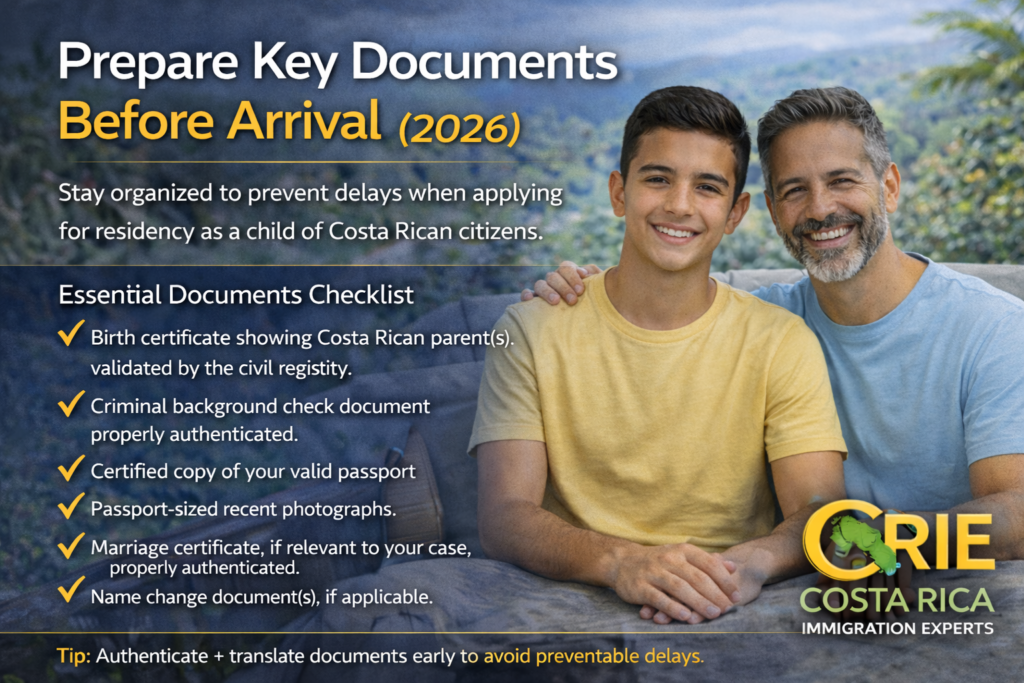
Most delays happen because documents are missing, expired, or don’t match names across records. A practical approach is to gather the standard documents first, then confirm what civil registry items are needed based on your exact situation.
- Birth certificate (your long-form version if available), showing parents’ names.
- Police clearance certificate (adult applicants), covering required jurisdictions, properly authenticated.
- Valid passport (and clear copies of key pages).
- Marriage certificate (only if relevant to your case or future filings), properly authenticated.
- Name change documents (if applicable), such as court orders or legal name change certificates.
- Parents’ documentation that supports the Costa Rican parent’s status (exact items depend on the case).
Authentication and translation: Foreign documents typically must be authenticated (apostille or consular legalization, depending on the issuing country) and translated into Spanish by an official translator in Costa Rica. Validity windows can apply to specific documents (especially police clearances), so timing matters.
Process Overview
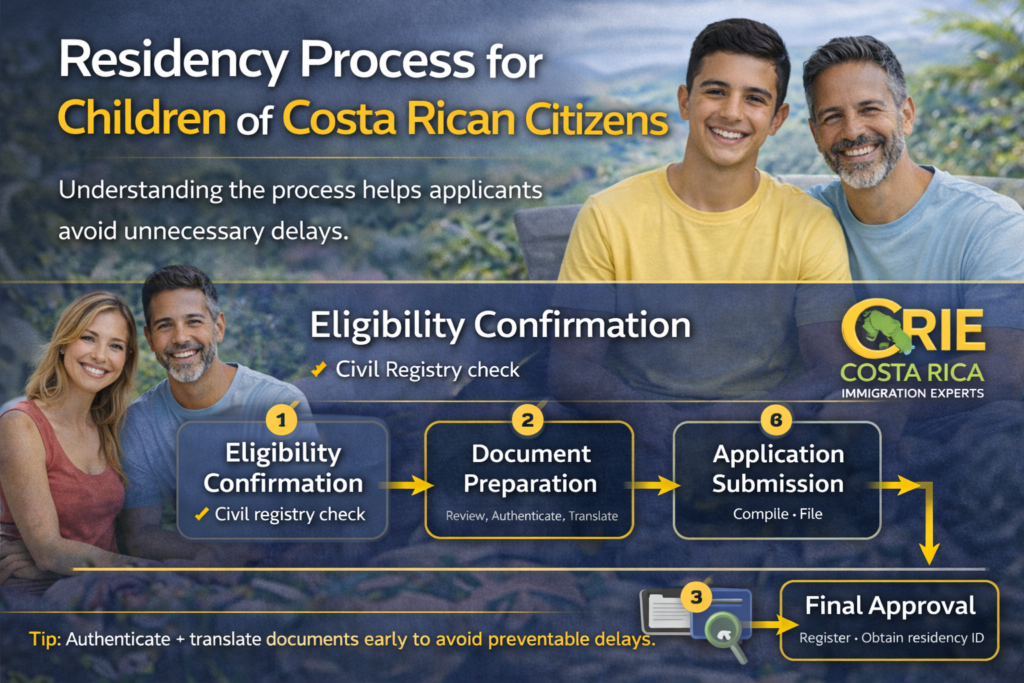
The goal is to confirm that your family tie is properly documented and then submit a complete, consistent application package. The steps below are intentionally high-level so you understand the flow without turning this page into a DIY checklist.
- Eligibility confirmation: We confirm whether your relationship to a Costa Rican parent is already properly recognized in Costa Rican records or whether a registration step is needed first.
- Document strategy: We identify which foreign documents you need, what must be authenticated, and what must be translated.
- Record alignment: We check for name and date consistency (common issues include middle names, accents, hyphens, and married names).
- Filing preparation: We prepare the application packet and ensure it matches current internal criteria typically used by authorities.
- Submission and tracking: Once filed, you receive a case reference and the application proceeds through review.
- Requests and updates: If authorities request additional documents or clarifications, we respond quickly to avoid re-starts and long pauses.
- Approval and final registrations: After approval, you complete the remaining registration steps and obtain the appropriate identification card/status documentation.
Can I Work With This Status?
This family-ties pathway commonly results in a status that allows legal work after approval and completion of the required registration steps. Most applicants should assume they cannot work legally as an employee in Costa Rica until the residency is approved and the final ID/registration steps are completed.
If your situation involves employment planning (job offer, professional licensing, or timing constraints), we recommend discussing it early so we can align expectations and point you to any related requirements that may apply.
Common Mistakes That Delay Approvals
- Unregistered foreign birth: Being born abroad to a Costa Rican parent but not completing the necessary civil registry registration first.
- Name mismatches: Different spelling, missing middle names, accent marks, or married names that don’t align across documents.
- Wrong document versions: Submitting a short-form certificate when a long-form version is required for parentage proof.
- Expired police clearances: Obtaining them too early and letting them fall outside validity windows before filing.
- Improper authentication: Apostille/legalization issues (wrong authority, missing seals, incomplete certifications).
- Unofficial translations: Using a translation that isn’t accepted for Costa Rican immigration filings.
- Incomplete packet: Filing without required supporting records and then losing months to document requests.
- Assuming “family ties = automatic”: Even straightforward cases can be delayed without clean records and correct sequencing.
Quick Comparison
Not sure if this is the best fit? Here are the four core options we compare most often:
- Pensionado (USD $1,000/month lifetime pension)
- Rentista (USD $2,500/month guaranteed foreign income, income-only)
- Investor (USD $150,000 qualifying investment)
- Permanent Residency (eligibility depends on your specific pathway and history)
How CRIE Helps
Family-based cases often look simple at first glance, but delays usually come from civil registry alignment, timing, and document sequencing. Our goal is to make the process predictable and prevent avoidable rework.
What we do
- Confirm whether your parentage and registrations are already correctly documented in Costa Rica.
- Create a document plan that matches your specific case and current requirements.
- Check consistency across names, dates, and records before filing.
- Coordinate translation requirements and help you avoid rejected formats.
- Prepare a clean filing package and respond to government requests efficiently.
What you do
- Share your basic details and documents you already have (passport + birth record).
- Request the required police clearance(s) and certificates based on our checklist.
- Follow the timing guidance so documents are valid at filing.
- Attend required appointments and complete final registration steps after approval.
Frequently Asked Questions
If I was born outside Costa Rica, do I need to register first?
Often, yes. Many applicants born abroad must complete a civil registry recognition/registration step before a residency filing is possible. The exact path depends on your parent’s Costa Rican status and how your birth was recorded.
Do I need a police clearance if I’m an adult?
In most adult cases, yes. Police clearance requirements depend on your age and residence history. Timing matters because police clearances can have validity windows that affect filing.
Can I apply from outside Costa Rica?
You can usually prepare documents from abroad, but certain steps typically require being in Costa Rica. We’ll map out what can be done before you arrive and what must be completed locally.
How long does the process take?
Timelines vary based on case complexity, document readiness, and government workload. The fastest cases are those with correctly registered parentage and a complete, consistent document packet.
Can I include my spouse or children on this application?
Whether dependents can be included depends on your situation and the specific filing approach. If family inclusion is important, tell us early so we can plan documents and sequencing correctly.
What if my documents have different spellings of my name?
This is common and fixable, but it must be handled carefully. We’ll identify where the mismatch occurs and what supporting records are needed to align your file before submission.
Do I need to renew this status?
Renewal rules depend on the specific status granted and your identification document. We’ll explain what renewals apply after we confirm your exact approval category and registration stage.
Can I work immediately after filing?
Most applicants should assume they cannot work legally as an employee until approval and final registrations are completed. If employment timing matters, discuss it upfront so expectations are clear.
What is the best first step?
Send us your basic details and a copy of your birth record (or the version you have). We’ll confirm what’s already registered in Costa Rica and what needs to be completed next.
Message us on WhatsApp
WhatsApp: +506 8706 3888
Email: info@crie.cr
Professional Disclaimer
This page is provided for general informational purposes only. Immigration rules, internal criteria, and required documentation can change. Information on this page is based on requirements checked against the official Costa Rica immigration authority site (DGME/Migración): https://migracion.go.cr/.