

Permanent residency is the “long-term” immigration status many people are ultimately aiming for in Costa Rica—especially if you want the ability to work legally as an employee, reduce renewals, and put down real roots in places like San José, Escazú, Santa Ana, Grecia, or the Central Pacific.
On this page, you’ll learn who qualifies, what documents typically matter most, and what the process generally looks like from eligibility to your DIMEX. We’ll confirm eligibility on WhatsApp, so you know the cleanest path before you invest time and money into documents.
Qualification Snapshot
Most applicants qualify for permanent residency in Costa Rica through one of two broad routes: (1) a time-based transition after maintaining qualifying temporary residency for the required period, or (2) a direct path based on certain first-degree family ties with a Costa Rican citizen. Your exact requirements depend on which route applies.
- Time-based route: You may qualify after maintaining qualifying temporary residency for the required time (commonly three consecutive years, depending on your category and compliance).
- Family-tie route: You may qualify through specific first-degree family ties to a Costa Rican citizen (documentation must clearly prove the relationship).
- Status compliance matters: Keeping renewals, entries, and records consistent can affect eligibility and timing.
- Document readiness matters: Most delays come from authentication, translations, and “validity window” issues—not the application form itself.
Who This Category Is For
Permanent residency is a strong fit if you’re building a long-term life here and want fewer restrictions than temporary residency. It’s most common for established temporary residents and for people with qualifying Costa Rican family ties.
- Temporary residents approaching the point where permanent residency becomes available.
- People who want the right to work legally in Costa Rica as an employee (not just own a company).
- Families who want long-term stability for schooling, healthcare registration, and local administrative life.
- Applicants with qualifying first-degree Costa Rican family relationships who want a direct permanent path.
- Long-term residents who are ready to simplify renewals and maintain a stable immigration status.
- Applicants planning for eventual citizenship eligibility (separate process and requirements).
Not a Fit If…
- You are still on tourist status and have not established a qualifying residency category first.
- You have not maintained the required time in a qualifying temporary status (or your status has gaps/expirations).
- You’re hoping the Digital Nomad Visa counts as residency toward permanent status (it does not).
- Your family relationship is not within the qualifying categories or is difficult to document cleanly.
- Your documents can’t be authenticated/translated properly within required validity windows.
Requirements at a Glance
Permanent residency applications are document-driven. The most important pieces are: (1) proof you qualify under the correct route, (2) properly authenticated civil documents, (3) certified Spanish translations, and (4) consistent identity details across every document (names, dates, passport, and local file records).
- Valid passport and certified copies (as required by the filing format).
- Birth certificate (authenticated and translated).
- Police clearance(s) when required (authenticated and translated).
- Proof of eligibility route:
- Time-based: proof of maintained qualifying temporary residency and compliance.
- Family-tie: civil records proving the qualifying relationship.
- Photos, forms, and local procedural steps (fingerprints/biometrics as applicable).
Documents to Prepare Before You Arrive
If you’re coming to Costa Rica specifically to start (or finish) a permanent residency filing, the smartest move is arriving with the right foreign documents already issued correctly. The goal is to avoid re-ordering documents from abroad after you’re already in San José—one of the most common causes of long delays.
- Birth certificate: request an official version that meets your country’s standards for international use.
- Police clearance(s): for the relevant country/countries as required by your route and history.
- Family-tie civil documents: (if applicable) the documents that prove the relationship (for example, parent/child records).
- Name consistency proof (if needed): if you use multiple last names, have had a legal name change, or your documents show variations.
Authentication and translation: Many foreign documents must be apostilled or consularly authenticated (depending on the issuing country), and then officially translated into Spanish in Costa Rica. Also note that some documents must be issued within specific validity windows close to filing—so timing matters.
Process Overview
The permanent residency process is straightforward on paper, but details and sequencing matter. Most successful applications follow a predictable rhythm: confirm eligibility first, align documents second, then submit with clean, consistent formatting so you don’t lose months to preventable back-and-forth.
- Eligibility confirmation: confirm whether you qualify via time-based status or qualifying family ties.
- Document plan: identify exactly which foreign and local documents you need for your route.
- Authentication + translations: ensure foreign documents are properly authenticated and translated.
- Application filing: submit your application package to DGME in the correct format.
- In-process proof: receive your processing document (commonly referred to as the Hoja de Trámite), which shows your case is underway.
- Biometrics/registrations: complete fingerprints/biometrics and related steps as required.
- Resolution + documentation: once approved, complete the final steps to be documented and issued your DIMEX under permanent status.
Can I Work With This Status?
In general, permanent residency is the status that opens the door to legal employment in Costa Rica without the same limitations that apply to many temporary categories. If working is a major reason you’re planning your move, permanent residency is often the cleanest long-term solution.
If you are not yet a permanent resident and need to work sooner, review the separate requirements for a work authorization path here: Work Permit in Costa Rica.
Common Mistakes That Delay Approvals
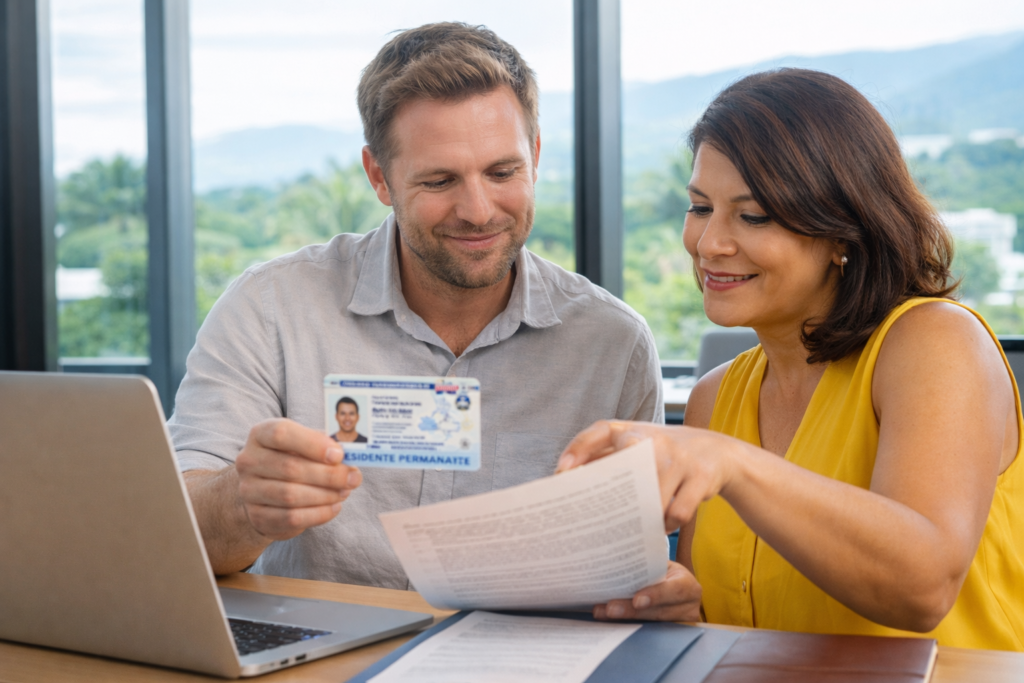
Most permanent residency delays come from document issues, category confusion, and small inconsistencies that trigger requests for clarification. Fixing these early is usually the difference between a smooth case and months of avoidable waiting.
- Applying under the wrong route (time-based vs. family-tie) or mixing requirements from different categories.
- Bringing documents that are outside required validity windows (or ordering them too early).
- Missing apostille/consular authentication (or using the wrong authentication type for the issuing country).
- Using non-official translations or translations that don’t match the final authenticated document exactly.
- Name/date mismatches across passport, birth certificate, marriage records, or prior filings.
- Gaps in temporary residency compliance (late renewals, expired DIMEX periods, or unclear continuity).
- Family relationship documents that don’t clearly prove the qualifying link (especially across countries).
- Assuming the Digital Nomad Visa is a residency pathway (it is not a residency category).
- Submitting incomplete copies/certifications of passport pages when the filing format requires it.
Quick Comparison
If you’re deciding which path best fits your situation, these core categories are the most common starting points before permanent residency becomes available. Permanent residency is often the “next step” after time in temporary status, or it can be available directly through qualifying family ties.
- Pensionado — for retirees with a lifetime pension (USD $1,000/month).
- Rentista — for applicants with guaranteed foreign income (USD $2,500/month for two years; income-only).
- Investor (Inversionista) — for qualifying investments (USD $150,000).
- Permanent Residency — long-term status, typically after qualifying time in temporary residency or via qualifying family ties.
How CRIE Helps
Permanent residency applications are rarely “hard,” but they are easy to delay if the filing is not perfectly aligned to the correct route and document standards. CRIE keeps your case structured, consistent, and ready for review—without you needing to guess what applies.
What we do
- Confirm the correct permanent residency route based on your history and goals.
- Provide a clear document plan that matches DGME expectations for your specific pathway.
- Coordinate review for authentication readiness and translation requirements.
- Reduce avoidable requests for clarification by checking consistency across all documents.
- Guide the submission flow and follow-ups so your file stays organized and trackable.
What you do
- Share your background (current status, time in Costa Rica, family ties, and travel history).
- Collect the required foreign documents using our timing guidance.
- Attend required appointments when needed (fingerprints/biometrics and related steps).
- Keep your passport and contact information current throughout processing.
Frequently Asked Questions
Do I always need three years of temporary residency first?
Not always. Many applicants reach permanent residency after maintaining qualifying temporary residency for the required time, but some applicants may qualify directly through specific first-degree family ties to a Costa Rican citizen. The correct route depends on your facts and documentation.
Is the Digital Nomad Visa a type of residency that leads to permanent residency?
No. The Digital Nomad Visa is not a residency category and does not count as temporary residency time toward permanent residency. If your goal is permanent residency, we’ll usually point you to a qualifying residency category such as Pensionado, Rentista, Investor, or a family-tie residency path (when applicable).
Can I work in Costa Rica once I have permanent residency?
In general, permanent residency is the status that allows you to work legally in Costa Rica without the same employment restrictions common to many temporary categories.
What is the Hoja de Trámite and why does it matter?
It’s the processing document that shows your residency case is underway. It’s an important piece of proof that your application has been filed and is in process.
Can I travel while my permanent residency application is processing?
Travel is often possible, but timing and documentation matter. Before you travel, it’s smart to confirm what documents you should carry and how travel may interact with your in-process file.
How long does permanent residency take?
Processing times vary based on application volume, your route (time-based vs. family-tie), and how cleanly your documents meet requirements. The most reliable way to avoid delays is getting document authentication, translations, and consistency right before filing.
Do my documents have to be translated into Spanish?
Yes. Foreign documents typically must be officially translated into Spanish in Costa Rica. Using the correct translation format and matching it to the final authenticated document is critical.
Will permanent residency help with healthcare registration?
Permanent residents can typically register with Costa Rica’s social security healthcare system (CCSS/Caja), subject to the standard requirements and procedures. We’ll guide you on what applies after approval.
Does permanent residency lead to citizenship?
Permanent residency can be part of the long-term path to citizenship, but citizenship is a separate process with its own eligibility rules and requirements. If that’s your goal, we’ll help you plan the correct sequence.
Message CRIE on WhatsApp
If you want permanent residency, the fastest first step is confirming which route applies to you and what documents you should (and should not) order. We’ll confirm eligibility on WhatsApp and tell you the cleanest path forward.
WhatsApp: +506 8706 3888
Email: info@crie.cr
Professional Disclaimer
This page is provided for general informational purposes only. Immigration rules, internal criteria, and required documentation can change. Information on this page is based on, and checked against, Costa Rica’s official immigration authority (Migración/DGME): https://migracion.go.cr/.