

Navigating the Costa Rica residency process can feel overwhelming. Many applicants face frustrating delays due to incomplete paperwork or unclear requirements.
This guide provides a clear, step-by-step roadmap. We help you understand exactly what’s needed before you even arrive.
At CRIE, we specialize in Costa Rica immigration. We offer transparent, realistic guidance—no hype, just expert support verified by official sources.
A critical point: Digital Nomad status is not legal residency. It does not count toward permanent residency or citizenship. We guide you to legitimate pathways instead.
The main residency categories are Pensionado, Rentista, and Inversionista (Investor). Each has specific financial thresholds.
Successful applications start at home. You must prepare apostilled and translated documents in advance. Typical processing takes 3 to 9 months with correct paperwork.
For a deep dive into one key pathway, learn more about investor residency qualification. Let’s begin your journey.
Understanding Costa Rica Residency Options
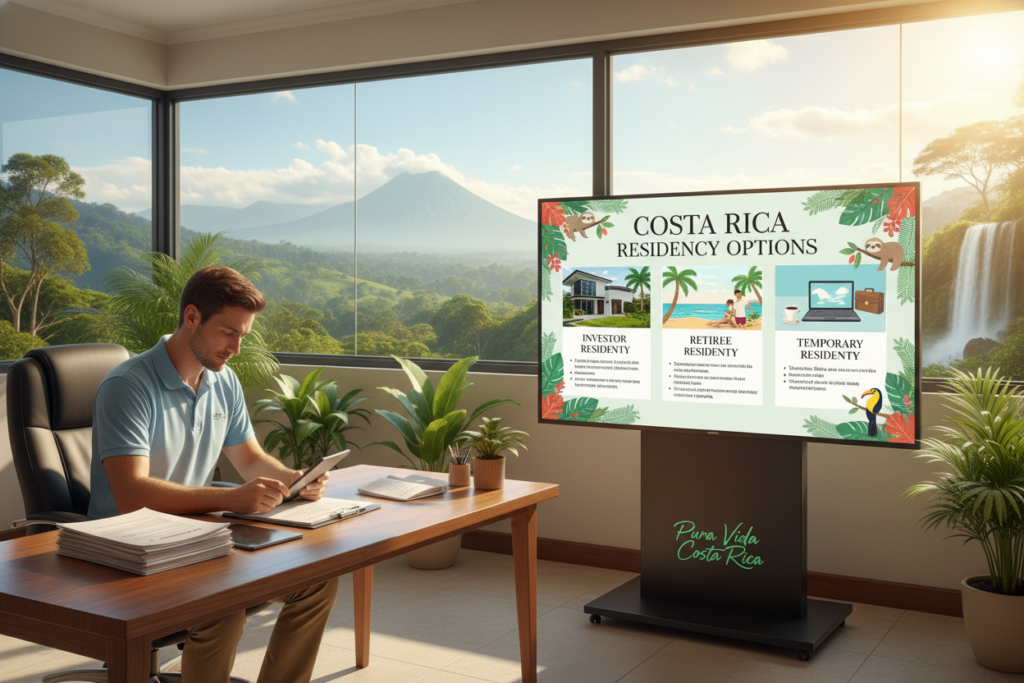
Costa Rica offers three official pathways to legal residency, each with specific financial requirements. These government-approved categories provide the only routes to permanent residence and eventual citizenship.
Overview of Residency Categories (Pensionado, Rentista, Inversionista)
The Pensionado (Pensionado) program is for retirees. It requires proof of a permanent pension of at least US$1,000 per month from a government or private source.
The Rentista (Rentista) category suits those with stable passive income. Applicants must demonstrate monthly income of US$2,500 for two years, verified through banking documents.
The Inversionista (Investor) pathway requires a minimum investment of US$150,000 in qualifying Costa Rican assets. This includes real estate, business shares, or approved projects.
Why Digital Nomad Status Does Not Qualify
Digital Nomad status is not a residency permit. It allows temporary legal stay but provides no path to permanent residence or citizenship eligibility.
For those considering this option, the Rentista or Inversionista programs offer legitimate alternatives. Only these three official categories establish a legal foundation for long-term residence in Costa Rica.
Who Qualifies for Costa Rica Residency?
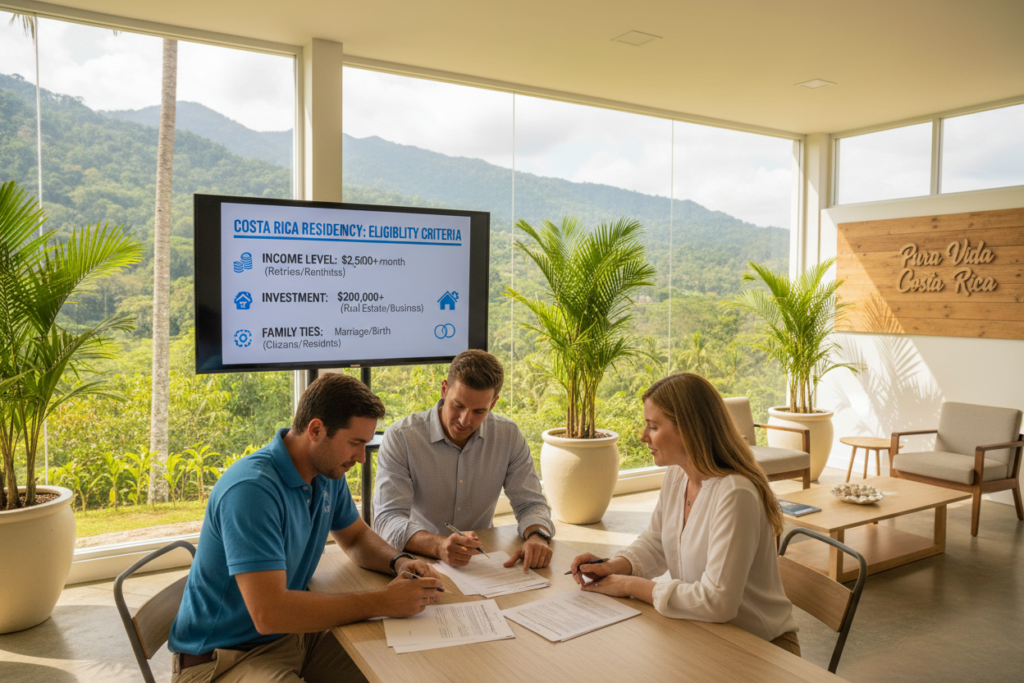
To qualify for legal residency in Costa Rica, applicants must meet specific financial and legal criteria. All individuals need a clean criminal record and valid entry documentation. Your eligibility depends on fulfilling the requirements for one of three official categories.
Eligibility Criteria for Pensionado & Rentista
The Pensionado route requires proof of a permanent monthly pension of at least US$1,000. This income must come from a government or private pension fund. Official certification confirming the amount is mandatory.
The Rentista category demands stable passive income of US$2,500 per month. We clarify that this means rental income, dividends, or interest—not a salary. Applicants must show this income history for two consecutive years.
Investor (Inversionista) Requirements at a Glance
The investor pathway requires a minimum qualifying investment of US$150,000. This can be in real estate, business shares, or approved projects.
A critical rule often missed: if using real estate, the property must be in the applicant’s personal name. Corporations or trusts do not meet the immigration requirements for this residency. Proper legal proof of the investment is essential for access to this program.
minimum-investment-for-costa-rica-investor-visa Requirements Explained
The investor residency pathway in Costa Rica is anchored by a clear financial benchmark. The program requires a minimum capital commitment of US$150,000. This threshold provides access to one of the region’s more accessible investment residency options.
Qualifying investments include real estate, shares in an operational corporation, or approved development projects. Real estate is the most common choice for North American applicants. It offers both residency qualification and a tangible asset.
Investment Threshold and Supporting Documentation
You must prove your investment meets the $150,000 minimum. For real estate, this requires a certified property appraisal and a registered deed. Official proof of payment and municipal tax records are also essential.
Financing is possible, but your documented equity must reach the full amount. Budget for additional closing costs of 3% to 5%. These cover transfer taxes, legal fees, and registration.
Ensuring Property is in the Applicant’s Personal Name
A critical rule is that qualifying property must be in your personal name. Immigration authorities need direct proof you control the investment. Corporate ownership structures, like an S.A., do not satisfy this requirement.
We advise working with legal counsel experienced in both real estate and immigration law. Proper structuring from the start avoids costly corrections later. This ensures your investment seamlessly supports your residency goals.
Step-by-Step Guidance for Your Application Process
The foundation of a successful Costa Rica immigration application is built before you ever submit paperwork. We guide clients through a sequential process that minimizes delays.
Proper preparation separates smooth applications from frustrating ones. Start gathering required documents in your home country first.
How to Prepare Apostilled and Translated Documents
Begin with birth certificates, marriage records, and police clearances. Each document from the U.S. or Canada needs an apostille.
This international certification verifies authenticity for use in Costa Rica. Once apostilled, documents must travel to Costa Rica for official translation.
Only translators registered with the Costa Rican Ministry of Foreign Affairs can perform this work. Translations done elsewhere will not be accepted by immigration authorities.
Timeline Overview from Home Preparation to Submission
Document gathering and apostilling typically takes 4-8 weeks. Allow another 2-4 weeks for Costa Rican translation services.
Your attorney then submits the complete application package to immigration authorities. Government processing generally takes 3 to 9 months for review.
Upon approval, you receive a temporary residence permit valid for two years. Registration with the Costa Rican social security system must follow within 90 days.
Complete documentation submitted upfront keeps this timeline on track. Missing or incorrect paperwork causes significant processing delays.
Key Documents to Prepare Before Arrival
Before packing your bags, the most critical task is assembling your complete documentation portfolio. We provide this practical checklist to systematically guide your preparation. Properly organized paperwork is the proven way to avoid processing delays.
Checklist of Essential Documentation
All applicants need universal documents. This includes a valid passport, an apostilled birth certificate, and police clearances from every country you’ve lived in recently.
If applying with family, include marriage certificates and children’s birth records. You’ll also need passport photos, proof of legal entry, and a Costa Rican address.
Financial proof varies by category. Pensionado applicants need a certified letter confirming a permanent $1,000 monthly pension. Rentista applicants must show 24 months of bank statements proving $2,500 monthly income.
For the investor pathway, required documentation includes a property deed in your personal name, a certified appraisal, and proof of payment. This confirms the qualifying investment amount.
Every foreign civil document requires an apostille first. Then, an official Costa Rican translator must convert it into Spanish. We advise getting multiple certified copies of key documents before this process begins.
Common Mistakes to Avoid During the Application
The path to legal residency in Costa Rica is often littered with common, yet costly, application missteps. We see these errors frequently because the process is complex. Our goal is to help you sidestep these pitfalls.
Errors in Documentation and Misinterpretation of Requirements
A major error is assuming a property purchase automatically grants residency. Simply buying real estate does not qualify you. The investment must be specifically documented and submitted through the formal application.
For investor residency, the property must be in your personal name. Purchasing through a corporation invalidates the application. Another frequent issue involves apostilles and translations.
Documents must be apostilled by the correct authority and translated by an official Costa Rican translator. Using non-official services causes rejection. Also, police clearances expire within six months.
Obtaining them too early leads to delays. For Rentista applicants, showing only a few months of income is insufficient. You need 24 consecutive months of verified income.
Mixing Up Residency and Digital Nomad Options
Confusing Digital Nomad status with a residency pathway is a critical mistake. The Digital Nomad permit allows temporary legal stay only.
It provides no progress toward permanent residency or citizenship. Years spent on this status do not count. Applicants must then start the residency process from scratch, losing valuable time.
To navigate these complexities and avoid other common pitfalls in Costa Rica residency, professional guidance is a practical investment. It saves both time and money.
Maintaining Eligibility Throughout Your Residency
Once your temporary residency is approved, your focus must shift to maintaining compliance with ongoing obligations. Receiving approval is not the finish line—it’s the beginning of preserving your status.
Obligations: Annual Visits and Social Security Registration
Your first critical step is social security registration. Within 90 days of approval, you must register with the CCSS, Costa Rica’s public healthcare system.
Monthly contributions are calculated based on declared income. Payments typically range from $50 to $100 or more each month.
You must also visit the country at least once per calendar year. Immigration tracks entry stamps—one day in Costa Rica maintains your temporary residency status.
Failing to complete this annual visit results in automatic loss of your residency. We guide clients to set calendar reminders for this simple but essential requirement.
You must continue meeting your category’s financial conditions throughout these years. Keep your investment active or maintain your qualifying income source.
Temporary residency permits are valid for two years and renewable. After three years of compliant residence, you become eligible for permanent residency.
Planning ahead makes this process straightforward. Automatic payments and organized documentation ensure you maintain your hard-won status in Costa Rica.
Navigating Timelines and Processing Delays
A clear breakdown of the immigration timeline provides a roadmap to manage expectations and avoid frustration. We set realistic expectations upfront. Plan on a total timeline of 6 to 12 months from decision to approval if everything proceeds smoothly.
Typical Timeframes and How to Mitigate Delays
The process unfolds in distinct phases. Initial document gathering and apostilling can take 4-8 weeks. Official translation in Costa Rica adds another 2-4 weeks.
For investor applicants, finalizing a qualifying investment may extend this preparatory time. Once submitted, official immigration processing typically takes 3 to 9 months.
Common delays stem from incomplete paperwork or translation errors. To mitigate these, start document collection immediately. Work with experienced legal counsel who knows exactly what authorities expect.
Submit a complete, organized application the first time. This proactive approach dramatically increases the likelihood of approval within the standard processing window.
Your Next Steps Towards Costa Rican Residency
Taking the first step toward Costa Rican residency requires matching your personal situation to the right official pathway. If you have a stable pension, consider the Pensionado program. For reliable passive income, the Rentista category is your route. If you plan a significant capital commitment, the investor program is designed for you.
Remember, a Digital Nomad permit offers no path to permanent residence. Your most important action is to start gathering documents now, from your home country. Apostilled birth certificates and police clearances are the foundation.
Your application can include your spouse and dependent children, granting the whole family access. The initial temporary permit is valid for two years. After three years of maintained residence, you qualify for permanent status.
This long-term pathway can eventually lead to full Costa Rican citizenship. To uncover Costa Rica citizenship by investment, specialized guidance is key.
We guide qualified applicants through every step. Contact us to begin your journey: WhatsApp +506 8706 3888 or email info@crie.cr.
FAQ
What is the minimum investment required for the Costa Rica investor residency program?
Can my spouse and children be included in my investor residency application?
How long does the investor residency process typically take?
What are the most common mistakes applicants make?
What are my obligations after I receive my temporary residency?
Does the investment property need to be in my personal name?
Article by Glenn Tellier (Founder of CRIE and Grupo Gap)
Don't wait, contact us right now!
Call or WhatsApp Costa Rica +506 8373 2085 or +506 8706 3888
Call USA/Canada +1 305-906-6784