
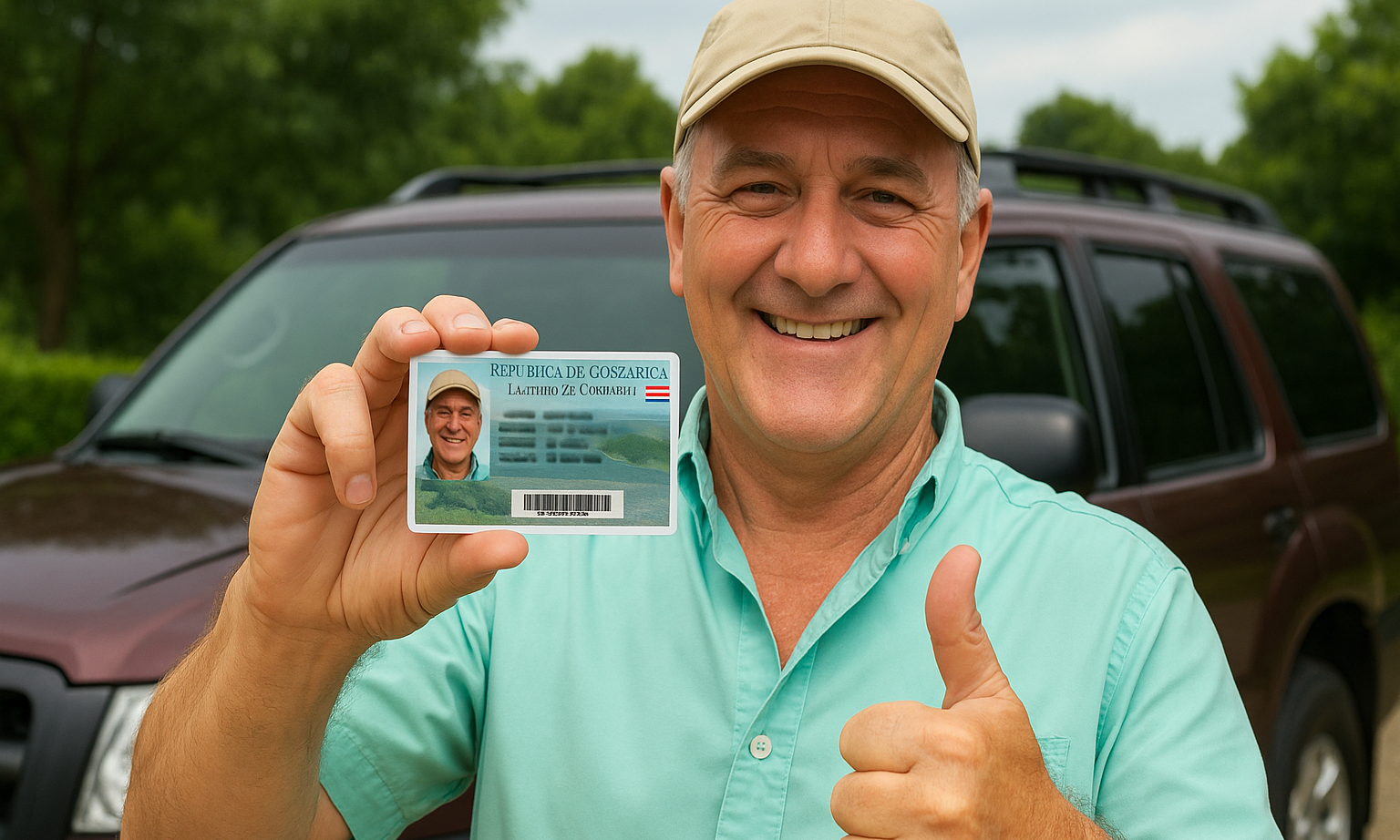
For newcomers to Costa Rica, navigating the process of getting a driver’s license can be challenging. To be eligible, one must be a resident or citizen, as the license is exclusively for those with a valid residency status.
Visitors from the US and Canada can use their foreign licenses for up to 180 days, but driving beyond 90 days requires an extension from an Immigration Agent. To drive legally in Costa Rica long-term, expats must apply for a local driver’s license, which involves meeting the age requirement of being at least 18 years old and adhering to local driving regulations.
This guide will walk expats through the process, covering eligibility, the application process, and recent changes to driving regulations in Costa Rica, ensuring a smooth transition to driving with a Costa Rican license.
Understanding the Costa Rican Driver’s License System
The Costa Rican driver’s license system is designed to ensure road safety and skilled drivers. It involves understanding local driving laws and requirements, which are crucial for expats planning to drive in Costa Rica.
License Categories and Requirements
Costa Rica’s driver licensing system is structured around different categories based on vehicle types. The main license types include the Standard Car License (B1) for vehicles up to 3,500 kg, Motorcycle License with varying requirements based on engine size, and Professional Driving Licenses for commercial vehicle operators.
- The B1 license category is the standard for most expats, covering vehicles up to 3,500 kg.
- Specialized categories exist for motorcycles and commercial vehicles, each with specific requirements.
- Understanding these categories is essential for expats to comply with Costa Rican driving laws.
Legal Framework for Foreign Drivers
Costa Rica maintains strict legal frameworks governing foreign drivers. Different rules apply to tourists versus residents or those seeking permanent status. The country’s licensing system prioritizes road safety through mandatory medical certifications and regular renewal requirements.
- Tourists can drive using their foreign license, but residents are required to obtain a Costa Rican license.
- Recent legislative changes have affected how foreign licenses are recognized in Costa Rica.
- The Costa Rican licensing authority, COSEVI, oversees all driver licensing matters and sets standards for both domestic and international drivers.
Eligibility Requirements for Expats in Costa Rica
Expatriates seeking to obtain a driver’s license in Costa Rica must meet specific eligibility criteria. These requirements are designed to ensure that only legal residents can apply for a local driver’s license, thereby enhancing road safety and compliance with immigration laws.
Residency Status Requirements
To be eligible for a Costa Rican driver’s license, expats must possess legal residency status, either temporary or permanent. The minimum residency period requirement is three months and one day in Costa Rica before an expat can apply for a local driver’s license. This rule applies to all foreign residents, and it’s crucial for expatriates to keep track of their stay to meet this requirement. Maintaining valid residency status is not only essential for obtaining a license but also for its continued validity.
Age and Identity Verification
Applicants must be at least 18 years old to obtain a standard driver’s license in Costa Rica, with no exceptions for international drivers. Identity verification is a crucial step in the process, requiring expats to provide valid identification documents that prove both their identity and legal status in the country. Expats must demonstrate their legal immigration status through proper documentation, including their residency card (DIMEX), which serves as the primary form of identification for residents.
Using a Foreign Driver’s License in Costa Rica
For individuals visiting or residing in Costa Rica, understanding the regulations surrounding the use of a foreign driver’s license is crucial. The country has specific rules that dictate how long a foreign license can be used.
Validity Period for Tourists
Tourists can drive in Costa Rica using their foreign driver’s license for up to 90 days, which aligns with the standard tourist visa duration. Recently, Costa Rica extended its maximum tourist visa to 180 days, but the driving license validity period remains at 90 days for now. It’s essential for tourists to be aware that there are proposals to extend the validity period for driving licenses to 180 days, but this change is not expected to take effect for several years. For the most current information, visiting the official Costa Rica driving license information page is recommended.
Legal Limitations for Foreign Licenses
While foreign licenses are valid for tourists, there are legal limitations to be aware of. Even after obtaining residency, the foreign license remains valid for 90 days. However, if you plan to stay long-term, obtaining a Costa Rican driver’s license is necessary. Foreign licenses must be valid and current in the driver’s home country to be recognized in Costa Rica. Certain driving privileges may not transfer directly, and insurance considerations are also important when driving on a foreign license.
How Can an Expat Get a Driver’s License in Costa Rica
The process of getting a driver’s license in Costa Rica has been streamlined for expats, thanks to recent legislative changes, such as bill No.23.531, which has simplified the process for foreigners.
Overview of the Application Process
To obtain a driver’s license in Costa Rica, expats must follow a series of steps. The process begins with scheduling an appointment at COSEVI (Costa Rican Road Safety Council), which can be done online or in person. The required documentation must then be submitted, followed by a medical examination to ensure the applicant’s fitness to drive.
The next steps involve paying the required license fees and taking both written and practical driving tests. Understanding each step is crucial to avoid delays or rejections.
- Schedule an appointment at COSEVI
- Submit all required documentation
- Complete a medical examination
- Pay the required license fees
- Take and pass the written and practical driving tests
Timeline and Planning Considerations
The entire application process typically takes 4-6 weeks, although this can vary based on factors such as appointment availability and document processing times.
To ensure a smooth application process, expats should plan ahead by gathering all required documents in advance and scheduling the medical examination early. Recent legislative changes have streamlined certain aspects, potentially reducing waiting times.
- Gather required documentation well in advance
- Schedule the medical examination early
- Allow extra time for unexpected delays
Required Documentation for License Application
To successfully obtain a driver’s license in Costa Rica, expats must navigate a series of documentation requirements. Ensuring that all necessary documents are gathered and properly prepared is crucial for a smooth application process.
Essential Personal Documents
Expats will need to provide several essential personal documents to support their driver’s license application. These include a valid passport with at least three months of remaining validity, serving as primary identification. Additionally, a residency card (DIMEX or cédula) is required as proof of legal status in Costa Rica. The card must be current and valid throughout the application process. A current foreign driver’s license is also typically required, especially for those seeking to homologate their existing license. Furthermore, a medical certificate (dictamen médico) obtained from an authorized Costa Rican medical provider is mandatory, with a validity period of 180 days or less.
- A valid passport is necessary for identification purposes.
- The residency card (DIMEX or cédula) confirms the applicant’s legal status.
- A current foreign driver’s license is needed, particularly for homologation.
- A medical certificate from an authorized provider is required within 180 days.
Proof of Residency Requirements
To fulfill the proof of residency requirements, applicants must demonstrate a physical address in Costa Rica. This can be achieved by providing utility bills, rental agreements, or other official documentation that shows the applicant’s name and address. Passport-sized photographs meeting specific requirements must also be provided for the application and final license. It’s also important to note that all documents not in Spanish must be officially translated by authorized translators, adding an additional step to the documentation process for many expats.

- Utility bills or rental agreements can serve as proof of address.
- Passport-sized photographs are required for the application.
- Documents not in Spanish require official translation.
Medical Examination Requirements
Expats aiming to drive in Costa Rica must pass a detailed medical examination to ensure they meet the country’s road safety standards. This crucial step is part of the driver’s license application process, verifying that applicants are physically and visually fit to drive.

Finding an Approved Medical Provider
To fulfill the medical examination requirement, expats must find an approved medical provider authorized by Costa Rican authorities. This involves researching clinics or doctors recognized for conducting the “dictamen médico.” Only examinations from these authorized providers are accepted for the driver’s license application.
The cost for this medical examination ranges between 15,000 and 20,000 colones, approximately $30-40 USD, and is a separate expense from the license application fee.
What to Expect During the Medical Exam
The medical examination is comprehensive, including vision screening to check visual acuity, physical fitness assessment, reflex and coordination testing, and a basic neurological evaluation. These tests are designed to assess the applicant’s overall fitness to drive safely.
During the examination, doctors will evaluate for any medical conditions that could impair driving ability, such as vision problems or seizure disorders. The certificate issued after the examination is valid for 180 days, within which the applicant must complete their license application.
Homologation Process for Foreign Driver’s Licenses
Expatriates in Costa Rica who wish to drive using a local driver’s license must undergo the homologation process, which requires careful preparation and documentation. This process allows individuals to convert their valid foreign driver’s license into a Costa Rican one without the need for driving tests, provided they meet specific requirements.
Translation and Authentication Requirements
If the foreign driver’s license is not in Spanish, it must be translated by a certified translator authorized in Costa Rica. The cost for this service is approximately 20,000 colones ($40 USD). Authentication requirements involve verifying the legitimacy of the foreign license, which may vary depending on the country of origin. To initiate the process, expats will need to gather necessary documents, including their valid foreign driver’s license, DIMEX residency card, passport with a current entry stamp, and passport-sized photographs.
- Valid foreign driver’s license
- DIMEX residency card
- Passport with current entry stamp
- Passport-sized photographs
Verification Procedures
Costa Rican authorities conduct thorough checks on the submitted documentation to verify the authenticity of the foreign license and confirm the applicant’s legal residency status. The verification procedures involve confirming that the foreign license is current, valid, and issued by a recognized authority in the expat’s home country. Upon successful verification, the applicant is issued a Costa Rican driver’s license valid for three years, regardless of the expiration date on the original foreign license.
The homologation process is generally faster and less complex than applying for a completely new license, making it the preferred option for eligible expats with valid foreign licenses.

Costs and Fees Associated with Getting a License
Understanding the costs associated with obtaining a driver’s license is crucial for expats in Costa Rica. The process involves several expenses that need to be considered to avoid unexpected financial burdens.
Initial Application Fees
The initial application fee for a first-time Costa Rican driver’s license is approximately 4,000 CRC (about $8 USD). This fee is relatively affordable compared to many other countries. Payment methods for official fees include cash, bank transfers, or online payments, with cash being the most widely accepted option at government offices.
Additional Costs to Consider
Beyond the initial application fee, there are additional costs to consider. These include the mandatory medical examination (15,000-20,000 CRC), document translation services if needed (approximately 20,000 CRC), and transportation costs to and from appointments. The total cost for obtaining a driver’s license in Costa Rica typically ranges from $50-100 USD when all expenses are considered.
- Medical examination fees can range from 15,000 to 20,000 CRC.
- Document translation services may cost around 20,000 CRC.
- Renewal fees are higher, costing around 10,000 CRC ($20 USD).
Scheduling Appointments at COSEVI
COSEVI, the Costa Rican government agency responsible for driver licensing, requires appointments to be scheduled online. This system is designed to streamline the process for expats and locals alike to obtain or renew their driver’s licenses.
Online Appointment System
The online appointment system is user-friendly, allowing individuals to create an account, select their preferred testing center, choose from available time slots, and receive confirmation of their appointment details. This process helps in planning and ensures that applicants are prepared for their tests.
- Create an online account on the COSEVI website.
- Select the preferred testing center from the available locations.
- Choose from the available time slots that suit your schedule.
- Confirm your appointment details to receive a confirmation.
Testing Locations Throughout Costa Rica
Driving tests are conducted at various locations across Costa Rica. Major testing centers include La Uruca in San Jose, which processes up to 40 license homologations daily, and Barva in Heredia, handling up to 10 daily homologations. Regional centers are also available in major cities, though the services and appointment availability may vary.
It’s essential to plan ahead, as appointment scheduling typically requires several weeks’ notice due to high demand, especially at central locations.
Navigating Costa Rican Driving Regulations
Navigating Costa Rica’s roads requires a thorough understanding of the country’s driving regulations. Costa Rica has its own set of traffic laws that govern driving in the country.
Important Traffic Laws to Know
Costa Rican traffic laws differ significantly from those in North America and Europe. Some key laws to be aware of include mandatory seatbelt use for all passengers, child safety seat requirements for children under 12, and strict regulations regarding mobile phone use while driving.
- Mandatory seatbelt use for all passengers
- Child safety seat requirements for children under 12
- Strict regulations regarding mobile phone use while driving
Road Safety Considerations
Road safety is a critical concern in Costa Rica, with challenging road conditions throughout the country. Drivers should be aware of the varying road conditions, from well-maintained highways to unpaved rural roads that may become impassable during the rainy season.
- Understanding challenging road conditions
- Awareness of unique driving practices, such as using hazard lights to indicate road hazards
- Knowledge of right-of-way rules, particularly at roundabouts and unmarked intersections
By understanding these traffic laws and road safety considerations, drivers can navigate Costa Rica’s roads safely and confidently.
Conclusion
A valid Costa Rican driver’s license is key to exploring the country safely. To drive legally in Costa Rica, expats must understand the licensing process, which involves gathering necessary documentation, including proof of residency, and complying with the homologation process if they have a valid foreign license.
By following the outlined steps and preparing all necessary documentation in advance, expats can efficiently navigate the licensing process and enjoy the freedom of driving in their new home country, Costa Rica.
Article by Glenn Tellier (Founder of CRIE and Grupo Gap)
Don't wait, contact us right now!
Call or WhatsApp Costa Rica +506 8373 2085 or +506 8706 3888
Call USA/Canada +1 305-906-6784