

Key Takeaways
- Gun ownership in Costa Rica is a privilege, not a right, and is strictly regulated
- Only citizens and permanent residents with valid residency cards can legally own firearms
- Temporary residents and tourists cannot own, register, or carry weapons
- The current limit is three handguns per person, soon to be reduced to two
- Military-style weapons and assault rifles are prohibited for civilian ownership
- Gun permits must be renewed every two years, with psychological evaluations
- Breaking gun laws can result in serious legal consequences, including imprisonment
Understanding the Legal Framework of Gun Laws in Costa Rica
Costa Rica’s approach to gun ownership is fundamentally different from that of countries like the United States. In Costa Rica, owning a firearm is not a constitutional right but a privilege granted under specific conditions. The primary legislation governing firearms is the Law of Arms and Explosives (Ley de Armas y Explosivos) and its accompanying regulations.
This legal framework establishes comprehensive firearms regulations in Costa Rica that cover everything from who can own guns to how they must be registered and stored. The law reflects Costa Rica’s commitment to maintaining its reputation as a peaceful nation with relatively low crime rates compared to neighboring countries.
Recent updates to the gun laws in Costa Rica have further tightened restrictions, with a focus on reducing the number of firearms in circulation. The government has announced plans to reduce the maximum number of handguns allowed per person from three to two, demonstrating an ongoing commitment to strict gun control.
“Costa Rica’s gun laws are designed to ensure that firearms are only in the hands of responsible individuals who have demonstrated both the need and the capability to own them safely.”
The Ministry of Public Security oversees the enforcement of these laws through the Department of Arms and Explosives. This department manages the registration process, conducts background checks, and ensures compliance with all regulations related to firearm ownership and use.
Who Can Own a Gun in Costa Rica?
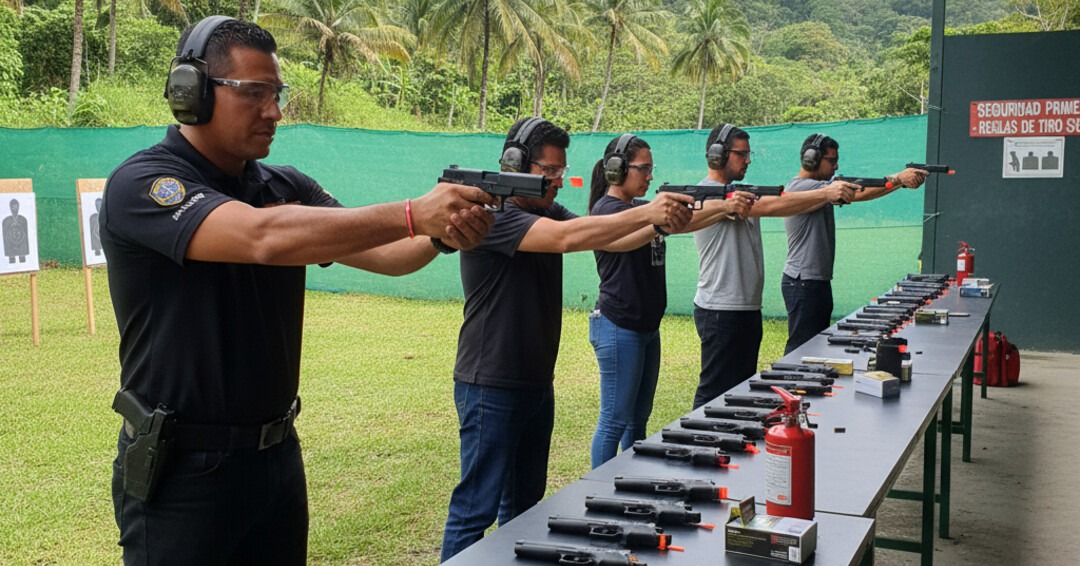
Eligibility for gun ownership in Costa Rica is strictly limited to specific categories of residents. Understanding these requirements is essential for expats considering firearm ownership in the country.
Citizenship and Residency Requirements
The gun ownership laws in Costa Rica clearly specify who can legally possess firearms:
- Costa Rican citizens with valid identification
- Permanent Residents with a valid permanent residency card (cédula de residencia)
Notably, Temporary Residents, including most expats in their first years in Costa Rica, are not eligible to own, register, or carry firearms. This restriction emphasizes the country’s cautious approach to gun ownership, ensuring that only those with established ties to the country can possess weapons.
Disqualifying Factors
Even for citizens and permanent residents, certain factors can disqualify individuals from gun ownership:
- Criminal record, especially involving drug offenses, violence, or domestic abuse
- History of mental illness or instability
- Physical impairments that would affect the safe handling of firearms
- Failure to pass the required psychological evaluation
- Age restrictions (must be at least 18 years old)
These restrictions demonstrate Costa Rica’s commitment to ensuring that firearms are only accessible to individuals who can handle them responsibly. The psychological evaluation, in particular, is a key component of the application process, requiring applicants to demonstrate mental fitness for gun ownership.
The Gun Permit Process in Costa Rica

Obtaining a firearm permit in Costa Rica involves a comprehensive process designed to ensure responsible gun ownership. For eligible individuals, the process typically takes about two months and requires several steps and documents.
Application Steps and Requirements
The process for obtaining a gun permit includes:
- Registration with the CONTROLPAS online system and obtaining a digital signature
- Submission of a formal written application to the Department of Arms and Explosives
- Completion of a criminal background check through the Judicial Investigation Police
- Psychological evaluation conducted by a government-certified psychologist
- Written examination on gun safety and relevant laws
- Practical shooting test to demonstrate competence (hitting 7 out of 10 targets from 6 meters)
- Fingerprinting at the Department of Arms and Explosives
- Inspection of the firearm by authorities (if purchasing from a private individual)
Required Documentation
Applicants must provide the following documents:
- Valid identification (national ID for citizens or permanent residency card for residents)
- Certification of no criminal record from the Police Archives
- Psychological examination certificate
- Proof of passing the weapons handling test
- Documentation regarding the origin of the weapon (bill of sale, gun shop invoice, import customs declaration, or sworn statement)
- Passport-sized photograph for fingerprinting
The application must include detailed information about both the applicant and the firearm, including the full legal name, identification number, exact physical address, and complete description of the weapon (type, caliber, manufacturer, model number, serial number).
Gun permits in Costa Rica must be renewed every two years, requiring another psychological evaluation and verification of continued eligibility. This regular renewal process helps ensure ongoing compliance with the country’s strict gun laws.
Restrictions and Prohibited Firearms in Costa Rica

Costa Rica maintains strict limitations on the types and quantities of firearms that individuals can legally own. These restrictions are designed to minimize the potential for gun violence while still allowing for legitimate uses such as self-defense and sport shooting.
Types of Prohibited Firearms
The following categories of weapons are strictly prohibited firearms in Costa Rica:
- Automatic firearms of any kind
- Military-grade weapons including assault rifles (such as AR-15s)
- Submachine guns and machine guns
- Explosive devices and weapons
- Firearms with silencers or sound suppressors
- Weapons disguised as other objects
These prohibitions reflect Costa Rica’s commitment to limiting access to weapons designed primarily for military use or that could facilitate criminal activity.
Quantity Limitations
In addition to restrictions on types of firearms, Costa Rica also limits the number of weapons an individual can own:
- Currently, individuals can own up to three handguns
- This limit is expected to be reduced to two handguns in the near future
- Additional firearms may be permitted for sport shooting under special licenses
- Ammunition purchases are monitored and must correspond to registered firearms
These quantity restrictions help prevent the accumulation of arsenals by private citizens while still allowing for reasonable personal protection and recreational use.
Violating Costa Rica’s firearms restrictions can result in serious legal consequences, including imprisonment for 3 to 8 years for illegal possession of prohibited weapons.
Purchasing and Registering Firearms in Costa Rica

For those eligible to own firearms in Costa Rica, the process of purchasing and registering a weapon involves several specific steps and considerations. Understanding this process is essential for legal compliance.
Authorized Dealers and Legal Sales
Firearms in Costa Rica can be purchased through:
- Licensed gun shops (armerías) that are registered with the government
- Private sales between individuals (with proper documentation and transfer procedures)
Major gun retailers in Costa Rica include Armeria El Hispano, Armeria Polini, and Armeria El Trabuco. These authorized dealers handle much of the paperwork associated with registering the firearm, making the process somewhat easier for buyers.
When purchasing from a licensed dealer, the buyer will receive an invoice that serves as proof of legal acquisition for registration purposes. This invoice must include detailed information about the weapon and the transaction.

Registration Requirements
After purchasing a firearm, it must be registered with the Department of Arms and Explosives. This process includes:
- Submitting the application with all required documentation
- Presenting the weapon for inspection by authorities (unless purchased from a registered gun shop that handles this step)
- Providing proof of the weapon’s origin (invoice, bill of sale, import documentation, or sworn statement)
- Completing the fingerprinting process
Firearms can be registered in either an individual’s name (persona física) or in the name of a Costa Rican corporation (persona jurídica). For expats who are not eligible to own guns directly, registering through a corporation may be an option, though the corporate officer must still meet all eligibility requirements.
“The initial shock for those intending to purchase a gun in Costa Rica are the prices. Guns are significantly more expensive than what you may have been accustomed to in other countries.”
Bringing Firearms into Costa Rica: Regulations for Visitors and Expats

For expats and visitors considering bringing firearms into Costa Rica, understanding the import regulations is crucial to avoid legal complications and potential confiscation of weapons.
Import Permit Requirements
To legally import firearms into Costa Rica, individuals must:
- Obtain import permits approved by the Ministry of Public Security before arrival
- Have all documentation certified by a Costa Rican consulate (approximately $45 per document)
- Meet all eligibility requirements for gun ownership in Costa Rica
- Register the firearm with Costa Rican authorities upon arrival
For non-residents who are not eligible to own firearms directly, weapons must be registered under a Costa Rican corporation before arrival. This process requires legal assistance and careful planning.
Customs Declaration Procedures
Upon arrival in Costa Rica with a firearm, individuals must:
- Declare all firearms to customs officials immediately
- Present all required permits and documentation
- Submit the weapon for inspection
- Complete the registration process with the Department of Arms and Explosives
Failure to declare firearms can result in confiscation, fines, and potential criminal charges. The customs declaration process is taken very seriously, and attempting to circumvent these requirements can lead to significant legal problems.
The process of importing firearms can be complex and time-consuming. Many expats find it more practical to purchase firearms from authorized dealers within Costa Rica rather than attempting to import their own weapons.
Costa Rican Gun Laws Compared to Other Countries
Costa Rica’s approach to gun regulation differs significantly from many other countries, particularly the United States. Understanding these differences provides valuable context for expats considering firearm ownership.
| Aspect | Costa Rica | United States | Other Central American Countries |
| Constitutional Right | No constitutional right to bear arms | Protected by the Second Amendment | Varies by country; generally, no constitutional protection |
| Eligibility | Citizens and Permanent Residents only | Most citizens and legal residents | Typically, citizens only, with variations |
| Background Checks | Rigorous, including psychological evaluation | Varies by state, generally less comprehensive | Varies, often less structured than Costa Rica |
| Weapon Restrictions | No military-style weapons, limit of 2-3 handguns | Varies by state; generally, there are fewer restrictions | Often stricter than the US but less regulated than Costa Rica |
| Carry Permits | Difficult to obtain, strictly regulated | Varies by state, often more accessible | Generally restricted, with significant variation |
| Renewal Requirements | Every 2 years with a psychological evaluation | Varies by state, typically less frequent | Varies, often less frequent than in Costa Rica |
Costa Rica’s gun laws are notably stricter than those in the United States, where gun ownership is protected by the Second Amendment and regulations vary significantly by state. In contrast to the US approach, Costa Rica treats gun ownership as a privilege rather than a right, requiring thorough vetting of all applicants.
Compared to neighboring Central American countries, Costa Rica generally maintains stricter enforcement and more comprehensive background checks. This approach aligns with the country’s overall emphasis on peace and security, which has contributed to its lower crime rates relative to some regional neighbors.
Self-Defense Alternatives to Firearms in Costa Rica

For expats who are not eligible to own firearms or prefer non-lethal options, Costa Rica offers several legal alternatives for personal security and self-defense.
Legal Non-Lethal Defense Options
Several non-lethal self-defense tools are legal and readily available in Costa Rica:
- Pepper spray (widely available and legal to carry)
- Personal alarms and whistles
- Tactical flashlights
- Home security systems and cameras
These options provide effective deterrents without the legal complications and responsibilities associated with firearm ownership. Many expats find these alternatives sufficient for their personal security needs, particularly in areas with lower crime rates.
Community Safety Measures
Beyond individual self-defense tools, community-based security measures are common and effective in Costa Rica:
- Neighborhood watch programs (vigilancia comunitaria)
- Private security guards for residential communities
- Gated communities with controlled access
- Community WhatsApp groups for security alerts
These collective approaches to security often provide a strong deterrent effect while fostering community connections. Many expat communities in Costa Rica have established such programs with considerable success.
“Understanding the local security landscape and adopting appropriate non-lethal defense strategies can be more practical for most expats than navigating the complex process of gun ownership in Costa Rica.”
Legal Consequences for Violating Gun Laws in Costa Rica
Costa Rica takes violations of its gun laws very seriously, with significant penalties for non-compliance. Understanding these consequences is essential for anyone considering firearm ownership in the country.
Criminal Penalties for Illegal Possession
Individuals found in possession of unregistered or illegal firearms face severe consequences:
- Imprisonment for 3 to 8 years for illegal possession of firearms
- Longer sentences for possession of prohibited weapons (military-grade or automatic weapons)
- Criminal charges for attempting to import firearms without proper permits
- Potential deportation for non-citizens convicted of weapons offenses
These penalties reflect Costa Rica’s commitment to strict enforcement of its gun control laws and serve as a strong deterrent against illegal firearm possession.
Administrative Consequences
Even for legal gun owners, failure to comply with administrative requirements can lead to serious problems:
- Confiscation of firearms for expired permits or registration
- Fines for failure to properly store or secure weapons
- Revocation of gun ownership privileges for violations
- Difficulty obtaining permits in the future after violations
The Costa Rican authorities maintain detailed records of gun ownership and regularly verify compliance with all regulations. This administrative oversight helps ensure that only responsible individuals maintain the privilege of gun ownership.
Costa Rica’s legal system takes a particularly firm stance on firearms used in crimes. Possession of an illegal firearm during the commission of another crime can significantly increase penalties and prison sentences.
Recent Changes and Future Trends in Costa Rican Gun Legislation
Costa Rica’s approach to gun regulation continues to evolve, with recent changes reflecting ongoing concerns about public safety and crime prevention. Staying informed about these developments is important for current and prospective gun owners.
Recent Legislative Updates
Several significant changes have been implemented or proposed in recent years:
- Plans to reduce the maximum number of handguns per person from three to two
- Implementation of the CONTROLPAS digital system for firearm registration and tracking
- Enhanced background check requirements and more rigorous psychological evaluations
- Increased scrutiny of corporate gun ownership to prevent circumvention of individual restrictions
These changes reflect a continuing trend toward stricter gun control in Costa Rica, consistent with the country’s emphasis on peaceful conflict resolution and public safety.
Emerging Trends and Future Outlook
Several trends suggest the direction of future gun legislation in Costa Rica:
- Growing emphasis on digital tracking and monitoring of firearms
- Potential further restrictions on ammunition purchases and possession
- Increased coordination with international law enforcement to combat illegal weapons trafficking
- Possible expansion of gun-free zones and restrictions on carrying in public places
These trends indicate that Costa Rica is likely to maintain or even strengthen its strict approach to gun control in the coming years. Expats and citizens interested in gun ownership should anticipate a continuing emphasis on thorough vetting and limited access to firearms.
The Costa Rica Segura plan, launched in April 2023, includes measures to strengthen law enforcement and address rising crime rates. While focused primarily on policing and security infrastructure, this initiative may also influence future approaches to gun regulation.
Conclusion: Navigating Gun Ownership as an Expat in Costa Rica

Understanding and navigating Costa Rica’s gun laws requires careful attention to detail and a respect for the country’s unique approach to firearm regulation. For expats considering gun ownership, several key points should be kept in mind.
First and foremost, only citizens and Permanent Residents can legally own firearms in Costa Rica. Temporary residents must explore alternative security options or wait until achieving permanent residency status. The process of obtaining a gun permit is thorough and time-consuming, requiring psychological evaluations, background checks, and practical demonstrations of competence.
Costa Rica’s restrictions on the types and quantities of firearms reflect its commitment to public safety and its cultural emphasis on peaceful conflict resolution. These restrictions, while potentially frustrating for those accustomed to more permissive gun laws, contribute to Costa Rica’s relatively low rates of gun violence compared to neighboring countries.
For many expats, non-lethal self-defense options and community security measures provide effective alternatives to firearm ownership. These approaches align well with Costa Rica’s pura vida lifestyle and can help newcomers integrate more smoothly into local communities.
Ultimately, respecting and complying with Costa Rica’s gun laws is not just a legal obligation but also a way of honoring the country’s values and traditions. By understanding these regulations and approaching them with an open mind, expats can successfully navigate this aspect of their new life in Costa Rica.
Need Help With Your Costa Rica Residency?
Our experts can guide you through the residency process and help you understand your rights regarding gun ownership and other legal matters in Costa Rica.
Frequently Asked Questions About Costa Rican Gun Laws
Can tourists bring firearms into Costa Rica?
No, tourists cannot bring firearms into Costa Rica for personal use. Only individuals with proper import permits approved by the Ministry of Public Security can legally import firearms, and these permits are generally not available to tourists. Attempting to bring firearms into the country without proper authorization can result in confiscation, fines, and potential criminal charges.
Can temporary residents own guns in Costa Rica?
No, temporary residents are not eligible to own, register, or carry firearms in Costa Rica. Only citizens and Permanent Residents with valid permanent residency cards can legally possess firearms. Temporary residents must wait until they obtain permanent residency status before applying for gun permits.
What types of firearms are legal in Costa Rica?
Costa Rica allows ownership of handguns and certain semi-automatic weapons for personal use. Military-style weapons, assault rifles, automatic firearms, and weapons with silencers are prohibited. Currently, individuals can own up to three handguns, though this limit is expected to be reduced to two in the near future.
How long does it take to get a gun permit in Costa Rica?
The process of obtaining a gun permit in Costa Rica typically takes about two months from start to finish. This timeline includes completing all required documentation, passing psychological evaluations and background checks, and processing by the Department of Arms and Explosives. Complex cases or incomplete applications may take longer.
Can I carry a concealed weapon in Costa Rica?
Concealed carry permits are available in Costa Rica, but are difficult to obtain. Applicants must demonstrate a genuine need for carrying a weapon, such as working in security or regularly transporting valuables. The application process is separate from basic gun ownership and requires additional scrutiny and documentation.
What are the penalties for illegal gun possession in Costa Rica?
Illegal possession of firearms in Costa Rica can result in imprisonment for 3 to 8 years. Possession of prohibited weapons or using firearms in the commission of crimes carries even heavier penalties. Non-citizens convicted of weapons offenses may also face deportation after serving their sentences.
Article by Glenn Tellier (Founder of CRIE and Grupo Gap)
Don't wait, contact us right now!
Call or WhatsApp Costa Rica +506 8373 2085 or +506 8706 3888
Call USA/Canada +1 305-906-6784