
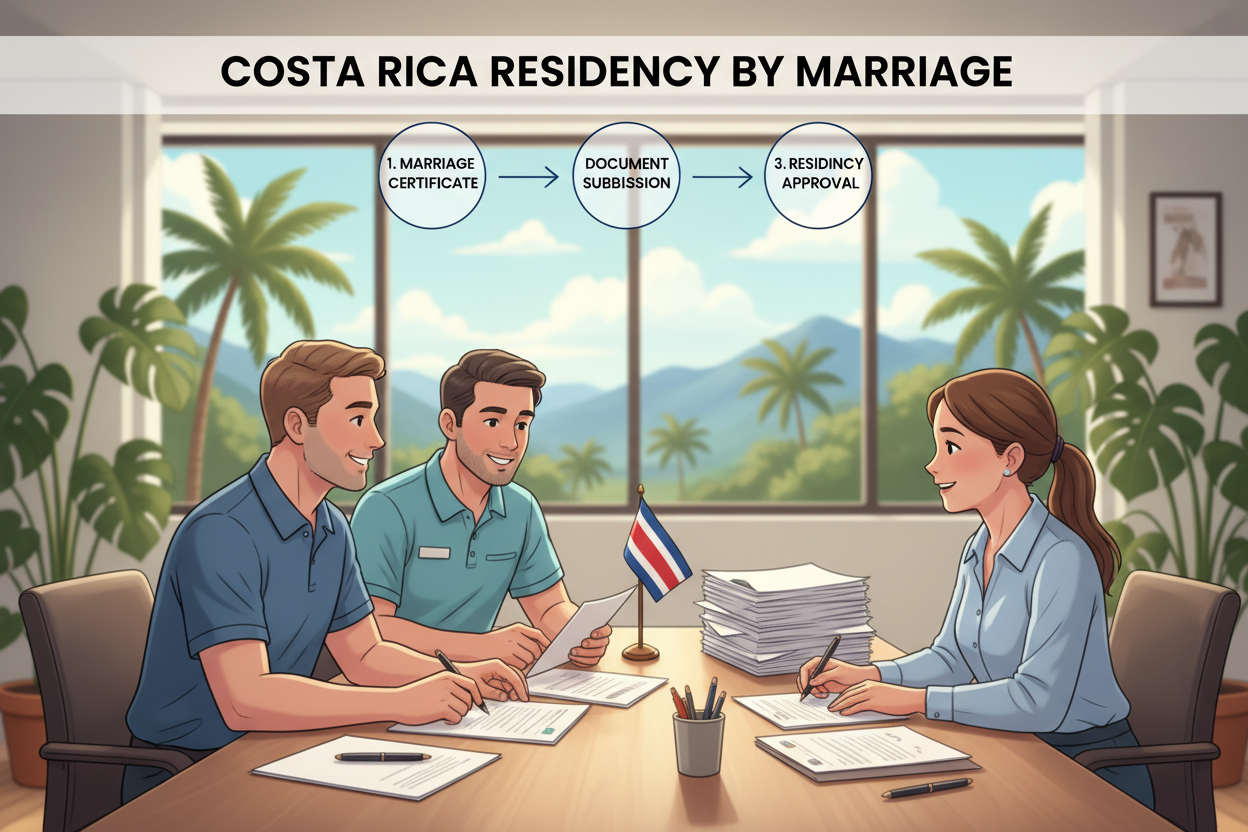
We understand that securing legal status in a new country can feel complex. For many, the Matrimonio category represents one of the most accessible pathways. Unlike other options, this route has no minimum income requirement.
This is a realistic three-year journey from temporary to permanent status. It is not an overnight process. We will walk you through every document, timeline, and government cost you will encounter.
It is crucial to start preparing your documentation from your home country. Apostilles and official translations take time. Beginning early prevents costly delays.
This guide provides your roadmap. We offer factual information on procedures you can verify yourself. We do not give specific pricing quotes or service guarantees.
Consider us your experienced partner. We help navigate this bureaucratic system. For personalized consultation, contact us via WhatsApp at +506 8706 3888 or email info@crie.cr.
Understanding Eligibility and Documentation Requirements

Before discussing documents, we must clarify who can apply under this specific immigration route. The Matrimonio category is unique in its focus.
Qualifying for Residency by Marriage (Matrimonio)
You must be legally married to a Costa Rican citizen or a legal resident. Same-sex marriages are fully recognized for this purpose. Your spouse’s status is the key.
This is a major difference from other options. Categories like Pensionado require a pension of over US$1,000 per month. The Rentista category needs proof of US$2,500 monthly income for two years. The Matrimonio path has no such income requirement for the foreign spouse.
Preparing Apostilles and Translations
Document preparation starts in your home country. Your passport needs at least six months of validity. We recommend more to cover processing time.
Critical documents like your birth certificate and police clearance require an apostille or consular legalization. They must then be translated into Spanish by a certified translator. This process cannot be done after you arrive.
If you married abroad, that certificate must also be apostilled, translated, and registered with Costa Rica’s Civil Registry. Authorities may request additional proof your relationship is genuine.
We provide this guidance so you can plan. Always verify the latest details at the official migracion.go.cr website. For help navigating these steps, contact us via WhatsApp at +506 8706 3888 or email info@crie.cr.
Costa Rica Residency by Marriage Fees

A clear breakdown of official charges helps you budget accurately for your application.
Breaking Down Government Deposit Requirements
Your first required payment is an application deposit to the DGME. This amount ranges from $50 to $200 USD. You must pay it at Banco de Costa Rica.
The bank receipt must show your full name as it appears on your passport. This receipt is mandatory before submission.
After approval, you pay a DIMEX card issuance fee. It is typically between $98 and $123 USD. A refundable guarantee deposit is also held by the government.
You can reclaim this deposit if you end your status or become a citizen. If changing from a tourist visa, a $200 USD change of status fee applies.
Additional Payment Details Without Promises
Enrollment in the CCSS social security system is mandatory. This involves separate monthly payments.
All government payments must be made at Banco de Costa Rica. Keep every receipt as proof.
A small fee is due at Correos de Costa Rica when you pick up your physical ID card.
We do not quote legal, translation, or apostille service costs here. All listed amounts are official fees subject to change.
Always verify current details at migracion.go.cr. For guidance, contact us via WhatsApp at +506 8706 3888 or email info@crie.cr.
Step-by-Step Guide to the Application Process
We guide you through the two pivotal stages: validating your union locally and filing with national authorities.
Registering Your Marriage in Costa Rica’s Civil Registry
If your wedding occurred outside the country, this is your first critical step. You must submit your apostilled and translated marriage certificate to the Civil Registry.
This registration is a mandatory prerequisite, not optional. It typically takes several weeks to process. The immigration authorities will not accept your residency application without this proof of official recognition in the Costa Rican system.
Submitting Your Complete Application to DGME
Next, assemble your full dossier. This includes your apostilled birth certificate, police clearances, and all official Spanish translations. You can submit this packet in person at the DGME office in San José or through a legal representative.
Your application must include Banco de Costa Rica payment receipts showing your exact name. Processing times vary widely but typically range from six to twelve months.
We set realistic expectations and avoid promises on specific timelines. Always verify the latest details at the official migracion.go.cr website. For personalized guidance through this process, contact us via WhatsApp at +506 8706 3888 or email info@crie.cr.
Common Pitfalls and Mistakes to Avoid
We see the same avoidable mistakes derail applications, with document expiration being the primary culprit. Other oversights can also prove costly and time-consuming.
Birth certificates and police clearances are only valid for six months from issuance. If the immigration process extends beyond that, you must obtain new documents and pay all fees again.
In one case, an FBI background check took five months to secure. By the time authorities reviewed the file months later, it had expired. This triggered a complete reapplication, costing approximately $600 USD for expedited service plus shipping.
The timing is extremely tight. If securing apostilles takes 8-12 weeks and DGME processing takes 6-12 months, any delay risks expiration. Starting document preparation in your home country is financially essential to avoid high overseas costs.
Handling Document Expirations and Reapplications
Other common errors include failing to register a foreign marriage with the Civil Registry first. Using non-certified translators also leads to rejection.
We outline these pitfalls to help you. The immigration system can be unpredictable. Professional guidance often prevents costly mistakes discovered too late. For assistance, contact us via WhatsApp at +506 8706 3888 or email info@crie.cr.
Tips for a Smooth Transition to Permanent Residency
The transition from temporary to permanent resident is a structured, three-year process with distinct phases. Your initial legal standing under the Matrimonio category is temporary, valid for one year and requiring renewal.
This temporary residency status grants you nearly all practical benefits. You gain legal residence, work authorization, and access to the CAJA healthcare system.
Understanding Temporary vs. Permanent Residency
You must renew this temporary status annually for three consecutive years. After completing the third year, you become eligible to apply for permanent residency.
The key advantage of this category is the lack of a continuing income threshold. Unlike the Pensionado route requiring over USD 1,000 monthly or Rentista needing USD 2,500, marriage-based residency imposes no such requirement once you achieve permanent status.
You must remain married to your Costa Rican spouse throughout the three-year temporary period. Permanent residency eliminates annual renewals, providing long-term stability. Your legal standing no longer depends on specific conditions.
This stable status is the final step before the separate citizenship pathway. After maintaining residency and marriage for at least two years each, you may apply for naturalization.
A practical tip is to set calendar reminders 60 days before each annual expiration. Never let your temporary status lapse. For detailed guidance on maintaining your status, review our resource on residency for spouses.
We provide this overview to help you plan. Always verify the latest procedures at the official migracion.go.cr website. For personalized assistance, contact us via WhatsApp at +506 8706 3888 or email info@crie.cr.
Your Next Steps Toward a New Life in Costa Rica
Your journey to building a life here begins with understanding and action. The Matrimonio path is a legitimate three-year progression from temporary to permanent legal status.
Your most critical move is to start gathering documents from your home country now. Getting apostilles and certified translations done early prevents costly delays later.
Always verify the latest procedures and official charges at migracion.go.cr. You can also review answers to common questions on our site.
Navigating this immigration system from abroad can feel complex. We serve as your experienced guide through the entire process.
Reach out via WhatsApp at +506 8706 3888 or email info@crie.cr. We provide a clear assessment and help ensure your application is complete.
We cannot guarantee specific outcomes, but with proper preparation, this category offers a straightforward route to establishing your new home.
FAQ
What are the main financial requirements for the residency by marriage application?
How long does the entire application process typically take?
What is the difference between temporary and permanent residency status in this category?
Why is registering our foreign marriage in the National Registry a critical first step?
What happens if my passport or a document expires during the application?
What is the DIMEX card, and when do I get it?
Article by Glenn Tellier (Founder of CRIE and Grupo Gap)
Don't wait, contact us right now!
Call or WhatsApp Costa Rica +506 8373 2085 or +506 8706 3888
Call USA/Canada +1 305-906-6784