
Costa Rica offers several legal pathways to live here long-term, but the right option depends on your income source, family ties, and whether you need local work authorization. Many people start with a temporary residency category (like Pensionado, Rentista, or Investor), while others qualify through family ties. There are also long-stay options that are not residency.
On this hub page, you’ll see the main residency categories, what they’re generally designed for, the documents that most often matter, and a high-level process overview. We’ll confirm eligibility on WhatsApp so you can choose the cleanest path without guessing.
Qualification Snapshot
- Most common starting points: Pensionado (USD $1,000/month), Rentista (USD $2,500/month for two years; income-only), Investor (USD $150,000).
- Family ties can change everything: certain relationships with a Costa Rican citizen can create different residency options.
- Work rules are strict: many residency categories allow you to live here but do not allow local employment as an employee.
- Permanent residency is usually later: often after maintaining qualifying temporary residency for the required time, or via qualifying family ties.
- Digital Nomad is not residency: it’s an “estancia” (long-stay) category for remote workers with foreign-sourced income.
- Documents drive approvals: authentication, official translation, and validity windows are where most delays happen.
- Consistency matters: names, dates, and identity details must match across every document and filing.
- We keep it organized: CRIE focuses on clean category selection + clean documentation so you avoid preventable delays.
Who This Page Is For
- People comparing all major residency options before starting Costa Rica immigration.
- Retirees deciding between Pensionado and other paths.
- Non-retirees with stable foreign income exploring Rentista or Investor.
- Applicants with a Costa Rican spouse/child/parent who may qualify through family ties.
- Remote workers evaluating the Digital Nomad option (and what it does not do).
- People who need clarity on work authorization vs. permission to reside.
- Anyone who wants a high-level roadmap before ordering documents.
Not a Fit If…
- You want a “one size fits all” answer—Costa Rica categories are fact-specific.
- You want to work locally immediately but don’t have a qualifying work authorization path.
- You plan to rely on the Digital Nomad Visa as a residency timeline toward permanent residency (it does not count as residency).
- You prefer minimal paperwork—Costa Rica immigration is documentation-heavy by design.
- You need legal advice (this page is informational; we handle the immigration process, not legal opinions beyond immigration scope).
Requirements at a Glance
Every category has its own “specific” requirements, but most residency processes share the same backbone: (1) choose the correct category, (2) prepare foreign civil documents correctly, (3) complete official Spanish translations, and (4) submit a consistent, complete file that fits the chosen pathway. Most delays are document timing and formatting—not “missing a form.”
- Identity: valid passport and required copies.
- Civil records: birth certificate (and marriage/divorce records if relevant).
- Police record(s): typically required in the appropriate format and within validity windows.
- Category proof: pension letter, income proof, investment proof, or family-tie evidence (depending on the category).
- Translations: official Spanish translations where required.
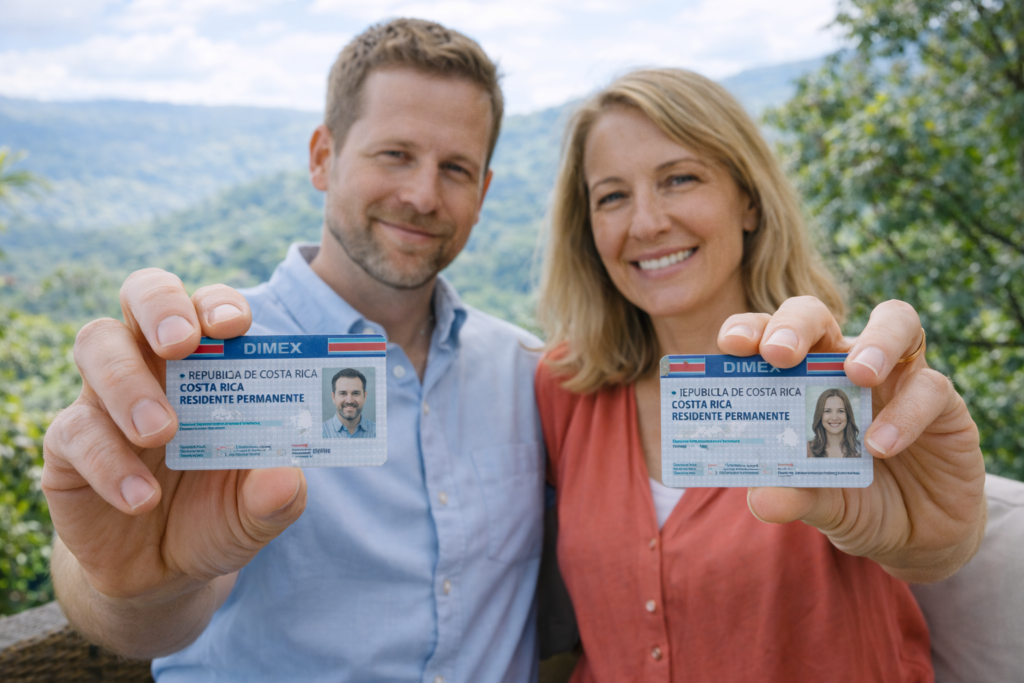
- Local steps: fingerprints/appointments and post-approval documentation steps (DIMEX, etc.).
Residency Options Overview
The categories below cover the most common ways people become legal residents in Costa Rica. Each section explains who it’s for, what it generally requires, and the most important “watch-outs.” For details, use the links to the dedicated category pages.
Pensionado Residency (Retirees)

Pensionado is typically the cleanest residency path for retirees who receive a lifetime pension. It’s popular because the financial requirement is straightforward and the category is well-established. If you have multiple pension sources, we focus on how to document them cleanly in the format Costa Rica expects.
- Threshold: USD $1,000/month lifetime pension.
- Best for: retirees with stable, documentable pension income.
- Work note: this category generally does not allow local employment as an employee.
Learn more about Pensionado Residency
Rentista Residency (Fixed Foreign Income)

Rentista is typically for people who are not yet “retired” but have guaranteed foreign income. It’s a strong option for those living off stable income sources outside Costa Rica and who want a true residency category rather than a short-term visa solution.
- Threshold: USD $2,500/month guaranteed foreign income for two years (income-only).
- Best for: people with stable foreign income who want residency without an investment requirement.
- Work note: generally does not allow local employment as an employee.
Learn more about Rentista Residency
Investor Residency (Inversionista)

Investor residency is for applicants who meet the investment threshold and can document it properly. This is often tied to real estate or a qualifying business investment. The most important issue is how the investment is documented and who holds it, because the filing must match the immigration requirements.
- Threshold: USD $150,000 investment.
- Best for: applicants who want residency tied to a qualifying investment in Costa Rica.
- Documentation focus: the investment must be proven clearly and consistently.
Learn more about Investor Residency
Family Ties Residency (Vínculo)

Family-tie categories can be the simplest path when you qualify—but the documentation must clearly prove the relationship and the Costa Rican status of the qualifying family member. These cases often move faster when civil records are clean, consistent, and prepared correctly.
- Best for: applicants with qualifying ties to a Costa Rican citizen (for example, spouse/parent/child scenarios depending on the pathway).
- Documentation focus: civil registry evidence and relationship proof.
- Work note: work rights vary depending on the final status granted.
.
Family Categories
Learn more about Residency for spouses in Costa Rica
Learn more about Residency for parents in Costa Rica
Learn more about Residency as a child of Costa Rican
Family ties: some applicants qualify through a Costa Rican spouse, parent, or child (documentation must be clean).
Long-Stay Options That Are Not Residency
Some programs allow you to stay longer than a tourist entry, but they are not “residency” and do not count toward permanent residency timelines. If your goal is permanent residency, we’ll normally compare these options to true residency categories like Pensionado, Rentista, or Investor.
Digital Nomad Visa (Estancia)
Costa Rica’s Digital Nomad category is for remote workers with foreign-sourced income who want to live in Costa Rica longer than a tourist stay. It can be a great way to experience Costa Rica before committing to residency, but it does not count as temporary residency time toward permanent residency.
- Not residency: it is an “estancia,” not temporary residency.
- Remote work focus: income must come from outside Costa Rica.
- Best for: people who want a longer stay while maintaining foreign employment or clients.
Learn more about the Digital Nomad Visa
Permanent Residency and Citizenship
Permanent residency and citizenship are often the long-term goals, but they are not “first steps” for most people. The correct path depends on your current category, your timeline, and whether you qualify through family ties. Planning your path correctly from day one prevents expensive detours later.
Permanent Residency
Permanent residency is a major milestone because it typically provides broader stability and, in many cases, broader work eligibility than many temporary categories. It is often available after maintaining qualifying temporary residency for the required time, or through qualifying family ties.
Learn more about Permanent Residency
Citizenship
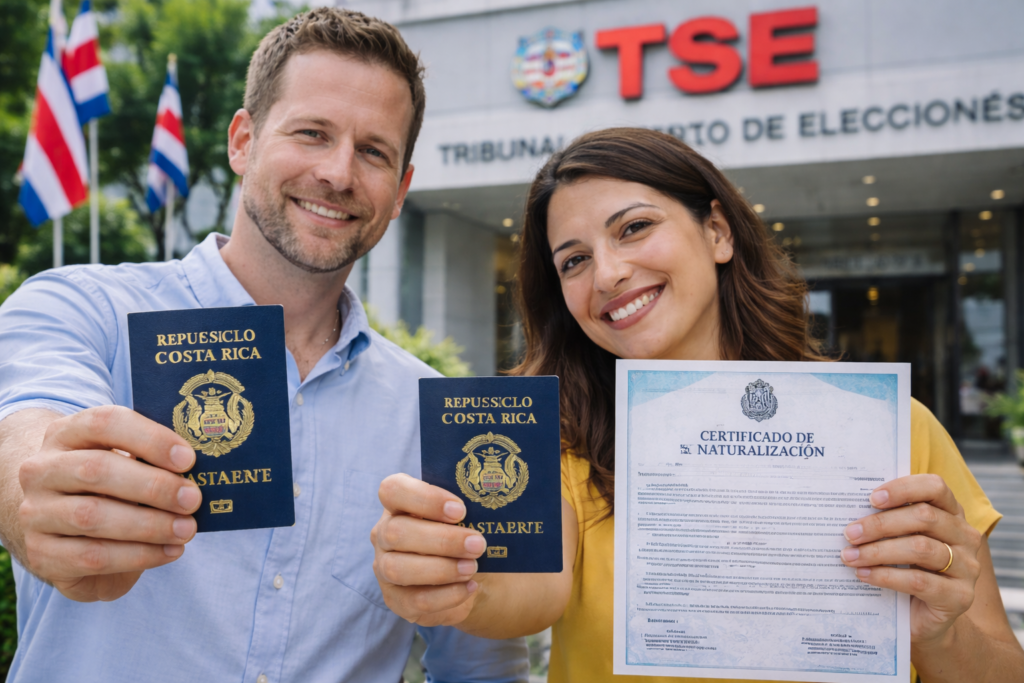
Citizenship is a separate process with its own requirements and timelines. Some routes are based on years of residency, while others can be affected by marriage or family ties. If citizenship is your long-term goal, we help you plan a realistic sequence (and avoid assuming the wrong timeline).
Documents to Prepare Before You Arrive
If you want a smoother immigration process, plan your documents before you travel—especially if you’re trying to file quickly after arriving in Costa Rica. Most delays happen when documents are not authenticated correctly, translations are not official, or documents fall outside validity windows and must be re-issued.
- Birth certificate: official version suitable for international use.
- Police record(s): issued by the correct authority and within required validity windows.
- Marriage/divorce records (if relevant): especially for family-tie pathways.
- Category proof: pension letter, income proof, or investment documentation depending on your chosen category.
- Passport: ensure validity and keep clean copies ready.
Authentication + translation + validity windows: Depending on your country and document type, you may need apostille or other authentication, and official Spanish translations in Costa Rica. Some documents must be recent at the time of filing. We help you time this correctly so you don’t order documents too early or too late.
Process Overview
Costa Rica immigration becomes much simpler when you follow a clean sequence: confirm category first, then build a complete file, then submit and stay responsive. The steps below are a high-level roadmap (not DIY instructions).
- Choose the correct pathway: Pensionado, Rentista, Investor, family ties, or another qualifying category.
- Document plan: identify which documents you need and their validity windows.
- Authentication strategy: confirm apostille/consular process based on the issuing country.
- Official translations: translate documents in the correct format when required.
- Submit the application: file in the correct format and category.
- In-process stage: respond promptly to any clarification requests.
- Approval + documentation: complete post-approval steps (including DIMEX) as applicable.
Can I Work With This Status?
Work rights depend on your immigration status. Many temporary residency categories allow you to reside in Costa Rica, but do not allow working locally as an employee. Permanent residency and citizenship typically provide broader work rights. If local employment is your priority, you should review work authorization paths early, because they are not automatic.
See: Work Permit in Costa Rica
Common Mistakes That Delay Approvals
Most problems are preventable. The issues below are the most common reasons immigration cases slow down, get stuck in clarification requests, or require rework.
- Choosing the wrong category (or mixing requirements from different categories).
- Ordering documents too early and missing validity windows at filing time.
- Missing apostille/consular authentication (or using the wrong authentication method).
- Using non-official translations or translations that don’t match the authenticated original.
- Name/date inconsistencies across passport, civil documents, and prior filings.
- Unclear income proof that doesn’t show the required source, stability, or format.
- Investor documentation that doesn’t clearly prove the qualifying investment.
- Assuming Digital Nomad counts as residency toward permanent residency (it does not).
- Underestimating appointment timing and local follow-up steps after approval.
- Working locally without authorization (creates serious risk for you and employers).
Quick Comparison
Use these links to review the most common residency starting points. We can help you compare them based on your goals, timelines, and work needs.
- Pensionado — USD $1,000/month pension.
- Rentista — USD $2,500/month for two years (income-only).
- Investor (Inversionista) — USD $150,000 investment.
- Permanent Residency — long-term status after qualifying time or family ties.
How CRIE Helps
Costa Rica immigration is manageable when your category choice is correct and your file is clean. CRIE focuses on accurate category selection, correct document timing, and consistent formatting so you avoid preventable delays and “back-and-forth” requests.
What we do
- Confirm the best category for your goals (and explain why).
- Provide a tailored checklist and document timing plan.
- Flag authentication/translation issues before submission.
- Check identity consistency across every document.
- Guide the submission flow and keep the process organized and trackable.
What you do
- Share your background (income source, family ties, work needs, and timeline).
- Order foreign documents using our timing guidance.
- Provide the category-specific proof (pension/income/investment/relationship evidence).
- Attend required appointments and respond quickly if clarification is requested.
Frequently Asked Questions
Which residency category is best for most retirees?
Many retirees start with Pensionado if they have a qualifying lifetime pension (USD $1,000/month). The best fit depends on how your pension is paid and how it can be documented.
What if I’m not retired but I have steady foreign income?
Rentista is commonly used when you can document guaranteed foreign income (USD $2,500/month for two years; income-only). If your income is structured differently, Investor or other pathways may fit better.
Does Digital Nomad count toward permanent residency?
No. Digital Nomad is an estancia category, not residency. If permanent residency is your goal, you should start with a true residency category such as Pensionado, Rentista, or Investor if you qualify.
Can I work in Costa Rica as a temporary resident?
Many temporary residency categories do not allow local employment as an employee. Work rights depend on your category and authorization. If work is central to your plan, review work permit rules early.
How do family ties change my options?
Qualifying family relationships with a Costa Rican citizen can create different pathways. The key is proving the relationship with clean civil records and correct documentation.
What documents should I start with first?
Birth certificate and police record(s) are commonly the first documents to plan, because they often need authentication, official translation, and must be within validity windows at filing time.
What is the biggest reason applications get delayed?
Document timing and formatting: missing authentication, unofficial translations, and identity inconsistencies cause many of the longest delays.
Do I have to be in Costa Rica to apply?
Many people prepare documents abroad first and then file once they’re in Costa Rica. The best approach depends on category, timing, and document readiness.
When do I get a DIMEX?
DIMEX is typically part of the post-approval documentation stage after your category is approved. The sequence and appointments depend on your approved status.
If I want citizenship one day, what’s the best strategy?
Start with the correct legal status and maintain clean continuity. Citizenship is separate from residency and depends on timelines and requirements. We help you plan the sequence correctly from the beginning.
Message CRIE on WhatsApp
If you want a clear path, start with a quick eligibility check. We’ll confirm eligibility on WhatsApp and tell you which category fits best—before you spend time and money ordering documents.
WhatsApp: +506 8706 3888
Email: info@crie.cr
Professional Disclaimer
This page is provided for general informational purposes only. Immigration rules, internal criteria, and required documentation can change. Information on this page is based on, and checked against, Costa Rica’s official immigration authority (Migración/DGME): https://migracion.go.cr/.