
If you’re living in Costa Rica, visiting, or in the middle of a move, there are times you’ll need your country’s embassy or consulate—passport renewals, emergency travel documents, notarial services, arrests/hospitalizations, child travel issues, or just official guidance.
This guide shows you the fastest, most reliable ways to find embassy and consular contacts in Costa Rica, what to do in an emergency, and what information to have ready before you call. It also includes a short list of commonly requested embassy contact sources and official directories.
Important: Embassy phone numbers, locations, and after-hours procedures can change. Always confirm details using official government sources and the Costa Rica Ministry of Foreign Affairs directory before you go in person.
What’s the fastest way to find embassy contacts in Costa Rica?
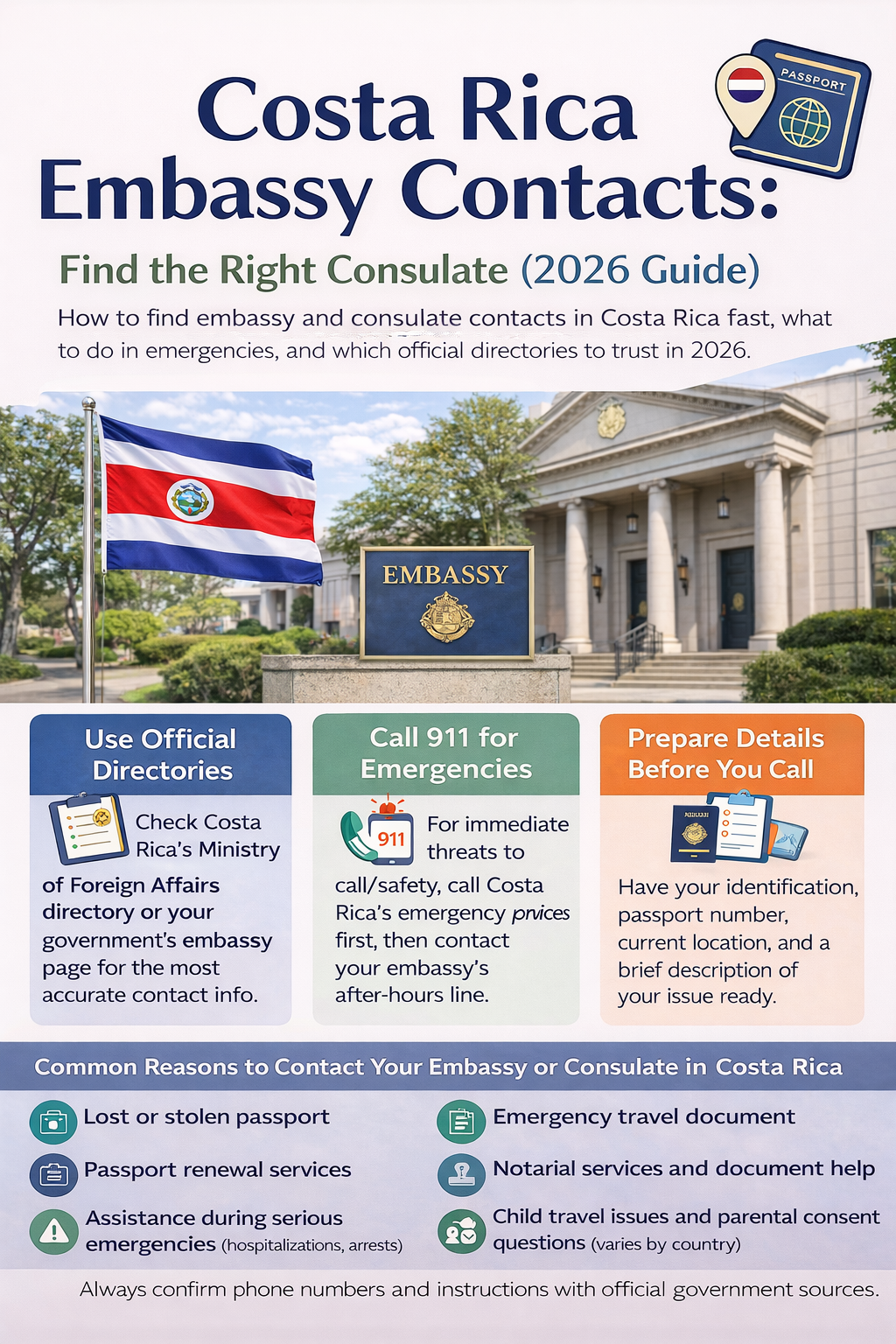
The most reliable starting point is Costa Rica’s official Ministry of Foreign Affairs directory of foreign missions (“Representaciones Extranjeras en Costa Rica”). It lists embassies and consulates accredited in Costa Rica and is updated by the government.
Costa Rica Ministry of Foreign Affairs: Foreign Representations in Costa Rica
If you already know your country, you can also use your government’s official “Embassy/Consulate in Costa Rica” page (often the most accurate for emergency numbers and service rules).
Embassy vs. consulate: which one do you actually need?
People often say “embassy” when they really mean “consular services.” In simple terms:
- Embassy: the main diplomatic mission (often in San José) handling government-to-government matters and usually hosting consular services too.
- Consulate: focuses on services for citizens (passports, emergency travel documents, notarials, civil registry guidance, some visa information) and may be located separately.
For most personal needs—passport issues, emergencies, documents—you’re looking for the consular section, even if it is housed inside the embassy.
What to do in an emergency in Costa Rica
If there is an immediate threat to life or safety, call Costa Rica’s emergency number first:
- Emergency services in Costa Rica: 911
Then contact your embassy/consulate using the official “emergency contact” instructions on their website. Many countries route emergencies through a central call center after hours.
Commonly requested embassy contact sources (official starting points)
Below are official contact pages and/or official directory listings. Use these to confirm the current phone numbers, addresses, and appointment requirements.
| Country | Official contact source | Notes |
|---|---|---|
| United States | U.S. Embassy Costa Rica — Contact | Includes main phone and emergency guidance. |
| Canada | Embassy of Canada to Costa Rica — Contact | Lists phone and email; consular help is available 24/7 via instructions on the page. |
| Spain | Embajada de España en Costa Rica — Contacto | Includes consular emergency phone and email. |
| Germany | Embajada de Alemania en San José — Portal oficial | For phone/address confirmation, you can also cross-check the Costa Rica Foreign Affairs directory entry. |
| Mexico | Embajada de México en Costa Rica — Contacto | Lists switchboard numbers and consular section info. |
| United Kingdom | British Embassy San José — GOV.UK (Office) | Location details may change; GOV.UK is the best source for updates and emergency routing. |
How to use Costa Rica’s official embassy directory
If you don’t see your country listed above, use the Costa Rica Ministry of Foreign Affairs directory and search by country. The directory typically shows the mission type (embassy/consulate), address area, and phone number(s).
Foreign Representations in Costa Rica (Official Directory)
For the most accurate result, cross-check the directory entry with your government’s official embassy page. If there is a mismatch, follow the embassy’s official website for instructions, and use the directory as a second reference.
Do I need an appointment to visit an embassy or consulate in Costa Rica?
Usually, yes. Many embassies and consulates operate by appointment only for passport services, notarials, and routine citizen services. Walk-ins are generally limited to emergencies (and even then, embassies may require you to call first). Always check the official website for booking instructions before going in person.
What information should I have ready before I call?
Having the right details ready saves time and reduces call transfers. Prepare:
- Your full name as shown on your passport
- Your passport number (if available)
- Your date of birth
- Your current location in Costa Rica (city/area)
- A brief, clear summary of the issue (lost passport, emergency travel, arrest/hospitalization, etc.)
- A local phone number where you can be reached
Common reasons people contact embassies in Costa Rica
- Lost or stolen passport
- Emergency travel document
- Passport renewal and citizen services
- Notarial services (where offered) and document guidance
- Assistance during serious emergencies (hospitalization, arrest, death notification procedures)
- Child travel issues and parental consent questions (varies by country)
- Voting information (country-specific)
Frequently Asked Questions (FAQ)
What is Costa Rica’s emergency number?
Dial 911 for emergencies in Costa Rica.
Where are most embassies located in Costa Rica?
Most are in the greater San José area, often in business districts such as La Sabana, Rohrmoser, Escazú, or nearby zones, though locations vary by country.
How do I find my embassy’s correct phone number?
Use your government’s official embassy/consulate website first, and cross-check with the Costa Rica Ministry of Foreign Affairs directory of foreign missions.
Do embassies in Costa Rica accept walk-ins?
Many routine services require appointments. For emergencies, call first and follow the embassy’s official emergency instructions.
What should I do if my passport is lost or stolen?
Contact your embassy/consulate using the official “lost/stolen passport” or “emergency travel document” instructions on their website. If there is immediate risk to your safety, call 911 first.
Can an embassy help me with Costa Rica residency or immigration?
Embassies can sometimes provide general guidance, but Costa Rica immigration processes are handled through Costa Rican authorities. If you need immigration/residency help, you typically work with a Costa Rica immigration professional.
Does the Costa Rica Ministry of Foreign Affairs list every consulate?
It lists official foreign representations accredited in Costa Rica, but services and office locations can change. Always confirm via the embassy’s official website.
Do I need to bring documents to an embassy appointment?
Yes, typically identification plus supporting documents related to your request. Requirements vary by country and service, so confirm the checklist on the embassy’s official site before your appointment.
What if my embassy says it moved or changed locations?
Follow the embassy’s official website for the most current instructions and address updates, and use the Costa Rica directory as a cross-check.
Professional Disclaimer
This article is provided for general informational purposes only and does not constitute legal, immigration, tax, or financial advice. Embassy and consular procedures can change without notice and vary by country. Always confirm details directly with the official embassy/consulate website and the Costa Rica Ministry of Foreign Affairs directory. CRIE provides immigration and residency services only.
Article by Glenn Tellier (Founder of CRIE and Grupo Gap)
Don't wait, contact us right now!
Call or WhatsApp Costa Rica +506 8373 2085 or +506 8706 3888
Call USA/Canada +1 305-906-6784