
Costa Rica attracts remote professionals with its stunning nature and stable infrastructure. It’s crucial to understand the legal options from the start.
The Digital Nomad visa, launched in 2022, is a temporary stay permit. It is not a residency pathway and does not count toward permanent residency or citizenship.
We at CRIE specialize exclusively in Costa Rica residency and immigration. We guide clients through permanent pathways like the Pensionado, Rentista, and Inversionista visas.
For context, the temporary Digital Nomad visa requires proof of $3,000 monthly income for individuals. It allows a one-year stay, renewable once. You can learn more in this detailed guide to the Costa Rica Digital Nomad.
Our approach involves step-by-step guidance from your home country. We ensure all critical documents are properly prepared before you arrive, avoiding common application delays.
Overview of Costa Rica Digital Nomad Visa and CRIE Residency (CRIE)
Choosing between a short-term stay permit and a formal residency status is a critical first step for anyone planning to live in Costa Rica. The two paths serve very different long-term goals.
Understanding the Visa and Residency Pathways
The Digital Nomad visa is officially a temporary “Estancia” or stay. It allows remote work for one to two years but does not lead to permanent residency or citizenship.
True residency is different. Categories like Pensionado, Rentista, and Inversionista offer renewable status. This time counts toward the seven-year requirement for citizenship eligibility.
CRIE’s Role in Costa Rica Immigration
We at CRIE work exclusively with these residency categories. Our role is to navigate the complex immigration system for you.
We guide clients to prepare their complete application from their home country. This includes gathering apostilled documents, certified translations, and financial proof.
We ensure everything meets the strict standards of the Dirección General de Migración y Extranjería (DGME). Always verify the latest rules at the official portal, migracion.go.cr. We translate those regulations into a clear, actionable plan for your move.
costa-rica-digital-nomad-visa-requirements-benefits-and-application-process
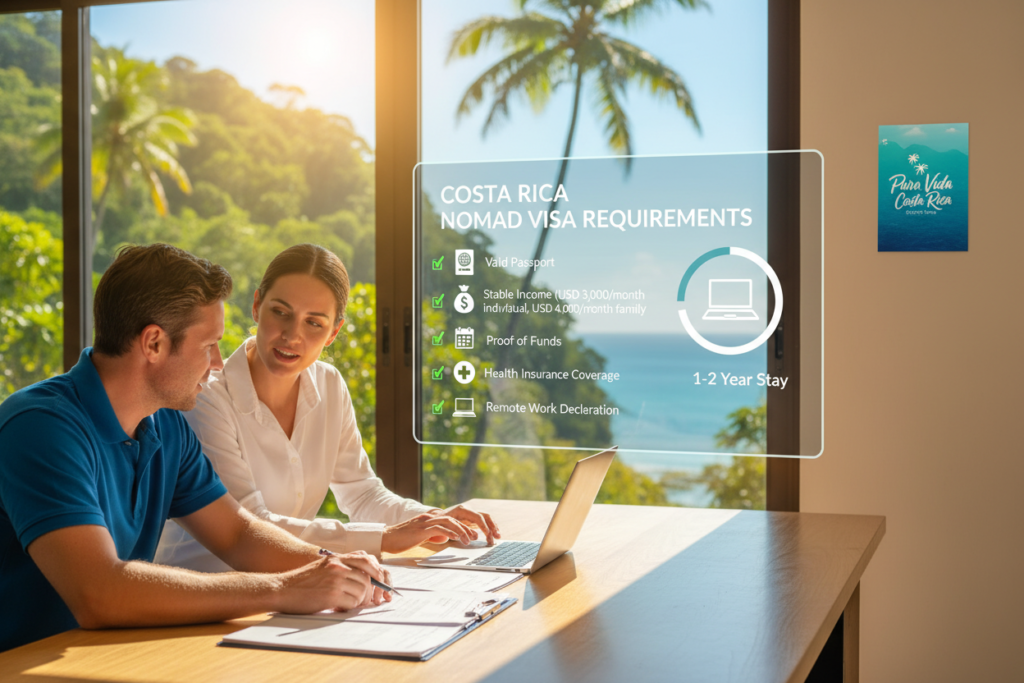
The temporary stay permit for remote professionals hinges on clear income thresholds and a streamlined online application. You must prove a monthly income of $3,000 for individuals or $4,000 with dependents.
This requires twelve months of bank statements and a notarized affidavit. You also need international health insurance with at least $50,000 in coverage.
Approved applicants gain significant benefits. These include a tax exemption on foreign-sourced income and the ability to open local bank accounts.
You can also import work equipment duty-free. Remember, these are temporary privileges for one year, renewable once.
The application involves a $100 fee paid to Banco de Costa Rica. You then submit documents through the official tramiteya.go.cr platform.
Initial review takes about 15 calendar days. A critical restriction is that you cannot work for any Costa Rican employer.
This permit does not count toward residency or citizenship. For long-term status, explore pathways like Pensionado or Rentista visas with our guidance.
Step-by-Step Application Process and Document Preparation
Securing legal residency in Costa Rica involves a meticulous, multi-step procedure that begins long before you arrive. We guide clients through each phase, ensuring no detail is overlooked.
Eligibility Criteria and Income Thresholds
The Pensionado category is for retirees with a guaranteed lifetime pension of at least $1,000 monthly. This income must be permanent.
The Rentista pathway requires proof of $2,500 in passive income each month, guaranteed for two years. Active business earnings do not qualify.
For the Inversionista option, a minimum investment of $150,000 in local assets is needed. Crucially, any real estate must be titled in your personal name.
Gathering Essential Documents: Apostilles, Translations, and More
The document preparation process starts in your home country. You need apostilled birth certificates and police clearances from every place you’ve lived.
All foreign-language papers require certified Spanish translations. Financial proof, like pension letters or bank statements, must be current and properly formatted.
We stress organizing everything before departure. Common mistakes—like expired apostilles or incomplete translations—cause major delays. Starting correctly from home prevents these errors.
Understanding Income Requirements and Additional Residency Options
Financial qualification is the cornerstone of any successful residency application. Distinct pathways exist for retirees, investors, and those with passive income.
Pensionado (US$1,000+/month) and Rentista (US$2,500/month for 2 years) Guidelines
The Pensionado visa has a clear income requirement. You must prove a permanent pension of at least US$1,000 every month.
Acceptable sources include government Social Security or private lifetime plans. Documentation requires an official award letter and recent bank statements.
The Rentista category is for passive income. You need US$2,500 per month guaranteed for a minimum of two years.
This can come from rentals, dividends, or annuities. You must provide proof like lease agreements or brokerage statements covering the full 24-month period.
You can generally combine income sources for the Rentista requirement. Social Security definitively counts for the Pensionado path.
Investor (Inversionista) Minimum Investment and Property Guidelines
The Inversionista visa requires a minimum investment of US$150,000 in local assets. This can be real estate, business equity, or approved securities.
A critical property requirement exists. If using real estate, the title must be in your personal name.
Ownership through a corporation does not qualify. You can invest in multiple smaller properties if their combined appraised value meets the minimum.
All financial proof requires apostilles and certified Spanish translations. These thresholds can change, so always verify current rules at migracion.go.cr.
Proper documentation is where applications succeed or fail. For a detailed look at how these options compare to a temporary stay permit, explore this comparison of permanent residency options.
Avoiding Common Application Mistakes and Timeline Considerations
The journey to residency is often delayed by simple, preventable errors in document preparation. We guide clients to understand these pitfalls from the start, as they directly impact your timeline.
Mistakes to Avoid During Your Application Process
Apostilles on birth certificates and police clearances must be current, typically within six months of submission. Using expired documents is a frequent error.
Translation mistakes also cause rejections. All foreign documents require certified Spanish translations from approved legal translators, not informal services.
Financial proof must match your chosen category. Pensionado requires permanent pension letters, not temporary statements. Rentista needs passive income proof, not active business earnings.
Understand the timeline difference. The Digital Nomad visa processes in about 15 days. A full residency application typically takes 3 to 6 months.
Each error adds weeks of delays. Starting with complete, correct paperwork from home is the best way to avoid these costly setbacks.
Pre-Arrival Prep: Organizing Your Documentation from Home
Organizing your paperwork from home is the single most effective way to avoid costly delays upon arrival. We guide clients to view this preparation as the critical first phase of their application.
Checklist for Preparing Documents Before Arrival
Start with your passport. Ensure it has at least six months of validity and blank pages. Next, obtain your apostilled birth certificate from your country of birth.
You also need apostilled police clearance certificates from every country you’ve lived in for the past three years. Every foreign document requires a certified Spanish translation.
Financial proof must match your chosen residency category. Gather pension letters, bank statements, or investment deeds accordingly. For dependents, collect recent apostilled marriage and birth certificates.
Do not forget passport photos and completed application forms. Verify the current official checklist at migracion.go.cr. For a complete breakdown, consult our detailed paperwork guide.
This systematic preparation prevents common mistakes. It sets you up for a smooth submission process from day one.
Navigating Immigration with CRIE and Migracion.go.cr
Successfully navigating Costa Rican immigration relies on two key pillars: official government resources and expert guidance. Understanding this distinction streamlines your entire process.
We help clients use both elements effectively. This combination provides clarity and reduces the risk of application errors.
Using Official Platforms for a Seamless Process
The migracion.go.cr website is your primary source for all official rules. Here you find current application forms, detailed requirement lists, and the latest fee schedules.
For certain submissions, you will use the tramiteya.go.cr digital platform. This is the official channel for online filing and is essential for a modern process.
Staying Updated on Immigration Guidelines
Regulations in this country can change with little public notice. Income thresholds, document lists, and procedures are periodically updated.
We continuously monitor migracion.go.cr for these updates. Our services translate complex regulatory changes into clear, actionable steps for your specific case.
This proactive approach ensures your application complies with the most current official standards. For personalized guidance, visit crie.cr.
Ready to Begin Your Costa Rican Adventure?
Making Costa Rica your home requires more than a temporary permit. It demands a commitment to a formal residency pathway.
We at CRIE specialize exclusively in these permanent options. Our focus is on guiding you through the Pensionado, Rentista, and Inversionista categories.
If you seek true residency—not just a short-term stay for digital nomads—we are your dedicated partner. We help you prepare the correct documents from your home country, avoiding costly delays.
Ready to take the next step? Contact us today for a professional assessment. Reach us via WhatsApp at +506 8706 3888 or email info@crie.cr.
Let’s discuss your eligibility and build a clear plan for your future in Costa Rica.
FAQ
What are the main benefits of the Costa Rica digital nomad visa?
What are the income requirements to qualify for this visa?
How long does the application process typically take?
Can my family join me on this visa?
Do I need to pay local taxes on my remote work income?
What is the role of CRIE in the application process?
What are the most common mistakes applicants make?
How do I get started with my application?
Article by Glenn Tellier (Founder of CRIE and Grupo Gap)
Don't wait, contact us right now!
Call or WhatsApp Costa Rica +506 8373 2085 or +506 8706 3888
Call USA/Canada +1 305-906-6784