
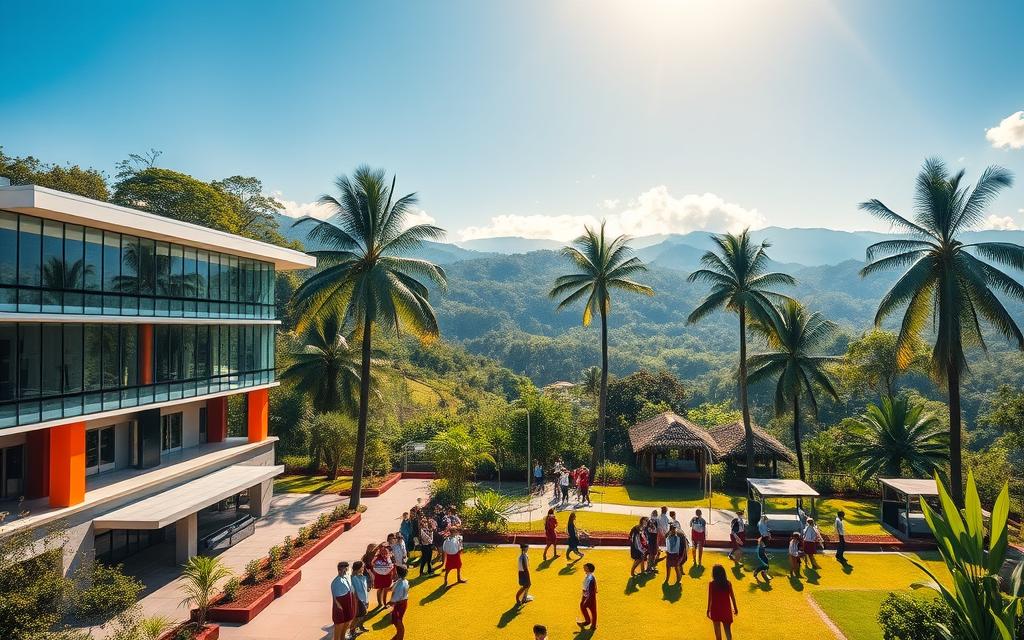
Costa Rica has become a popular destination for expat families, drawn by its high standard of living and excellent education system. With a literacy rate approaching 95%, Costa Rica’s education system is among the best in Latin America.
Expat families can choose from a range of schooling options, including public, private, international, and homeschooling. International schools in Costa Rica offer bilingual education, cultural diversity, and a variety of extracurricular activities, making them an attractive choice for families seeking a global education.
The country’s education system is designed to cater to diverse needs, providing expat families with the opportunity to select the best fit for their children. Whether you’re looking for a school that follows an American, British, or European curriculum, Costa Rica has a range of options to suit your preferences.
Costa Rica’s Education System: An Overview
Costa Rica’s education system is a beacon of excellence in Latin America. The country has made significant investments in its education sector, resulting in a highly literate population and a robust education system that attracts expat families.
Costa Rica shines with its outstanding education system, often ranking in the global top 20%. It invests 6.5% of its GDP into education, one of the highest shares internationally. Thanks to this, almost 95% of the population can read and write. This shows the government’s strong focus on quality education for all.
The education system in Costa Rica is a model for Latin America. Schools here perform well on worldwide tests. The country boasts a 97.9% literacy rate, reflecting its commitment to educating every child.
High Literacy Rate and Quality Ranking
The high literacy rate in Costa Rica is a testament to the effectiveness of its education system. Some key highlights include:
- Costa Rica’s education system consistently ranks in the global top 20%, making it a standout performer in Latin America and an attractive option for expat families seeking quality education for their children.
- The country demonstrates its commitment to education by investing approximately 6.5% of its GDP into the sector, one of the highest percentages worldwide, which directly contributes to its educational success.
- With a remarkable literacy rate of 97.9%, Costa Rica showcases the effectiveness of its educational approach and the government’s dedication to ensuring all children have access to quality schooling.
- Costa Rican schools generally perform well on international standardized tests, further validating the system’s strength and providing reassurance to expat parents concerned about academic standards.
- The education system’s strong foundation makes Costa Rica a model for other Latin American countries and offers expat families a reliable educational environment that balances academic rigor with a holistic approach to learning.
The emphasis on quality education has positioned Costa Rica as a leader in the region, making it an appealing destination for families looking for a robust and reliable education system.
Public vs. Private Schools: Key Differences
The decision between public and private education is a critical one for expat families in Costa Rica, with each option presenting its own set of advantages and disadvantages. Both public and private schools in Costa Rica follow the guidelines set by the Ministry of Education, but there are significant differences in terms of cost, curriculum, and overall educational experience.
One of the primary considerations for expat families is the cost associated with each type of schooling. Public schools in Costa Rica are almost free, with families only needing to purchase school materials such as books and uniforms. The government also provides scholarships to help families who cannot afford these costs. On the other hand, private schools charge monthly tuition fees that can range from $300 to $1,000, depending on the school’s reputation and programs offered.
Cost and Fees Comparison
A key difference between public and private schools lies in their cost structures. While public schools are largely free, private schools require significant tuition fees. Here are some key differences:
- Public schools offer free education with minimal fees for materials, making them an economical option for expat families, although instruction is primarily in Spanish.
- Private schools charge monthly tuition ranging from $300 to $1,000, representing a significant investment for expat families, but often offer stronger English language programs and more extracurricular activities.
- Class sizes vary significantly, with public schools typically having 30-40 students per class, compared to private schools’ smaller classes of 10-20 students, potentially affecting the quality of individual attention students receive.
For expat families, the choice between public and private education often depends on budget considerations, language preferences, and the specific educational needs of their children. Many expat families opt for private schools due to the smoother transition they provide, as well as the more comprehensive curricula and stronger English language programs offered. For more information on private schools in Costa Rica, you can visit https://crie.cr/private-schools-in-costa-rica-2/.
In conclusion, while both public and private schools in Costa Rica have their advantages, the decision ultimately depends on the individual needs and preferences of expat families. By considering factors such as cost, curriculum, and class size, families can make an informed decision that best suits their children’s educational needs.
International Schools: A Popular Choice for Expats
The international schools in Costa Rica stand out as a favored option among expat families. These schools offer a range of curricula, including the International Baccalaureate (IB) program, American, and British standards, providing educational continuity for children transitioning from other countries.
Expat families in Costa Rica have a variety of top-notch school options. They can choose from international and bilingual schools that often follow globally recognized curricula. Students can maintain their proficiency in their first language while acquiring Spanish through immersion. International and bilingual schools in Costa Rica are known for their smaller class sizes, averaging 10-20 students per class, which allows for more personalized attention and tailored learning experiences.

American Curriculum Options
Some international schools in Costa Rica offer an American curriculum, which closely mirrors the educational standards found in the United States. This includes Advanced Placement (AP) courses and preparation for American college entrance exams. The American International School of Costa Rica is a notable example, boasting 171 students from 20 countries, all taught in English. Many of these schools maintain accreditation with U.S. educational authorities, ensuring that students receive credentials recognized by American universities.
For more information on alternative educational options, such as homeschooling, expat families can visit https://crie.cr/about-homeschooling-in-costa-rica/ to learn about the legal status and requirements in Costa Rica.
- International schools offer curricula aligned with American, British, or International Baccalaureate standards.
- Smaller class sizes provide more personalized attention and tailored learning experiences.
- American curriculum options include Advanced Placement (AP) courses and preparation for American college entrance exams.
- Many international schools are accredited with U.S. educational authorities.
- International schools command premium tuition rates but offer English-language instruction and a global perspective.
While international schools command premium tuition rates, many expat families consider them worth the investment for the quality education, familiar educational approach, and global perspective they foster among students.
Bilingual Education in Costa Rica
Costa Rica offers a unique bilingual education system that blends Spanish and English instruction, catering to the needs of both local and expat families. This system has gained popularity among expatriates due to its ability to provide students with a balanced education in both languages.
Bilingual education in Costa Rica is implemented through various models, each with its distinct approach to balancing Spanish and English instruction. The main models include:
- Dual Language: Equal instruction time in Spanish and English across all subjects.
- Transitional: Begins with English-dominant instruction and gradually increases Spanish exposure.
- Content-Based: Teaches core subjects in English with supplementary classes in Spanish.
- Immersion Plus: Spanish immersion with dedicated English instruction periods.

Dual Language Models
The dual language model is particularly noteworthy as it allocates equal instruction time to both Spanish and English across all subjects. Research from the Costa Rican-American Chamber of Commerce education committee suggests that this model produces the strongest bilingual outcomes, with students achieving academic proficiency in both languages by graduation.
The benefits of bilingual education in Costa Rica for expat families are numerous. Some of the key advantages include:
- Developing strong Spanish proficiency while maintaining academic progress in English.
- Creating truly bilingual and bicultural students.
- Offering a middle path between local immersion and international schooling.
- Providing students with a competitive edge in a globalized world.
By choosing a bilingual education in Costa Rica, expat families can give their children the gift of language proficiency and cultural understanding, setting them up for success in an increasingly interconnected world.
Child Education Options for Expats in Costa Rica: Regional Differences
The educational landscape for expats in Costa Rica is characterized by regional differences that impact the quality and availability of schooling options. Educational options vary dramatically across Costa Rica’s regions, with concentration and quality directly correlating to expat population density.
Central Valley (San José, Escazú, Santa Ana)
The Central Valley region, including San José, Escazú, and Santa Ana, offers the highest concentration of international and premium bilingual schools in Costa Rica. This region is the preferred location for expat families prioritizing educational options due to its widest selection of curricula, strongest AP/IB programs, and most established facilities. However, considerations include heavy traffic, higher costs, and an urban environment.

Other regions in Costa Rica, such as Guanacaste, feature growing educational options catering to the surf-oriented expat community. Guanacaste, including areas like Tamarindo, Nosara, and Flamingo, offers strong outdoor components, close-knit communities, and an entrepreneurial focus. However, these areas typically have smaller schools with more limited advanced placement options and experience seasonal population fluctuations.
Rural areas and smaller communities in Costa Rica present fewer formal educational options for expat families. These families often face longer commutes to access quality schools or may rely more heavily on homeschooling alternatives.
- The Central Valley offers the widest range of educational options, making it ideal for families seeking diverse curricula and advanced programs.
- Coastal regions like Guanacaste provide unique educational experiences with outdoor and entrepreneurial focuses.
- Rural areas have limited formal educational options, necessitating longer commutes or alternative schooling methods.
- Expat families must consider practical factors like commute times, transportation, and extracurricular activities when evaluating regional school options.
- The quality and availability of child education options directly correlate with expat population density, with more established alternatives in areas with larger expatriate communities.
When evaluating regional school options, expat families must balance academic considerations with practical factors. The choice of educational institution depends on the family’s priorities, lifestyle, and the age of their children.
Preschool and Kindergarten Options
Expat families in Costa Rica have a diverse range of preschool and kindergarten options to choose from, catering to their unique needs and preferences. The country’s pre-primary education system is designed to support the developmental needs of young children, providing a solid foundation for their future academic success.

Ciclo Materno Infantil and Ciclo de Transición
The Costa Rican pre-primary education system is divided into two main components: the Ciclo Materno Infantil and the Ciclo de Transición. The Ciclo Materno Infantil program is designed for children as young as 2 months old, offering a nurturing environment that supports their early development. The Ciclo de Transición is a one-year program that prepares children aged 5-6 years for primary school, focusing on their transition to more structured learning.
When selecting preschool options, expat families should consider several factors, including the language of instruction, the educational philosophy of the institution, and the qualifications of the teachers. Additionally, the proximity of the preschool to their home and whether the program adequately prepares children for their intended primary school path are crucial considerations.
- Costa Rica’s pre-primary education system includes the Ciclo Materno Infantil for young children and the Ciclo de Transición for those preparing to enter primary school.
- Expat families can choose from a range of preschool and kindergarten options, including free public programs and private institutions with monthly fees between $200 and $800.
- Private preschools often offer bilingual education, smaller class sizes, and more structured curricula, making them popular among expat families.
- Various childcare alternatives are available, including nannies, au pairs, and babysitters, with costs ranging from $400-$800 monthly for full-time care.
- Factors such as language instruction, educational philosophy, and teacher qualifications are key when selecting a preschool or kindergarten.
The costs associated with preschool and kindergarten programs in Costa Rica can vary significantly, depending on whether families choose public or private institutions. While public preschool is available at no cost, private preschools can range from $200 to $800 per month. Expat families are advised to research thoroughly to find a program that best fits their budget and educational preferences.
Primary and Secondary Education Pathways
Costa Rica offers a diverse range of educational options for expat families, including public, private, and international schools. The government ensures that all children receive a quality education, making it a priority for families to consider factors such as cost, curriculum, and language proficiency when selecting a school.
Elementary School Structure
The elementary school structure in Costa Rica, covering Grades 1-6, focuses on developing fundamental skills in literacy, mathematics, science, and social studies. Public schools follow the national curriculum, while private and international schools often supplement with additional subjects, providing a well-rounded education.

In Costa Rica, public elementary schools are a budget-friendly option, with classes typically ranging from 30 to 40 students. They help students build strong basics, although they might not offer as much English instruction as private or international schools.
Private and international schools, on the other hand, have smaller class sizes, usually between 10 to 20 students, and offer a broader range of subjects with a focus on English language instruction. These schools attract a mix of local and international students, creating a diverse learning environment.
- The Costa Rican elementary school structure emphasizes foundational skills.
- Middle and high school options include public colegios, private secondary schools, and international institutions.
- The education system divides secondary education into two phases: the Third Cycle and Diversified Education.
For expat families, understanding the different educational pathways is crucial, especially when planning for their children’s university education. The various pathways, including public, private, and international schools, prepare students differently for higher education both within Costa Rica and internationally.
Graduation requirements vary significantly between these pathways, with public schools requiring the Bachillerato examination, and international schools having their own set of requirements such as credits, community service hours, and capstone projects.
The Academic Calendar and School Schedules
The school year in Costa Rica has a unique schedule that differs from many other countries. Expat families need to understand this schedule to plan effectively. The academic calendar in Costa Rica typically runs from February to December, divided into two semesters.

The first semester starts in February and ends in June, while the second semester runs from July to December. Private schools may end their academic year a week or two earlier than public schools. Costa Rican schools operate on a dual-session system, with a morning schedule from 7:00 AM to 1:00 PM and an afternoon schedule from 1:00 PM to 5:00 PM. Students can attend either session, allowing schools to maximize their resources and cater to different student needs.
School Year Timeline
The Costa Rican academic calendar is distinct, running from February to December. This can pose challenges for expat families arriving mid-year, especially those from North America or Europe where the school year typically runs from August/September to May/June. The school year is divided into two semesters, with breaks in July, April (Easter), and September (Independence Day). Understanding this calendar is crucial for planning family vacations, visits back home, and coordinating with work schedules, particularly for those working remotely across different time zones. For more information on relocating to Costa Rica, families can refer to resources like considerations for expat families.
- The school year in Costa Rica is divided into two semesters, with a two-week break in July.
- Major holidays include Easter in April and Independence Day in September.
- Private and international schools may follow modified calendars aligned more closely with Northern Hemisphere academic years.
By understanding the academic calendar and school schedules in Costa Rica, expat families can better navigate the education system and make informed decisions about their children’s education.
Understanding the Costa Rican Grading System
Understanding the grading system in Costa Rica is crucial for expat families to assess their children’s academic performance accurately. Costa Rica’s schools use a detailed grading system to show how well students are doing, employing both numbers and letters to give a full picture of a student’s work in class.

The grading system is designed to provide a nuanced view of student achievement. Students in Costa Rica receive grades on either a 100-point or a 10-point scale, with corresponding letter grades that include S (Sobreasaliente/Outstanding), N (Notable), Suf (Suficiente/Sufficient), and I (Insuficiente/Insufficient).
Numerical and Letter Grading Scales
The numerical grading scales in Costa Rica typically range from 0 to 100 or 0 to 10. The corresponding letter grades are assigned based on specific numerical ranges. For instance, on the 100-point scale, grades are interpreted as follows: 90-100 corresponds to S (Outstanding), 80-89 to N (Notable), 70-79 to Suf (Sufficient), and below 69 to I (Insufficient). Similarly, on the 10-point scale, the ranges are: 8-10 for S, 7-7.9 for N, 6-6.9 for Suf, and below 5.9 for I.
For expat families, it’s essential to understand that a passing grade in Costa Rica may differ from what they’re used to. For example, on the 100-point scale, a passing grade is typically 65 or 70, which is higher than the North American standard of 60. This difference can impact how expat students perceive their academic performance. Families can find more information on residency requirements, which may be relevant for their children’s education, on the CRIE website.
Assessment methods in Costa Rican schools include a combination of exams, projects, homework, class participation, and attendance. The specific weighting of these components can vary between public and private institutions. Report cards, known as “boletines,” are typically issued quarterly, providing detailed feedback on academic performance, behavior, and attendance.
- Costa Rican schools use both numerical and letter grading scales to evaluate student performance.
- The letter grading system includes S, N, Suf, and I, corresponding to specific numerical ranges on either a 100-point or 10-point scale.
- Assessment methods vary between institutions but generally include exams, projects, and class participation.
Enrollment Requirements and Documentation
The enrollment requirements for schools in Costa Rica vary significantly between public and private institutions, making it essential for families to understand these differences when choosing the right education path for their children.
Public School Registration Process
To enroll in a public school in Costa Rica, students are required to have a good grasp of the Spanish language. The registration process involves submitting several key documents, including authenticated and translated birth certificates, previous school records, proof of residency, vaccination records, and passport copies.
Public schools in Costa Rica place a strong emphasis on residency, requiring proof that the family is living in the country. This requirement is part of ensuring that students integrate well into the local education system.
Private schools, on the other hand, may have more flexible requirements regarding residency status, sometimes accepting students on tourist visas with the expectation that they will begin the residency process. Documentation for foreign students must be apostilled or authenticated by the Costa Rican consulate and translated into Spanish.
Enrollment timelines can vary, but most schools start their registration in October or November for the following year. Many private and international schools require entrance assessments to determine the appropriate grade level and identify any additional support needs, particularly for students with limited Spanish proficiency.
Regardless of whether families choose public or private schools, the admissions offices are available to guide them through the enrollment process, making it easier to understand what documents are needed and when to apply.
Cost of Education in Costa Rica
For expat families in Costa Rica, navigating the educational landscape requires a clear understanding of the associated costs. The cost of educating children can vary significantly depending on whether parents choose public, private, or international schools.
Public School Expenses
Public education in Costa Rica is free, making it an attractive option for expat families. However, there are still some expenses to consider. Families should budget for uniforms, which can cost between $200 to $500 annually, basic school supplies, and occasional voluntary contributions for school maintenance.
- Uniforms: $200-$500 per year
- Basic school supplies: variable costs
- Voluntary contributions for school maintenance: variable
Private and international schools, on the other hand, come with tuition fees that can range widely. Budget-friendly private schools may charge between $2,000 to $4,000 annually, while premium international schools can cost $12,000 to $25,000 per year. Most mid-range options fall between $4,000 to $10,000 per year.
Additional Costs for Private and International Schools
Beyond tuition, families must consider additional expenses such as registration fees, technology fees, transportation, school lunches, and extracurricular activities. These costs can add up, with registration fees ranging from $800 to $3,000, technology fees from $300 to $1,200, and transportation costs from $400 to $2,500 annually.
- Registration fees: $800-$3,000
- Technology fees: $300-$1,200
- Transportation: $400-$2,500 per year
- School lunches: $600-$1,500
- Extracurricular activities: $300-$2,000
Many schools offer flexible payment plans, including annual payments with discounts, semester payments, or monthly installments, which can help families manage their educational budgets more effectively.
When comparing educational costs, it’s worth noting that Costa Rica’s international school expenses are, on average, 23% lower than comparable options in the United States but 15% higher than similar schools in other Central American countries.
Top International and Bilingual Schools in Costa RicaLearn More
With numerous international and bilingual schools, Costa Rica provides expats with a range of educational options for their children. These schools are recognized for their smaller class sizes, which enable more personalized attention and a more effective learning experience.
San José Area Schools
The San José area is home to some of Costa Rica’s most prestigious international and bilingual schools. These include the American International School of Costa Rica, which follows an American curriculum and has 171 students from 20 countries, and Lincoln School, which offers AP courses and American accreditation.
The American International School of Costa Rica boasts a diverse student body and a curriculum that is taught entirely in English.
Lincoln School, on the other hand, offers a rigorous academic program that includes Advanced Placement courses and is accredited by the US-based AdvancED organization.
Other notable schools in the San José area include Country Day School in Escazú, which teaches the American curriculum and has students from over 30 countries.
Some of the key features of top international schools in Costa Rica include smaller class sizes, diverse student populations, and comprehensive English-language instruction, while also incorporating Spanish language development.
Many leading international and bilingual institutions offer specialized programs, including Advanced Placement courses, International Baccalaureate curricula, robust arts and athletics programs, and technology integration that rivals or exceeds what’s available in North American or European schools.
Coastal regions also offer international education options, such as La Paz Community School in Guanacaste, which offers IB programs, and CRIA (Costa Rica International Academy) in Tamarindo.
When selecting a school, it’s essential to evaluate factors such as accreditation, teacher qualifications, graduate university acceptance rates, and the quality of facilities.
Homeschooling as an Alternative Option
For expat families in Costa Rica, homeschooling emerges as a viable alternative to traditional schooling. Even though Costa Rica doesn’t officially recognize homeschooling, many expat families have successfully adopted this educational approach for their children.
Homeschooling in Costa Rica offers several benefits, particularly for expat families. One significant advantage is the ability to create a customized education plan that incorporates more English, which can be challenging in Spanish-only public schools. Additionally, homeschooling offers flexibility in scheduling and fosters stronger family bonds.
Legal Status and Requirements
The legal status of homeschooling in Costa Rica exists in a gray area; while it’s not explicitly recognized, neither is it outright banned. Expat families choosing to homeschool must inform the Ministry of Public Education, which may involve following the national curriculum and participating in evaluations.
To navigate these requirements, many expat families register with umbrella schools abroad or join homeschool cooperatives within expat communities. These resources help maintain educational continuity and provide necessary documentation. Curriculum resources include international online programs and local support groups that organize shared learning activities and field trips, leveraging Costa Rica’s rich natural environment.
- Homeschooling allows for customized education plans tailored to a child’s needs.
- Expat families can maintain educational continuity regardless of their location.
- Local support groups offer shared learning activities and field trips.
- Online curriculum providers cater to diverse educational needs.
While homeschooling offers numerous benefits, it also presents challenges such as potential social isolation and the responsibility of being solely accountable for educational outcomes. Despite these challenges, many expat families in Costa Rica find homeschooling to be a rewarding educational choice.
Language Considerations for Different Age Groups
For expat families in Costa Rica, understanding language considerations for different age groups is essential for making informed educational decisions. Their age significantly influences the ability of a child to adapt to a new language environment.
Young Children and Language Acquisition
Research consistently shows that children under the age of 10 adapt quickly to new language environments. According to Dr. Maria Rodriguez, a bilingual education specialist at Universidad de Costa Rica, “Young children acquire conversational fluency within 6-12 months in immersion settings. Their neural plasticity allows natural absorption of phonetics and grammar.” This rapid adaptation is a result of their brain’s ability to absorb and process new information quickly.
For elementary-age children, schools that offer transitional language support can be particularly beneficial. This support may include initial ESL assistance with gradual mainstreaming, buddy systems that pair new arrivals with bilingual peers, parent communication in English during transition periods, and cultural orientation activities. These measures help ensure a smoother transition into the new language environment.
Older students, particularly adolescents, face more significant challenges in adapting to language. Academic language proficiency typically requires 3-5 years to develop, potentially creating learning gaps during the transition to Spanish-language instruction. Effective schools for teenage students provide specialized language support, including subject-specific vocabulary development, modified assessment during transition periods, bilingual resource materials, and content-based language instruction.
Supporting bilingual development at home is also crucial. Families can encourage consistent language exposure through reading materials in both languages, foster cross-cultural friendships, participate in community activities, and maintain a positive attitude toward language learning. By doing so, families can help their children navigate the challenges of language adaptation in Costa Rica’s schools.
- Young children (under age 10) typically adapt quickly to new language environments in Costa Rica.
- Elementary-age children benefit from schools offering transitional language support.
- Older students face more significant language adaptation challenges.
- Effective schools provide specialized language support for teenage students.
- Families play a crucial role in supporting bilingual development at home.
Cultural Integration and Social Adaptation
Expat families in Costa Rica face the challenge of balancing their home culture with local integration, and school choice is a key factor in this balancing act. According to Dr. Elena Morales, a cross-cultural education specialist, “The school community often becomes the primary social network for expatriate families. The degree of local integration at school directly correlates to overall adaptation success.”
Different educational approaches offer varying levels of cultural integration. Public and bilingual schools typically provide faster Spanish acquisition and a deeper understanding of Costa Rican culture. On the other hand, international schools offer educational continuity and easier transitions for temporary assignments.
Balancing Home Culture and Local Integration
Balancing home culture and local integration is a significant challenge for expat families in Costa Rica. School choice dramatically influences the degree of cultural immersion children experience. Different educational approaches serve different family goals, ranging from high local integration to low integration.
- High Local Integration (Public/Bilingual Schools): Faster Spanish acquisition, deeper understanding of Costa Rican culture, more local friendships, and greater community involvement.
- Moderate Integration (Bilingual/International with Local Focus): Balanced cultural exposure, bilingual social networks, hybrid celebration of holidays and traditions, and selective community involvement.
- Low Integration (Premium International): Educational continuity, easier transition for temporary assignments, expatriate-dominated social circles, home culture maintenance, and limited local language acquisition.
Extracurricular activities and social development opportunities play crucial roles in helping expat children adapt to life in Costa Rica. Sports, arts programs, community service, and clubs serve as important venues for cross-cultural friendships. Costa Rican schools emphasize different extracurricular activities than North American or European institutions, with soccer, volleyball, and basketball being prominent.
Building community connections beyond the school environment helps expat families develop a support network and deeper cultural understanding. Many families supplement school-based activities with community sports leagues, private lessons, language exchanges, and volunteer opportunities.
Conclusion: Making the Right Educational Choice for Your Expat Family
For expat families, navigating the educational landscape in Costa Rica requires careful consideration of various factors. The decision-making process involves weighing several elements, including budget constraints, language preferences, desired curriculum, location, and long-term residency plans.
Costa Rica offers a diverse range of educational options, from international schools with familiar curricula to bilingual programs and public schools, ensuring there’s something for every family’s needs. International schools may provide a smoother transition for families on short-term stays, while bilingual or public schools could be more beneficial for those planning a longer stay, promoting deeper cultural integration.
The ideal educational choice balances academic quality with practical considerations such as commute times, extracurricular activities, and the alignment of the school community with the family’s values and educational philosophy. Expat families should also remain flexible, as their needs may evolve over time.
Key considerations include evaluating the quality of education, understanding the enrollment processes, and assessing the overall fit of the school with the family’s lifestyle and goals. By carefully examining these factors, expat families can make an informed decision that meets their children’s educational and personal needs.
Costa Rica’s educational diversity, ranging from premium international institutions to innovative bilingual programs and public immersion options, along with supportive homeschooling communities, ensures that expat families have a wide range of choices. Ultimately, the right educational path will depend on the individual priorities and circumstances of each family.
By understanding the various educational pathways available and considering their unique needs, expat families in Costa Rica can choose the best school for their children, ensuring a fulfilling educational experience.
Article by Glenn Tellier (Founder of CRIE and Grupo Gap)
Don't wait, contact us right now!
Call or WhatsApp Costa Rica +506 8373 2085 or +506 8706 3888
Call USA/Canada +1 305-906-6784