

Updated to reflect the 2024 reform of Article 91 of the Costa Rican Traffic Law (Ley 9078), as modified by Ley 10.591.
For years, tourists and expats in Costa Rica were told that their foreign driver’s licence was only valid for 90 days, even if Immigration allowed them to stay longer. That created a confusing (and sometimes risky) mismatch between immigration rules and traffic regulations.
With the reform of Article 91 of the Ley de Tránsito por Vías Públicas Terrestres y Seguridad Vial (Ley 9078) through Ley 10.591, that conflict has finally been resolved. Today, the law clearly says that a valid foreign driver’s licence is tied to the same period as your legally authorised stay in the country.
The Short Answer
If you enter Costa Rica as a tourist and Immigration stamps your passport for up to 180 days, your valid foreign driver’s licence is now recognised for that same period. In other words, if you are legally allowed to remain in the country for 180 days, you can drive with your foreign licence for those same 180 days.
The key is that the licence’s validity follows the exact length of your authorised stay, as shown in your entry stamp or immigration resolution – not an automatic 90-day cap.
The Legal Change: Article 91 of Ley 9078 (as Reformed by Ley 10.591)
Article 91 of the Ley de Tránsito regulates the use and homologation of foreign driver’s licences in Costa Rica. The 2024 reform aligned this article with current immigration practice so that foreigners can drive for the full period of their legal stay.
The law now states (Spanish original):
“Los conductores acreditados con licencia de conducir en el extranjero… quedan autorizados para conducir el mismo vehículo que les permite dicha licencia por un plazo idéntico al autorizado para su permanencia legal en el territorio nacional.”
Translation:
“Drivers accredited with a foreign driver’s license… are authorized to drive the same type of vehicle permitted by that license for a period identical to that authorized for their legal stay in the national territory.”
This language appears in Article 91 of the Ley de Tránsito (Ley 9078), as reformed by Ley 10.591, and is reflected in official publications such as La Gaceta (Imprenta Nacional) and the Sistema Costarricense de Información Jurídica (PGR).
What This Means for Tourists and Short-Stay Visitors
Under the current legal framework, the validity of your foreign licence in Costa Rica depends on the length of stay that Immigration grants you on entry:
- If Immigration stamps your passport for up to 180 days, your valid foreign driver’s licence is recognised for the full length of that authorised stay.
- If you are granted fewer than 180 days, your licence is recognised only for that shorter period.
There is no longer an automatic rule that cuts off your licence at 90 days if your immigration status allows you to stay longer. The law ties driving rights directly to your authorised period of stay.
Always Check Your Entry Stamp
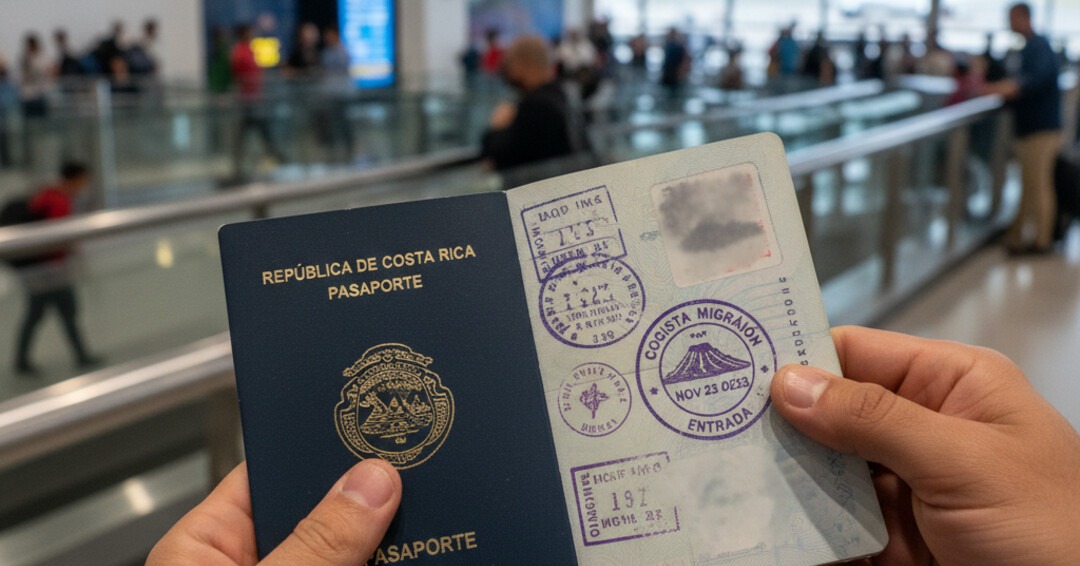
Because the validity of your licence follows your authorised stay, it is essential to check the number of days granted on your entry stamp when you arrive. Immigration officers may authorise the maximum period, but they can also grant fewer days depending on your circumstances and documentation.
The safest practice is:
- Verify the number of days stamped in your passport on arrival.
- Assume your foreign licence is valid only for that exact period, not more.
- If you want to stay longer than your authorised period, you must resolve your immigration status – you cannot “extend” your driving rights just by remaining in the country.
What About the Old 90-Day Rule?
Historically, Article 91 was interpreted to limit foreign-licence driving to 90 days, which clashed with immigration practice when certain tourist categories were allowed up to 180 days of stay. The 2024 reform eliminated that rigid 90-day cap and instead tied the driving period to the authorised stay granted under the Ley General de Migración y Extranjería.
In practical terms, this means that the “90-day licence vs. 180-day stamp” conflict that many expats worried about has been corrected at the statutory level. You should now think in terms of “my licence is valid for the same number of days as my legal stay”, not “90 days no matter what.”
Residents and People in the Residency Process
Article 91 also addresses foreigners who have residency or who are in the process of obtaining residency in Costa Rica. The reform simplifies homologation (the process of converting a foreign licence into a Costa Rican one) by removing the old requirement for a minimum uninterrupted period of stay before you could homologate.
In general terms:
- Tourists and people in transit can drive with a valid foreign licence for the same period as their authorised stay.
- Foreigners with an approved legal status in Costa Rica, or who have already filed for residency, can homologate their foreign licence without proving a continuous three-month stay.
- For long-term life in Costa Rica, you are expected to homologate your licence through COSEVI once you have an approved or in-progress immigration status.
For the official details on homologation requirements (appointments, documents, and steps), you should consult the COSEVI/Educación Vial page on foreign-driver accreditation: Acreditación de conductor – COSEVI.
Do I Need a Physical Licence or Is a Digital Licence Enough?
The current text of Article 91 expressly recognises that some countries issue driver’s licences in digital-only formats. In those cases, Costa Rica accepts a valid digital licence as long as it is issued that way by the country of origin or residence.
However, in day-to-day practice it is still wise to:
- Carry your physical licence if your country issues one, or at least a clear and accessible digital version.
- Carry your passport or valid ID showing your authorised immigration status and dates.
Traffic officers will look at both your identity document and the validity of your licence when enforcing the law.
How This Relates to the 2025 180-Day Driving Update

This article works alongside our more detailed legal breakdown here: Driving in Costa Rica for 180 Days: The 2025 Legal Update. Both pages are based on the same legal reform of Article 91 and the same principle: your foreign driver’s licence is valid for the same period as your authorised stay, up to 180 days where Immigration grants it.
If you need a deeper dive into how this interacts with residency, border runs, or long-term relocation plans, we recommend reading that update as well.
Official Legal and Government Sources
If you want to review the official texts yourself, you can consult:
- Ley 9078 – Ley de Tránsito por Vías Públicas Terrestres y Seguridad Vial (PGR)
- La Gaceta – Reforma a la Ley de Tránsito (Ley 10.591)
- COSEVI – Acreditación de Conductor (Homologación de licencias extranjeras)
These official government sources confirm that the validity of a foreign driver’s licence in Costa Rica is now tied to the period of authorised legal stay, resolving the previous inconsistency between immigration rules and traffic regulations.
Article by Glenn Tellier (Founder of CRIE and Grupo Gap)
Don't wait, contact us right now!
Call or WhatsApp Costa Rica +506 8373 2085 or +506 8706 3888
Call USA/Canada +1 305-906-6784