
Utilities in Costa Rica depend on the exact property, its service providers and your household’s consumption. Before renting or buying, ask for recent electricity and water bills, identify the account holders, and confirm internet availability at the address. A national monthly average is a poor substitute for checking the home you will actually use.
Reviewed 7 September 2026. Official tariff links below were checked against ARESEP pages updated 4 September 2026.
Electricity: find the provider and review consumption
Electricity distribution is provided by regional companies and cooperatives as well as ICE. The supplier depends on the property’s location. Start with the name and account number on an existing bill; do not assume every address uses the same company.
ARESEP publishes current electricity tariffs by provider and service category. Check the residential tariff that applies to the home and compare the billed consumption in kilowatt-hours (kWh). Air conditioning, electric water heating, pool equipment and occupancy can change your usage substantially.
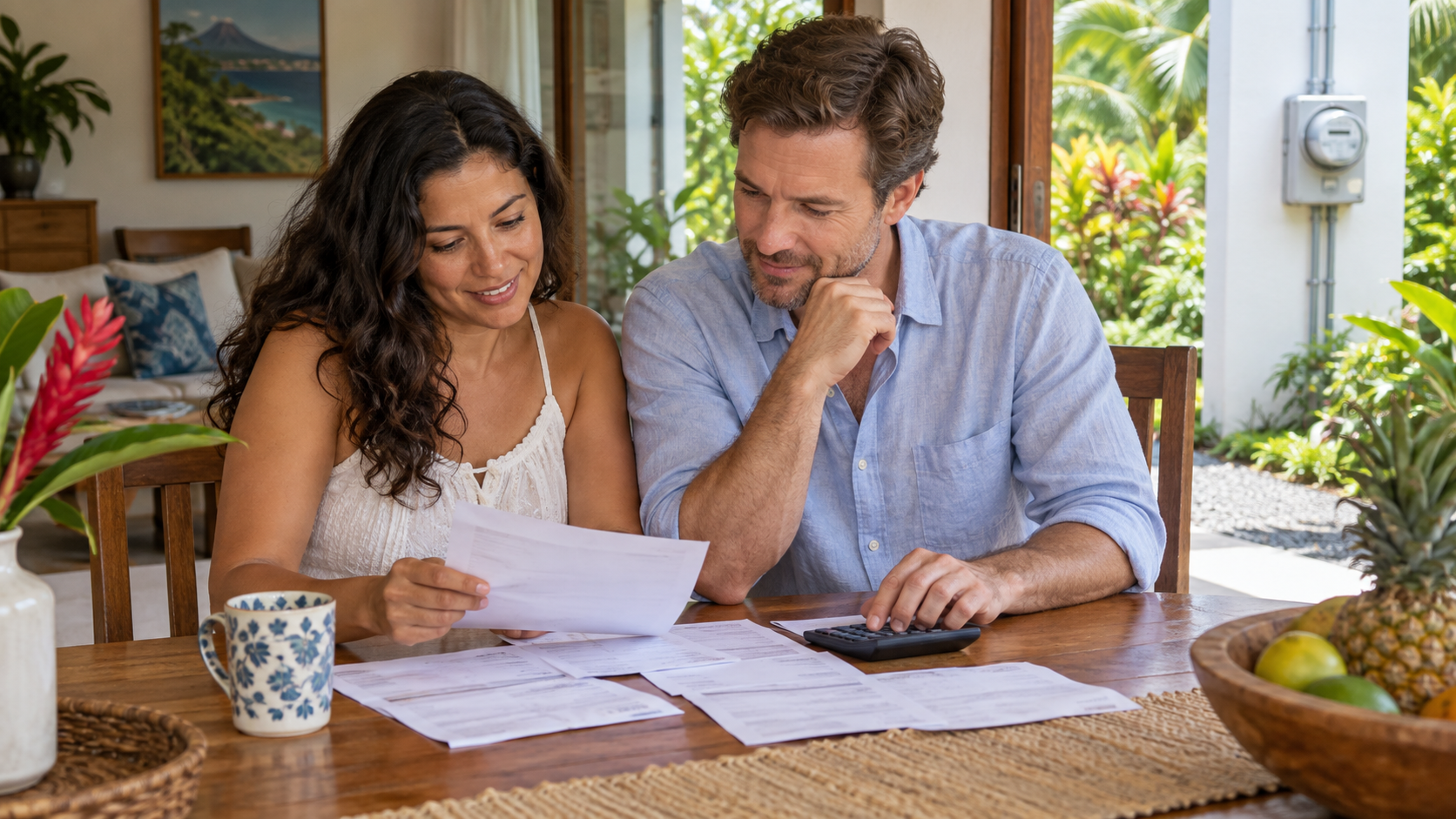
Ask for several months of bills rather than one unusually low month. Confirm whether the quoted rent includes electricity, whether there is a consumption limit, and how any excess is calculated. Keep photographs of meter readings at handover when practical.
Electrical plugs, voltage and adapters in Costa Rica
Costa Rica uses Type A plugs (two flat pins) and Type B plugs (two flat pins plus a grounding pin). Electrical Safety First lists the supply as 120 V, 60 Hz; the Costa Rican Tourism Board describes standard outlets as 110 V with US-style plugs. Check your appliance label and the outlet at your accommodation before connecting it.
Many US and Canadian devices have a matching plug, but plug shape alone does not establish compatibility. A travel adapter changes the connection, not the voltage or frequency. A device marked 100–240 V, 50/60 Hz accepts the listed supply range; check the manufacturer’s instructions. A device rated only for a different voltage may need a suitable converter or transformer. Check its power limit against the appliance, especially for heating appliances. Never force an adapter into an outlet.
Sources checked 7 September 2026: Costa Rican Tourism Board FAQs and Electrical Safety First: Costa Rica travel adaptors.
Water: check the operator, bill and local notices
Identify the operator serving the address, which may be AyA, ESPH, an ASADA or another local service. ARESEP’s water tariff page lists regulated schedules by operator. Bills can include charges for more than water consumption, so review the individual lines instead of assuming a universal dollar amount.
Ask about the property’s service history, storage arrangements and any current interruption or water-quality notices. Check advice from the operator for that supply; a general statement about Costa Rica does not establish that every tap is safe at all times. See our guide to drinking water in Costa Rica.
Internet: confirm installation at the actual address
Ask prospective providers to confirm service at the property, including the connection type, installation charge, monthly price, contract term and equipment arrangements. Coverage elsewhere in the same town does not guarantee that your home can be connected on the same terms.
If you work from home, ask about upload speed as well as download speed. Test the connection where you intend to work and consider how you would manage an outage. A mobile backup is useful only if that network has adequate signal there. Our internet-provider guide explains what to compare.
Setting up or transferring accounts
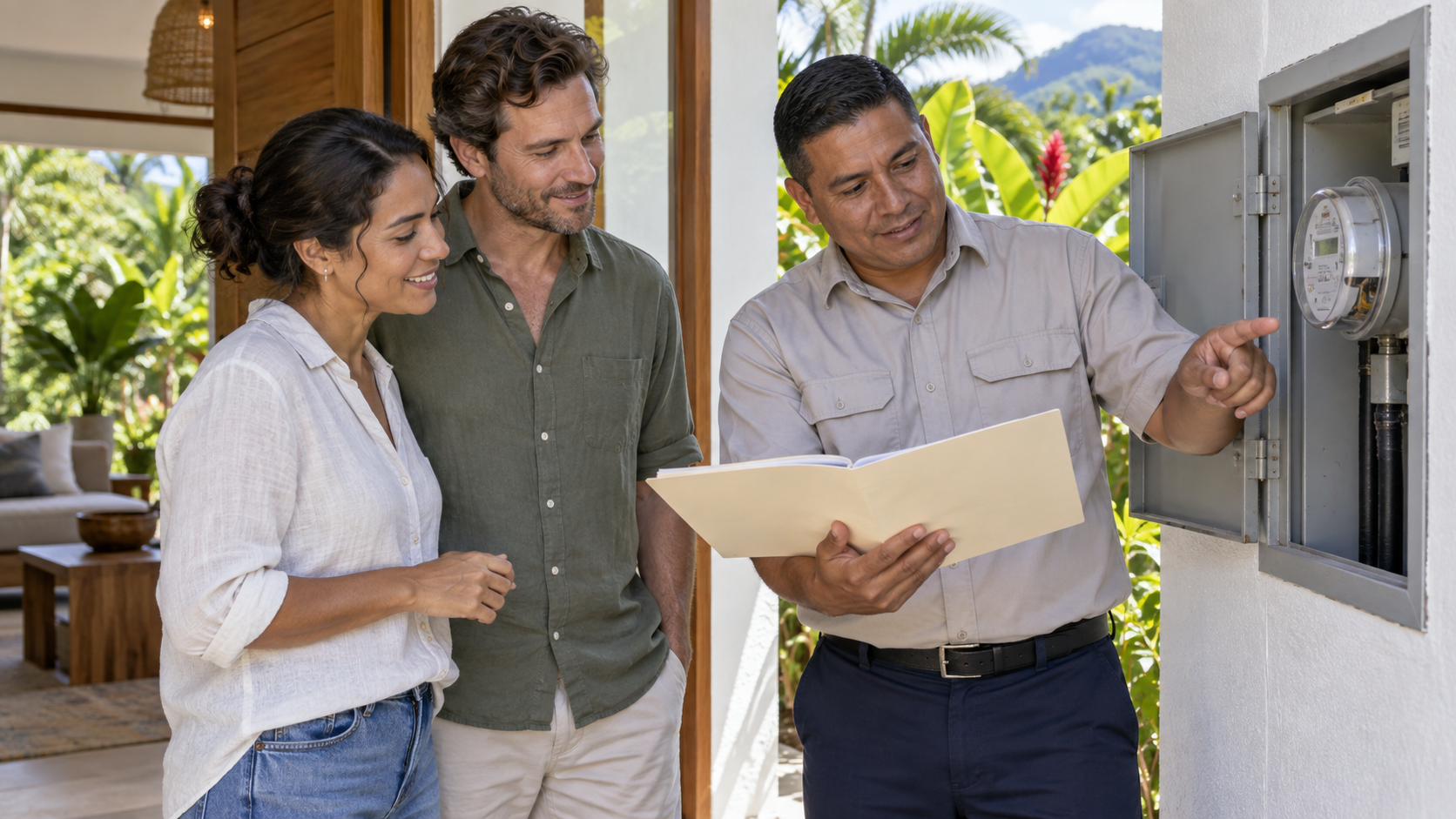
Contact each provider for its current checklist. Ask which identification and property or authorization documents apply to your situation, whether a deposit is required, and whether you need a new connection or an account change. A tenant and a property owner may need different arrangements.
- Record the service and meter numbers.
- Confirm the account holder and who is responsible for payment.
- Agree with the landlord how prior balances and final bills will be handled.
- Use payment methods confirmed by the provider and retain receipts.
- Check due dates and how to report a billing error or outage.
Buying land or a home: verify service availability

Ask the relevant providers for written confirmation of availability and any connection conditions before relying on a seller’s assurances. Existing service at a neighbouring property does not establish that a new connection is approved for your project.
Discuss the intended use and expected demand with your builder or other qualified professional. Ask who will pay for any required infrastructure, what approvals are outstanding and whether the connection timetable fits the purchase or construction plan. A private well should not be treated as an automatic alternative to an approved water connection.
Wastewater, rubbish and cooking gas
Confirm whether the home uses a sewer connection or an onsite wastewater system, and ask who is responsible for maintenance. For rubbish and recycling, obtain the actual schedule, accepted materials and collection point from the municipality or property management. There is no reason to assume every neighbourhood has twice-weekly collection or receives bins.
If the home uses bottled cooking gas, have the equipment and installation checked by a qualified service provider. Compare the correct cylinder size and delivery arrangements when requesting prices.
Build a realistic household budget
List recurring bills separately from deposits, installation and maintenance. Use recent property bills and written quotes as your starting point, then allow for differences in your own usage. Our cost-of-living guide covers the wider household budget.