
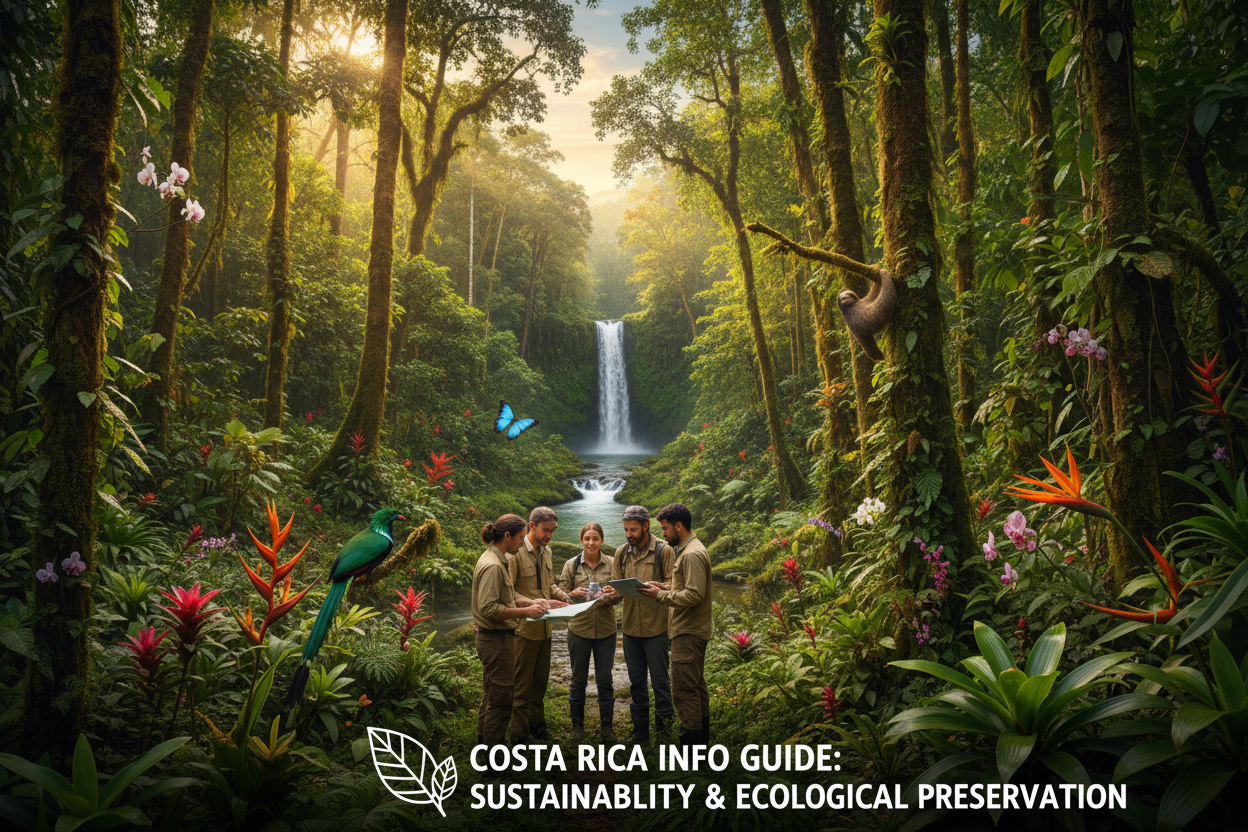
Costa Rica is a global leader in environmental protection. The country’s commitment is written into its constitution. This framework places responsibility on both the government and its people to safeguard nature.
This guide offers practical insights into these rules. It explains how they shape life in Costa Rica. The focus is on information for visitors and potential residents.
You will learn how sustainability policies affect tourism, business, and daily living. This is a lifestyle guide, not legal advice. For specific residency questions, expert guidance is available from CRIE.
Understanding Costa Rica’s Environmental Policy Landscape
A ‘1.5°C compatible’ climate rating highlights Costa Rica’s serious approach to global warming. This means the country’s climate policies align with international goals. The right to a healthy environment is even written into the constitution.

Overview of National Environmental Priorities
The country has a National Decarbonisation Plan. It aims for net-zero emissions by 2050. Protecting natural resources is a top priority.
Costa Rica dedicates over 25% of its land to conservation. This includes many national parks. These efforts safeguard the nation’s incredible biodiversity.
Real-World Safety Tips for a Sustainable Stay
Visitors can help by following simple guidelines. These actions support the country’s conservation goals. Here is a quick reference table for your trip.
| Do | Don’t |
|---|---|
| Stay on marked trails in protected areas. | Use single-use plastic bags or straws. |
| Put all trash in designated bins. | Touch or feed wildlife in the forests. |
| Follow rules at beaches and coral reefs. | Take shells, plants, or rocks from parks. |
Understanding these policies shows respect for the country. It makes your visit safer and more enjoyable. Everyone plays a part in protecting this special place.
Historical Development of Environmental Laws in Costa Rica
Costa Rica’s journey to becoming a green pioneer began with a bold decision in 1949. The country abolished its army. This freed up significant resources for social programs, including early conservation efforts.

Evolving Legislation and Key Milestones
Over time, Costa Rica built a strong legal framework. The landmark 1998 Biodiversity Law created a system for protecting genetic resources. It won a global award in 2010.
The Legislative Assembly passed other crucial laws. A key forestry law established payments for environmental services. This rewarded landowners for conservation.
Major bans followed. Open-pit mining was prohibited in 2011. The Constitutional Court outlawed trawl fishing in 2013.
Recent actions show long-term commitment. A moratorium on new fossil fuel exploration was extended to 2050. In 2021, marine protected areas jumped from 2% to 30% of coastal waters.
This steady development of policies made Costa Rica a leader in biodiversity protection.
Deep Dive: about-costa-rica-environmental-laws and Their Impact
Costa Rica’s approach to protecting its natural wealth is built on three core objectives that shape daily life. These goals guide everything from park management to business permits.

Core Principles and Objectives
The landmark Biodiversity Law focuses on conserving species, using resources sustainably, and sharing benefits fairly. This means businesses using local plants for products must follow strict rules.
A key principle is taking precautionary action even without full scientific proof. If a project might harm a habitat, officials can require protective measures first.
Institutions like SINAC manage protected areas with help from local councils. Another body, CONAGEBIO, oversees access to genetic resources.
By 2020, they granted over 660 permits for research and commercial use. This system turns scientific discovery into regulated, sustainable activity.
Perspectives from Recent Policy Reviews
Local councils include members from various community sectors. This participatory model gives residents a voice in conservation decisions.
The law also recognizes valuable traditional knowledge from indigenous groups. Protecting this intellectual heritage remains a work in progress.
Recent reviews praise the comprehensive framework. Challenges include balancing economic development with habitat protection.
Ensuring benefits from genetic resources reach all communities is another ongoing focus. The system evolves to meet these practical needs.
Implementing Sustainable Practices and Renewable Energy Policies
Turning on a light in Costa Rica often means using power generated from rivers, volcanoes, or breezes. The country has produced over 98% of its electricity from renewable sources since 2015. This is a core part of its climate and sustainability policies.

Government Initiatives on Renewable Sources
The government’s energy plans aim for 100% renewable generation. Hydropower provides most electricity, but droughts are a challenge. To reduce risk, new policies promote solar, wind, and biomass.
For example, the Generation Expansion Plan adds over 2,000 MW of new capacity by 2040. A Green Hydrogen Strategy could fuel transport in future decades. These efforts cut national emissions.
Daily life is affected. Many hotels use solar panels. Electric vehicle charging stations are growing. Businesses find incentives for clean energy practices.
Visitors and residents should follow simple guidelines for energy use.
| Do | Don’t |
|---|---|
| Conserve electricity even though it’s clean. | Assume renewable power means waste is okay. |
| Support businesses using solar or wind. | Leave air conditioning on in empty rooms. |
| Consider an electric vehicle for local travel. | Ignore local advice on peak energy hours. |
Costa Rica also continues to invest in diversifying its renewable sources. This ensures leadership in clean energy for the long term.
Costa Rica Power Sector and Smart Grid Advancements
Behind Costa Rica’s clean energy success lies a diverse mix of renewable sources. The power sector is now focusing on smart grid technology. This modernization improves reliability for everyone.
Renewable Electricity Mix and Hydropower Insights
Costa Rica’s electricity production in 2023 came mostly from water. Hydropower provided 69.7% of the total. Geothermal and wind contributed about 12% each.
Thermal plants using fossil fuels made up 5.1%. Biomass and solar provided smaller shares. This mix shows a strong reliance on renewables.
Droughts are a real challenge. In 2024, dry conditions pushed thermal energy use to an average of 10%. It spiked to 25% during April and May.
This highlights hydropower’s vulnerability. The country needs a balanced portfolio for energy security.
Smart Meter Rollout and Grid Modernization
A national smart grid strategy runs from 2021 to 2031. The goal is to install one million smart meters by 2026. This will cover 60% of households.
These devices send real-time data to the utility. They enable more accurate billing and faster outage response. Residents can also track their own electricity use patterns.
The Costa Rican Electricity Institute (ICE) manages the system. Its focus is on renewable sources, low costs, and sustainability. Grid modernization helps integrate more solar and wind power.
| Energy Source | 2023 Share | Key Role | Note |
|---|---|---|---|
| Hydropower | 69.7% | Primary base load | Vulnerable to drought |
| Geothermal | 12.4% | Stable, constant supply | Uses volcanic heat |
| Wind | 12.2% | Variable, complements hydro | Depends on seasonal winds |
| Thermal (Fossil) | 5.1% | Critical backup | Used during dry spells |
| Biomass & Solar | ~0.6% | Growing distributed sources | Supported by smart grid |
For residents and businesses, smart meters offer control. Check your online account for usage data. Plan high-energy tasks for off-peak hours.
Always have a backup plan for rare outages during extreme weather. Understanding the grid helps you use electricity wisely.
Approaches to Fossil Fuel Moratorium and Oil Regulations
Costa Rica’s stance on fossil fuels is a topic of ongoing national debate. An executive decree currently bans oil and gas exploration until 2050. This policy is central to the country’s green reputation.
Navigating the Fossil Fuel Debate
A bill to make this ban permanent law is moving through the Legislative Assembly. However, the current government opposes it. Officials argue untapped reserves could benefit the economy.
They have even proposed building a new refinery. This represents a shift from past policies. Environmental groups strongly disagree.
They say developing fossil fuels would hurt Costa Rica’s climate leadership. It could create stranded assets and clash with net-zero goals. The debate involves complex energy policy.
Another proposed law would let the state refinery import natural gas as a “transition fuel.” Critics note this goes against climate science. Costa Rica also stepped back from a global oil alliance.
For visitors and businesses, the practical effect is clear. The country produces no oil or gas now. Its clean energy leadership remains intact for the time being.
Any future change could impact Costa Rica’s environmental brand. Understanding this debate helps explain the region’s commitment.
Electrification of Transport and Modal Shifts
Costa Rica faces its toughest climate challenge on the roads. The transport sector creates 76% of energy-related CO2 emissions. National policy now focuses on electrification and shifting how people travel.
Electric Mobility Strategies in Practice
Law 9518 (2018) provides strong incentives for electric vehicles (EVs). Benefits include tax breaks, exemption from traffic restrictions, and preferential parking. It also promotes the installation of charging stations.
EV adoption is growing fast. From just 349 vehicles in 2018, the fleet surpassed 12,770 by mid-2024. Electric models made up 12% of new car sales in 2023.
Charging infrastructure is expanding but faces hurdles. The number of plugs grew from 139 to 355 between 2021 and 2024. However, fast chargers only increased from 39 to 57.
A current rule limits installation to electricity distributors. This slows private sector development of fast-charging areas.
Public Transport Upgrades and Challenges
Modernizing public transit is also key. A major $1.9 billion electric light rail project for San José was abandoned. Current plans involve modernizing three railway lines, with only two being fully electrified.
To cut emissions from existing cars, a 10% ethanol-gasoline mix becomes mandatory in 2025. This is a complementary strategy while electrification advances.
For visitors and potential residents, understanding these practices is useful, especially when considering the legal residency process.
| Do’s for EV Use & Transit | Don’ts for EV Use & Transit |
|---|---|
| Research charging maps before a long EV trip. | Assume fast chargers are as common as gas stations. |
| Use apps to find available public buses. | Expect a fully electrified train network yet. |
| Take advantage of EV tax and parking benefits. | Forget that regular cars will use biofuel soon. |
Guidelines for Visitors: Do’s and Don’ts for Environmental Safety
Exploring Costa Rica’s vast protected areas requires visitors to follow simple yet crucial guidelines. The country dedicates 25% of its land to conservation. This includes massive marine reserves like Cocos Island National Park.
Responsible Tourism in Protected Areas
Following the rules keeps you safe and protects fragile ecosystems. It also supports the work of local park rangers. Your visit directly funds biodiversity conservation.
| Do’s | Don’ts | Park Example | Reason |
|---|---|---|---|
| Stay on marked trails. | Never feed or touch wildlife. | Manuel Antonio National Park | Protects species and prevents animal aggression. |
| Use certified guides for special viewings. | Do not remove plants, shells, or rocks. | Tortuguero National Park | Preserves natural habitats and nesting sites. |
| Dispose of all waste in park bins. | Avoid single-use plastics inside. | Monteverde Cloud Forest | Prevents pollution and protects sensitive soil. |
| Keep a 30-meter distance from animals. | Do not venture off established paths. | Corcovado National Park | Ensures visitor safety and minimizes habitat damage. |
Know when to call for help. Contact park rangers immediately for injured wildlife or if you see illegal activities. The national emergency number 911 works throughout Costa Rica.
Your responsible practices make a real difference. They help conserve nearly 6% of the world’s known species found in these unique areas.
Enforcement and Compliance: How Regulations Are Monitored
Monitoring compliance is a shared responsibility between government agencies and local communities in Costa Rica. This collaborative approach ensures the nation’s rules are actively upheld.
Government Oversight and Local Participation
The National System of Conservation Areas (SINAC) manages protected zones. It uses a decentralized model with local and regional councils.
These councils include elected members from indigenous groups, farmers, academics, and the private sector. This gives communities a direct role in conservation management.
The National Commission for Biodiversity Management (CONAGEBIO) oversees access to genetic resources. By 2020, it had granted 666 permits for research and commercial use through a tiered system.
A unique legal principle strengthens enforcement. The Biodiversity Law establishes objective liability. This means anyone accused of environmental damage must prove their innocence.
Practical enforcement includes park ranger patrols and monitoring bioprospecting permits. The Constitutional Chamber of the Supreme Court frequently cites environmental law in its rulings.
The Ministry of Environment and Energy (MINAE) provides overall policy direction. This ensures local actions support national and international conservation goals.
Integration of Environmental Laws with Costa Rica’s Lifestyle and Culture
The success of Costa Rica’s green reputation stems from a cultural embrace of sustainability that transcends legal mandates. Article 50 of the constitution guarantees a healthy environment as a fundamental right. This principle guides daily life.
Since abolishing its army in 1949, the country redirected funds into education and conservation. This choice created a development model prioritizing people and nature over military spending.
Costa Rica invests 7-8% of its GDP in education. This focus produces environmentally literate citizens from a young time. The nation ranks 8th globally for primary school enrollment.
Business culture also reflects these values. The voluntary C-Neutral certification program motivates companies to measure and offset emissions. This shows how the economy aligns with ecological goals.
High living standards in Latin America are partly due to abundant nature access. The famous “pura vida” philosophy includes deep appreciation for biodiversity. Community watershed committees and school eco-clubs make protection a shared responsibility.
Environmental laws work here because they match existing cultural values. This integration ensures broad support across Costa Rican society. It turns policy into a source of national pride and identity.
Tips for Living Sustainably in Costa Rica
Individual actions, from waste sorting to energy conservation, form the building blocks of Costa Rica’s collective environmental success. The country’s culture and infrastructure make adopting green habits simpler than you might think.
Practical Advice on Green Living
Start with your waste. Most municipalities require separating recyclables like plastic, glass, and paper. Composting organic material is also common and reduces landfill use.
For energy, take advantage of the clean grid. Use natural ventilation before air conditioning. Unplug devices and consider solar water heating, which is widespread.
Water is a precious resource. Fix leaks quickly and limit shower time, especially during the dry season from December to April.
Your daily choices support national goals. The Payment for Environmental Services program rewards landowners for conservation. This helped avoid millions of tonnes of carbon emissions.
Support the National Decarbonisation Plan by using public transport when possible. Shop at local farmers’ markets to cut down on transportation emissions.
Do’s and Don’ts for a Sustainable Stay
| Do’s | Don’ts |
|---|---|
| Separate all recyclable materials properly. | Dispose of trash in natural areas or waterways. |
| Use reusable bags and bottles daily. | Purchase single-use plastics or styrofoam. |
| Choose hotels with a CST sustainability rating. | Water gardens during the heat of the day. |
| Collect rainwater for plants where allowed. | Burn trash, as it is illegal and polluting. |
CRIE’s Role in Residency and Environmental Guidance
For those considering life in Costa Rica, residency status connects directly to the country’s environmental framework. Since 2010, a mandatory rule requires residency applicants to enroll in the CCSS social security system. This shows how legal and social compliance are linked.
Costa Rica offers a range of residency categories. Business or investment visas may involve environmental reviews for land use. All residents must follow local environmental law.
Quick Tips for Residency Questions
Understanding the requirements is key. The Free Trade Zone regime under Law 1982 offers major tax incentives. This includes exemptions from corporate income tax and import duties for qualifying businesses.
| Residency Aspect | Environmental Link | Action Tip |
|---|---|---|
| CCSS Membership | Shows compliance with national social systems. | Secure this proof of enrollment early. |
| Business/Investment Visa | May require specific land or resource permits. | Check with authorities before applying. |
| General Compliance | All must follow Costa Rican environmental regulations. | Learn the basic rules for your area. |
This guide offers general information, not legal advice. For specific help, professional guidance is essential. CRIE plays a vital role as specialists in Costa Rican residency processes.
They help determine the correct category and navigate requirements. Their services cover the entire application process. For personalized help in Latin America’s green leader, contact CRIE.
CRIE can help with residency questions: WhatsApp +506 8706 3888 | info@crie.cr | www.crie.cr.
Embracing a Sustainable Future in Costa Rica
The path to a sustainable future in this Central American nation is marked by both celebrated milestones and ongoing tests. Costa Rica has dramatically increased forest cover and runs on nearly all renewable electricity.
Protected areas span a quarter of its land. The country aims for net-zero emissions by 2050. Challenges include drought affecting hydropower and debates on energy policy.
Quick Environmental Checklist: Respect protected area rules. Separate recyclable waste. Conserve water and energy. Avoid single-use plastics. Support certified sustainable businesses.
FAQ: Is tap water safe? Generally yes in urban areas. How can I help? Participate in local conservation efforts.
For residency questions involving environmental compliance, CRIE offers guidance. Contact them via WhatsApp +506 8706 3888, email info@crie.cr, or visit www.crie.cr.
FAQ
What are the main goals of Costa Rica’s environmental policies?
How did Costa Rica’s environmental laws develop historically?
What is Costa Rica’s stance on fossil fuels and renewable energy?
Are there specific rules for tourists visiting protected areas?
How does the government enforce its environmental regulations?
What are some everyday sustainable practices for living in Costa Rica?
Article by Glenn Tellier (Founder of CRIE and Grupo Gap)
Don't wait, contact us right now!
Call or WhatsApp Costa Rica +506 8373 2085 or +506 8706 3888
Call USA/Canada +1 305-906-6784