

Costa Rica’s pensionado residency is described almost everywhere as a retirement programme. That description is incomplete, and the gap matters.
The requirement is a lifetime pension of at least US$1,000 a month. It is not a requirement to be retired, and it is not a requirement to be a particular age. A disability pension can meet it.
If you receive a permanent disability pension of US$1,000 a month or more, this category is worth looking at properly — and very few people ever tell you that.
What the government actually requires
The Dirección General de Migración y Extranjería sets out the financial condition for the pensionado category in a single sentence:
“Demostrar con documento emitido por autoridad competente que disfruta de pensión en forma vitalicia cuyo monto no podrá ser inferior a mil dólares mensuales (US$1000,00) moneda de los Estados Unidos de América o su equivalente en colones al tipo de cambio de venta que determine el Banco Central de Costa Rica.”
In English: demonstrate, by a document issued by a competent authority, that you enjoy a pension on a lifetime basis whose amount is not less than US$1,000 per month, or the colón equivalent at the Banco Central selling rate.
Read what that sentence does and does not say.
It says “pensión.” Not pensión de jubilación. Not retirement pension. Just a pension.
It says “en forma vitalicia.” Lifetime. That is the real test — the income must be for life, not for a fixed term.
It says nothing about age. There is no minimum age anywhere in the requirement.
So the question is not “am I old enough” or “am I retired”. The question is:s: is my pension a lifetime pension, and is it at least US$1,000 a month?
A permanent disability pension is, by its nature, a lifetime pension. That is why this route is open to people who are nowhere near retirement age — and it is a route CRIE handles regularly for exactly that reason.
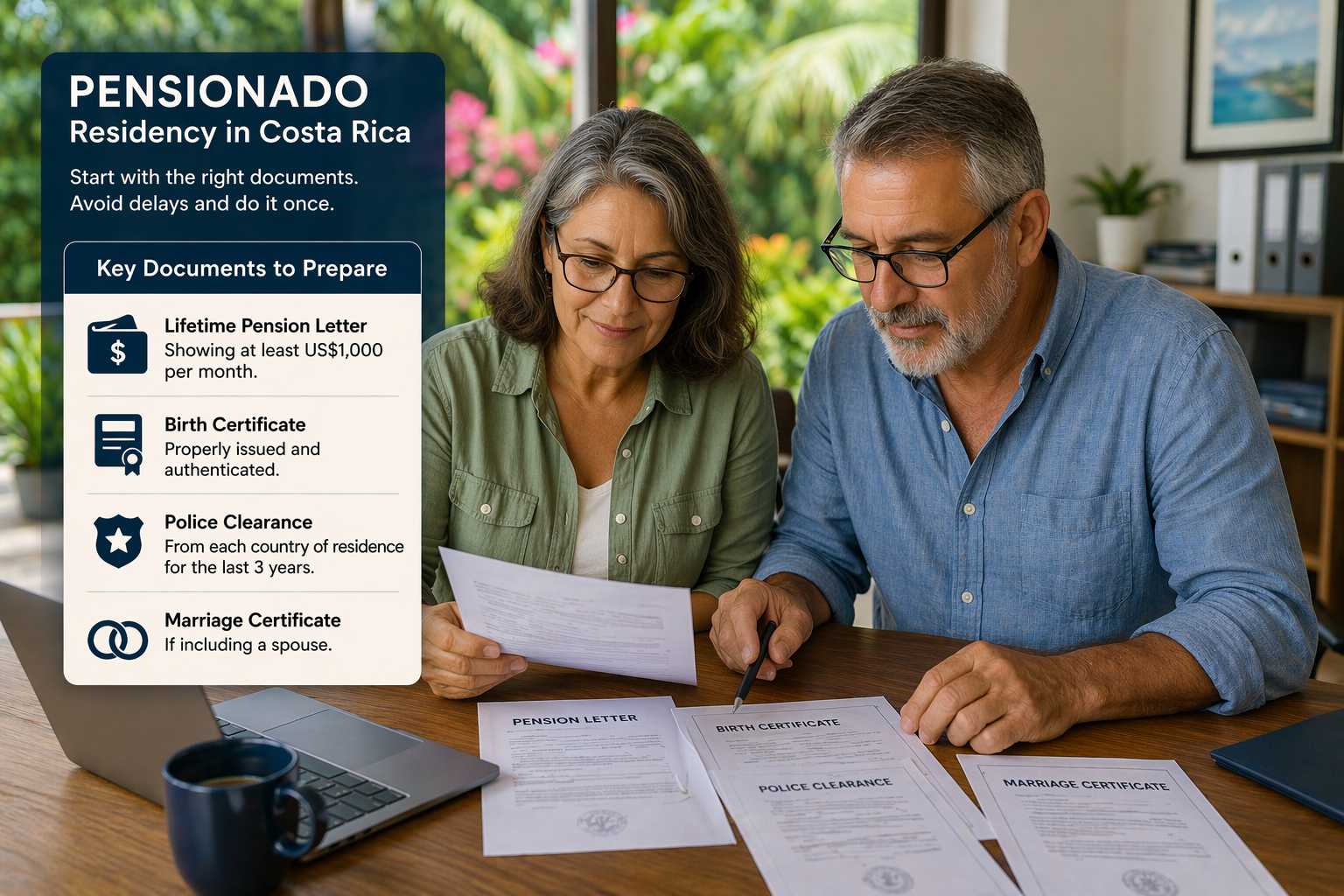
The proof is the whole game
The requirement is not simply that the pension exists. It is that you can demonstrate it with a document issued by a competent authority.
Your bank statements are not that document, however clearly they show the payments arriving. What is needed is a certification from the body that pays the pension — the government agency, the pension administrator, the insurer — attesting to the pension and its amount.
And there is a second condition attached: if the certification is issued abroad, it must be duly legalised and authenticated, or apostilled.
That combination is worth planning around. The body awarding your pension has its own process for issuing certifications, and it is rarely designed around someone who then needs the document apostilled for a foreign immigration authority. Building in time for both steps is the single most useful thing you can do.
What the certification needs to establish
Working back from the wording, the document has to show three things clearly:
- That the pension is yours, issued by an authority competent to say so.
- That it is lifetime — vitalicia. A pension stated as running to a review date, or for a fixed number of years, is not obviously answering the requirement, and this is worth resolving before you file rather than after.
- That the monthly amount is not less than US$1,000, or the colón equivalent.
If your award letter is ambiguous about permanence, that ambiguity is the thing to fix first. It is far easier to ask the awarding body for clearer wording than to argue the point with a case officer.

The rest of the file
The financial condition sits on top of the general requirements that apply across temporary residency categories:
- A written application stating your particulars, what you are applying for, your current address and a means for notifications — signed before a public official or authenticated by a lawyer.
- Proof of payment of the government application fee, under article 255 of the Ley.
- Two recent passport-sized photographs.
- Your birth certificate from your country of origin, legalised and authenticated or apostilled.
- A criminal record certificate from your country of origin, or from wherever you have legally resided for the last three years, legalised and authenticated or apostilled.
- Photocopies of your passport pages showing your particulars, your Costa Rica entry stamp and your entry visa where required — certified by a notary or checked against the original by an immigration official.
Bringing your family
Dependants apply alongside you. A spouse proves the link with a marriage certificate, legalised or apostilled. Minor children are applied for by their parents. Adult children with a disability require a medical opinion and, where applicable, a certification of guardianship issued by a judge.
That last provision is worth noting on its own. Costa Rica’s residency rules make specific allowance for an adult child with a disability to be included as a dependant, rather than treating adulthood as an automatic cut-off.
Practical points
Start with the certification, not the application. Everything else in the file is obtainable. The pension certification, in the right form, from an authority abroad, with an apostille, is the item with the longest and least predictable lead time.
Watch the validity window. Documents that state no validity period of their own must be no more than six months old when presented. A certification obtained too early ages out.
Check the wording says lifetime. If it does not, get it changed at source.
Do not rule yourself out on age. This is the point of the whole article. The requirement is about the nature and size of the pension, not about whether you have stopped working.
Do you have a pension of US$1,000 a month or more?
If you do — retirement, disability, or otherwise — you may be able to apply for Costa Rican residency under the pensionado category. CRIE — Costa Rica Immigration Experts handles pensionado, rentista and investor applications, renewals and citizenship, and can tell you whether your pension certification will do the job before you spend anything on it.
Compare the routes in our guide to the types of residency in Costa Rica, or get in touch with the details of your pension.
Requirements are taken from the Dirección General de Migración y Extranjería. General information only, not legal advice — confirm current requirements with the DGME before acting.
Article by Glenn Tellier (Founder of CRIE and Grupo Gap)
Don't wait, contact us right now!
Call or WhatsApp Costa Rica +506 8373 2085 or +506 8706 3888
Call USA/Canada +1 305-906-6784