
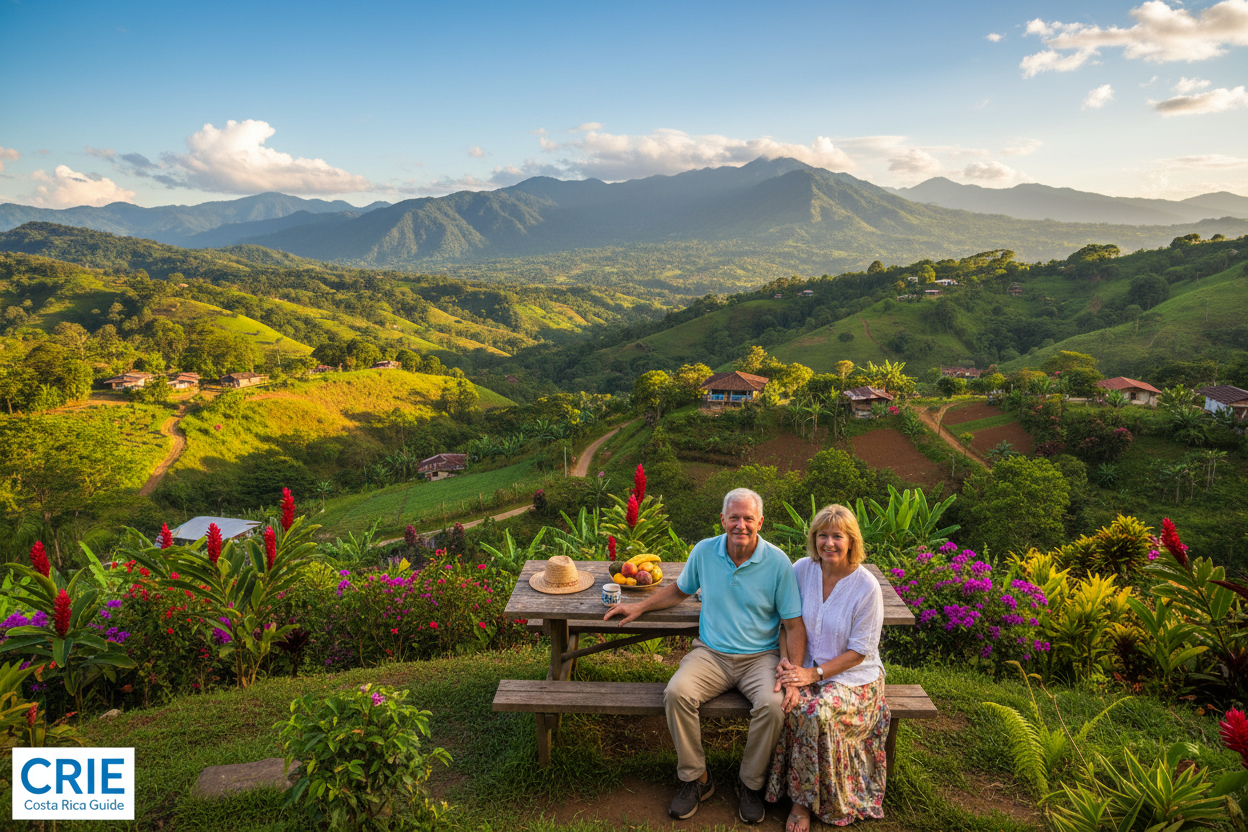
Most people arrive in Costa Rica thinking about beaches and leave thinking about the mountains. The highlands are where a large share of foreign residents actually settle — and the reasons are practical rather than romantic.

Why the highlands
Between roughly 800 and 1,600 metres, the Central Valley sits in a permanent 20–27°C band. Warm days, cool nights, no air conditioning, no heating, no bills for either.
Against the coast, the highlands offer:
- Lower humidity and far fewer insects
- Cheaper property and rent — often dramatically
- Much better hospital access — CIMA in Escazú, Clínica Bíblica and Hospital México in San José, plus every Caja regional hospital
- Proximity to SJO airport
- Far lower electricity bills, because the air conditioning that costs $200–400 a month in Guanacaste is simply not needed
The trade-offs are real too: no beach, heavier rain in the September–October peak, and mountain driving that takes getting used to.
The towns
Grecia — about 1,025 m
A long-standing expat favourite, roughly 45 minutes from the airport. Cool, green, well-serviced, and surrounded by coffee.
The landmark is the Iglesia de Nuestra Señora de las Mercedes, built in the late nineteenth century from riveted imported Belgian steel plates — shipped in pieces and bolted together, and unlike any other church in the country.
Canton population around 77,000, so it has real services rather than a handful of shops.
San Ramón — about 974 m
Known as the Tierra de Poetas. Canton population 93,264 at the 2022 census and growing.
This is a genuine Costa Rican town rather than an expat enclave — a University of Costa Rica campus, a hospital, and full services, about an hour from San José. For anyone who wants to live in Costa Rica rather than in a foreign community inside it, San Ramón is one of the strongest propositions in the country.
Atenas — around 700 m, and the famous climate claim
Roughly 30 to 40 minutes from SJO, and the subject of the most repeated claim in Costa Rican real estate. We went looking for its source, and the answer is worth the space.
Where “the best climate in the world” actually came from
You will be told, everywhere, that National Geographic declared Atenas to have the best climate in the world. It is painted on the back of the buses. A RE/MAX office is named after it. It is in every property listing in the canton.
National Geographic says it never happened.
A broker in Atenas, Dennis Easters of PLD Atenas Realty, did what apparently nobody else had done and wrote to the magazine’s archives department. The reply he published:
“National Geographic magazine has never made the assertion that Atenas, Costa Rica has the best climate in the world, nor has an article about Atenas been published in National Geographic.”
The evidence supports him. Not one source anywhere cites an issue, a date, a page or an author. The attributed year is unstable in exactly the way folklore is — Spanish Wikipedia says 1960 with no citation; one property site says 1994; the Tico Times says “the 1990s” and softens it to “one of the best.” English Wikipedia’s supporting reference is a 2023 University of Costa Rica book which, when you actually read it, mentions the claim once in passing with no citation and does not mention National Geographic at all.
So where did it come from?
The most concrete account traces it to a Costa Rican tourism marketing campaign in the mid-1990s. A government marketing committee, including CANATUR, the national chamber of tourism, asked towns and provinces around the country to develop promotional slogans. Atenas’s municipality and local business leaders came up with “the best climate in the world” and unveiled it at the town’s annual April agricultural fair in the Parque Central, then pushed it through posters, banners and advertising.
It stuck — and somewhere along the way it acquired a National Geographic attribution and a 1960 date it never had.
In fairness, that origin story comes from a single undated source who is himself a local broker, and we could not independently corroborate it. But it is the only concrete account that exists, and it matches the timeline: every attribution that gives a year at all points at the 1990s.
What the weather is actually like
Here is the part that will interest anyone comparing towns:
| Town | Elevation | Annual mean | Typical highs | Annual rain |
|---|---|---|---|---|
| Atenas | ~700 m | 22.4°C | 82–89°F | ~3,000–3,180 mm |
| Grecia | ~1,000 m | 19.5°C | 77–82°F | ~2,700–2,820 mm |
| San Ramón | ~1,050 m | — | 77–84°F | ~2,860 mm |
| Naranjo | ~1,050 m | — | 77–83°F | similar |
Atenas is genuinely different from its neighbours — but by being warmer, not milder. It sits about 300 metres lower on the western lip of the Central Valley, so it runs roughly 3°C warmer than Grecia, Naranjo, San Ramón and Palmares. That is the entire meaningful difference. Whether warmer is better is a preference, not a measurement, and plenty of people find Atenas too hot.
All of these towns share the same seasonal system: a hard February–March dry season, a wet May to November, October the wettest month, and 2,700 to 3,200 mm of rain a year. Three metres of annual rainfall is not a serious candidate for “the world’s best climate” on any objective measure — and Grecia, San Ramón and Palmares are all drier than Atenas.
Two more details worth knowing. The marketing material commonly cites 60–70% relative humidity; the actual range is 79% to 88%. And the “2,500 hours of sun a year, above the national average, according to the IMN” line that appears on property sites traces to a commercial weather aggregator, not to any publication by Costa Rica’s national meteorological institute.
The wider pattern
The same claim, attributed to the same magazine, with the same absence of a citation, also circulates for Boquete in Panama, Cuenca in Ecuador and Medellín in Colombia. It is a portable retirement-marketing trope rather than anything specific to Atenas.
None of which makes Atenas a bad place to live. It is pleasant, convenient, close to the airport and full of people who are happy there. It just has the same Central Valley climate as its neighbours, three degrees warmer, and considerably better marketing.
Zarcero — 1,736 m
The highest of the Alajuela hill towns, and cold enough that you will want wool at night.
Dairy and organic farming country. The famous sight is Parque Francisco Alvarado, whose topiary arches and animal shapes have been trimmed continuously since the 1960s. About 90 minutes from San José, and a small town — around 4,000 people in the district.
Monteverde and Santa Elena — about 1,400 m
Mean annual temperature 18°C, around 3,000 mm of rain, humidity between 74 and 97 percent, and a near-constant Caribbean trade wind.
Founded by US Quakers in 1951 who left the United States over conscription. Cloud forest, 500 orchid species, and the place where the canopy zipline was effectively invented. Roughly 250,000 visitors a year against a district population of about 4,000.
Three and a half to four hours from San José, with a notoriously rough final approach road.
Living there: cool, damp, windy, small, expensive by Tico standards and heavily tourism-dependent. It suits people who genuinely enjoy fog. It does not suit everyone who enjoyed visiting.
Turrialba — about 768 m
Warmer and wetter than the Central Valley proper, an hour and a half to two hours from San José via Cartago.
An active volcano above it, Guayabo National Monument 18 km north (Costa Rica’s most accessible pre-Columbian site), the CATIE agricultural research centre, Turrialba cheese, and the Pacuare and Reventazón rivers — some of the best whitewater in Central America.
San Isidro de El General, Pérez Zeledón — 702 m
Population around 45,000, making it the largest urban centre of the southern Brunca region and a functioning city rather than a town — a regional hospital, a symphonic music school, a public library, art schools.
Warm rather than cool at that elevation. About three hours from San José over the Cerro de la Muerte, which is the catch. It is also the base for climbing Chirripó, Costa Rica’s highest peak.
The smaller places
We could not verify precise elevations for these to a citable source, so here they are by character rather than by number:
- Sarchí — the ox-cart and artisan-furniture town. The giant painted cart in the plaza is billed as the world’s largest.
- Naranjo — a working coffee town with almost no expat scene at all, which for some people is precisely the appeal.
- Orosi — a green river valley south-east of Cartago with a 1743 colonial church, one of the oldest still in use in Costa Rica, and hot springs.
- Santa María de Dota and Copey — Los Santos coffee country, producing some of the best beans in the country.
- San Gerardo de Dota — a narrow cloud-forest valley off the Cerro de la Muerte. Costa Rica’s premier site for the resplendent quetzal, plus trout and apples. Genuinely cold.
- Vara Blanca — on the Poás–Barva saddle. Strawberries, dairy, La Paz waterfalls, and near-permanent cloud.
Choosing between them
A rough guide:
- Want services, other foreigners and an easy airport run? Grecia or Atenas.
- Want a real Costa Rican town with a university and a hospital? San Ramón.
- Want genuinely cool weather? Zarcero, or higher into Dota.
- Want cloud forest and do not mind rain? Monteverde.
- Want a river, a volcano and lower prices? Turrialba.
- Want a southern city away from the Central Valley entirely? San Isidro.
The one piece of advice that matters
Elevation changes everything here, and it changes over very short distances. Two houses fifteen minutes apart can be in different climates entirely — one needing a fire at night, the other needing a fan.
Rent before you buy, in the specific neighbourhood, for at least one full rainy season. Nobody who has done this regrets it. A great many people who skipped it do.
Planning a move to the highlands?
CRIE — Costa Rica Immigration Experts handles residency applications, renewals and citizenship for people relocating to Costa Rica.
See the residency options in Costa Rica, or get in touch.
Thinking About Making Costa Rica Home?
Thousands of expats, retirees, and investors have made Costa Rica their permanent home. If you are considering residency, CRIE’s licensed immigration attorneys can walk you through your options — Pensionado, Rentista, Investor, or family-based — and handle every step of the process.