
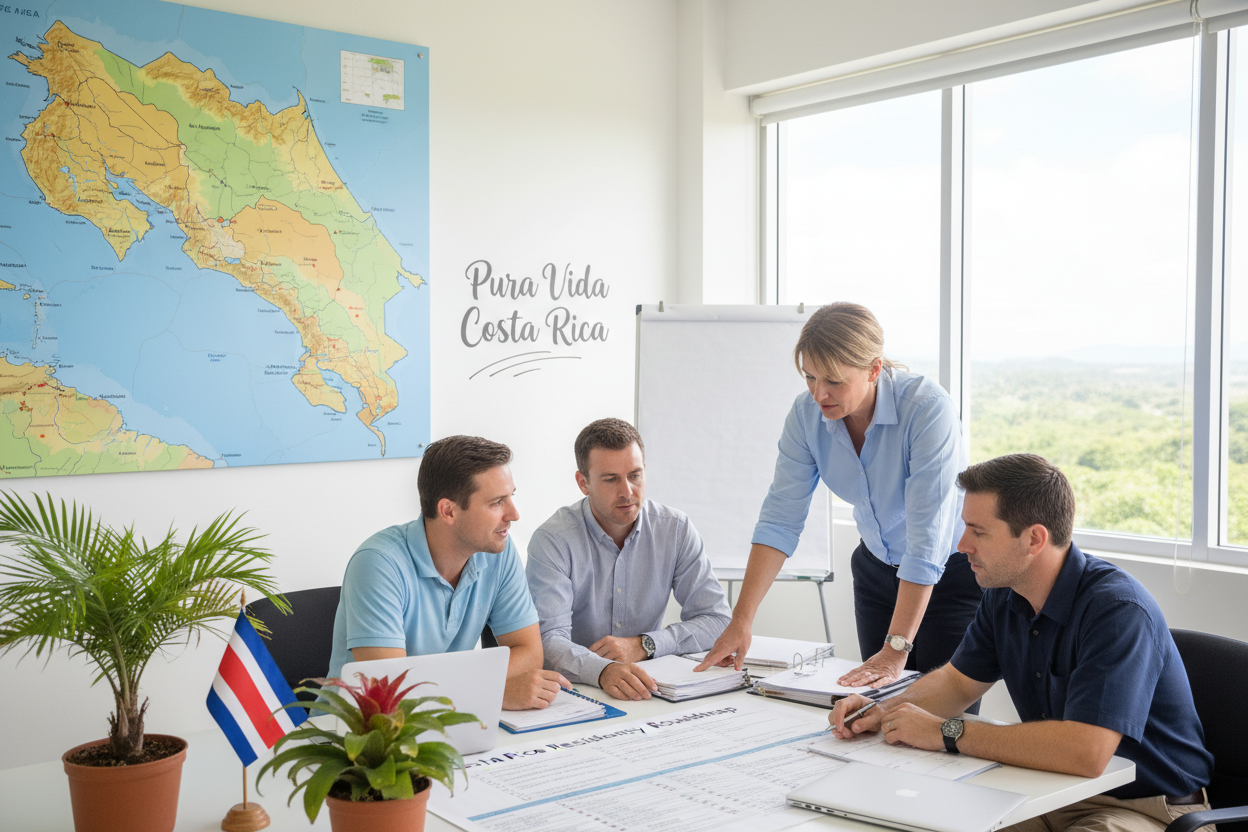
With nearly 70,000 US citizens now calling it home, Costa Rica has become a premier destination for Americans seeking a new life. This beautiful Central American nation attracts expatriates with its stunning landscapes and stable democracy.
A common first question for many is about the immigration timeline. We serve as your professional guide, cutting through the complexity to provide clear, realistic expectations.
The residency process typically spans between 3 and 12 months. This range depends heavily on your chosen category and how swiftly you prepare required documents—like apostilles and translations.
Understanding the distinct pathways is crucial. Programs like Pensionado, Rentista, and Inversionista each have specific financial thresholds. These are different from a Digital Nomad visa, which is a separate, non-resident option.
Our team at CRIE provides specialized support for those looking to live in Costa Rica. We focus on transparency for every applicant. You can reach us via WhatsApp at +506 8706 3888 or email info@crie.cr to discuss your goals.
Introduction to Costa Rica Residency Options

For those planning a long-term move, Costa Rica’s residency system is built around three key categories: Pensionado, Rentista, and Inversionista. Each offers a structured legal pathway, but your choice depends entirely on your financial profile.
Overview of Pensionado, Rentista, and Inversionista
The Pensionado program is for retirees. It requires a guaranteed lifetime pension of at least $1,000 per month.
Rentista residency suits those with stable passive income. You must prove $2,500 monthly for two years or make a $60,000 deposit in a local bank.
The Inversionista category is for investors. It demands a minimum investment of $150,000 in Costa Rican real estate or a business registered in your name.
Key Residency Benefits and Considerations
These options provide a clear route to long-term legal status. You gain the right to live, work, and access services.
Choosing correctly is crucial. We help you match your specific income or investment situation to the right program. This ensures a solid foundation for your new life.
Clarifying Digital Nomad vs. True Residency
The Digital Nomad visa offers a convenient entry point for remote professionals, yet it operates on a completely different legal footing than permanent residency. Many confuse this popular option with a path to long-term status in Costa Rica. We clarify this critical distinction to protect your long-term plans.
Digital Nomad: A Temporary Work Permit
This visa is designed as a temporary work permit for remote employees and entrepreneurs. To qualify, you must prove a stable monthly income of at least US$3,000 for individuals or US$4,000 for families. It allows you to live and work remotely in Costa Rica for a set period, but it is not a form of residency.
Why It Doesn’t Count Toward Residency or Citizenship
Time spent in the country under a Digital Nomad visa does not accrue toward permanent residency or citizenship requirements. The program exists outside the formal immigration structure. If your ultimate goal is Costa Rican citizenship, this temporary permit will not help you get there.
For a genuine path to long-term status, programs like Rentista or Inversionista are necessary. We help clients navigate this complex landscape, ensuring their chosen visa aligns with their final objectives in Costa Rica.
Step-by-Step Timeline: how-long-does-costa-rica-residency-take
Understanding the step-by-step flow of the application process is key to setting accurate expectations.
Your journey unfolds through distinct administrative phases, not a single event.
Phases of the Residency Process
The initial stage happens in your home country. You must gather and authenticate documents like birth certificates and police records.
Next, you submit your complete file to Costa Rican authorities. They will verify every detail before granting final approval.
Expected Processing Times Based on Category
The entire process typically spans between 3 and 12 months. This range depends heavily on your chosen category and how perfect your paperwork is.
Pensionado applications often take 8 to 12 months. Rentista status usually requires 6 to 10 months.
For Inversionista applicants, the timeline can be shorter, often 4 to 8 months. These are estimates, not government guarantees.
We advise building a realistic schedule. The speed hinges on your document accuracy. For the latest official updates, always check migracion.go.cr. You can also review our detailed frequently asked questions for more insights.
Who Qualifies for Costa Rica Residency?
Determining your eligibility is the foundational step in the Costa Rica residency journey. Qualification hinges on meeting specific financial criteria across the three main categories.
Each program has strict requirements you must prove to immigration officials. We help clients match their situation to the correct pathway.
Eligibility for Pensionado Applicants
The Pensionado program is designed for retirees. You must prove a guaranteed lifetime pension of at least $1,000 per month.
This income must come from a reliable source like Social Security or a private pension fund. Providing clear documentation is non-negotiable for this residency.
Income and Investment Criteria for Rentista and Inversionista
Rentista applicants demonstrate stable passive income. The requirement is proof of $2,500 monthly for two years, or a $60,000 deposit in a Costa Rican bank.
The Inversionista category is for investors. It demands a minimum investment of $150,000 in local real estate or a registered business.
A critical rule for investors: the asset must be held in your personal name, not a corporation. We guide you to ensure your financial proof meets all official standards for Costa Rica residency.
Preparing Your Documents Before Arrival
Properly preparing your documentation from your home country is the single most effective step to avoid delays. The Costa Rica residency process demands absolute accuracy in your paperwork.
We advise starting this work early. Missing or incorrect documents are the primary cause for extended processing times.
Apostilles and Required Translations
Every vital record, like your birth certificate and marriage certificate, must be apostilled. For US citizens, this is done by the US Department of State.
An apostille certifies the document’s authenticity for international use. After this, each paper requires an official translation into Spanish by a certified translator in Costa Rica.
This two-step authentication is non-negotiable. Your application cannot proceed without it.
Creating a Document Checklist for Success
A detailed checklist is your best tool for organization. Track each document from gathering to translation.
Pay special attention to your criminal background check. This report is only valid for six months from its issue date.
Timing its procurement is critical. You must submit your complete file before it expires to avoid repeating the step.
For complex situations, such as needing to authorize representation, ensure all legal documentation is included. Starting this systematic approach from home ensures a smooth transition and minimizes stress upon your arrival in Costa Rica.
Navigating the Application Process at DGME
Once your documents are prepared and authenticated, the next step is formal submission through the DGME’s appointment system. This phase moves your file from preparation to active government review.
We guide our clients through each administrative step. The goal is a smooth, efficient interaction with Costa Rica’s immigration authority.
Scheduling Your Cita and Paying Application Fees
Initiating the process requires booking a cita (appointment) online via the official DGME website. Due to high demand, you should schedule this at least three to four weeks before your planned visit.
A critical pre-appointment task is paying the government fee. The application cost is approximately US$50.
You must pay this at a Banco de Costa Rica branch and bring the stamped receipt to your cita. Without this receipt, your submission cannot proceed.
Submission Steps and Document Verification
At your appointment, an officer will review your complete file. You will provide fingerprints and a digital photo for your file.
Upon acceptance, you receive an official expediente number. This is your tracking code for the residency process.
We advise organizing all documents in labeled folders. This assists the officer during verification and demonstrates thorough preparation.
Successful submission yields a comprobante. This receipt proves your application is pending review. It also allows you to stay legally in Costa Rica while awaiting a decision.
Common Pitfalls to Avoid in Your Application
Many applicants encounter preventable setbacks due to overlooked errors in their submission. We focus on the most frequent issues that can delay or derail your Costa Rica residency process. Attention to detail is your best defense.
Incomplete Documentation and Expired Background Checks
A criminal background check is only valid for six months. Submitting an expired report leads to automatic rejection. We also see name mismatches between passports and birth certificates cause major delays.
Missing apostilles or incorrect Spanish translations are other common flaws. Each document must be perfectly authenticated. Misunderstanding the financial rules for your chosen category is another costly error.
Working with a professional guide helps you sidestep these pitfalls. We ensure your entire application package is complete and compliant from the start.
Managing Legal Stay During Processing
After submitting your residency application, managing your legal stay in Costa Rica becomes the next critical focus. This phase has its own set of rules that protect your status while authorities review your file.
Your official comprobante receipt is the key document. It allows you to remain in the country legally for the entire processing period. This holds true even if your standard 90-day tourist visa expires.
You do not need to make border runs every three months while your application is active. Your legal status is protected by this pending review.
Maintaining Valid Tourist Status and Exit Permits
If you must travel outside of Costa Rica during this waiting period, special rules apply. You are required to obtain an official exit permit from the DGME before your departure.
We emphasize this point strongly. Leaving the country without this permit will result in the automatic cancellation of your pending residency application. Careful attention to these immigration rules ensures you remain in compliance throughout the entire process.
Insights into CAJA Healthcare and Its Role in Residency
Securing your legal status in Costa Rica includes a mandatory step: enrolling in the national healthcare system. This universal public provider, known as CAJA, is a cornerstone of residency. Your enrollment is not optional—it’s a legal requirement tied directly to your approved status.
Enrollment Requirements and Payment Structures
After your residency is approved, you must visit your local EBAIS clinic to register. This process finalizes your entry into the healthcare system and provides your medical card.
Your monthly financial contribution to the system is calculated as a percentage of your declared income. Payments typically range from 7% to 11% of your total monthly earnings.
This investment grants you comprehensive coverage for doctor visits, hospital stays, and prescriptions without copays. Maintaining these payments is essential, as it is a mandatory condition for keeping your legal residency status active in Costa Rica. For a detailed guide, you can explore our resource on CAJA for permanent residents.
Transitioning from Temporary to Permanent Residency
Your initial residency approval is just the beginning of a longer journey toward permanent status in Costa Rica. Temporary residency grants you legal footing, but the ultimate goal for many is greater stability.
The system allows for progression. After maintaining your temporary status for three consecutive years, you become eligible to apply for permanent residency. This status offers enhanced long-term security.
Renewal Processes and Long-Term Considerations
This shift requires careful attention to renewal rules. You must stay current with all CAJA payments and demonstrate ongoing compliance with your category’s financial requirements.
The path to citizenship follows a separate timeline. Generally, you can apply after seven years of legal residency in Costa Rica.
If you are married to a Costa Rican citizen or have children born locally, this period reduces to five years. We guide clients through each phase, ensuring all criteria are met for a successful transition.
Expert Tips for a Smooth Immigration Journey
A smooth transition to life in Costa Rica often depends on the quality of legal guidance you secure from the start. The immigration process involves numerous detailed steps where small errors can cause significant delays.
We believe that professional support is not a luxury but a necessity for navigating this system effectively. The right guidance transforms a complex journey into a manageable series of clear steps.
Leveraging Professional Legal Guidance
An experienced attorney reviews your apostilles and translations to meet the strict standards required by authorities. This meticulous attention ensures your documents are perfect for submission, avoiding costly errors.
Proper legal support provides the stability you need to focus on building your new life. You can proceed with confidence, knowing your application is handled correctly.
We always recommend verifying that your legal representative is a member of the Colegio de Abogados. This credential confirms they are qualified to assist with your residency process in Costa Rica.
Understanding the Financial and Administrative Costs
Financial planning for your residency extends beyond government fees to include long-term tax obligations. We provide transparency to help you budget effectively without unrealistic promises.
Administrative costs start with official government fees. These include approximately US$50 for filing, US$100 for approval, and US$123 for your DIMEX card.
You must also budget for document certification and official translations. Mandatory contributions to the social security system are based on your declared monthly income.
For US citizens, worldwide income must still be reported to the IRS annually. Costa Rica operates a territorial tax system, but this does not override your filing requirement.
Those pursuing the Inversionista path face a significant investment commitment of US$150,000. This demands careful planning and proper legal oversight.
We help you understand all these costs as part of your broader Costa Rica immigration visa strategy. This ensures a solid foundation for your journey toward permanent status.
Final Steps and Key Takeaways for Your Residency Journey
Your path to legal residency in Costa Rica concludes with these essential final steps and insights. A clear strategy and meticulous document preparation form the foundation of your application.
We encourage you to begin gathering apostilles and translations early. This proactive approach ensures a smoother experience with the immigration process for your residency.
Our team at CRIE serves as your expert guide through every phase in Costa Rica. We provide the specialized knowledge needed to achieve your goals and build a new life here.
Contact us via WhatsApp at +506 8706 3888 or email info@crie.cr for a personalized consultation. With proper guidance, you can navigate this journey successfully and enjoy the pura vida lifestyle you desire.
FAQ
What are the main residency options for moving to Costa Rica?
The primary pathways are the Pensionado for retirees with a guaranteed lifetime pension, the Rentista for those with stable passive income, and the Inversionista for individuals making a significant financial investment in the country. Each category has specific financial requirements and leads to temporary residency first.
Does the Digital Nomad Visa lead to permanent residency?
No, it does not. The Digital Nomad Visa is a temporary work permit, typically valid for one year and renewable once. It is a separate immigration status that does not count toward the years required for permanent residency or eventual citizenship in Costa Rica.
What is the realistic timeline to obtain legal residency?
A> The complete process, from document preparation to receiving your physical *cédula* (ID card), generally takes between 6 to 12 months. This timeline can vary based on the applicant’s category, the completeness of the dossier, and the current workload at the DGME immigration authority.
Who qualifies for the Pensionado residency program?
This program is for retirees who can prove a lifetime pension of at least
FAQ
What are the main residency options for moving to Costa Rica?
The primary pathways are the Pensionado for retirees with a guaranteed lifetime pension, the Rentista for those with stable passive income, and the Inversionista for individuals making a significant financial investment in the country. Each category has specific financial requirements and leads to temporary residency first.
Does the Digital Nomad Visa lead to permanent residency?
No, it does not. The Digital Nomad Visa is a temporary work permit, typically valid for one year and renewable once. It is a separate immigration status that does not count toward the years required for permanent residency or eventual citizenship in Costa Rica.
What is the realistic timeline to obtain legal residency?
A> The complete process, from document preparation to receiving your physical *cédula* (ID card), generally takes between 6 to 12 months. This timeline can vary based on the applicant’s category, the completeness of the dossier, and the current workload at the DGME immigration authority.
Who qualifies for the Pensionado residency program?
This program is for retirees who can prove a lifetime pension of at least $1,000 USD per month from a qualified source, such as a government or private entity. A marriage certificate can be used to include a spouse under the same primary income.
What documents do I need to prepare before starting my application?
You will need a valid passport, birth certificate, marriage certificate (if applicable), and police background checks from your home country and any country you’ve lived in recently. These documents must be apostilled and officially translated into Spanish by a certified translator in Costa Rica.
What is the most common reason applications get delayed or denied?
The most frequent pitfall is submitting incomplete or incorrectly prepared documentation. This includes expired background checks, documents missing an apostille or proper translation, or insufficient proof of financial stability. Even small errors can add months to your process.
How do I stay in the country legally while my application is being processed?
You must maintain valid tourist status by exiting Costa Rica every 90 days or by obtaining an exit permit from immigration that extends your stay while your file is under review. Overstaying your visa can jeopardize your entire residency application.
Is enrolling in the CAJA healthcare system mandatory for residency?
Yes, enrolling in the CAJA (Caja Costarricense de Seguro Social) is a mandatory step for all residency holders. You and your dependents must enroll and begin making monthly payments based on your declared income to complete the residency process and access public healthcare.
When can I apply for permanent residency status?
You can apply for permanent residency after maintaining your temporary residency status for three consecutive years. This requires proving you have consistently met all conditions, including CAJA payments and timely renewals, and allows you to live in Costa Rica indefinitely.
Why is professional legal guidance recommended for this process?
The immigration system involves complex, ever-changing regulations and Spanish-language legal procedures. An experienced immigration attorney helps navigate the DGME system, ensures your documentation is flawless, manages communications, and significantly reduces the risk of costly delays or rejections.
What are the main costs associated with obtaining residency?
Beyond government fees, major costs include legal fees for your attorney, document apostilles and translations, mandatory CAJA healthcare premiums, and potential financial guarantees or investment amounts required by your specific residency category. Budgeting for these expenses is crucial for planning.
,000 USD per month from a qualified source, such as a government or private entity. A marriage certificate can be used to include a spouse under the same primary income.
What documents do I need to prepare before starting my application?
You will need a valid passport, birth certificate, marriage certificate (if applicable), and police background checks from your home country and any country you’ve lived in recently. These documents must be apostilled and officially translated into Spanish by a certified translator in Costa Rica.
What is the most common reason applications get delayed or denied?
The most frequent pitfall is submitting incomplete or incorrectly prepared documentation. This includes expired background checks, documents missing an apostille or proper translation, or insufficient proof of financial stability. Even small errors can add months to your process.
How do I stay in the country legally while my application is being processed?
You must maintain valid tourist status by exiting Costa Rica every 90 days or by obtaining an exit permit from immigration that extends your stay while your file is under review. Overstaying your visa can jeopardize your entire residency application.
Is enrolling in the CAJA healthcare system mandatory for residency?
Yes, enrolling in the CAJA (Caja Costarricense de Seguro Social) is a mandatory step for all residency holders. You and your dependents must enroll and begin making monthly payments based on your declared income to complete the residency process and access public healthcare.
When can I apply for permanent residency status?
You can apply for permanent residency after maintaining your temporary residency status for three consecutive years. This requires proving you have consistently met all conditions, including CAJA payments and timely renewals, and allows you to live in Costa Rica indefinitely.
Why is professional legal guidance recommended for this process?
The immigration system involves complex, ever-changing regulations and Spanish-language legal procedures. An experienced immigration attorney helps navigate the DGME system, ensures your documentation is flawless, manages communications, and significantly reduces the risk of costly delays or rejections.
What are the main costs associated with obtaining residency?
Beyond government fees, major costs include legal fees for your attorney, document apostilles and translations, mandatory CAJA healthcare premiums, and potential financial guarantees or investment amounts required by your specific residency category. Budgeting for these expenses is crucial for planning.
Article by Glenn Tellier (Founder of CRIE and Grupo Gap)
Don't wait, contact us right now!
Call or WhatsApp Costa Rica +506 8373 2085 or +506 8706 3888
Call USA/Canada +1 305-906-6784