
Understanding the DIMEX appointment process in Costa Rica is crucial. Your DIMEX is the official residency card issued by the DGME. This physical identification allows you to live and participate fully in local society.
Securing this essential card requires a formal appointment. The national immigration system mandates this step for most residency services. Proper preparation of your documents before arrival is the foundation for success.
We at CRIE specialize in guiding expatriates through this complex system. Our team provides clear, step-by-step support for every stage of your application. We help you avoid common pitfalls that cause unnecessary delays.
For personalized assistance with your residency process, contact our experts. Reach us via WhatsApp at +506 8706 3888 or email info@crie.cr.
Introduction to Your Costa Rica DIMEX Appointment
We believe the most critical phase of your residency process happens before you ever set foot in an immigration office. The entire journey is built on the foundation of documents you prepare from home.
Overview of the Residency Process
Your residency application is the formal request for legal status, granted by the Dirección General de Migración y Extranjería (DGME). This approval transforms your status into a tangible card for daily use.
It’s wise to understand the local administrative culture. The unhurried “Pura Vida” philosophy often influences office rhythms, so managing your expectations from the start is key.
Importance of Pre-Arrival Document Preparation
Meticulous organization of personal records while still abroad is non-negotiable. We advise securing apostilles for vital documents and planning for official translations within Costa Rica.
This meets the strict standards of the DGME. By focusing on this pre-arrival work, you drastically reduce the risk of discrepancies that could stall your progress later.
We guide you through every nuance, ensuring each piece of paper is primed for final verification.
Who Qualifies for Residency in Costa Rica (Residencia)
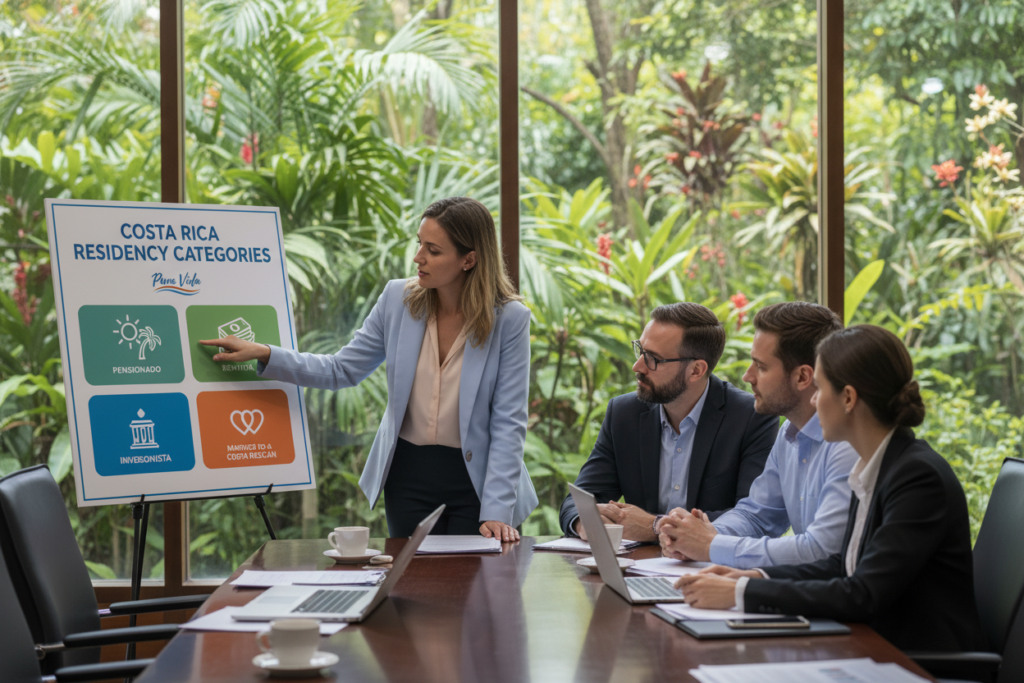
Selecting the right residency category is a foundational decision that shapes your entire application process. We help you identify which official path aligns with your financial and personal situation.
Pensionado (Pensionado): US$1,000+ per Month
This category is for retirees with a guaranteed lifetime pension. You must provide authenticated proof of income totaling at least US$1,000 per month.
Rentista (Rentista) and Inversionista (Inversionista) Requirements
The Rentista category requires a guaranteed monthly income of US$2,500 for two years. The Inversionista path demands a minimum investment of US$150,000 in an asset held in your personal name.
It’s crucial to understand that Digital Nomad status is not a formal residency category. It does not count toward the time needed for permanent residency or citizenship.
Each option has specific financial thresholds. Meeting these requirements with properly authenticated evidence is non-negotiable for approval.
For precise guidance on choosing and proving your category, consult with our Costa Rica immigration lawyers and consultants.
Essential Documentation and Pre-Arrival Preparations
The strength of your residency application rests entirely on the authenticity and organization of your paperwork. We treat this phase with the utmost seriousness, as it directly impacts your timeline.
Required Documents and Their Authenticity
Your core required documents include your current passport, proof of CAJA enrollment, and the official Resolution from the DGME. Each piece must be pristine and verifiable.
We stress that every birth certificate or marriage certificate must be apostilled in your home country first. After apostille, an authorized translator in Costa Rica must provide the official translation.
Apostilles, Official Translations, and Organized Paperwork
Canadian citizens follow a specific path. Authentication involves Global Affairs Canada, the Costa Rican consulate, and the Ministry of Foreign Affairs in San Jose.
You must prepare a typed paper with your parents’ full names and another with your email address. Handwritten notes are not accepted by officials.
Keep all paperwork organized in a master folder. Include DGME-stamped photocopies from your initial submission. We also recommend creating digital backups of all documents.
For comprehensive guidance through these precise steps, explore our dedicated residency support services.
Booking Your DIMEX Appointment
Two primary systems exist for scheduling your required meeting with immigration authorities. Your choice often depends on which venue you will use for the final step.
How to Book via Phone and Online Platforms
To secure a slot at a DGME office, you must call 1311. This service requires a Kolbi mobile phone and that you are physically located within the country.
For an appointment at the Banco de Costa Rica (BCR), dial 800-BCRCITA. You can also use the BCR online portal to schedule your visit conveniently.
What to Expect During the Appointment
This meeting finalizes your card production. You will provide biometric data—fingerprints and a photo—for your official DIMEX.
We advise arriving at least 10 minutes early. Late arrivals often result in a forfeited slot.
The actual processing time is typically 20 to 30 minutes if your documents are perfectly organized. Be prepared to communicate in Spanish or bring a professional translator.
This appointment is the final verification of your entire application. Proper preparation here ensures a smooth conclusion.
Understanding the Payment and Fee Process
The payment process for your residency card involves specific channels and strict rules. We guide you through this final financial step to ensure no delays in obtaining your legal status in Costa Rica.
Breakdown of Government and Administrative Fees
The total fees for your card include several parts. You have the government solicitation fee, shipping costs to the post office, and the bank’s commission for processing.
Always keep your payment receipts safe. They serve as concrete proof you have fulfilled all financial obligations for card issuance.
Methods of Payment at DGME, BCR, and Correos de Costa Rica
You must pay the required government fees at a Banco de Costa Rica (BCR) branch before your appointment. Ensure the receipt reflects your name exactly as on your passport.
At any BCR bank, you can pay using cash or a BCR credit or debit card. Other bank cards are generally not accepted for these transactions.
If your appointment is at a post office, bring the exact amount of ₡7,910 in cash for administrative expenses. We remind you that any name discrepancy on receipts can cause rejection by authorities.
Navigating Venue Options for Your DIMEX Appointment
Your choice of venue for the final step of your residency process is not arbitrary. It’s determined by your official category.
Inversionista applicants are restricted to DGME offices. Pensionados and Rentistas under 65 can use a Banco de Costa Rica branch or the post office.
Seniors aged 65 and over have a unique benefit. They can visit a DGME office without needing to book an appointment in advance for their card.
Comparing DGME Offices, BCR Branches, and Post Offices
Many clients find the post office locations offer more patient service. This is compared to the busier main immigration offices.
The post office system is particularly beneficial for those in rural areas. It avoids the need to travel to the capital for your residency needs.
We recommend checking the list of participating BCR branches on their official website. Find a location that is convenient for your specific situation.
Regardless of the venue, ensure you have all documents and correct payment receipts. This preparation is key before heading to your chosen office.
Common Mistakes to Avoid During Your DIMEX Process
We see the same handful of mistakes repeatedly delay or jeopardize otherwise solid residency applications. These errors are often simple to prevent with proper guidance and attention to detail.
Document Discrepancies and Timing Errors
A single letter difference in your name across documents can trigger significant delays. Officials require exact matches on your passport, payment receipts, and forms.
Arriving late is a frequent cause of frustration. Immigration schedules are strict, and missing your slot can mean forfeiting the appointment entirely.
Forgetting your CAJA payment receipt or the typed sheets with your parents’ full names will halt the process. Also, never sign your informed consent form before the meeting. It must be signed in the officer’s presence to be valid.
Managing Language Barriers and Translation Issues
This is a serious legal process where professional translation is essential. Relying on apps or friends often leads to costly errors.
Inaccurate translations can cause misunderstandings that reject your residency application. We advise hiring a certified translator familiar with immigration terminology.
By working with experienced guides, you sidestep these preventable pitfalls. This ensures your application proceeds smoothly without unnecessary complications.
Timeline and Processing Stages for Your DIMEX Card
Once your biometrics are submitted, the clock starts on the production and delivery of your essential card. This final administrative phase has a predictable sequence, but its duration requires realistic planning.
Scheduling and Expected Waiting Times
You will first receive a digital version of your card via email. This typically happens within a couple of weeks after your appointment.
The production of your physical residency card usually takes about one month. Current experiences range from three to eight weeks, depending on system volumes at the time.
Once your card arrives at the selected post office, you have exactly 30 days to retrieve it. You must collect it in person, as this task cannot be delegated to anyone else.
We advise planning for a total timeline of 60 to 90 days from your appointment date. The post office often does not send notifications when your card is ready.
We recommend checking the status of your application proactively after 22 business days. Patience is essential during this waiting period.
The system involves multiple stages of verification between the immigration office and the postal service.
Digital Transition: Embracing the Electronic DIMEX
Your official residency card now comes in a secure electronic format, accessible from anywhere. This digital DIMEX is a protected PDF file sent directly to your email.
It represents a major step forward in how you prove your legal status. The transition eases the administrative burden for everyone involved.
Benefits of Receiving a Digital DIMEX
This digital card contains a scannable QR code. Officials can instantly verify your residency status by linking to the official database.
You receive proof of your status much faster than waiting for the plastic card. The digital file holds the same legal weight as the physical version.
This system provides a reliable backup while your official card is being produced. It’s a practical solution for daily verification needs.
Tips for Safely Storing Digital Copies
We recommend saving your DIMEX PDF in a secure, encrypted cloud storage service. Also, email a copy to yourself for easy emergency retrieval.
Keep a printed copy as some private institutions may request the plastic card. Always ensure your contact information is current with the authorities.
Update your email address and physical address promptly. This ensures you receive all vital notifications about your residency without delay.
Residency vs. Citizenship: Clear Steps and Clarifications
Clarifying the distinction between residency and citizenship is a fundamental step in your long-term planning. Many newcomers conflate these separate legal statuses, which can lead to misplaced priorities early in the process.
Why Residency Steps Come First
Your journey must begin with securing temporary residency. It is crucial to understand that a Digital Nomad visa is not a form of legal residency. This status does not count toward the time required for permanent residency or future citizenship.
Your first residency application establishes your legal footing. This temporary status requires renewal at the end of your first and second years of stay. We emphasize that all discussions about future citizenship are premature until you successfully maintain this status.
Pathways to Future Citizenship
After maintaining continuous physical presence for two years, some individuals may become eligible to apply for permanent residency. Specific circumstances can allow for an earlier application for citizenship in certain cases.
For most applicants, the path to permanent residency opens after completing three years of temporary residency. At this point, the burdensome annual renewals are no longer required.
By focusing on the immediate steps of your residency application, you build the necessary foundation. This groundwork supports any future goals you may have regarding naturalization.
Final Thoughts on Securing Your Costa Rica Residency Journey
Completing your residency journey in Costa Rica marks a pivotal achievement in establishing your new life. Securing this legal status is a significant milestone that requires careful planning from the very start.
We encourage you to approach your DIMEX appointment with patience and the right professional support. Remember, this meeting is just one step in your ongoing residency journey, which will require the same diligence for future renewals.
Always verify the latest official rules, as policies can change. For expert guidance through this complex process, our team is ready to help. You can find answers to many common questions on our FAQs page.
With proper preparation, thousands successfully secure their status here each year. For personalized assistance, reach us via WhatsApp at +506 8706 3888 or email info@crie.cr.
FAQ
How do I book my DIMEX appointment?
You book it through the Dirección General de Migración y Extranjería (DGME) website or by phone. We recommend setting your appointment early, as slots can fill up quickly. Having all your required documents prepared and authenticated before you book helps avoid delays.
What documents do I need to bring to my appointment?
A>You’ll need your passport, birth certificate, marriage certificate (if applicable), and proof of financial means—all with an apostille and official Spanish translation. Bring originals and copies. Even a small name discrepancy on your papers can cause a rejection, so verify everything matches your passport exactly.
Where do I pay the government fees for my residency card?
Fees are paid at authorized banks like Banco de Costa Rica (BCR) or at certain post office (Correos) branches. You’ll receive a payment form during your application process. Do not pay fees directly at the immigration office; they only accept payment confirmations from these approved institutions.
How long does it take to get the physical DIMEX card after my appointment?
After approval, it typically takes several months for the plastic card to be produced and mailed. Costa Rica now issues a digital DIMEX (e-DIMEX) first, which is legally valid for use while you wait for the physical one. Processing times can vary, so we advise planning for potential delays.
What’s the difference between temporary and permanent residency?
Temporary residency is your first status, granted for categories like Pensionado or Rentista. After maintaining that status for three years, you can apply for permanent residency. Permanent residency removes the need to prove ongoing income and offers a longer-validity card, but citizenship is a separate, longer process.
What are the most common reasons for a residency application to be denied?
The top reasons are incomplete documentation, missing apostilles or translations, and discrepancies in personal details like your name or birth date across different papers. Submitting documents that are expired or not meeting the exact financial requirements for your chosen residency category will also result in a denial.
Article by Glenn Tellier (Founder of CRIE and Grupo Gap)
Don't wait, contact us right now!
Call or WhatsApp Costa Rica +506 8373 2085 or +506 8706 3888
Call USA/Canada +1 305-906-6784