
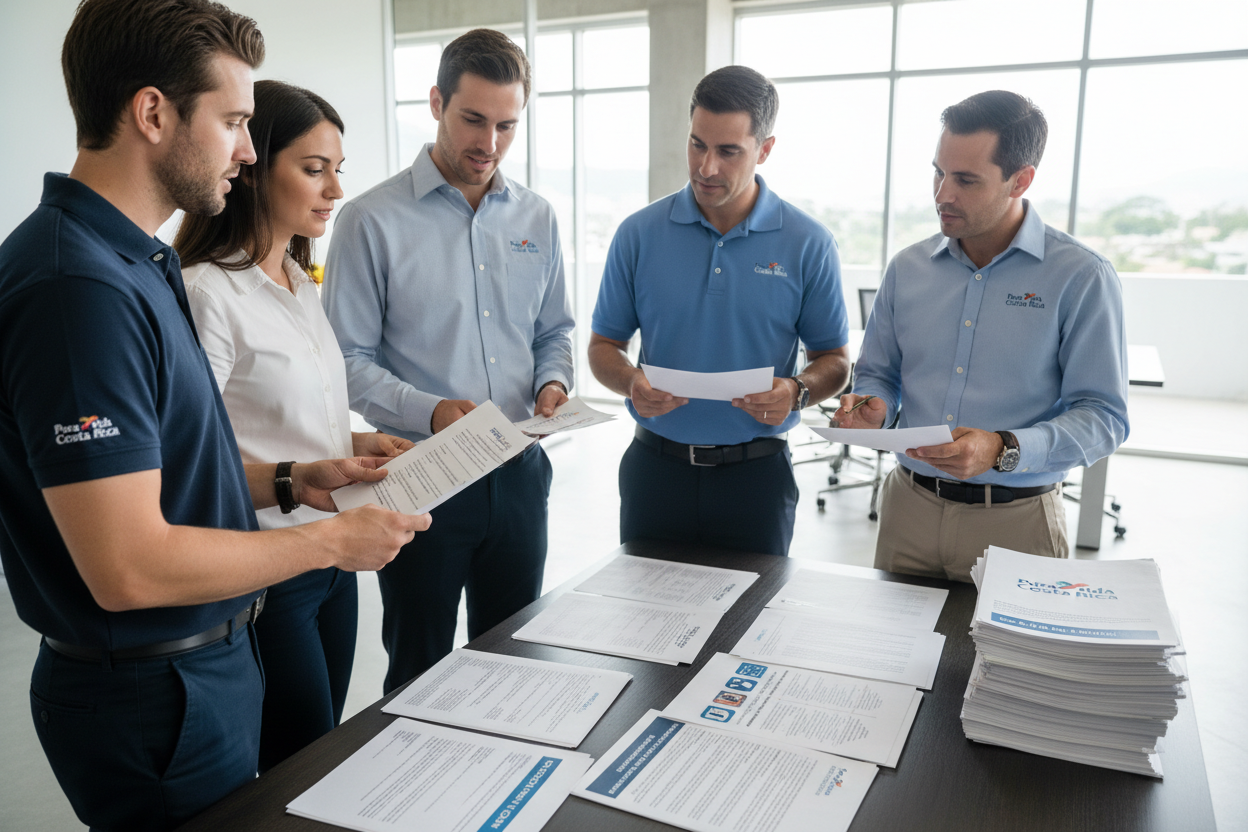
Understanding the local healthcare system requirements is a foundational step for any foreigner planning to establish long-term residency here. Over twelve thousand American expats already call this beautiful Central American nation home—a testament to its appeal.
We recommend you begin the entire immigration process from the comfort of your current home. Organizing your essential documentation before arrival creates a significant advantage.
Our team provides expert guidance to ensure your transition is handled with necessary legal precision. We help you navigate each step to avoid common pitfalls that often delay official approval.
By preparing your paperwork early, you build a streamlined path toward achieving your goal. This proactive approach turns a complex administrative journey into a manageable, clear process.
Understanding Costa Rica Residency Options (Residencia)

A common misconception we address early is the difference between a temporary visa and formal residency. Many people believe the Digital Nomad visa leads to permanent residency, but it does not grant that legal status.
Who Qualifies for Residency?
To qualify, you must apply under a specific financial category. Obtaining legal resident status is a formal commitment to the nation’s laws and social systems.
Importantly, Immigration Law 8764 requires every new resident to register with the Caja to finalize their migratory status. This step is non-negotiable.
Overview of Residency Categories
The Pensionado category is for those with a guaranteed lifetime pension. The Rentista category serves applicants with a consistent, verifiable monthly income from abroad.
The Inversionista category requires a significant financial commitment into the country. We provide professional guidance to navigate this process smoothly. Each pathway is tailored to different financial profiles.
Step-by-Step Guidance for caja-requirements-costa-rica Application

Many applicants find the document preparation phase to be the most critical—and often the most confusing—part of the entire journey. A methodical approach from your current home is essential for a smooth process.
Preparing Your Documents: Apostilles and Translations
You must begin by obtaining apostilles for vital records like birth certificates. This official stamp validates documents for use abroad. All paperwork not in Spanish requires translation by a certified professional recognized here.
Timeline Expectations and Key Milestones
Factor in significant time for the apostille process itself. This step, often overlooked, can delay your entire timeline. We help you map out realistic milestones to manage expectations.
Common Pitfalls to Avoid
A major error is submitting documents without these mandatory validations. Another is not verifying specific requirements directly with official sources. By organizing everything from home, you submit a complete application upon arrival.
Meet the Residency Thresholds for Pensionado, Rentista, and Inversionista
Each residency category in Costa Rica has distinct financial thresholds that applicants must meet to qualify. The government enforces these minimums strictly to ensure all new residents can support themselves independently.
We guide you through the precise requirements for each pathway. Understanding these benchmarks is your first practical step.
Pensionado: US$1,000+/month Pension Requirement
This category is designed for retirees with a guaranteed lifetime pension. You must prove a stable income of at least US$1,000 per month from that pension source.
The documentation must clearly show this income is permanent. This verifies your long-term financial stability.
Rentista: Demonstrating US$2,500/month Income for Two Years
Rentista applicants need to show consistent monthly income from sources like investments or rentals. The requirement is proof of US$2,500 for a consecutive two-year period.
This demonstrates you have reliable funds without needing local employment. Your evidence must be verifiable and official.
Inversionista: Minimum US$150,000 Investment and Personal Property Ownership
This path requires a direct capital investment into the country. The minimum is US$150,000 in an approved asset, like real estate or a business.
A critical rule is that the property must be held in your personal name, not through a corporation. This ties the investment directly to you as the resident.
Always verify the latest figures on the official migration portal at migracion.go.cr. Requirements can change.
Essential CAJA and Healthcare System Insights
The public healthcare framework here is a key factor contributing to the nation’s high average life expectancy and overall well-being. Founded in 1941, the Caja Costarricense de Seguro Social (CCSS) provides universal healthcare to every legal resident in the country.
This enrollment is not optional—it’s a mandatory step for finalizing your status. It forms the bedrock of your medical security.
Benefits of CAJA Enrollment for Residents
The primary benefit is comprehensive coverage. Your registration grants access to preventive, curative, and emergency services without additional copayments at the point of care.
The system’s effectiveness is clear. Costa Rica’s average life expectancy of 80.8 years surpasses that of the United States.
While about 30% of people also use private services, the public system provides the essential, legally required base for all residents.
Accessing Primary, Clinic, and Hospital Services
Once enrolled, you gain entry to a full network. This includes local primary care clinics, specialized facilities, and national hospitals.
We help you understand how to navigate this structure. It’s important to know that out-of-pocket payments still account for 22.42% of total healthcare expenditure in the country.
This highlights the value of understanding your specific coverage as an investor. Knowing what is covered helps you plan effectively and use the system with confidence.
Required Documentation and Procedural Details Before Arrival
A proactive strategy for organizing your essential paperwork transforms a daunting administrative task into a manageable process. The foundation for a smooth application is built long before you arrive.
For foreigners, this initial phase is arguably the most critical. It directly influences the entire residency timeline.
Organizing and Preparing Essential Documents
Begin by gathering all vital records from your home country. This includes birth certificates and marriage licenses, if applicable.
We advise checking the official migration portal at migracion.go.cr for the latest required list. Submitting a complete package upon arrival prevents immediate setbacks.
Ensuring Apostilles and Translations Are Correct
Every document must carry an apostille. This is a special certification that validates it for use in Costa Rica.
All paperwork not originally in Spanish requires translation by a government-certified professional. The immigration office enforces this standard strictly.
Handling these validations from home eliminates the stress of navigating new systems abroad. It is the surest way to avoid significant delays in your residency approval.
How to Start Your Residency Process from Home
We always advise beginning your application while still in your current location. This strategy lets you organize documents without in-country pressure. It establishes a strong base for your legal standing.
Pre-Arrival Checklist and Documentation Preparation
Develop a thorough checklist of all requirements. Include background checks and financial proof to uphold your status. Remember, Immigration Law 8764 requires Caja registration to finalize your migratory standing.
We recommend initiating this work at least six months before your planned move to Costa Rica. This timeframe allows apostilles to be obtained and translations completed. Finalizing paperwork abroad ensures an efficient transition.
Always consult the official portal at migracion.go.cr. Verify your checklist matches the latest rules for Costa Rica. This diligence prevents common setbacks.
Navigating the Caja and Social Security Contributions
The financial structure of your mandatory healthcare enrollment involves two key components that fund both current and future benefits. Your monthly payment is not just a fee—it’s your entry into a comprehensive social security program.
Understanding SEM and IVM Contributions
Your required payment to the Caja Costarricense de Seguro Social funds two main programs. The SEM covers sickness and maternity, while the IVM handles disability, old age, and death.
Your share of the cost is based on your declared income. You will contribute between 2.89% and 10.69% of your earnings each month.
The national government then adds funds to reach a full 12% of your income for the social security system. This shared funding model is a core part of the public healthcare policy.
Linking Contributions to Future Pension Benefits
These payments are a direct investment in your long-term stability. Your consistent contributions secure your future eligibility for a state pension.
Your monthly payment provides extensive coverage. It ensures access to medical services for you, your spouse, and your children.
By participating in this program, you integrate into the country’s social fabric. You gain not just immediate care but also contribute to the system’s sustainability for everyone.
Real-life Timelines and Insights from Approved Applications
Real-world experience shows that managing expectations for your residency timeline is crucial for a stress-free transition. We have seen that approved applications often take several months to process.
The exact duration depends on your case complexity and the government’s review stages. Setting a realistic schedule from the start prevents frustration.
Expected Application Timelines and Processing Stages
People moving to Costa Rica should plan for a multi-stage process. Initial document review is followed by verification of financial proofs like monthly income.
Final approval of your legal status includes registering for the mandatory public healthcare program. This Caja fee is a required cost for all new residents in the country.
Strategies to Avoid Delays and Mistakes
The most effective strategy is thorough preparation from your home country. Residents who submit complete, apostilled documents experience far fewer delays.
Avoid simple errors like using expired paperwork. This ensures your residency is approved in a timely manner.
Many people find the benefits of the system—including hospital access and medication coverage—are well worth the monthly fee. This is true even if you also use private services.
Understanding all options, including family-based residency pathways, helps you build a solid plan. Proper care during preparation secures your future access to care and pension benefits.
Final Insights and Your Next Steps Toward Residency
Finalizing your legal status as a resident involves more than just immigration approval—it requires active participation in the national healthcare system. Your mandatory health insurance and social security contributions are the final, essential steps to secure your residency in Costa Rica.
Understanding this process protects your legal standing. We provide accurate information on the healthcare system and immigration policy to guide you.
Take the next step toward your new life. Contact our team via WhatsApp at +506 8706 3888 or email info@crie.cr for professional support and transparent guidance on your journey.
FAQ
What is the CAJA, and why is it important for my residency application?
The CAJA, or Caja Costarricense de Seguro Social, is Costa Rica’s public healthcare and social security system. Enrollment is a mandatory part of the residency process for most applicants. It provides you and your family with access to the national healthcare system, including clinics and hospitals. Showing proof of enrollment is a key requirement to finalize your legal resident status.
Do I qualify for Costa Rican residency?
Most foreigners qualify through specific categories based on financial means. The common paths are the *Pensionado* visa for retirees with a stable pension, the *Rentista* visa for those with guaranteed passive income, and the *Inversionista* visa for investors. Each category has distinct financial thresholds you must prove to the immigration authorities.
What are the income requirements for the Pensionado and Rentista residency categories?
For the Pensionado category, you must prove a lifetime pension of at least US
FAQ
What is the CAJA, and why is it important for my residency application?
The CAJA, or Caja Costarricense de Seguro Social, is Costa Rica’s public healthcare and social security system. Enrollment is a mandatory part of the residency process for most applicants. It provides you and your family with access to the national healthcare system, including clinics and hospitals. Showing proof of enrollment is a key requirement to finalize your legal resident status.
Do I qualify for Costa Rican residency?
Most foreigners qualify through specific categories based on financial means. The common paths are the *Pensionado* visa for retirees with a stable pension, the *Rentista* visa for those with guaranteed passive income, and the *Inversionista* visa for investors. Each category has distinct financial thresholds you must prove to the immigration authorities.
What are the income requirements for the Pensionado and Rentista residency categories?
For the Pensionado category, you must prove a lifetime pension of at least US$1,000 per month. For the Rentista category, you must demonstrate a guaranteed income of US$2,500 per month for at least two years, often through a deposit held in a Costa Rican bank. These amounts are set by the government and are subject to change.
What documents do I need to start the residency process from my home country?
You should begin by gathering your birth certificate, marriage certificate (if applicable), and a police clearance report. These documents must be apostilled (or authenticated) in their country of origin and then officially translated into Spanish by a certified translator in Costa Rica. Starting this early is crucial, as it can be the most time-consuming part.
What are the benefits of enrolling in the CAJA healthcare system?
Enrolling gives you and your dependents full access to the public healthcare network. This includes appointments with general practitioners, specialist referrals, emergency care, surgeries, and prescriptions at a very low cost. Your monthly contributions also build your eligibility for a future retirement pension from the social security system.
How do social security (IVM) contributions work, and what do they cover?
As a resident, you’ll make monthly contributions based on a declared income. These are known as IVM (Invalidez, Vejez y Muerte) payments. They fund your access to the CAJA’s medical services and simultaneously accrue toward your future old-age, disability, and death pension benefits through the state system.
How long does the entire residency application process typically take?
The timeline can vary, but you should generally plan for a process that takes 6 to 12 months from submission to approval. This includes time for document preparation, application filing, background checks, and the final mandate requiring CAJA enrollment. Working with a reputable legal advisor is the best strategy to avoid delays from incomplete paperwork.
Can I use my private international health insurance to fulfill the CAJA requirement?
No, you cannot. While maintaining a private policy is highly recommended for faster service and additional coverage, it does not replace the mandatory enrollment in the Caja Costarricense de Seguro Social. Proof of CAJA affiliation is a non-negotiable legal requirement to complete your residency status.
,000 per month. For the Rentista category, you must demonstrate a guaranteed income of US,500 per month for at least two years, often through a deposit held in a Costa Rican bank. These amounts are set by the government and are subject to change.
What documents do I need to start the residency process from my home country?
You should begin by gathering your birth certificate, marriage certificate (if applicable), and a police clearance report. These documents must be apostilled (or authenticated) in their country of origin and then officially translated into Spanish by a certified translator in Costa Rica. Starting this early is crucial, as it can be the most time-consuming part.
What are the benefits of enrolling in the CAJA healthcare system?
Enrolling gives you and your dependents full access to the public healthcare network. This includes appointments with general practitioners, specialist referrals, emergency care, surgeries, and prescriptions at a very low cost. Your monthly contributions also build your eligibility for a future retirement pension from the social security system.
How do social security (IVM) contributions work, and what do they cover?
As a resident, you’ll make monthly contributions based on a declared income. These are known as IVM (Invalidez, Vejez y Muerte) payments. They fund your access to the CAJA’s medical services and simultaneously accrue toward your future old-age, disability, and death pension benefits through the state system.
How long does the entire residency application process typically take?
The timeline can vary, but you should generally plan for a process that takes 6 to 12 months from submission to approval. This includes time for document preparation, application filing, background checks, and the final mandate requiring CAJA enrollment. Working with a reputable legal advisor is the best strategy to avoid delays from incomplete paperwork.
Can I use my private international health insurance to fulfill the CAJA requirement?
No, you cannot. While maintaining a private policy is highly recommended for faster service and additional coverage, it does not replace the mandatory enrollment in the Caja Costarricense de Seguro Social. Proof of CAJA affiliation is a non-negotiable legal requirement to complete your residency status.
Article by Glenn Tellier (Founder of CRIE and Grupo Gap)
Don't wait, contact us right now!
Call or WhatsApp Costa Rica +506 8373 2085 or +506 8706 3888
Call USA/Canada +1 305-906-6784