
Dreaming of a life in the tropics? You’re not alone. Recent data shows nearly 70,000 Americans now call Costa Rica home. The expat community here has grown by about 14% each year since 2020. This surge reflects a shared desire for the renowned “pura vida” lifestyle.
We understand that navigating the legal landscape for residency can feel overwhelming. The immigration environment is complex and requires careful planning. That’s where we come in.
As experienced guides, we provide clear, fact-based information. Our goal is to simplify the steps for establishing your new life. We focus on the requirements for U.S. citizens specifically.
This guide offers a realistic understanding of the process. Whether you’re a retiree or a professional, we aim to help you transition smoothly. Let’s walk through what to expect, step by step.
Overview of Costa Rica Residency Programs (Opciones de Residencia)
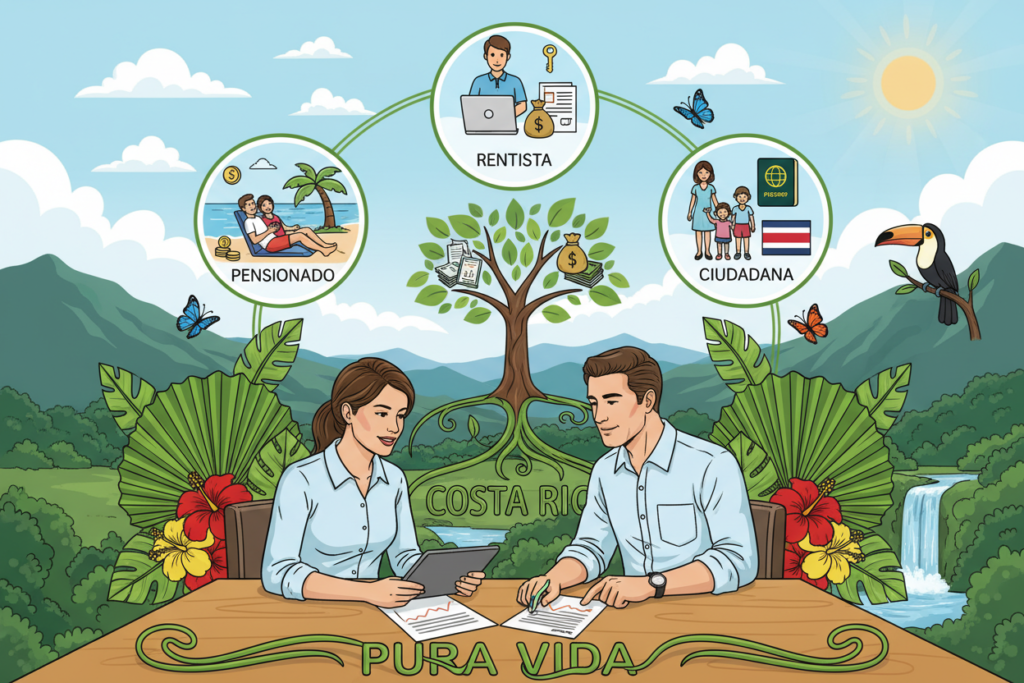
The residency landscape in Costa Rica is structured around three primary categories and one notable temporary permit. We’ll clarify the core options to help you identify the best fit.
Pensionado, Rentista and Inversionista Pathways
The Pensionado program is for retirees with a guaranteed lifetime pension of at least $1,000 per month. For non-retirees, the Rentista option requires proof of $2,500 monthly income for two years or a $60,000 bank deposit.
The Inversionista pathway demands a minimum investment of $150,000 in local assets. These are the main routes to permanent status.
Digital Nomad Visa: Temporary Permit vs. True Residency
It’s vital to understand the Digital Nomad visa is a temporary permit. It requires $3,000 monthly income but does not lead to permanent residency.
For remote workers seeking a long-term path, the Rentista option often serves as the most viable alternative. This is a key distinction in planning your future.
Eligibility and Key Requirements for U.S. Citizens
Qualifying for life in Costa Rica requires U.S. citizens to navigate a set of clear, non-negotiable requirements. Your eligibility for residency hinges on two pillars: proven financial means and an unblemished legal history.
We guide you through these fundamentals to set a solid foundation for your application.
Who Qualifies for Residency?
As a U.S. citizen, you are in Visa Group 1. This allows a tourist stay of up to 180 days. This period gives you time to start your residency process legally from within the country.
Your qualification is primarily financial. You must meet specific income or investment thresholds. A clean criminal background check is also mandatory for all applicants, without exception.
Income & Investment Thresholds Explained
The Pensionado category requires a guaranteed lifetime pension of at least $1,000 per month. For the Rentista program, you must prove a stable $2,500 monthly income.
The Inversionista pathway demands a minimum investment of $150,000 in approved local assets. A critical detail: this investment must be in your personal name, not a corporate entity, to qualify.
These financial benchmarks are the government’s core criteria for granting residency status.
costa-rica-residency-timeline: Step-by-Step Process Overview
Submitting your file initiates a multi-stage review that requires patience and organization. The entire residency application is managed by the Dirección General de Migración y Extranjería (DGME).
This government body processes all files. The timeline typically spans between 3 and 12 months. The duration depends on your specific category and how complete your documentation is upon submission.
Stages of Application Processing
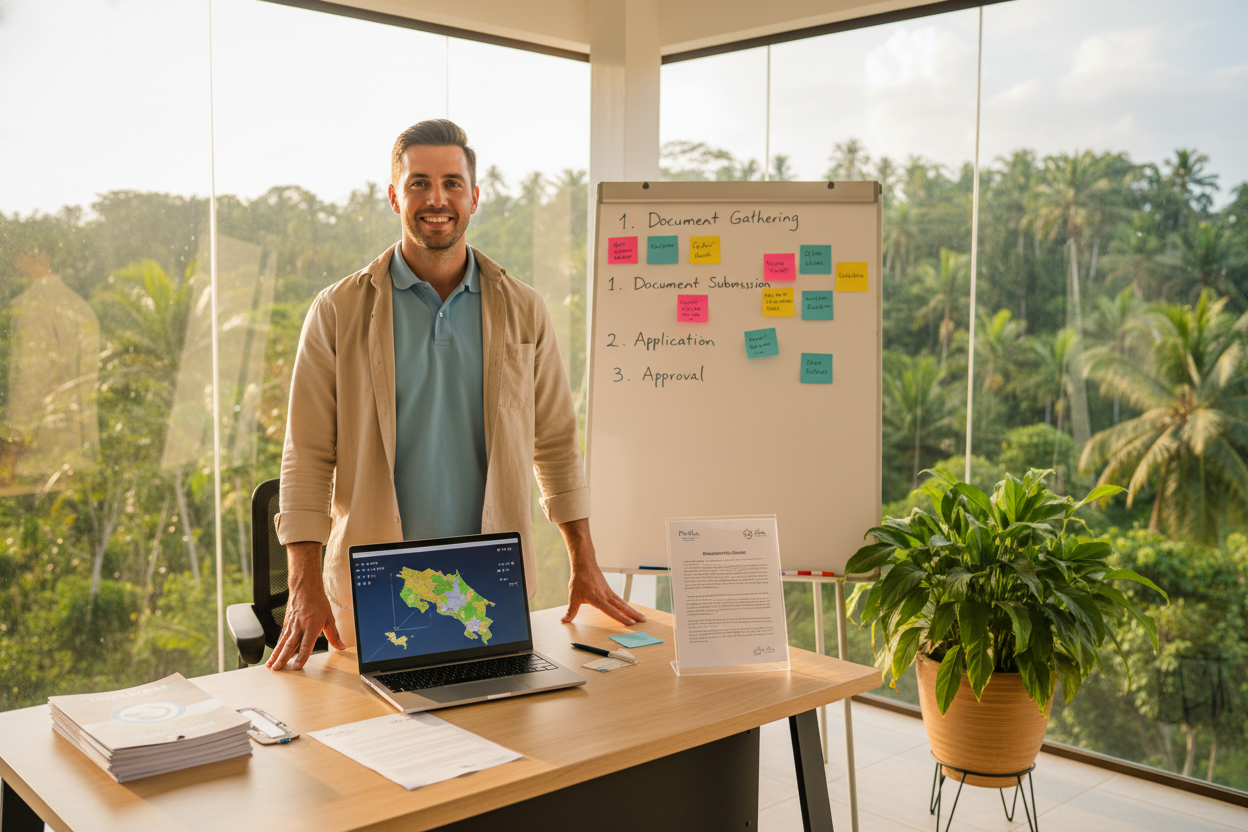
The first phase involves gathering and authenticating your documents. This includes obtaining apostilles and official translations. A meticulous start here prevents major delays later.
Next, you formally submit your complete file to the DGME office in San José. Upon filing, you receive a crucial document called a comprobante. This official receipt proves your application is pending. It also allows you to remain in the country legally during the review.
You then enter the waiting period for approval. Current processing volumes mean this review can take several months. For Pensionado applicants, the DGME estimates 8 to 12 months. We strongly advise building this timeline into your relocation plans from the outset.
Proper planning for this phase is key to a smooth transition. For answers to common questions about this process, visit our detailed FAQ resource.
Preparing Essential Documents Before Arrival (Preparación de Documentos)
Before you pack your bags, the most critical task is assembling your official paperwork. A complete and properly prepared file is your strongest asset. We cannot overstate its importance for a smooth application.
Apostilles, Translations, and Notarization
All foreign documents must be apostilled by the U.S. Department of State. This authentication is mandatory for validity in Costa Rica. We strongly advise initiating this process from home.
Every vital record requires translation into Spanish. This includes birth and marriage certificates. Only translations by a recognized official translator in Costa Rica are accepted.
Creating a Detailed Document Checklist
A precise checklist prevents costly oversights. Tailor it to your specific residency category. Common errors involve missing a single required document.
Pay close attention to your criminal background check. It is only valid for six months from issuance. Submitting an expired check leads to automatic rejection.
Verify name consistency across all records before you leave. Discrepancies between your passport and birth certificate cause significant delays. Meticulous preparation here saves months of waiting.
Scheduling and Submitting Your DGME Application
Successfully navigating the submission phase requires precise scheduling and a meticulously prepared file. This is the point where your paperwork transitions into an official immigration case.
We guide you through this critical administrative step to ensure a smooth filing.
Booking Your Appointment Online
You must schedule your submission appointment through the official DGME website. Due to high demand in San José, secure your slot three to four weeks in advance.
Before your appointment date, visit any Banco de Costa Rica branch. Pay the required application filing fee of approximately US$50. Keep the bank receipt—it is mandatory for your filing.
What to Bring to the DGME Office
On appointment day, bring all original documents and their official Spanish translations. Also, prepare two complete sets of photocopies for the immigration officer.
During your visit, you will provide biometric data. This includes digital fingerprints and a photograph.
After submitting your package, you will receive an expediente number. This number is essential for tracking your residency application status online.
Once approved, you will pay for your DIMEX card. This official ID costs between US$98 and US$123. Understanding potential delays in the review process helps manage expectations after submission.
Managing the Waiting Period and Maintaining Legal Stay
Your legal standing during the application review hinges on a single document: the comprobante receipt. This phase requires active management rather than passive waiting. We guide you through the rules that preserve your application’s good standing.
Understanding Your Legal Status with the Comprobante
The official comprobante you receive after filing is your legal proof of stay. It allows you to remain in Costa Rica without making border runs every 90 days. This document is essential throughout the entire review period.
We recommend using this time productively. Establish local banking relationships and secure long-term housing. These steps prepare you for the practical long-term benefits of residency.
If you must travel internationally during processing, obtain an exit permit from the DGME first. Leaving the country without this official authorization risks severe consequences. Your pending application could be automatically canceled.
This cancellation would reset your progress to zero. Compliance with all immigration rules during this interim is non-negotiable. View this as an active period where careful attention preserves your status.
Common Application Mistakes and How to Avoid Them
Avoiding common errors can be the difference between a smooth approval and months of frustrating delays. Many pitfalls are entirely preventable. Organizations like the Association of Residents of Costa Rica (ARCR) provide valuable checklists to help applicants stay organized.
Preventing Incomplete Documentation Errors
One major error is submitting an expired criminal background check. This document is only valid for six months from its issue date. Applications with older checks face automatic rejection.
Ensure every required form is included and properly authenticated. Missing a single item halts the entire process.
Clarifying Income Proof and Name Consistencies
Providing only bank statements is insufficient for income proof. You must provide official documentation verifying the source of your funds. This is a strict requirement for residency.
Also, verify name consistency across your passport and birth certificate. Discrepancies are a common red flag that cause significant delays.
Remember, the Pensionado program accepts only guaranteed pension or Social Security income. Investment returns do not qualify. Working with a qualified professional helps you navigate these strict standards and avoid costly mistakes.
Navigating CAJA Enrollment and Healthcare Requirements
Securing your residency card is a major milestone, but it also activates a key legal requirement. You must enroll in the national healthcare system, known as CAJA or CCSS. This step is mandatory for all new residents, with one specific exception.
The Digital Nomad visa is the only pathway that does not require CAJA enrollment. For everyone else, registering is a non-negotiable part of maintaining your legal status in Costa Rica.
Understanding CAJA Premiums and Coverage
Your first task is to visit your local EBAIS clinic to register. Your monthly premium is not a fixed fee. It is calculated as a percentage of your declared income, typically between 7% and 11%.
You can use the official CCSS online calculator to estimate your costs. This system provides comprehensive medical coverage with no copays for services. It is a significant benefit for long-term planning.
Many residents also maintain private insurance for faster specialist access. However, your public CAJA enrollment remains a mandatory legal requirement. After paying your first premium, you will receive your healthcare card.
This card grants you access to the national system’s hospitals and clinics. We advise viewing this not just as an obligation, but as a foundational part of your new life. It provides security and aligns with the practical benefits of residency.
Ensuring Compliance and Staying Organized
After your residency is approved, the journey shifts from application to long-term compliance. Protecting your status requires a proactive and organized approach. We guide you through the essential rules for maintaining your legal standing.
Timely DIMEX Card Renewals
Your DIMEX card has an expiration date. You must renew it before that date to remain in compliance. This process is straightforward but non-negotiable.
After three years of holding temporary residency, you become eligible to apply for permanent residency. This status offers more stability and fewer renewal requirements. It’s a key milestone on your path.
Avoiding the Pitfalls of Overstaying Your Visa
If you travel abroad frequently, you must visit Costa Rica at least once per year. This rule maintains your residency status. Failing to do so can risk your legal standing.
Citizenship is an option after seven years of legal residency. It requires passing Spanish language and civics exams. Staying organized with your renewal dates and CAJA payments is essential. It protects your path toward permanent status and potential future citizenship.
Exploring U.S. Tax Considerations for New Costa Rican Residents
Establishing residency abroad does not relieve U.S. citizens of their domestic tax filing duties. You must continue to file annual returns with the IRS. This rule applies regardless of how many years you live in another country.
However, significant benefits exist. The Foreign Earned Income Exclusion (FEIE) may allow you to exclude a substantial portion of your foreign-earned income from U.S. taxation. For 2024, this exclusion is up to $120,000.
Another key rule involves foreign bank accounts. If the total value of your accounts outside the U.S. exceeds $10,000, you must file an FBAR report under FATCA rules.
We strongly recommend consulting a tax professional who understands both U.S. and Costa Rican law. Proper planning helps you avoid double taxation. It also ensures your financial transition to this new country is efficient and fully compliant.
Investing in Costa Rican Property & Business Opportunities
The Inversionista pathway opens doors to both real estate and business ventures as a route to residency. This category requires a minimum investment of US$150,000 in approved local assets. Your capital can flow into sectors like tourism or sustainable agriculture.
Personal vs. Corporate Property Ownership
If you use real estate to qualify, the property title must be in your personal name. Many foreigners traditionally hold assets in a corporation for liability reasons. However, this structure can complicate your residency application.
We advise working with a reputable real estate attorney. They ensure your transaction is legal and the title is clear. Understanding local property laws is critical for any long-term commitment.
Costa Rica offers diverse business opportunities. Sectors like eco-tourism qualify for the Inversionista program. This investment not only secures your residency but can also generate income.
The Role of Legal Guidance and Professional Support
The decision to seek expert legal support can significantly impact the success of your residency application. The immigration system involves detailed regulations that change periodically.
We provide specialized residency and immigration services for those moving to Costa Rica. Our goal is to simplify the complex legal landscape for you.
Choosing a Qualified Immigration Attorney
Look for an attorney with specific experience in Costa Rican immigration law. They should understand the nuances of different residency categories.
A professional with years of work in this field can anticipate potential issues. This local expertise is crucial for a smooth process.
Benefits of Expert Document Review
A thorough review by a qualified professional ensures your documents meet all current government requirements. This step prevents common errors that cause delays.
It is an investment that saves time and reduces stress. Our team positions itself as an experienced guide, helping you navigate without unrealistic promises.
You can reach out to our team at CRIE via WhatsApp at +506 8706 3888 or email us at info@crie.cr. We are dedicated to providing transparent, fact-based support for your transition to life in Costa Rica.
Embarking on Your New Life in Costa Rica
We see obtaining residency as a strategic process that opens the door to long-term stability and new opportunities. This journey requires a clear commitment to following legal procedures from the start.
Choosing the right program for your financial situation is the first critical decision. We encourage you to begin gathering your documents early to avoid delays.
Your temporary status is the initial step. After several years, it can lead to permanent residency and even citizenship in this beautiful country.
With a solid plan and the right support, you can navigate this path successfully. For a clear starting point, consider our personalized residency assessment.
FAQ
What are the main residency options for a retiree or someone with a stable monthly income?
The two primary pathways are the Pensionado and Rentista programs. The Pensionado visa is for retirees with a guaranteed lifetime pension. The Rentista visa is for individuals who can prove a stable monthly income from sources like investments or a business. Both require proof of meeting specific monthly income thresholds deposited into a Costa Rican bank account.
How long does the entire residency application process typically take?
From document preparation to receiving your physical DIMEX card, you should plan for a timeline of 6 to 12 months. The initial application review by immigration (DGME) can take several months. After provisional approval, there’s another waiting period for your card to be issued. We help clients navigate this waiting period legally.
Can I work or run a business in Costa Rica with temporary residency?
No, standard temporary residency categories like Pensionado and Rentista do not grant work permission. To work legally for a Costa Rican company, you need a specific work permit. To operate your own business, you typically need to establish a corporation. The Digital Nomad visa is a separate temporary permit for remote workers employed outside the country.
What is the most common mistake that delays applications?
Incomplete or incorrectly prepared documentation is the top cause for delays. This includes documents without proper apostilles, translations by a non-accredited professional, or name inconsistencies across your passport, birth certificate, and income proofs. We provide detailed checklists and review services to prevent these errors.
What legal status do I have while my application is being processed?
After submitting your application, you receive a *comprobante* (receipt). This document allows you to stay in the country legally while your file is under review, without needing to make border runs. It’s crucial to keep this document safe, as it’s your proof of legal stay during the processing period.
Is enrolling in the public healthcare system (CAJA) mandatory?
Yes, enrolling in the CAJA is a mandatory requirement for all residency holders, including dependents. You must enroll and begin paying monthly premiums after your residency is provisionally approved. Coverage is comprehensive, but many residents also maintain private insurance for faster access to certain services.
How important is it to hire a local immigration attorney?
A> Engaging a qualified, licensed immigration lawyer is highly recommended. The process involves complex regulations and direct interaction with government offices. An attorney ensures your application is complete, represents you before the DGME, and helps you avoid costly errors that can result in denial or significant delays.
What happens if I overstay my tourist visa before applying?
Overstaying can lead to fines and complications. You must be in a legal tourist status (typically 90 days) when you file your residency application. We advise clients to plan their entry and document preparation timeline carefully to apply well before their tourist stamp expires, ensuring a clean transition.
Do I need to report my worldwide income to U.S. authorities after moving?
Yes, U.S. citizens and permanent residents are required to report their global income to the IRS, regardless of where they live. Obtaining residency in Costa Rica does not change your U.S. tax filing obligations. It’s essential to consult with a tax professional familiar with expatriate taxation to understand your specific reporting requirements.
Article by Glenn Tellier (Founder of CRIE and Grupo Gap)
Don't wait, contact us right now!
Call or WhatsApp Costa Rica +506 8373 2085 or +506 8706 3888
Call USA/Canada +1 305-906-6784