
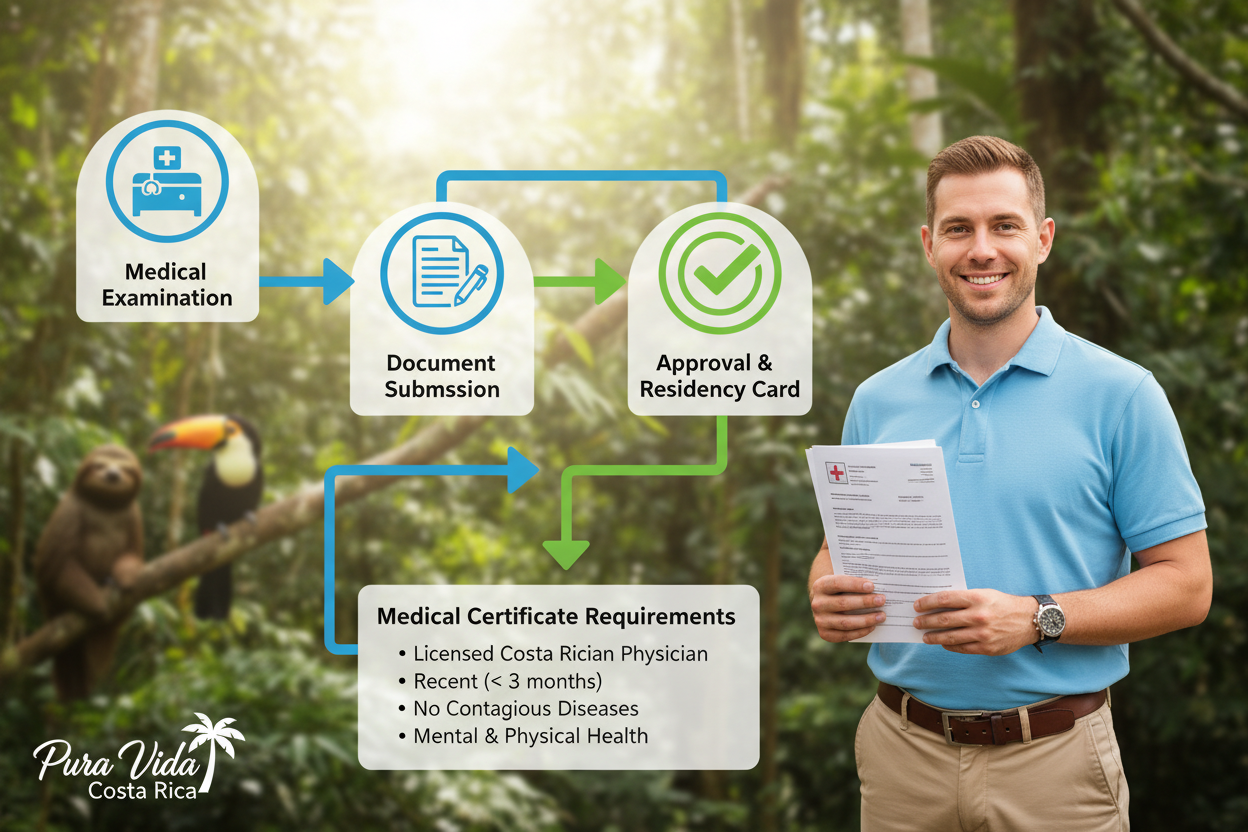
Many people worry about health checks when applying for legal status abroad. We want to clear this up immediately. Your medical history is not evaluated for approval here.
The system focuses on your financial qualifications and legal paperwork. This approach removes a common barrier. Nearly 70,000 Americans now call this beautiful nation home, with numbers growing fast.
There are three main pathways: Pensionado (Pensionado), Rentista (Rentista), and Inversionista (Inversionista). Each has specific income or investment criteria. For example, you need a US$1,000+ monthly pension or a US$150,000 minimum investment.
The crucial first step happens before you arrive. Proper document preparation prevents delays. This includes getting apostilles and official translations for key papers.
While no medical certificate is needed for approval, all approved residents must enroll in CAJA. This is the country’s universal healthcare system. It covers pre-existing conditions without exclusions, which is a significant benefit.
Processing times are realistic, not instant. They range from 4 to 12 months depending on your chosen category. We provide honest guidance, not unrealistic promises.
Ready to begin? Contact us on WhatsApp at +506 8706 3888 or email info@crie.cr. Always verify official criteria at migracion.go.cr. We’re here to guide you through every step.
Welcome to Your Ultimate Guide on Costa Rica Residency and Medical Certificate Requirements
Let’s clear the air right away: your physical well-being is not a hurdle for obtaining legal permission here. Many future expats share this concern, but the local immigration authority, DGME, does not evaluate your health history.
Their assessment focuses solely on your financial stability and legal background. This opens the door for individuals from all health backgrounds.
A critical point often misunderstood involves the nation’s universal healthcare system, CAJA. Enrollment is mandatory after you receive your approval. This system provides comprehensive coverage, including for pre-existing conditions, with contributions based on your declared income.
We’ve helped countless applicants navigate this journey. Our guide will walk you through the main categories, precise document needs, and realistic timelines. We combine official DGME criteria with practical insights from our experience.
Costa Rica’s inclusive approach to healthcare makes it a uniquely attractive destination. This guide provides the information you need for informed decisions. When you’re ready to begin your specific application, our team is here for personalized support.
Overview of Costa Rica Residency Options (Pensionado, Rentista, Inversionista)
Your financial profile determines which of the three main legal pathways you should pursue. Selecting the right category is the foundational step for your entire application strategy.
Understanding Each Residency Category
The Pensionado (Pensionado) category is designed for retirees. It requires proof of a permanent monthly pension of at least US$1,000 from sources like Social Security or a company retirement plan.
The Rentista (Rentista) pathway suits those with stable passive income. You must show US$2,500 in monthly income for two years. Alternatively, a US$60,000 deposit in a local bank, with monthly withdrawals of $2,500, qualifies.
The Inversionista (Inversionista) option is for investors. It demands a minimum US$150,000 investment in local real estate or a business. A critical rule: any property must be titled in your personal name, not a corporation.
Income and Investment Criteria Explained
Honestly matching your situation to these thresholds prevents complications. None of these categories exclude applicants based on health status.
This makes the nation’s system uniquely accessible. We help you assess which pathway aligns with your finances for a smooth process.
Who Qualifies for Costa Rica Residency – Step-by-Step Eligibility Criteria
Determining your eligibility for legal status in this Central American nation starts with a clear understanding of two non-negotiable pillars. You must meet specific financial thresholds and possess a spotless legal background. Your physical well-being is not part of this evaluation.
Financial Thresholds and Documentation Needs
The primary qualification is financial. For the Pensionado category, you need proof of a permanent $1,000+ monthly pension. Official verification letters from your pension provider are required.
Rentista applicants must demonstrate $2,500 in monthly income for two years. This requires bank statements showing six months of consistent deposits, plus documentation that the income will continue.
The Inversionista pathway demands a $150,000 minimum investment. You must provide proof of the fund’s source and show the transfer through official local banking channels.
Importance of a Clean Criminal Record
A clean criminal history is mandatory for all applicants. You need a background check from your country of citizenship and from every nation where you’ve lived in the past three years.
These documents are only valid for six months from issuance. Using an expired record is a common mistake that causes significant delays. All checks must be properly apostilled.
Universal requirements include a valid passport with six months’ validity and an apostilled birth certificate. If applicable, an apostilled marriage certificate is also needed.
This step-by-step checklist serves as an honest self-evaluation. We believe in transparency about these firm requirements before you invest time and resources in the process.
Essential Document Preparation Before Arrival
Properly preparing your paperwork from your home country is the most critical step to avoid costly delays. Attempting to obtain apostilles or certified documents after you arrive creates exponential complexity. We emphasize completing this foundational work before your departure.
Apostilles and Official Translations
For the United States and other Hague Convention countries, each vital document requires an apostille. This official certification comes from specific authorities like your Secretary of State. The sequence is non-negotiable: apostille first, then translation.
You must use a translator officially authorized by Costa Rican immigration authorities. Using an unofficial service invalidates your paperwork. Budget for these steps, as apostilles cost $50-100 per document and translations run $30-60 per page.
Organizing Your Paperwork at Home
Create a meticulous checklist. Core items include a valid passport with at least six months validity, a birth certificate, and a recent criminal background check. Financial proof specific to your category is also essential.
The most common errors involve expired background checks and name inconsistencies across different certificates. Verify every item multiple times. Always consult the official source, migracion.go.cr, for the latest requirements. Organized documentation demonstrates professionalism and prevents frustrating setbacks.
Costa Rica Residency Medical Certificate Requirements Explained
One of the most reassuring aspects of this nation’s immigration policy is its approach to personal health. We state this unequivocally: no health exam or doctor’s note is needed to secure your legal permission. The Dirección General de Migración y Extranjería (DGME) does not review medical histories.
Their evaluation focuses solely on your finances and clean criminal record. Whether you manage a chronic condition or are in perfect health, your application process is identical. There are no extra forms or health-based reasons for denial.
Health becomes relevant only after approval, when you enroll in the CAJA system. This mandatory step is a benefit, providing comprehensive coverage without exclusions. Many choose this path specifically for this accessible healthcare.
For a smooth transition, bring detailed medical records and a medication supply. These are for your new doctor, not for immigration. This clarity removes a major concern for future residents.
Timeline and Processing Stages for Your Residency Application
The path to securing your legal permission unfolds through several distinct administrative phases with varying durations. We provide honest estimates to help you plan, but these timeframes can change based on government workload.
Expected Processing Periods by Category
Each category has a different typical processing window. Pensionado applications often take 8 to 12 months from submission to completion.
Rentista cases usually require 6 to 10 months. The Inversionista process tends to be faster, averaging 4 to 8 months.
Family-based applications generally wrap up in 3 to 6 months. Always check migracion.go.cr for the most current information.
Key Milestones from Submission to DIMEX Issuance
After submitting your paperwork and biometrics, you receive a comprobante. This document maintains your legal status during the review period.
A critical rule: if you must travel internationally, obtain an exit permit first. Leaving without it can cancel your entire application.
Final approval leads to CAJA enrollment. Your DIMEX card is issued shortly after, completing the process.
Common Pitfalls and Mistakes to Avoid During the Application Process
We’ve seen countless cases where simple, avoidable errors have set back an application by months. We share these points not to alarm you, but to prepare you. Learning from common mistakes is the best way to ensure a smooth process.
Outdated Documents and Apostille Errors
The most frequent error is submitting a criminal background check older than six months. These documents have a strict validity period. Using an expired one triggers an automatic rejection.
Another critical mistake involves apostille sequence. You must authenticate federal documents at the federal level. Also, always get the apostille first, then the official translation. Reversing this order invalidates your paperwork.
Maintaining Legal Status Throughout the Process
Your comprobante allows you to stay during review, but your tourist visa clock still ticks. Overstaying without an official exit permit can jeopardize your entire application. Tracking your legal status is essential.
Finally, the immigration authority communicates primarily in Spanish. Missing a request for more documents or an interview can pause your case. Reliable local contact and language support are crucial.
Managing Healthcare and Pre-Existing Conditions During Residency
A key advantage of securing your legal status is access to an inclusive medical safety net. This universal system is a cornerstone of life here, offering significant peace of mind.
Enrollment in the Caja Costarricense de Seguro Social
Once you receive your DIMEX card, enrollment in the CAJA healthcare system is mandatory. The process is straightforward. You visit your local EBAIS clinic with proof of address and your documentation.
You will declare your monthly income and complete registration forms. Contributions are calculated as a percentage of that declared income. This typically ranges from 7% to 11% each month.
Clarifying Health Requirements and Exemptions
A fundamental principle of this system is inclusivity. All pre-existing conditions are covered without any exclusions. This is a core benefit that distinguishes it from many private plans.
Your entire family, as listed on your application, receives coverage under your single contribution. Many residents combine this robust public safety net with affordable private insurance for added flexibility. For more details, see our frequently asked questions.
Distinguishing Residency Options from the Digital Nomad Visa
The Digital Nomad visa, introduced in 2021, offers attractive short-term benefits but carries a critical long-term limitation. It is a temporary permit, entirely separate from the formal Costa Rica residency system. We clarify this distinction to prevent future planning headaches.
This popular visa requires proof of stable foreign income—$3,000 monthly for individuals or $4,000 for families. Processing typically takes 2-3 months. It provides benefits like tax exemptions and no mandatory healthcare enrollment.
Understanding the Limitations of the Digital Nomad Option
Its core limitation is pivotal. Time spent here under this visa does not count toward the three-year period required for permanent status. If you later apply for actual residency, your clock starts from zero upon approval.
For remote workers seeking a genuine pathway, the Rentista category is the closest alternative. It requires demonstrating $2,500 in guaranteed monthly income for two years. Unlike the Digital Nomad visa, Rentista status is true residency that counts toward your long-term goals.
Choose the Digital Nomad visa for a 1-2 year experience without commitment. Pursue Rentista residency from the start if your goal includes eventual permanent status or citizenship. This honest guidance ensures your choice aligns with your ultimate plans.
Navigating the Application Submission Process at DGME
The actual submission of your residency file marks the transition from preparation to official government review. This formal process takes place at the Dirección General de Migración y Extranjería (DGME), the official immigration authority.
Steps for Booking and Preparing for Your Appointment
First, schedule your appointment through the DGME website at migracion.go.cr. Due to backlogs, book 3-4 weeks before you plan to be in Costa Rica.
Next, pay the required fees. The government filing fee is approximately $50. You must pay this at a Banco de Costa Rica branch and bring the receipt.
Gather all original documents with apostilles and Spanish translations. Bring photocopies of everything, your passport, passport photos, and the payment receipt.
At your appointment, you’ll submit your package. An immigration officer will take your fingerprints and photo. You may answer questions in Spanish and pay certification fees of about $30 per document.
You will receive an expediente number for tracking. Most importantly, you get a comprobante receipt. This document proves your pending application and allows legal stay during processing.
Always verify the latest requirements at migracion.go.cr. Policies at this government agency can change.
Practical Tips for a Smooth Transition to Life in Costa Rica
With your official status secured, the real work of building your daily life begins. We shift from application mechanics to establishing practical foundations. This phase requires patience and local knowledge.
Setting Up Your Local Banking and Health Systems
Open a local bank account with your DIMEX card and proof of address. This account is essential for paying monthly bills and CAJA contributions.
Next, visit your assigned EBAIS clinic to enroll in the healthcare system. Bring the same documents to register your family. Driver’s license conversion is another key step after approval.
Adapting to a New Lifestyle in Costa Rica
Living costs here are typically 30-50% lower than in major U.S. cities. Many couples live comfortably on a budget of $2,000 to $3,000 per month.
You’ll discover the benefits of the “Pura Vida” philosophy. This emphasis on balance reduces stress for many retirees and families. The supportive expat community also eases your adjustment.
Embrace the slower pace and fresh, local diet. These cultural shifts significantly improve quality of life in this beautiful country.
Final Thoughts on Embarking on Your Costa Rica Residency Journey
Your path to calling this beautiful nation home is defined by clear financial criteria, not personal health evaluations. We reiterate this core point: no medical certificate is required for approval. The inclusive CAJA system covers pre-existing conditions after enrollment.
You have three primary pathways. Pensionado requires a $1,000+ monthly pension. Rentista needs $2,500 monthly income for two years. Inversionista demands a $150,000 investment.
Success requires thorough document preparation from your home country. Apostilles must come before official translations. Realistic timelines range from three to twelve months.
Maintain legal status throughout. After three years of temporary status, permanent residency becomes available. Citizenship requires seven years and Spanish proficiency.
We guide you through this complex process. Contact us on WhatsApp at +506 8706 3888 or email info@crie.cr. Explore our services at crie.cr and verify official criteria at migracion.go.cr.
We provide expert knowledge and support—final approval rests with DGME authorities. Begin your journey with proper planning and realistic expectations.
FAQ
Is a medical exam mandatory for all residency applicants?
Yes, a medical certificate is a standard requirement for most permanent residency applications. It confirms you are free from communicable diseases and is a key part of the documentation submitted to immigration authorities.
Can I use my private health insurance to meet the medical requirement?
No, private insurance does not substitute for the official medical certificate. You must undergo a specific physical exam with a licensed physician in Costa Rica, who will complete and stamp the government-required form. This is a separate step from securing health coverage.
How long is the medical certificate valid for the application process?
The medical exam results are typically valid for three months from the date of issuance. We advise timing this appointment so the document is current when you submit your full application packet to avoid delays or needing a re-examination.
What happens if I have a pre-existing health condition?
Having a managed, non-communicable condition like hypertension or diabetes does not automatically disqualify you. The exam primarily screens for infectious diseases. Be transparent with the examining doctor, as the goal is to verify you pose no public health risk, not to judge personal medical history.
Do my dependents also need a separate medical certificate?
Yes, every person listed on the residency application, including spouses and children, must provide their own individual medical certificate from an approved doctor. Each certificate is a separate, required document in the family’s application file.
Where do I get the medical exam form, and how much does it cost?
The official form is provided by the Dirección General de Migración y Extranjería (DGME). A licensed physician will have it. Examination fees vary but are a standard, out-of-pocket cost in the application process, separate from government filing fees.
Article by Glenn Tellier (Founder of CRIE and Grupo Gap)
Don't wait, contact us right now!
Call or WhatsApp Costa Rica +506 8373 2085 or +506 8706 3888
Call USA/Canada +1 305-906-6784