

Navigating residency in Costa Rica begins with a single, vital document. Upon submitting your application, the immigration authority issues an Expediente. This is your official proof of filing and case number.
It acts as your legal lifeline, allowing you to stay in the country indefinitely while your case is processed. You are not alone in this journey. A community of nearly 70,000 Americans now calls this beautiful nation home, with that number growing steadily each year.
We serve as your dedicated guide through this system. Our focus is exclusively on residency and immigration services—no distractions. Our core philosophy is simple: successful applications start with preparation at home.
Proper document gathering, including apostilles and translations, should be completed before you arrive. This guide outlines the steps, qualifications, and main pathways like Pensionado, Rentista, and Inversionista.
We set realistic expectations—we provide no promises on approval speed or guarantees. Note that Digital Nomad visas do not lead to permanent residency or citizenship.
Our approach is transparent. We offer process guidance, but individual consultations are needed for quotes. Always verify the latest requirements directly with the official immigration website, as laws evolve.
Understanding What Is an Expediente Number in Costa Rica Immigration

A crucial piece of paper grants you legal standing during the lengthy residency review. This document is your Expediente (case file). It is issued by the Dirección General de Migración y Extranjería (DGME) the moment your submission is accepted.
Its primary function is straightforward. It allows you to stay in Costa Rica indefinitely while your case is processed. Your initial tourist visa can expire without issue.
The benefit extends to practical matters. You can come and go from the country freely during this period. Remember, you’ll still need an onward ticket when flying in until you have your physical DIMEX card. Your foreign driver’s license also remains valid.
Government review typically takes four to twelve months for approval. Your Expediente tracks your temporary residency application. This is the mandatory first step toward qualifying for permanent residency later.
Keep this document safe. Banks, healthcare providers (CAJA), and other institutions will request it as proof of your legal status. Always verify current procedures at the official migracion.go.cr website, as immigration law can evolve.
Exploring Costa Rica Residency Options: Pensionado (Pensionado), Rentista (Rentista), and Inversionista (Inversionista)
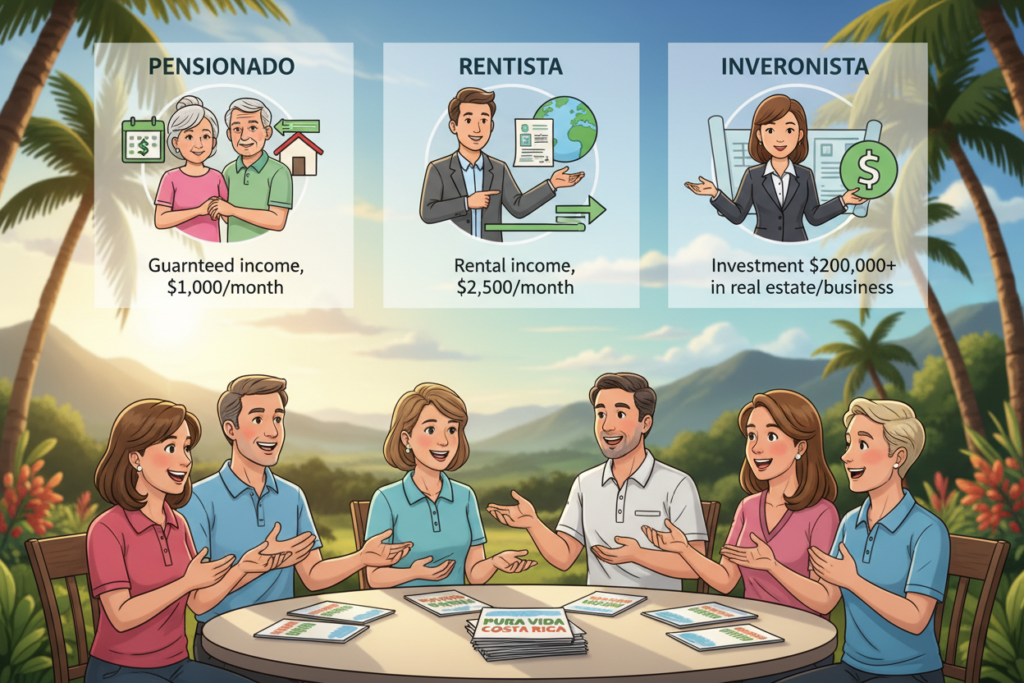
Understanding the key differences between Pensionado, Rentista, and Inversionista programs is essential. Your choice depends on your primary financial source.
Eligibility & Financial Thresholds
The Pensionado category requires a guaranteed lifetime pension of at least USD $1,000 per month. Only the principal applicant must show proof.
Rentista is for those without a started pension. It demands proof of USD $2,500 monthly for two years. This income must come from investments, not salary.
Inversionista requires a minimum USD $150,000 investment in local assets like real estate. The property must be in your personal name. If using a corporation, it must be ACTIVE and paying taxes.
A couple owning a $250,000 property 50/50 does not qualify. Neither individual meets the $150k threshold. We also recognize the Vinculo category for marriage to a Costa Rican citizen.
Program Specific Document Requirements
Pensionado grants temporary residency for two years initially. It is renewable every two years. You become eligible to apply for permanent residency in year three.
For Rentista, you typically provide a bank letter confirming stable investment income. An alternative is a $60,000 deposit in a local bank with scheduled monthly transfers.
Inversionista applicants must show provable property value. This requires registration with the National Registry and current tax receipts.
Marriage-based residency starts with a one-year temporary permit. It requires an apostilled marriage certificate and an interview with both spouses.
Step-by-Step Guidance for Preparing Your Application
Your path to legal status hinges on careful document assembly before you even board the plane. We build every successful case on this core principle. Proper preparation at home eliminates stressful delays after you arrive.
Gathering Apostilled Documents and Translations
Start with authentication. Documents from the U.S., Canada, and EU nations need an apostille. This certification verifies their authenticity for international use.
Every apostilled page then requires an official Spanish translation. You must use a translator registered in Costa Rica. Unofficial versions cause immediate rejection.
Time your criminal background check carefully. It is only valid for six months from its issue date. Obtain this document last in your sequence.
Verify name consistency across all paperwork. Your passport, birth certificate, and other records must match exactly. Even small spelling differences can derail your process.
Setting Up Your Application from Home
Schedule your appointment early. Create an account on the official DGME website to book a cita. Expect to wait three to four weeks for an opening at their Uruca office.
Before your appointment, visit a Banco de Costa Rica branch. Pay the application fee, approximately $50 USD. Bring the payment receipt with you—it is mandatory for submission.
On your scheduled day, bring the complete package. This includes all original apostilled documents, official translations, and two photocopy sets. Also bring passport photos, proof of local address, and your category-specific financial proofs.
Officers will review everything, take biometrics, and ask questions. If all is in order, they issue your Expediente number on the spot. For more details on this stage, visit our FAQ page.
Always confirm the latest required documentation directly with immigration authorities, as procedures can change.
Key Eligibility Requirements and Document Checklist
A complete document package forms the foundation of every successful residency application. We guide you through assembling the correct papers to meet official standards.
Essential Personal and Financial Documents
Universal requirements apply to all applicants. You need a valid passport, an apostilled birth certificate, and a recent criminal background check. Each document requires an official Spanish translation.
If married, your certificate must also be registered with Costa Rica’s Registro Nacional. This extra step is mandatory for the immigration file.
Financial proof varies by category. Pensionado applicants must show a guaranteed lifetime pension of $1,000 per month. Rentista candidates need proof of $2,500 monthly investment income or a $60,000 bank deposit.
Inversionista requirements include property titles and tax receipts proving a $150,000+ investment. Vinculo applicants must provide a spouse’s cedula and relationship photos.
After approval, CAJA healthcare enrollment is mandatory. If you must travel during processing, obtain an exit permit first. Leaving without it cancels your application.
This checklist outlines common requirements. Specific needs can vary. We recommend consulting our detailed paperwork guide and verifying with official sources.
Common Pitfalls and Mistakes to Avoid in the Residency Process
We regularly see the same documentation and financial misunderstandings causing application rejections. Knowing these common errors can save you months of delay.
Incomplete or Outdated Documentation
The most frequent error is submitting a criminal background check older than six months. Immigration automatically rejects expired documents.
Name inconsistencies across your passport and birth certificate also raise red flags. Even minor variations like “John” versus “Jonathan” require correction.
Missing apostilles or using unofficial translations lead to immediate rejection. Every document must be properly authenticated and translated by a registered professional.
Misinterpretation of Income and Investment Criteria
For the Pensionado category, only guaranteed lifetime pension income qualifies. Investment or rental revenue does not meet the requirements.
Rentista applicants must prove their $2,500 monthly income comes from investments, not salary. A bank balance alone is insufficient proof.
Inversionista mistakes often involve property ownership. If held in a corporation, your personal share value must meet the $150,000 threshold.
Also, leaving the country during processing without an exit permit cancels your application. Language barriers at official offices frequently compound these issues.
Clarifying the Digital Nomad Visa vs. True Residency Path
Costa Rica’s Digital Nomad program offers a streamlined entry, but with a major long-term caveat. It is a modified temporary visa, not a form of legal residency. The years you spend on this visa do not count toward permanent residency or citizenship eligibility.
Why Digital Nomad Doesn’t Count Toward Residency
This visa allows remote work for up to one year, renewable once for a two-year maximum. Processing is fast, often under a month, with fewer documents.
Single applicants must prove a minimum $3,000 monthly income. Family applications require $4,000 per month. You also need private health insurance.
When your two-year period ends, your time resets to zero for residency purposes. It provides no credit toward the three-year temporary residency period required for a permanent status application.
Identifying the Closer Alternatives for Permanent Status
For remote workers seeking a genuine path, the Rentista residency category is the closest fit. It requires proof of $2,500 monthly investment income.
This category provides true temporary residency. Those years count toward your eventual application for permanent residency after three years.
We view the Digital Nomad visa as a useful trial period. For a long-term future in Costa Rica, starting with a proper residency process saves years.
Maintaining Your Legal Stay During the Application Waiting Period
Your comprobante is more than a receipt; it’s your authorization to remain in the country indefinitely during review. This document, issued at submission, legally allows you to stay in Costa Rica for the entire processing period. You do not need to exit every 90 days.
Managing Your Comprobante and CAJA Enrollment
Alongside your comprobante, CAJA healthcare enrollment is mandatory for all residency applicants. Monthly payments are income-based, typically ranging from $60 to $300. This provides comprehensive coverage without copays.
If you must leave the nation during this process, obtain an exit permit from immigration first. Leaving without this permit triggers automatic cancellation of your application, regardless of progress.
We recommend using this waiting time productively. Establish local banking, secure long-term housing, and integrate into your community. These steps ease your transition after final approval.
Keep your comprobante accessible. Banks and other institutions will request it as proof of your legal status. Silence from the government usually means your application is progressing normally through the queue.
Patience and compliance with these rules ensure nothing derails your residency in these final months. Always verify the latest procedures at the official migracion.go.cr website.
Your Final Steps Before Embarking on Costa Rica Residency
The final phase of your residency planning involves looking beyond the initial approval to permanent status and citizenship.
After three years of maintaining your temporary residency, you can apply for permanent residency. This status removes the original income or investment conditions.
For long-term goals, Costa Rican citizenship becomes possible after seven years of legal residency. Time spent outside the country is deducted, and you must pass language and civics exams.
Remember, successful applications start with preparation at home. We provide expert guidance through this process but make no promises on approval speed or guarantees.
Maintain compliance by renewing your DIMEX card on time, keeping CAJA payments current, and visiting the country at least once a year.
Ready to begin? Contact us via WhatsApp at +506 8706 3888, email info@crie.cr, or visit crie.cr. Always verify the latest requirements at the official migracion.go.cr website.
FAQ
What exactly is an expediente number in the Costa Rican immigration process?
Your expediente number is the official file identifier assigned by the Department of Immigration (DGME) when you submit your residency application. It’s your case number for tracking your file’s status, communicating with officials, and managing renewals. Think of it as your application’s unique passport within the system.
How do I check the status of my residency application using my expediente number?
You can check your status online through the DGME’s official website by entering your expediente number. This portal shows your file’s current stage, from initial submission to final approval. We recommend checking monthly, as this is your primary tool for monitoring progress without direct calls.
Can I stay in Costa Rica legally while my residency application is being processed?
Yes, you can. Once your application is submitted and you receive your official *comprobante* (receipt), you are legally allowed to remain in the country while your case is reviewed. You must also enroll in the CAJA public health system to maintain good standing during this waiting period.
What are the main differences between the Pensionado, Rentista, and Inversionista residency categories?
The Pensionado category requires a lifetime pension of at least
FAQ
What exactly is an expediente number in the Costa Rican immigration process?
Your expediente number is the official file identifier assigned by the Department of Immigration (DGME) when you submit your residency application. It’s your case number for tracking your file’s status, communicating with officials, and managing renewals. Think of it as your application’s unique passport within the system.
How do I check the status of my residency application using my expediente number?
You can check your status online through the DGME’s official website by entering your expediente number. This portal shows your file’s current stage, from initial submission to final approval. We recommend checking monthly, as this is your primary tool for monitoring progress without direct calls.
Can I stay in Costa Rica legally while my residency application is being processed?
Yes, you can. Once your application is submitted and you receive your official *comprobante* (receipt), you are legally allowed to remain in the country while your case is reviewed. You must also enroll in the CAJA public health system to maintain good standing during this waiting period.
What are the main differences between the Pensionado, Rentista, and Inversionista residency categories?
The Pensionado category requires a lifetime pension of at least $1,000 USD per month. The Rentista path requires a guaranteed income of $2,500 USD per month for two years, backed by a bank deposit. The Inversionista program requires a minimum investment of $150,000 USD in approved Costa Rican assets, like property or businesses.
What is the most common mistake people make in their residency application?
The most frequent error is submitting incomplete or outdated documentation. Every document, from birth certificates to bank letters, must be recently issued, apostilled (or authenticated), and officially translated into Spanish by a certified translator in Costa Rica. An expired document can cause significant delays.
Does holding a Digital Nomad Visa count toward permanent residency or citizenship?
No, it does not. The Digital Nomad Visa is a separate, non-resident permit designed for temporary remote work. Time spent under this visa does not accumulate toward the years required for permanent residency or future citizenship applications. It’s a great option for a trial stay, but a distinct path from formal residency.
What are the key financial documents I need to prepare for my application?
You’ll need to provide proof of your income or investment. This includes original bank statements, letters from your financial institution verifying funds, proof of pension deposits, or property titles and registered investment documents. All must show the funds are stable and meet the specific program’s monthly or total threshold.
How long does the initial residency approval process typically take?
Processing times can vary, but you should generally expect the initial review and approval for temporary residency to take several months. The government’s timeline depends on application volume and completeness. After approval, you’ll receive your *cédula de residencia*, and can apply for permanent status after three years.
,000 USD per month. The Rentista path requires a guaranteed income of ,500 USD per month for two years, backed by a bank deposit. The Inversionista program requires a minimum investment of 0,000 USD in approved Costa Rican assets, like property or businesses.
What is the most common mistake people make in their residency application?
The most frequent error is submitting incomplete or outdated documentation. Every document, from birth certificates to bank letters, must be recently issued, apostilled (or authenticated), and officially translated into Spanish by a certified translator in Costa Rica. An expired document can cause significant delays.
Does holding a Digital Nomad Visa count toward permanent residency or citizenship?
No, it does not. The Digital Nomad Visa is a separate, non-resident permit designed for temporary remote work. Time spent under this visa does not accumulate toward the years required for permanent residency or future citizenship applications. It’s a great option for a trial stay, but a distinct path from formal residency.
What are the key financial documents I need to prepare for my application?
You’ll need to provide proof of your income or investment. This includes original bank statements, letters from your financial institution verifying funds, proof of pension deposits, or property titles and registered investment documents. All must show the funds are stable and meet the specific program’s monthly or total threshold.
How long does the initial residency approval process typically take?
Processing times can vary, but you should generally expect the initial review and approval for temporary residency to take several months. The government’s timeline depends on application volume and completeness. After approval, you’ll receive your *cédula de residencia*, and can apply for permanent status after three years.
Article by Glenn Tellier (Founder of CRIE and Grupo Gap)
Don't wait, contact us right now!
Call or WhatsApp Costa Rica +506 8373 2085 or +506 8706 3888
Call USA/Canada +1 305-906-6784