
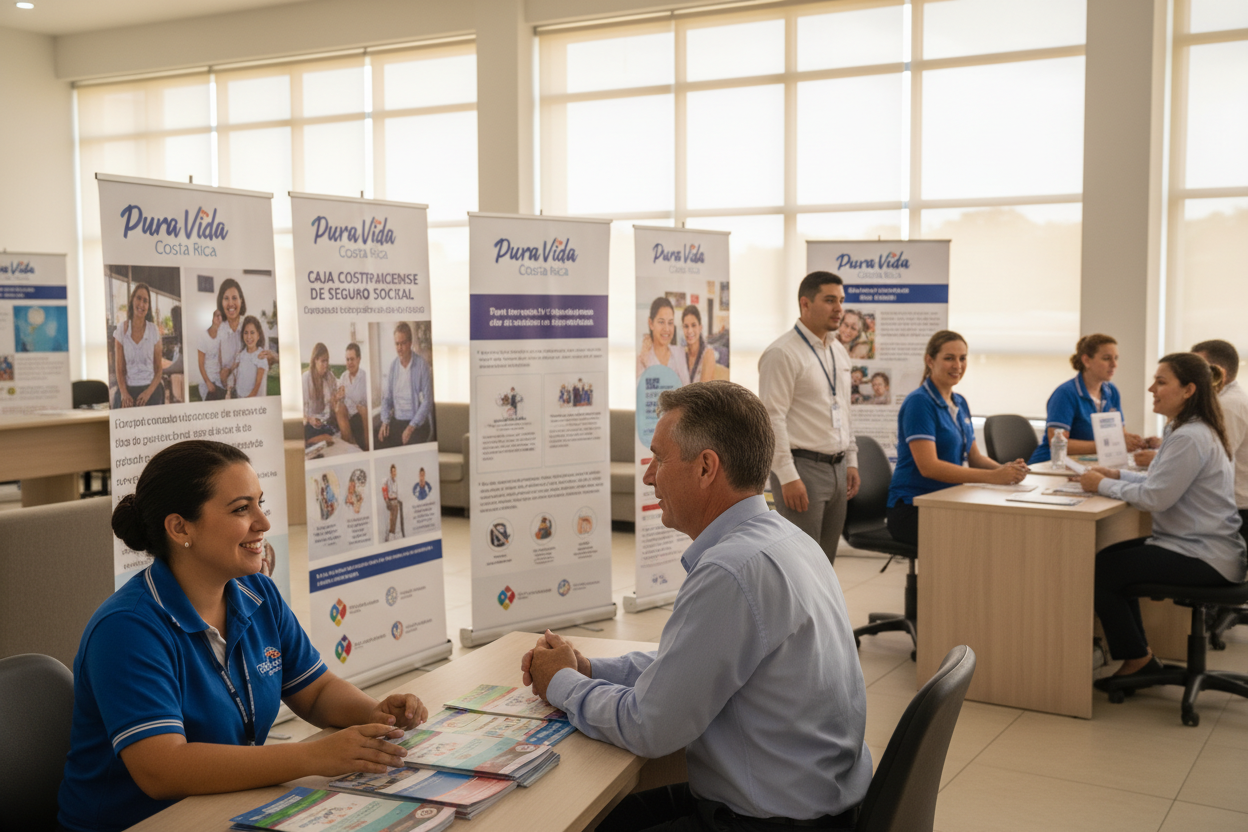
Navigating the requirements for establishing legal status in this beautiful country involves a crucial step: understanding your mandatory healthcare obligations. We are CRIE (crie.cr), the exclusive Costa Rica residency and immigration service provider. Our role is to guide you through this essential process.
The system, known locally as CAJA, is the nation’s universal healthcare plan. Formally called the Caja Costarricense de Seguro Social (CCSS), it was founded in 1941. This social security fund provides medical services and administers pensions for everyone living here legally.
Your enrollment is directly tied to your legal residency status. Once your residency is approved by the immigration directorate (DGME), you must register with this system within 90 days. This rule applies to both temporary and permanent visa holders.
This guide provides the step-by-step information you need. We offer no pricing guarantees or promises about approval timelines. Our goal is to give you factual data so you can start preparing your documents from home with clear, realistic expectations.
Overview of Costa Rica Residency Options (Residencia en Costa Rica)

Selecting the right legal pathway for living in Costa Rica involves evaluating three distinct residency categories. Each one has unique financial requirements that directly impact your future monthly healthcare insurance costs.
Understanding the Categories: Pensionado (Pensionado), Rentista (Rentista), and Investor (Inversionista)
The Pensionado category is for retirees with a guaranteed pension of at least US$1,000 per month. This income can come from government or private sources.
The Rentista category requires proof of a stable US$2,500 monthly income for two years. You must provide official bank letters to document this.
The Inversionista category demands a minimum investment of US$150,000 in the country. A critical rule: if investing in real estate, the property title must be in your personal name.
Key Income and Investment Thresholds Explained
Your chosen category sets your mandatory insurance premium. Pensionado typically has the lowest monthly cost, often between $80 and $100.
Rentista status, due to its higher proven income, leads to significantly higher premiums—usually over $350 per month. The Inversionista category results in fixed premiums similar to Pensionado, around $75-$100.
We always advise choosing Pensionado if you qualify for multiple paths. It is the simplest and most cost-effective option to maintain.
Important note: The Digital Nomad visa is not a residency. It does not count toward permanent status or citizenship. If you hold it and seek real residency, apply for Rentista or Inversionista instead.
Your initial choice is crucial. Switching categories later is complex and your premium structure is locked in for your first three years.
Step-by-Step Guidance for the Application Process (Guía Paso a Paso)
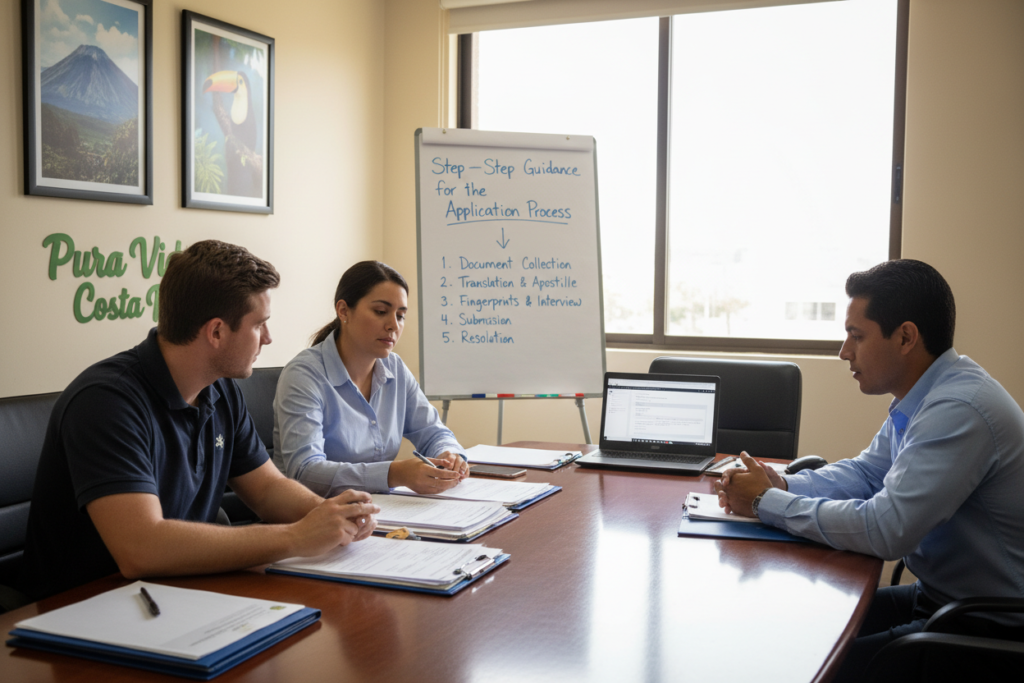
Successfully applying for residency requires you to meet specific qualifications and gather authenticated documents well in advance. The immigration process is structured, and your preparation begins at home.
Who Qualifies and the Essential Requirements
Qualification hinges on your chosen category: Pensionado, Rentista, or Inversionista. Each has strict income or investment thresholds. The DGME mandates official proof for these financial requirements.
This evidence must be flawless. For many expats, navigating these rules demands careful attention to detail.
Documents to Prepare Before Arrival: Apostilles and Translations
All foreign documents—birth certificates, police checks, financial proofs—require an apostille from their country of origin. This authentication cannot be done after you arrive.
Once in Costa Rica, these papers need official Spanish translation by a government-authorized translator. We always advise starting this document collection from home to avoid major delays.
If you are uncertain about any requirement, use placeholders and verify the latest information at the official frequently asked questions page or migracion.go.cr. This step ensures your application aligns with current immigration standards.
Expected Timelines and Residency Journey Milestones
Your residency timeline consists of two major segments: the initial application and the mandatory healthcare enrollment. We set honest expectations rather than promising expedited processing.
Critical Timeframes and Submission Deadlines
The immigration process with DGME typically takes 4 to 8 months from submission to approval. This varies based on application volume and document completeness.
Once you receive your temporary residency approval, a strict 90-day clock starts. You must complete your enrollment in the national healthcare system within this period.
Failure to meet this deadline can jeopardize your legal status. The registration itself can be fast if you are prepared.
In some rural offices, it can be done in a single day. Urban offices in San José often require appointments, adding weeks to your timeline.
Many expats plan a one-week trip specifically for this step. After three years of temporary status, you become eligible to apply for permanent residency.
This milestone allows for potential adjustments to your monthly premiums. We cannot guarantee specific processing times, but we guide you through each deadline.
Understanding Caja for Permanent Residents in Costa Rica
The amount you pay for public healthcare each month is not arbitrary. It’s derived from a dual-chart system applied to your declared income.
Calculation of CAJA Premiums Based on Residency Categories
Your premium is the sum of two separate calculations. The Healthcare Chart funds your access to the national system. The Pension Chart covers your social security contributions.
Reported income is applied to both charts. For Pensionado status with $1,000 income, premiums are typically $80-$100 monthly.
Rentista status with $2,500 income yields premiums around $350-$370. Inversionista premiums are fixed near $75-$100.
Pensionado usually offers the most affordable ongoing rate.
Strategies for Negotiating or Adjusting Your Monthly Payments
Officially, Pensionado holders cannot deduct expenses. In practice, many local offices allow this, lowering your amount.
Rentista premiums use net income. Provide three months of local bank statements or a CPA letter detailing income minus expenses.
After three years, permanent status lets you renegotiate. Show a CPA letter proving lower current income.
You can also switch from Rentista to Pensionado if you qualify. If a caja office disputes the procedure, present your DGME resolution.
Common Pitfalls and Mistakes to Avoid During the Application
Understanding potential pitfalls before your appointment can save you significant time, money, and frustration. The registration process is not easy for most people. A language barrier creates immediate difficulties.
Documentation Errors and Misinterpretation of Income Thresholds
Document errors are a top cause of delay. Missing apostilles or using uncertified translators will send you home. This can push you past the strict 90-day deadline.
Misreporting your income is another common error. You should report only the specific income used for your residency application. Reporting total worldwide income can trigger a much higher insurance premium calculation.
Tips for a Smooth In-Person Registration Process
The entire process is conducted in Spanish at the CAJA office. Expats without fluency often face misunderstandings. This can lead to incorrect premium quotes or incomplete paperwork.
We have seen at least three different interpretations of the rules at various offices. Having bilingual, personal assistance at your appointment is crucial. It ensures correct processing according to official policy and provides peace of mind.
We provide this service because we understand the anxiety this step creates for expats. Letting an expert guide you through the healthcare system registration is the best strategy.
Additional Insights: Beyond Digital Nomad and Exploring the Right Residency Option
Choosing the correct legal pathway requires understanding what the Digital Nomad visa is—and what it is not. We see widespread confusion on this point.
Why Digital Nomad Status Does Not Count and What to Consider Instead
The Digital Nomad visa is not a residency status. It does not grant resident benefits or count toward permanent status or citizenship. It is essentially an extended tourist visa with work permission.
If you want actual residency, you must apply for a legitimate category. Consider Rentista if you have consistent monthly income. The Inversionista category is for those with capital to invest.
Advice for US Expats on Choosing the Optimal Residency Category
For US expats, the best category depends on your finances. Pensionado is optimal if you have qualifying pension income. It offers the lowest monthly premiums and simplest process.
If you have investment capital, Inversionista is attractive despite the upfront cost. Rentista suits those with steady monthly income but higher premiums.
Many people use the public healthcare system for routine care. They may use private insurance or pay out-of-pocket for specialized tests. Remember, citizenship requires completing the residency steps first.
Final Steps: Prepare, Verify, and Connect with CRIE
The foundation for a smooth transition into Costa Rican residency is laid not upon arrival, but during the document preparation phase in your home country. All foreign documents require apostilles and official translations before you travel. Remember, your mandatory registration with the public healthcare system must be completed in person within 90 days of approval.
Rules and income thresholds can change. We strongly recommend verifying the most current requirements at the official immigration website, migracion.go.cr, before finalizing your plans.
CRIE specializes exclusively in this residency and immigration process. We provide bilingual, personal assistance at your Seguro Social office appointment anywhere in the country. This service helps navigate language barriers and ensures correct premium calculations.
We provide transparent guidance, not pricing promises or guarantees. Ready for clear, professional help? Connect with us via WhatsApp at +506 8706 3888 or email info@crie.cr.
FAQ
What are the main residency categories for applying for the Caja?
The primary pathways are Pensionado, Rentista, and Inversionista. Each category has specific financial requirements—like a stable pension, guaranteed income, or a qualifying investment—that determine your eligibility for the public healthcare system.
How do I start the application process for residency and the Caja?
You begin by gathering and authenticating your documents, like birth certificates and proof of income, with apostilles and official translations. Then, you submit your complete file to immigration to start the official process.
How are my monthly Caja payments calculated?
Your monthly contribution to the Caja Costarricense de Seguro Social is based on a declared income amount, which varies by your residency category. There’s a cap, and we can help you understand how to declare an amount that provides good coverage while managing costs.
What’s a common mistake people make during the application?
A frequent error is misinterpreting the income thresholds or submitting documents with small discrepancies. Ensuring every detail matches perfectly across all paperwork is crucial to avoid delays or rejection.
Why doesn’t a Digital Nomad visa lead to Caja coverage?
The Digital Nomad residency is a temporary, non-immigrant status. It doesn’t provide a path to permanent residency, which is a prerequisite for enrolling in the universal healthcare system managed by the Caja Costarricense de Seguro Social.
How long does it take to get residency and access to healthcare services?
A> The entire process, from application submission to receiving your physical *cédula* (ID card), can take several months to over a year. You can only register for the public healthcare system after your permanent residency is officially approved.
Article by Glenn Tellier (Founder of CRIE and Grupo Gap)
Don't wait, contact us right now!
Call or WhatsApp Costa Rica +506 8373 2085 or +506 8706 3888
Call USA/Canada +1 305-906-6784