
Navigating a new country’s legal framework can feel complex. This guide simplifies the pathway to legal residence through a qualified investment.
The investor category, known locally as “Inversionista,” requires a minimum commitment of US$150,000. This capital must be invested in real estate or an approved business venture.
A central pillar of this process is enrolling in the national healthcare and social security system. Registration here is not optional—it’s a mandatory step required before you receive your official resident identification card.
We believe in starting your preparation from home. Gathering the correct documents, including apostilles and official translations, before you arrive is crucial. Proper groundwork significantly smooths the application journey with the immigration authority.
This article provides clear, step-by-step guidance on eligibility and document preparation. We offer realistic advice but cannot quote prices or guarantee approval timelines, as these depend on individual circumstances.
Understanding Costa Rica Residency and Immigration (Residencia y Migración)
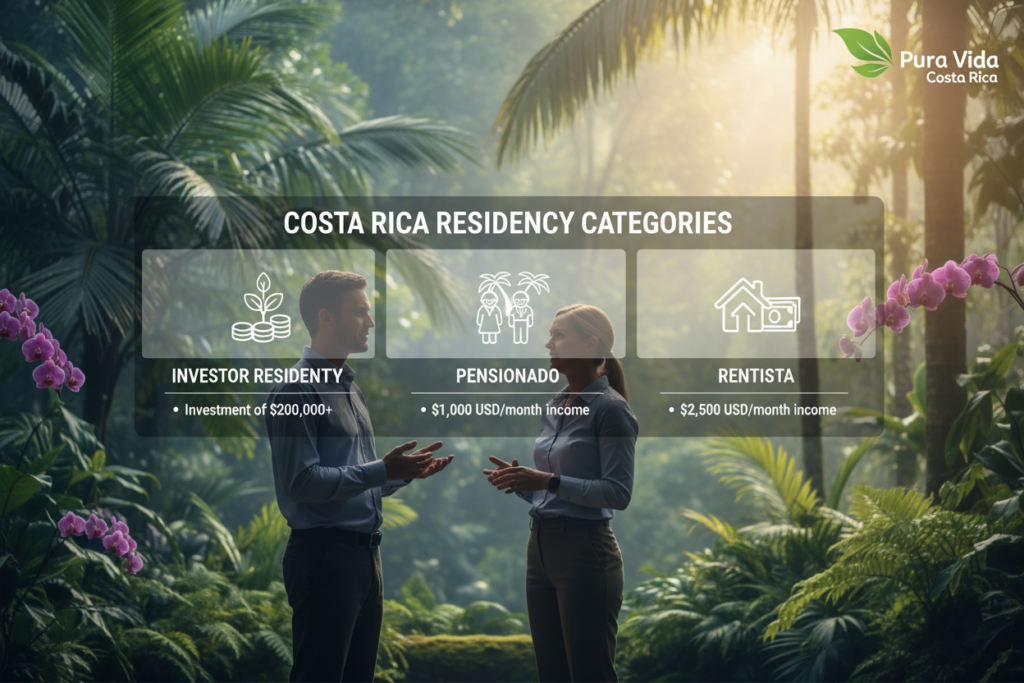
To plan your future here, you must first grasp the three main financial-based residency categories. Choosing the correct pathway is the essential first step toward long-term establishment.
Overview of Residency Categories: Pensionado, Rentista, Inversionista
Costa Rica offers three primary routes. The Pensionado (Pensionado) category is for retirees with a guaranteed lifetime pension. The Rentista (Rentista) path suits those with stable external income.
The Inversionista (Investor) category is for individuals making a significant capital investment in the country. Each has distinct financial thresholds that determine your eligibility.
Key Eligibility Criteria and Financial Thresholds
For Pensionado, you need proof of a lifetime pension of at least US$1,000 per month. Rentista applicants must demonstrate a guaranteed monthly income of US$2,500 for two years or a US$60,000 local bank deposit.
The Investor category requires a minimum investment of US$150,000 in approved assets like real estate or a business. These are the foundational financial requirements for each residency type.
It’s vital to understand that legal residence starts with a temporary, renewable status. After three years, you may apply for permanent residency.
Citizenship through naturalization is possible only after seven years of continuous lawful residence. Note: Digital Nomad visas do not count toward this residency time. They are not a path to permanent status or citizenship.
Enrollment in the national social security system is mandatory for all residents under these categories.
Step-by-Step Guidance: Who Qualifies and What You Need
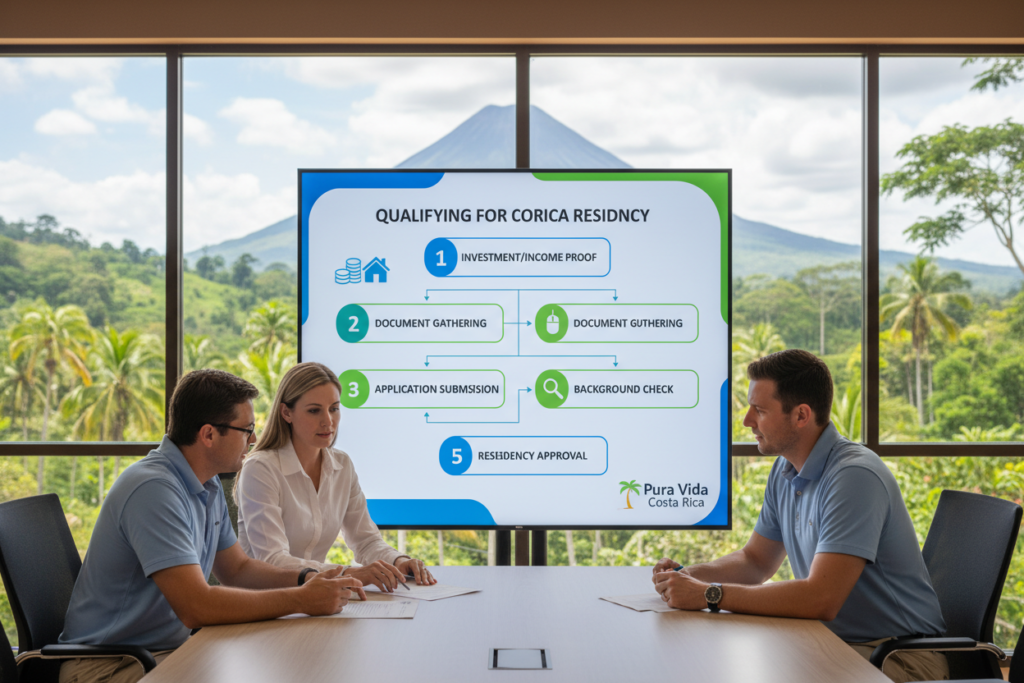
Let’s break down the qualification criteria for Pensionado, Rentista, and Inversionista applicants step by step. The right category for you depends entirely on your source of funds.
Qualifying as a Pensionado (Pensionado), Rentista (Rentista), or Investor (Inversionista)
If you have a guaranteed lifetime pension of at least $1,000 per month, the Pensionado route is for you. The Rentista category suits those who can prove a stable $2,500 monthly income for two years or place a $60,000 deposit locally.
Ready to commit capital? The Investor path requires a minimum $150,000 investment in approved real estate or a business venture.
Essential Requirements and Initial Document Preparation
A critical requirement for the Investor category: your real estate must be titled in your personal name. Corporations or trusts do not qualify. You’ll need the certified deed, tax receipts, and a professional valuation.
Every applicant must prepare a core set of documents before arriving. This includes your passport, a recent criminal record check, and proof of your pension, income, or investment.
All foreign documents require an apostille and a certified Spanish translation. We strongly advise completing this paperwork at home. If any requirement is unclear, verify details directly at the official migration website.
Preparing Your Documents at Home for a Smooth Application
The most effective way to ensure a smooth residency application is to prepare your entire document package before leaving your home country. Apostilles, translations, and notarizations take time. Securing them from abroad is far more complex and costly.
Checklist of Required Documents and Translations with Apostille
Your core checklist includes a valid passport, a recent criminal record check, and a medical report. For investor applicants, add the property deed, tax receipts, and a certified valuation. This proof confirms your investment meets the threshold.
Every foreign document must be apostilled or authenticated. Then, it needs a certified Spanish translation. This two-step process is mandatory for approval.
Tips for Organizing Your Paperwork Before Arrival
We recommend a physical binder and a digital backup folder. Organize documents by category—personal, financial, and property. Label each file clearly by type and date.
Officials may request specific papers multiple times. If a document is missing, you typically have only 10 business days to respond. Preparation at home is the foundation for a successful process.
Timelines and Mistakes to Avoid in the Residency Process
Setting realistic expectations about the approval process helps manage stress and planning. We want to outline typical durations and highlight where applicants often stumble.
Estimated Processing Times and Important Milestones
Processing varies by category. Investor cases often take four to six months. Rentista applications usually need three to six months. Pensionado files may conclude in three to five months.
These are averages, not guarantees. Your timeline includes key steps. First is document submission and the DGME’s initial review. They may issue a “prevención” requesting more information.
After formal approval, you must register with the national healthcare system within 22 business days. The final step is biometrics and receiving your DIMEX card, which typically arrives four to six weeks later.
Common Errors and How to Prevent Them
A frequent mistake is submitting photocopies or uncertified translations. Always provide notarized, apostilled originals. Format deviations cause major delays.
Another error is ignoring official notifications. Check your status weekly on the DGME website under “Consulta de expediente.” If you receive a prevención, respond within ten business days.
Missing the enrollment window or renewal deadlines can reset your progress. Stay organized and verify any uncertain details directly at migracion.go.cr. This careful way is part of protecting your investment.
Caja for Investor Residents in Costa Rica
The investor residency pathway includes a unique method for calculating your monthly social security payments. Every legal resident must contribute to this national system, which funds both healthcare and pension benefits.
Understanding the CAJA Contribution for Investor Residency
Your monthly payment is based on declared income. For this category, you need an Income Certification from a local Certified Public Accountant.
This certified amount in U.S. dollars is converted to colones. The total contribution has two parts: SEM for health insurance and IVM for the pension system.
Rates range from 2.89% to 10.69% for SEM and 3.83% to 8.09% for IVM. These percentages are fixed until December 2025.
As an example, a $1,000 monthly income might result in a combined payment of around ₡36,297. This is an illustrative calculation.
Special Considerations for the Investor Category
A major benefit is the family plan. Your single monthly contribution covers your spouse and dependent children at no extra cost.
You must maintain a relationship with your CPA for annual renewals. Keeping your certified income figure consistent is crucial for compliance.
This system provides comprehensive healthcare coverage. For many, it becomes a highly valued part of living here.
Navigating CAJA, DGME, and Regulatory Requirements
After receiving your residency approval, a critical sequence of actions with CAJA and DGME begins. This phase finalizes your legal status.
Registration Process: From CAJA to DIMEX Card
You have 22 business days to register with the national healthcare system. Missing this deadline can void your approval.
Visit a local CAJA office with your passport, approval letter, and proof of address. You’ll be assigned to an EBAIS clinic and make your first payment.
The agency provides a “comprobante de afiliación.” This proof of enrollment is mandatory. You cannot get your DIMEX card without it.
Next, schedule a biometrics appointment. Bring your passport, CAJA proof, and approval resolution. Your physical card typically arrives in four to six weeks.
Clarifying SEM and IVM Contributions and Their Impact
Your monthly payment has two parts. SEM funds your access to clinics, hospitals, and medications. IVM builds your pension and disability benefits.
Rates depend on your declared income. They range from 2.89% to 10.69% for SEM and 3.83% to 8.09% for IVM. These brackets are fixed until December 2025.
Government databases now automatically cross-check information. Keep your income and address details consistent across all systems.
For answers to common questions, visit our detailed FAQ resource. Always verify official requirements at migracion.go.cr.
Final Steps and Next Actions for Securing Your Residency
The path from temporary resident to potential citizen is a multi-year process built on compliance.
Your initial status is valid for two years and renewable. To maintain it, you must keep your investment active, file taxes, and contribute to the healthcare system.
Submit renewal applications 90 days before expiration with updated financial proof and a new police certificate.
After three consecutive years of lawful residence, you can apply for permanent residency. This grants indefinite legal status.
Citizenship through naturalization requires seven years of continuous residence. You must demonstrate Spanish language ability and civic integration.
We provide a clear roadmap, but we cannot guarantee outcomes. Each application receives individual review by authorities.
Ready to proceed? Contact CRIE via WhatsApp +506 8706 3888 or email info@crie.cr for personalized guidance. Always verify the latest requirements at migracion.go.cr.
FAQ
What are the main residency categories for moving to Costa Rica?
The primary pathways are Pensionado, Rentista, and Inversionista. The Pensionado category requires a guaranteed lifetime pension. Rentista applicants must prove stable external income. The Investor category requires a significant capital investment into the country, such as in real estate or a business.
What is the CAJA, and do I need to enroll for residency?
The CAJA is Costa Rica’s public health and social security system. Enrollment and making monthly contributions are a mandatory requirement for all residency applicants, including investors, before final approval is granted by immigration authorities.
How much are the monthly CAJA contributions for a residency applicant?
Your monthly payment is based on a declared income. The current contribution rate is approximately 10.67% of that declared amount. For the Investor category, the minimum declared income is often set at a specific threshold, which determines your base payment.
Can I use my home country health insurance to fulfill this requirement?
A> No. Private international medical plans do not substitute for mandatory enrollment in the CAJA system. You must register and pay into the local public health system as part of your residency application process, though many expatriates also maintain private coverage for additional services.
What is a DIMEX card, and when do I get it?
The DIMEX card is your official physical residency identification document. You receive it after your residency application is fully approved, you have completed your CAJA registration, and you have fulfilled all other requirements with the DGME (Dirección General de Migración y Extranjería).
What common mistakes should I avoid during the application process?
Frequent errors include submitting documents without proper apostille certification or official Spanish translations, under-declaring income which affects your CAJA rate, and not allowing sufficient time for the entire process, which can take several months from start to finish.
Are my spouse and children included in my residency and CAJA application?
Yes, your direct dependents—spouse and minor children—can be included as part of your main residency application. They will also be covered under your same CAJA plan, but their inclusion must be documented from the very beginning of your process.
What happens after my temporary residency is approved?
After approval, you must complete your CAJA registration, pay the required fees, and schedule an appointment to provide biometrics for your DIMEX card. You will maintain this status for several years before becoming eligible to apply for permanent residency and, eventually, citizenship.
Article by Glenn Tellier (Founder of CRIE and Grupo Gap)
Don't wait, contact us right now!
Call or WhatsApp Costa Rica +506 8373 2085 or +506 8706 3888
Call USA/Canada +1 305-906-6784