
Let’s clear up a major point of confusion right away. The Digital Nomad visa for this beautiful Central American nation is a temporary stay permit—it is not a legal residency pathway and does not count toward citizenship.
This guide, developed with CRIE (crie.cr), the country’s residency and immigration specialist, focuses on the bigger picture. We’ll explain the actual routes to permanent status, not just the temporary remote work option.
You’ll see the clear difference between the nomad visa—requiring $3,000 monthly for individuals—and true residency categories like Pensionado, Rentista, and Inversionista.
Our professional, transparent approach will help you identify which path aligns with your long-term goals here. We believe in starting your preparation from home with the correct documents.
We make no promises of approval. Instead, we offer realistic, step-by-step guidance based on current regulations to help you make informed decisions for your future.
Overview of Costa Rica Residency Options and Digital Nomad Misconceptions
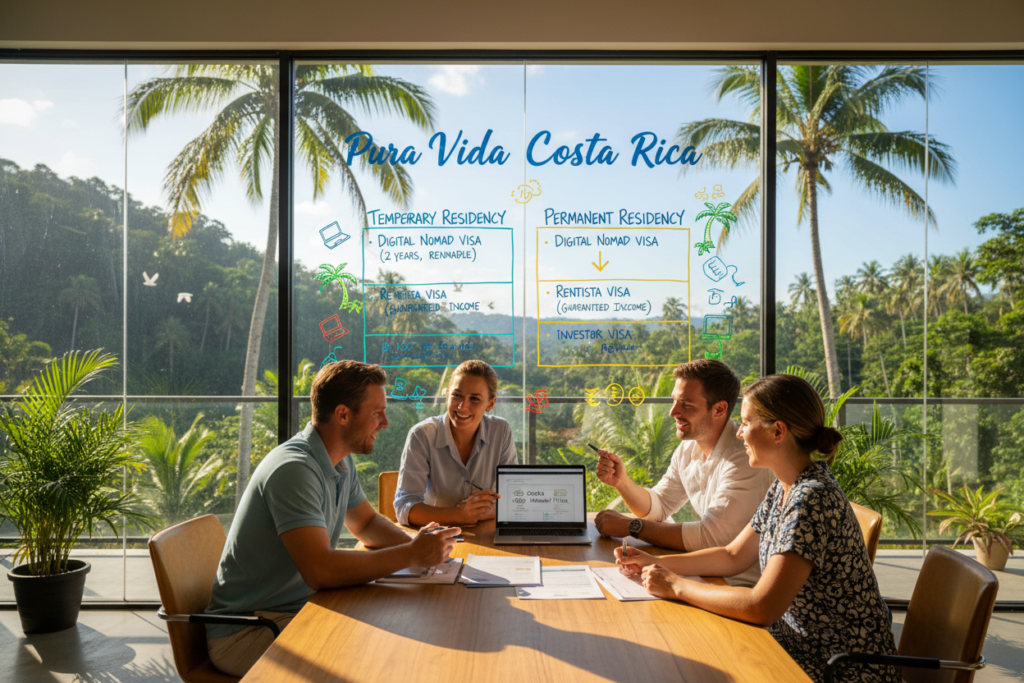
It’s crucial to distinguish between short-term authorization and long-term settlement from the outset. The remote work permit, often called the digital nomad visa, is a temporary stay permit. It does not provide a pathway to permanent residency or citizenship.
Digital Nomad Visa vs. Traditional Residency
Launched in 2022, this visa allows remote professionals to live here for one year, renewable once. Holders cannot work for local companies. After a maximum of two years, you must leave or secure a different status.
This contrasts sharply with traditional residency categories. Those pathways are designed for permanent settlement and do count toward future citizenship.
Residency Alternatives: Pensionado (Pensionado), Rentista (Rentista), and Inversionista
For long-term goals, three main options exist. The Pensionado category requires a stable pension of at least $1,000 monthly.
The Rentista path needs proof of $2,500 in guaranteed monthly income for two years. The Inversionista option demands a minimum $150,000 investment in local assets.
A critical rule for investors: any real estate must be held in your personal name, not a corporate entity. If you’re considering the remote work permit, evaluating these residency tracks from the beginning is often wiser.
Who Qualifies for Residency Under CRIE Guidelines

Who actually qualifies for permanent status? The answer depends entirely on which of the three primary residency pathways you pursue. We help applicants understand these distinct categories and their specific criteria.
Eligibility Criteria for Applicants
The Pensionado category requires a verifiable, permanent pension of at least $1,000 monthly. Official statements are needed.
For the Rentista path, you must show guaranteed income of $2,500 per month for two years. This can come from rentals or investments.
The Inversionista option demands a $150,000 investment in local assets. A key detail: any real estate must be titled in your personal name.
Special Considerations for Family and Dependents
All categories allow you to include immediate family. This means a spouse or legal partner, plus children under 25.
Each dependent needs extra documentation. Birth and marriage certificates must be apostilled and translated into Spanish.
While the financial threshold doesn’t automatically increase, officials will assess your ability to support the entire family unit. This is a case-by-case review by Costa Rican immigration.
Step-by-Step Documentation Process for Your Application
The foundation of a successful residency application lies in your document preparation. We guide you through a systematic process that begins in your home country. This careful approach prevents costly delays.
Essential Documents to Prep Before Arrival (Apostilles and Translations)
Your required documents start with a valid passport and birth certificate. If applying with family, include marriage and children’s birth certificates. Every document from abroad needs an apostille.
This official certification authenticates papers for international use. After apostilles, all non-Spanish documents require certified translations. Authorities will reject applications without these steps completed correctly.
Completing the Online Application and Affiliation Form on Official Platforms
Once your paperwork is ready, the application moves online. You must use the official government platform at migracion.go.cr. This is where you submit the affiliation form and upload all documents.
We recommend using resources at crie.cr for guidance through this digital platform. Starting this entire process from home ensures you arrive with everything prepared. It transforms a complex procedure into a manageable one.
Costa Rica Digital Nomad Income Requirements
Financial thresholds serve as the primary gatekeeper for both temporary and permanent stays. The monetary prerequisites for the remote work permit differ greatly from those for actual residency.
Understanding the Financial Thresholds
The digital nomad visa mandates a minimum of $3,000 USD per month for individuals. Applicants with dependents must show at least $4,000 monthly.
This requires verification through twelve months of bank statements. A sworn affidavit from a CPA or notary is also essential.
Differences Between Digital Nomad Income and Residency Requirements
True residency pathways have distinct financial benchmarks. The Pensionado category needs a $1,000+ monthly pension.
The Rentista option requires $2,500 in guaranteed income for two years. The Inversionista path demands a $150,000 minimum investment.
Critically, the remote work permit is temporary. It does not lead to permanent status or citizenship.
If your goal is long-term settlement, the Rentista category is often the closest parallel. For a detailed guide to the digital nomad visa, review the resources at crie.cr. We help applicants see the strategic landscape clearly.
Preparing Financial Statements and Supporting Documentation>
Your financial paperwork is the most scrutinized part of any residency application. Authorities demand clear proof of your economic stability. We guide you through preparing these documents correctly from your home country.
Bank Statements, Affidavits, and Notarizations
Your bank statements must show twelve consecutive months of consistent income deposits. The source and regularity of funds are critical for review.
Statements alone are insufficient. You need a sworn affidavit from a CPA or notary. This document confirms your income sources and verifies the bank records.
This affidavit requires notarization and then an apostille from your home government. Each authentication step takes time and planning.
Specific proofs vary by category. Pensionado needs official pension letters. Rentista requires proof of a two-year income guarantee. Inversionista must show investment titles or account statements.
Work with your financial professionals early. Errors after apostille mean restarting the entire process, causing major delays. We provide guidance but cannot guarantee approval.
Timeline for the Residency Application Process
One of the most common questions we receive concerns the actual time frame from start to finish. We’ll be candid—this process takes longer than many expect.
Key Milestones and Expected Processing Times
Your journey begins with document preparation. Gathering, apostilling, and translating paperwork can take several months before you even apply.
Once submitted, the official review period typically spans 30 to 90 days. This depends on your category and application completeness.
For context, the Digital Nomad visa has a 15-day review. Traditional residency requires more thorough vetting.
After approval, in-country steps like biometrics add another 30 to 60 days to your timeline. Initial residency is often granted for one or two years.
Always verify current processing times at migracion.go.cr. Building buffer time into your plan is essential for a smooth transition.
Common Mistakes to Avoid in Your Application
We consistently observe the same critical errors applicants make, errors that cost them both time and money. Awareness of these common pitfalls is your first defense against unnecessary delays.
Documentation Errors and Translation Oversights
Submitting documents without proper apostille authentication is a frequent error. Simple notarization is not enough for immigration authorities.
They will reject such paperwork outright. Similarly, translations must be officially certified, not just done by a bilingual person.
Police background checks also have a strict six-month validity window. Missing these details forces a complete restart of your process.
Mixing Up Digital Nomad and Residency Requirements
The most significant confusion involves the temporary remote work permit. Many believe it leads to permanent status, but it does not.
Applying for the wrong category based on this misunderstanding is a major setback. The financial and legal prerequisites for each path are entirely distinct.
For example, investment property must be held in a personal name, not a corporation. Guaranteed income for certain categories must be truly passive.
Always verify the specific rules for a residency visa versus a digital nomad visa. This clarity is essential from the start.
Our advice is to work with professionals familiar with local processes. Triple-check every document and build extra time into your plan.
When in doubt, verify information directly through official government channels. We provide guidance to help you navigate, but we cannot guarantee approval.
How to Get Started from Home with CRIE
Starting your application process from home is the single best strategy for a smooth transition. We guide you to begin preparations months before your intended move. This upfront work prevents stress and costly delays after arrival.
Organizing Your Essential Documents
Create a category-specific checklist for your paperwork. Pensionado, Rentista, and Inversionista paths each need different proofs.
Organize both physical and digital copies in a clear folder system. You’ll need originals for in-person steps and scans for online uploads.
Work through authentication steps in order: notarization, apostille, then official Spanish translation. Skipping a step creates problems.
Utilizing Resources at crie.cr and migracion.go.cr
CRIE specializes in residency and immigration matters for Costa Rica. We provide step-by-step guidance tailored to your situation.
Always verify current rules at the official migracion.go.cr website. Regulations can change, and this is your authoritative source.
When ready, contact us for a professional assessment. Reach CRIE via WhatsApp at +506 8706 3888 or email info@crie.cr.
What to Expect After Approval of Your Residency Visa
Congratulations on your residency approval—this marks a pivotal transition in your journey. However, approval is not the final step. Several in-country procedures must be completed to activate your legal status.
Final Steps Upon Arrival in Costa Rica
Your first priority is biometric registration. This must be done within 30 days of entry. Fingerprints and photographs are required before receiving your DIMEX card.
The DIMEX is your official identification document. Processing typically takes 30-60 days after biometrics. You’ll need this card for banking, healthcare, and proving your status.
You must also register with your local immigration office. Provide your address and contact information there. This creates your official file for future correspondence.
Unlike temporary remote work permit holders, residency visa holders must maintain their qualifying conditions. Pension, income, or investment requirements continue throughout your stay.
Your initial approval is typically temporary. Renewal requires proving you still meet all criteria. After maintaining status for the required period, permanent residency becomes an option.
Final Insights and Next Steps for Your Costa Rica Residency Journey
Your journey toward establishing a life in this Central American nation hinges on choosing the right legal pathway. Remember, the digital nomad visa is a temporary permit. It does not lead to permanent residency or citizenship.
For long-term settlement, three main options exist. The Pensionado route requires a $1,000+ monthly pension. The Rentista path needs $2,500 in guaranteed passive income for two years.
The Inversionista category demands a $150,000 investment in local assets. Success depends on thorough preparation from your home country.
Gather documents early. Secure apostilles and official translations. This foundational work prevents delays.
We offer professional guidance for this process. Verify current rules at the official immigration website. For personalized support, contact us via WhatsApp at +506 8706 3888 or email info@crie.cr.
FAQ
What is the main difference between the Digital Nomad Visa and a traditional residency option?
How do I prove I meet the digital nomad income requirements?
What is a common mistake people make when applying for residency?
How long does the residency application process typically take?
What are my first steps if I want to start the process from abroad?
What happens after my residency visa is approved?
Article by Glenn Tellier (Founder of CRIE and Grupo Gap)
Don't wait, contact us right now!
Call or WhatsApp Costa Rica +506 8373 2085 or +506 8706 3888
Call USA/Canada +1 305-906-6784