
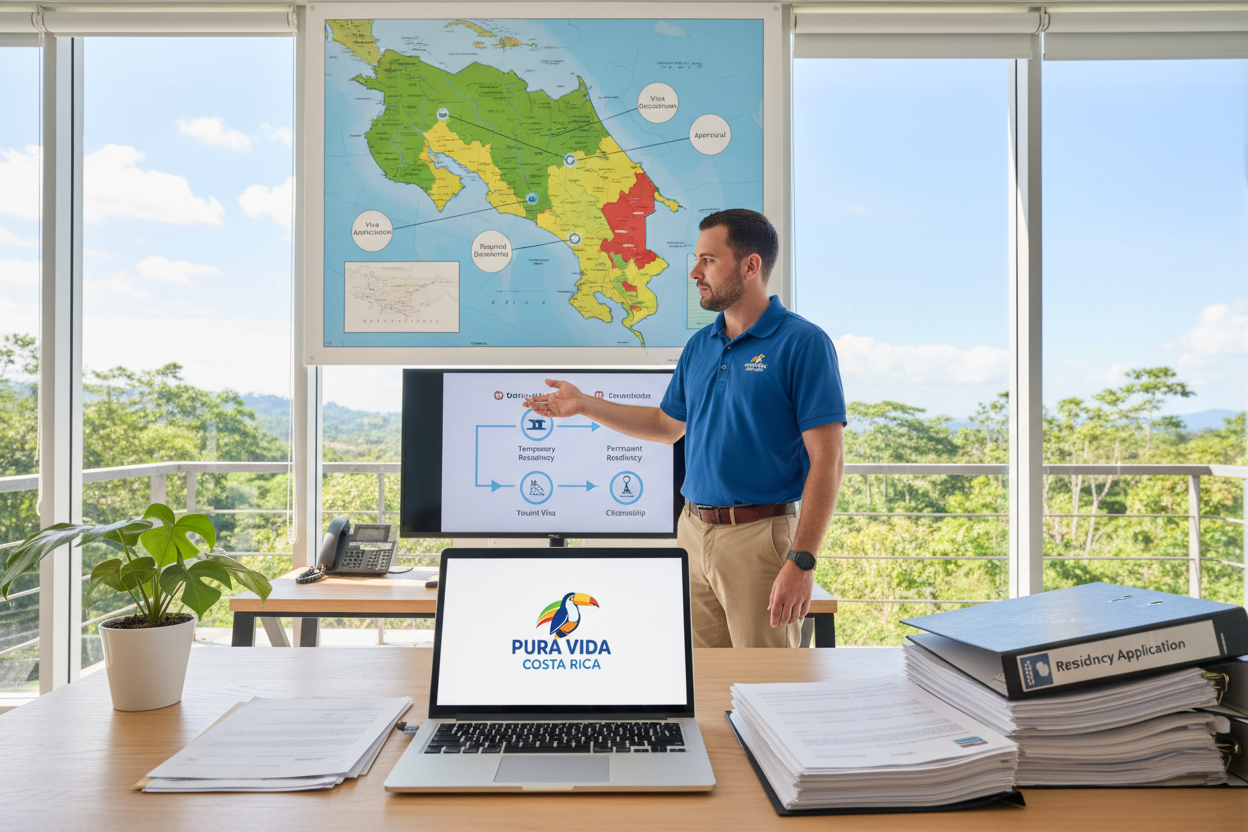
We focus exclusively on residency and immigration for Costa Rica. Many from the United States fall in love with this beautiful country during a visit. This guide is for those dreaming of a permanent move, not a tourist stay.
You can enter as a tourist for up to 180 days. But using that status to live here is risky. It can lead to deportation and a future entry ban.
We offer candid, step-by-step information for the legal path. The right preparation starts at home—before you travel. You’ll need specific documents apostilled and translated.
Our guidance is based on official sources like migracion.go.cr. We believe in transparency and realistic timelines. Understanding the process upfront saves time and frustration later.
Understanding Costa Rica Residency Options (Residencia)
Costa Rica provides specific legal pathways, known locally as ‘residencia,’ for individuals wishing to live there permanently. These are not short-term tourist visas but formal statuses designed for different life circumstances.
The three most common options for applicants from the United States are Pensionado (retiree), Rentista (income-based), and Inversionista (investor). Each category serves a distinct purpose within the country’s immigration framework.
Securing residency grants you legal authorization to live as a resident, not a tourist. This eliminates the risks associated with overstaying a travel permit. You become a legal part of the community.
This status unlocks access to local services and establishes a foundation for the future. It’s the proper first step for anyone considering a long-term move. Understanding the specific criteria for each pathway is essential, and details on financial thresholds follow in later sections. For information on maintaining status, you can learn about the visa renewal process. The U.S. Embassy also provides useful guidance for its citizens abroad.
Who Qualifies for Costa Rican Residency (¿Quién Califica?)
Not everyone who wishes to live in Costa Rica permanently can obtain residency. Specific financial and personal benchmarks must be met. Love for the country or length of visit does not override these non-negotiable requirements.
Overview of Eligibility Criteria
The Pensionado category requires a verifiable, permanent pension of at least $1,000 monthly. Sources include U.S. Social Security or a qualified private plan.
Rentista applicants must show guaranteed income of $2,500 per month for two years. This often comes from investments or rental properties.
The Inversionista pathway demands a minimum $150,000 investment. A critical detail: the asset must be titled in the applicant’s personal name, not a corporation.
Qualified applicants can include spouses and dependent children. Each family member needs proper documentation. Note that a child born in the country automatically receives Costa Rican citizenship and requires an exit permit to travel.
Age requirements are minimal—you must be a legal adult. The focus is on financial stability, a clean record, and supporting dependents without local work. Meeting these criteria grants the right to apply for a residency visa, not a guarantee of approval. For long-term planning, understanding citizenship by naturalization is wise.
Step-by-Step Guide to the costa-rica-visa-process-for-us-citizens
Your successful application hinges on a clear, two-part sequence. It involves meticulous preparation at home followed by formal procedures on the ground. Trying to shortcut this logical order leads to expensive delays.
Initial Document Preparation and Research
Honestly, this first phase determines if your application succeeds or stalls. You must identify your residency category and gather all source documents from U.S. institutions. This includes birth certificates, police checks, and financial proofs.
Each document requires an apostille from the U.S. Department of State for certification. They also need official translation into Spanish. Complete this entire step before booking your flight.
Application and Post-Arrival Procedures
Once you arrive with your complete packet, the formal part begins. You must register your entry and submit your application to immigration authorities. This isn’t something you can rush through on a short vacation.
Always ensure your passport is valid and undamaged for the entire stay. Carry copies of your immigration papers at all times. Local officials may request them to verify your status.
Following this step-by-step information saves significant time and frustration. The sequence cannot be bypassed.
Preparing Essential Documents: Apostilles & Translations (Documentación)
Document preparation is the non-negotiable first step where applications are often won or lost. Success hinges on perfecting your paperwork before you arrive. We focus on two critical validations: apostilles and official translations.
Necessary Apostilles Explained
An apostille is a government certification that validates your U.S. documents for use abroad. Authorities will reject any document without this seal.
You typically need apostilles for birth and marriage certificates, divorce decrees, and police records. Certain financial proofs also require this step. The process runs through the U.S. Department of State or state-level offices and takes several weeks.
Translation Requirements and Tips
Every English document needs translation by a certified official translator (traductor oficial). Using an uncertified service guarantees rejection.
For family applications, you may need a “certificado de nacimiento literal.” This specific birth record shows registration dates and parental data. You can obtain it from the Civil Registry in San Jose or via their official online portal.
Create a tracking spreadsheet and request multiple certified copies. Budget a minimum of two to three months for gathering, certifying, and translating all your records. This attention to detail is what separates a smooth process from a failed one.
Meeting Financial Thresholds for Pensionado, Rentista, and Inversionista
The numbers are non-negotiable: $1,000 per month, $2,500 per month, or $150,000 invested. These are the fixed financial benchmarks for the three main residency pathways in Costa Rica.
Meeting these minimums is a firm requirement, not a suggestion. Your application hinges on proving you satisfy one set of criteria.
Required Income and Investment Benchmarks
The Pensionado visa requires a verifiable, permanent pension of at least $1,000 monthly. This income must be guaranteed for the long term.
For the Rentista category, you must show $2,500 of guaranteed monthly income. This commitment must be documented for a two-year period.
The Inversionista pathway demands a minimum $150,000 investment in the country. A critical detail: the asset must be titled in your personal name.
When applying with family, the primary applicant’s financial proof must support the entire household. While the official number doesn’t increase per child, demonstrating extra stability is wise.
Meeting the minimum gets your Costa Rican visa application considered. Providing rock-solid documentation for amounts above these thresholds strengthens your case significantly.
Timelines and Key Milestones in the Residency Process
We advise clients to measure their residency journey in seasons, not weeks, to align with reality. The process is measured in months, not days. Attempting to rush it leads to frustration.
Total time from document collection to approval typically ranges from 6 to 12 months. This depends on your category and documentation.
Expected Processing Timeframes
We break the timeline into phases. Document preparation takes several months if you’re organized. Submission and initial review often require 1-2 months.
Final processing and approval can take 3-6 months in a typical case. Some extend longer. Costa Rican government processes operate on different timelines than you may expect.
Critical Milestone Checkpoints
The first milestone is completing your apostilled and translated packet. This period is under your control. The second is formal application submission.
After filing, you work on the government’s schedule. The review period involves verification and background checks. Respond promptly to any requests.
Approval grants temporary residency for an initial period, often two years. You’ll then renew your residency visa with updated financial proof.
Common Mistakes to Avoid During the Application Process
The most frequent errors in the residency process often relate to timing and documentation validity. Learning to sidestep these pitfalls can save you months of delay.
Overlooking Document Validity and Deadlines
Many applicants submit expired background checks or old birth certificates. Authorities enforce strict validity periods for apostilles and translations.
Presenting a damaged passport can lead to denied entry. A critical timing error is overstaying your tourist period. This can trigger fines, complicate your case, and risk future travel to the country.
Misunderstanding Financial Requirements
Immigration needs official proof, not informal statements. Your financial security must be documented with certified bank letters or pension awards.
For the investor pathway, a major error is buying property through a corporation. The requirement mandates the asset be in your personal name. Failing this specific rule disqualifies the entire application.
Getting proper guidance is a key part of success. Navigating alone with outdated information often means restarting from scratch.
Digital Nomad vs. Residency Options: What You Need to Know
Digital Nomad authorization offers an extended stay, yet it remains a tourist visa—not a pathway to permanent residency. This is a critical point of confusion for many remote workers considering a move to this country.
The program allows foreign nationals to live and work remotely for up to one year, with a possible renewal. Your income must come from outside Costa Rica. However, this status does not grant you the rights of legal residents.
Time spent under this visa does not count toward the residency period required for citizenship. You cannot join the national healthcare system or obtain a local driver’s license. Essentially, you remain a tourist with extended travel permissions.
For U.S. citizens with remote income, the Rentista residency is often the closest actual option. If you can document $2,500 in monthly income, this provides a genuine legal foundation for living here permanently.
Choose the Digital Nomad route if you want a 1-2 year trial period with maximum flexibility. If your goal is to build a life, buy property, or pursue Costa Rican citizenship, proper residency is the necessary first step from day one.
This special visa is a useful tool for a specific situation. It is not a substitute for the legal status required for permanent living in Costa Rica.
Useful Resources and Official Guidance: crie.cr and migracion.go.cr
Navigating the residency landscape requires two key websites: one for official rules and another for expert guidance. The government’s official immigration page, migracion.go.cr, provides current forms and legal requirements. For specialized help, our site at crie.cr offers detailed process guidance.
Always verify details directly on the official government website. Rules and financial thresholds can change. Relying on outdated forum posts or blogs is a common mistake.
Our team provides focused support. You can reach us for specific questions via WhatsApp at +506 8706 3888 or email at info@crie.cr.
The U.S. Embassy in San Jose offers important consular services. These include passport help and emergency assistance for U.S. citizens. Enroll in the Smart Traveler Enrollment Program (STEP) through the Department of State website for security updates.
Remember, embassy staff cannot influence local immigration decisions. Your best approach is to cross-reference information from both official government sources. When in doubt, please visit migracion.go.cr for definitive answers.
Additional Tips for Starting Your Process from Home
Think of your U.S. home as the command center for assembling your perfect application packet. The most controlled part of your residency journey happens right here. We emphasize starting your document gathering at least three to four months before your planned submission date.
Organizing Your Documents Digitally
Create a dedicated cloud folder with subfolders for each category. Scan every original document at high resolution as soon as you receive it. Store these digital copies in multiple secure locations.
This protects against loss during travel or after arrival. For physical organization, use a labeled portfolio. Keep original apostilled papers and multiple certified copies separate.
Before you travel, verify your passport has at least six months of validity. Also, confirm you have every required document, apostille, and certified translation. Once in the country, always carry copies of your passport and immigration papers.
Local authorities may request them to verify your identity and status. The U.S. Embassy in San Jose provides important consular services. They can replace a lost passport and offer assistance.
However, preventing issues through careful preparation is your best security. This foundational work from the United States ensures a smooth path forward.
Final Insights and Next Steps for Your Costa Rican Journey
Your journey toward establishing a permanent home in Costa Rica culminates with careful planning and informed action. This residency process is a significant life decision, not just a bureaucratic step.
Success hinges on choosing the right category and preparing your documents from home. Thousands of U.S. citizens achieve this goal each year through thorough preparation.
Your clear next step is to review the latest requirements at the official migracion.go.cr page. Begin gathering your source documents and please visit the U.S. Department of State site for apostille guidance.
For specific questions, contact our team via WhatsApp at +506 8706 3888 or email info@crie.cr. We focus exclusively on Costa Rican immigration.
With realistic expectations and detailed preparation, securing your legal foundation in this beautiful country is an entirely achievable goal.
FAQ
What are the main residency options for a U.S. citizen moving to Costa Rica?
The primary pathways are the Pensionado, Rentista, and Inversionista visas. The Pensionado is for retirees with a guaranteed lifetime pension. The Rentista is for those with stable passive income. The Inversionista requires a significant financial investment in the country. Each category has specific financial requirements set by the government.
How long does the entire residency application process typically take?
From initial document preparation to final approval, you should plan for a process lasting several months—often between 6 to 12 months. Timelines can vary based on the consulate, the completeness of your application, and Migración’s caseload. We advise starting well before your intended move date.
Which documents need an apostille for my application?
Key documents like your birth certificate, marriage certificate (if applicable), and proof of a clean criminal record from the FBI or your state police require an apostille. This is a certification from the U.S. Department of State or a state official that verifies the document’s authenticity for use abroad.
What are the current financial requirements for the Rentista and Pensionado visas?
Requirements are updated periodically. Currently, the Pensionado visa requires proof of a minimum lifetime pension of at least
FAQ
What are the main residency options for a U.S. citizen moving to Costa Rica?
The primary pathways are the Pensionado, Rentista, and Inversionista visas. The Pensionado is for retirees with a guaranteed lifetime pension. The Rentista is for those with stable passive income. The Inversionista requires a significant financial investment in the country. Each category has specific financial requirements set by the government.
How long does the entire residency application process typically take?
From initial document preparation to final approval, you should plan for a process lasting several months—often between 6 to 12 months. Timelines can vary based on the consulate, the completeness of your application, and Migración’s caseload. We advise starting well before your intended move date.
Which documents need an apostille for my application?
Key documents like your birth certificate, marriage certificate (if applicable), and proof of a clean criminal record from the FBI or your state police require an apostille. This is a certification from the U.S. Department of State or a state official that verifies the document’s authenticity for use abroad.
What are the current financial requirements for the Rentista and Pensionado visas?
Requirements are updated periodically. Currently, the Pensionado visa requires proof of a minimum lifetime pension of at least $1,000 per month. The Rentista visa requires proof of a guaranteed stable income of at least $2,500 per month for two years. Always verify the latest figures directly on the official Migración website.
What is the biggest mistake people make during their application?
A common error is submitting documents that are nearly expired or not understanding the strict validity periods for items like police reports and medical exams. Another critical mistake is miscalculating or improperly documenting the financial requirements, which can lead to immediate rejection of your case.
How does the Digital Nomad Visa differ from traditional residency?
The Digital Nomad Visa is a temporary permit for remote workers and entrepreneurs, allowing a one-year stay with the possibility of renewal. It doesn’t lead to permanent residency. Traditional residency categories like Pensionado or Rentista are designed for long-term settlement and can be a stepping stone to permanent residency status.
Where can I find the most reliable, official information?
The definitive sources are the Dirección General de Migración y Extranjería at migracion.go.cr and the Costa Rican Immigration Experts site (crie.cr). For U.S.-specific procedures, the U.S. Embassy in San Jose website provides vital consular services information and alerts.
Can I start the process while still living in the United States?
Absolutely. In fact, we recommend it. You can gather documents, obtain apostilles, get translations, and even file the initial application through the Costa Rican consulate with jurisdiction over your state. This proactive approach can significantly streamline your transition once you arrive in the country.
,000 per month. The Rentista visa requires proof of a guaranteed stable income of at least ,500 per month for two years. Always verify the latest figures directly on the official Migración website.
What is the biggest mistake people make during their application?
A common error is submitting documents that are nearly expired or not understanding the strict validity periods for items like police reports and medical exams. Another critical mistake is miscalculating or improperly documenting the financial requirements, which can lead to immediate rejection of your case.
How does the Digital Nomad Visa differ from traditional residency?
The Digital Nomad Visa is a temporary permit for remote workers and entrepreneurs, allowing a one-year stay with the possibility of renewal. It doesn’t lead to permanent residency. Traditional residency categories like Pensionado or Rentista are designed for long-term settlement and can be a stepping stone to permanent residency status.
Where can I find the most reliable, official information?
The definitive sources are the Dirección General de Migración y Extranjería at migracion.go.cr and the Costa Rican Immigration Experts site (crie.cr). For U.S.-specific procedures, the U.S. Embassy in San Jose website provides vital consular services information and alerts.
Can I start the process while still living in the United States?
Absolutely. In fact, we recommend it. You can gather documents, obtain apostilles, get translations, and even file the initial application through the Costa Rican consulate with jurisdiction over your state. This proactive approach can significantly streamline your transition once you arrive in the country.
Article by Glenn Tellier (Founder of CRIE and Grupo Gap)
Don't wait, contact us right now!
Call or WhatsApp Costa Rica +506 8373 2085 or +506 8706 3888
Call USA/Canada +1 305-906-6784