

We recognize that many people researching this topic are actually seeking information about residency. That’s the essential first step that must come before any citizenship application, and that’s precisely what this guide addresses.
Dual citizenship in Costa Rica is possible under Law N° 7514. However, the pathway requires establishing legal residency first. This typically involves one of three primary categories: Pensionado, Rentista, or Inversionista.
Our approach emphasizes practical preparation from your home country. You’ll need to gather apostilled documents and obtain official translations. Understanding these requirements before you arrive is crucial for a smooth process.
We’ll be candid about what this actually requires. Citizenship typically follows 5 to 7 years of established residency. The approval itself then takes about 10-12 months. Digital Nomad status does not count toward this residency requirement.
This guide walks you through the residency steps. We’ll help you determine which category fits your situation. Our goal is to provide clear, trustworthy information as you navigate this journey.
Understanding Costa Rica Residency Options (CRIE)
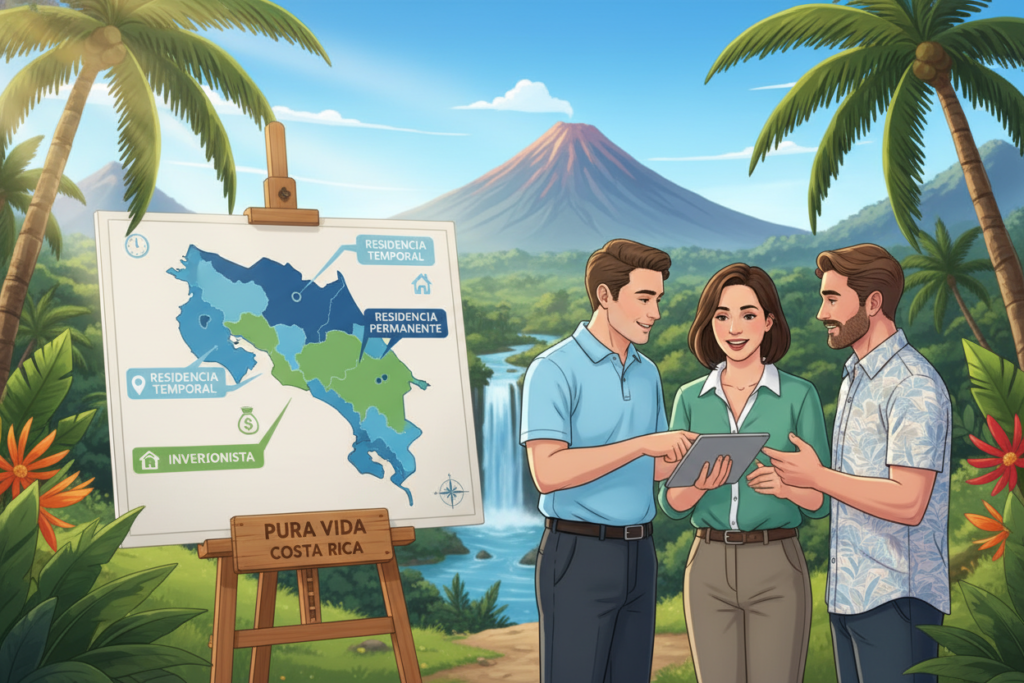
Costa Rica’s immigration system offers distinct residency pathways, each with specific financial thresholds. Securing legal residency is the mandatory foundation before any future citizenship application. We guide you through the three primary categories designed for different situations.
Overview of Residency Categories: Pensionado, Rentista, and Inversionista
The Pensionado (Pensionado) category is for retirees. It requires a guaranteed pension income of at least US$1,000 per month. This must come from a verifiable source like Social Security.
The Rentista (Rentista) pathway demands a higher, stable income. You must prove US$2,500 per month for a minimum of two years. This income can stem from investments or rentals.
The Inversionista (Inversionista) option requires a minimum investment of US$150,000 in the country. A critical rule: the property or asset must be in your personal name, not a corporation’s.
Key Requirements and Spanish Category Names on First Mention
Costa Rican immigration authorities require proof of economic self-sufficiency and good conduct. All applications are processed through this system.
Nationals from Central America, Latin America, and Spain may receive preferential treatment. Their required residency period before citizenship can be reduced.
Each category grants legal authorization to live in Costa Rica. This status is the essential first step you must complete. Choosing the right pathway based on your genuine financial situation is crucial for success.
Who Qualifies for Residency in Costa Rica

Qualifying for residency in Costa Rica hinges on meeting specific, objective criteria. The requirements are designed to ensure financial self-sufficiency for all applicants.
Eligibility Criteria for Each Category
The Pensionado category is for retirees with a guaranteed lifelong pension. You need at least US$1,000 per month from a source like Social Security.
Rentista applicants must prove US$2,500 monthly for two consecutive years. This income should come from investments or annuities, not a job.
The Inversionista pathway demands a US$150,000 minimum investment in Costa Rican assets. Ownership must be in your personal name.
Marriage to a Costa Rican citizen creates a faster track. Foreign spouses can apply for residency for spouses immediately. After two years of marriage and continuous residency, citizenship becomes an option.
Your family—spouse and minor children—can be included as dependents on your application. The primary applicant must meet the financial thresholds.
Digital Nomad status does not count toward residency or citizenship. If you work remotely, the Rentista category is typically the closest actual residency option.
Your nationality affects your access to the citizenship process. Spanish-speaking nationals need five years of residency. Others require seven years before applying.
Essential Documentation and Preparation (Documentos Requeridos)
Before you even book your flight, your focus should shift to gathering and legalizing the required paperwork. This foundational step is non-negotiable for a smooth immigration process. We strongly advise starting all document preparation from your home country.
Preparing Legal Documents and Apostilles
Your birth certificate and a criminal background check are mandatory. Each requires an Apostille from the issuing authority, like a U.S. state or the Department of State for an FBI check. This authentication under international law validates the documents for use in Costa Rica.
Attempting this after arrival causes major delays. The background check must typically be issued within six months of your application date.
Official Translations and Pre-arrival Checklist
Every foreign-language document needs an official Spanish translation by a certified Costa Rican translator. This includes your apostilled papers. Factor this extra step into your timeline and budget.
You must also complete consular inscription at your home country’s embassy in Costa Rica. Always verify the latest document checklist at migracion.go.cr, as requirements can change. Following the law precisely from the start prevents costly errors.
Navigating the Application Process for Dual Citizenship
Your application timeline for legal residency in Costa Rica effectively begins the moment you start gathering documents in your home country. This is the foundational process for residency, which must be completed years before any citizenship application.
We emphasize this is strictly a residency process. Citizenship consideration comes much later, following years of established legal status.
Step-by-Step Guidance Starting from Home
The first phase involves systematic preparation abroad. You must obtain apostilled birth certificates and a recent criminal background check.
Official translations into Spanish come later. Factor in processing time for these steps, as mail delays can add weeks.
Once your documents are ready, you enter Costa Rica as a tourist. The formal residency submission begins after arrival.
Submission Process and Follow-Up
You will submit your file to the Costa Rican immigration authority, the Dirección General de Migración y Extranjería. All documents require official translation by a certified Costa Rican translator at this stage.
The immigration office reviews your application for compliance with all requirements. Follow-up is your responsibility, as status updates are not always proactive.
You can contact their main office in Uruca, San José, or call (506) 9000-7672. Always verify the latest procedures at migracion.go.cr.
We guide clients through this process but cannot guarantee approval. Immigration decisions and timelines rest solely with Costa Rican authorities.
Meeting the Income and Investment Thresholds
The financial thresholds for Costa Rican residency are non-negotiable and form the core of your application’s success. You must provide concrete proof that you meet these specific monetary requirements.
Pensionado: US$1,000+ per Month Pension (Pensionado)
This category requires a guaranteed lifetime pension of at least US$1,000 monthly. You prove this with official award letters and bank statements.
Sources include Social Security or a private pension fund. Temporary income does not qualify.
Rentista: US$2,500/Month for Two Years (Rentista)
The Rentista requirements are higher at US$2,500 per month. Critically, you must prove this income is secured for a full two-year period.
Acceptable proof includes investment statements or annuity contracts. This shows financial stability without local employment.
Investor: Minimum US$150,000 with Personal Property (Inversionista)
This path demands a minimum US$150,000 investment in Costa Rican assets, like real estate. A common mistake disqualifies many applications.
The property must be registered in your personal name, not a corporation. Immigration assesses the official registered value, not the market price.
These thresholds cover your entire family unit. We help clients verify their documentation meets these strict requirements for retiring in Costa Rica before applying.
Timeline Expectations and Key Milestones
The journey from initial application to potential citizenship unfolds across several distinct phases, each with its own duration. We provide realistic timeframes to help you plan effectively.
Typical Processing Times
Residency application processing typically takes 3 to 6 months after submission. This period depends on documentation completeness and immigration office workload.
Document preparation in your home country often requires 2 to 3 months. Rushing this initial step can lead to errors and delays.
Important Milestones in the Application Journey
Key residency milestones include submission, review, approval, and receiving your temporary card. Each stage involves waiting periods outside your control.
Citizenship consideration comes much later. It requires 5 or 7 years of continuous residency, based on your nationality.
The final citizenship process itself takes about 10 to 12 months. We set these expectations clearly, but cannot guarantee specific timelines. Authorities in Costa Rica operate on their own schedule.
Common Pitfalls and Mistakes to Avoid
A surprising number of residency applications fail not on major issues, but on small, preventable documentation errors. We help clients sidestep these common traps through careful preparation.
Frequent Documentation Errors
Many errors stem from misunderstanding official requirements. A frequent mistake is getting apostilles from the wrong authority.
Your birth certificate needs a state-level apostille. An FBI check requires a federal one. Using the incorrect office will invalidate your documents.
Financial proof must meet strict standards. For the Rentista category, showing current account balances is not enough.
You must prove the $2,500 monthly income is guaranteed for two full years. Immigration officials in Costa Rica reject applications with variable or temporary income sources.
A critical error for investors involves property ownership. The Inversionista requirements state the asset must be in your personal name.
Purchasing through a corporation for asset protection will disqualify the investment. This mistake often requires a costly title transfer to fix.
We emphasize starting the preparation process from your home country. Attempting to gather apostilled papers after arrival creates major delays and can derail your entire timeline.
Understanding the Difference Between Residency and Citizenship
Residency and citizenship in Costa Rica are two separate legal milestones. Each status carries distinct rights and obligations. Legal residency is the mandatory first step for anyone seeking Costa Rican nationality.
Why Establish Residency Before Pursuing Citizenship
You must obtain and maintain residency for years before applying for citizenship. Spanish-speaking nationals need five years. Others require seven years of continuous living in Costa Rica.
Costa Rica has allowed dual citizenship since 1995. You can obtain Costa Rican citizenship without renouncing your original nationality. Residency grants the right to live and work here.
Citizenship provides full rights, including a Costa Rican passport and voting privileges. The Civil Registry records this change in status.
Clarifying the Role of Digital Nomad Status
Digital Nomad status is not a form of legal residency. It does not count toward the years required for citizenship. This is a critical distinction many people miss.
For remote workers, the Rentista residency category is the closest appropriate pathway. It requires proving stable income. This provides a real foundation for future citizenship eligibility, unlike the temporary digital nomad permit.
We clarify this distinction to set proper expectations. Your journey begins with securing the correct residency status.
Optimizing Your Application Strategy
Final Steps and Key Takeaways for a Successful Process
Your journey toward acquiring a Costa Rican passport is built upon a foundation of meticulous preparation and patience. Securing legal residency is the mandatory first step. This requires meeting specific income or investment thresholds through the Pensionado, Rentista, or Inversionista categories.
Critical success starts with document preparation in your home country. Obtain proper apostilles and official Spanish translations. Complete applications prevent delays with Costa Rican immigration authorities.
Understand that realistic timelines span years, not months. You must maintain residency for five to seven years before applying for citizenship. Digital Nomad status does not count toward this requirement.
Costa Rica permits dual nationality, offering significant benefits. We cannot guarantee outcomes, but proper preparation improves your likelihood. For expert guidance, contact CRIE via WhatsApp at +506 8706 3888 or email info@crie.cr. Always verify current procedures at migracion.go.cr.
FAQ
What are the main residency categories in Costa Rica?
Costa Rica offers three primary residency paths: Pensionado for retirees with a lifetime pension, Rentista for those with stable income, and Inversionista for investors. We help you understand the Spanish terms and key requirements for each option to choose the best fit.
Who is eligible to apply for residency?
Eligibility depends on your category. Pensionado requires a verified pension of at least US
FAQ
What are the main residency categories in Costa Rica?
Costa Rica offers three primary residency paths: Pensionado for retirees with a lifetime pension, Rentista for those with stable income, and Inversionista for investors. We help you understand the Spanish terms and key requirements for each option to choose the best fit.
Who is eligible to apply for residency?
Eligibility depends on your category. Pensionado requires a verified pension of at least US$1,000 monthly. Rentista needs proof of US$2,500 per month for two years. Inversionista demands a minimum US$150,000 investment in Costa Rican property or business. We assess your situation against these criteria.
What documents do I need to gather?
You’ll require legal documents like birth certificates, police clearances, and proof of income or funds. All foreign documents must be apostilled and translated into Spanish by an official translator. We provide a pre-arrival checklist to streamline this preparation.
What is the step-by-step application process?
We guide you from document preparation in your home country to submission at Costa Rican immigration. The process involves filing with the Dirección General de Migración y Extranjería, followed by regular follow-ups until your residency card is issued.
How much income or investment is required?
For Pensionado, you need a US$1,000+ monthly pension. Rentista requires US$2,500 per month for two years, often from a guaranteed source. Inversionista involves a minimum US$150,000 investment, typically in real estate. We help you structure your finances to meet these thresholds.
How long does the entire process take?
Residency applications typically take 6 to 12 months for approval. After obtaining permanent residency, you must live in Costa Rica for 7 years before applying for naturalization. We outline key milestones so you can plan your timeline realistically.
What common mistakes should I avoid?
Frequent errors include incomplete apostilles, unofficial translations, or insufficient proof of income. We help you avoid these pitfalls by reviewing your dossier against current Costa Rican immigration laws before submission.
What is the difference between residency and citizenship?
Residency allows you to live and work in Costa Rica, while citizenship grants full rights like voting and a Costa Rican passport. Establishing permanent residency is a mandatory step before pursuing naturalization. Note that digital nomad status does not count toward residency.
How can I ensure my application is successful?
Start by selecting the correct residency category, meticulously prepare all documents, and consider professional guidance. We offer strategies for a smooth process, from initial consultation to final approval, ensuring compliance every step of the way.
,000 monthly. Rentista needs proof of US,500 per month for two years. Inversionista demands a minimum US0,000 investment in Costa Rican property or business. We assess your situation against these criteria.
What documents do I need to gather?
You’ll require legal documents like birth certificates, police clearances, and proof of income or funds. All foreign documents must be apostilled and translated into Spanish by an official translator. We provide a pre-arrival checklist to streamline this preparation.
What is the step-by-step application process?
We guide you from document preparation in your home country to submission at Costa Rican immigration. The process involves filing with the Dirección General de Migración y Extranjería, followed by regular follow-ups until your residency card is issued.
How much income or investment is required?
For Pensionado, you need a US
FAQ
What are the main residency categories in Costa Rica?
Costa Rica offers three primary residency paths: Pensionado for retirees with a lifetime pension, Rentista for those with stable income, and Inversionista for investors. We help you understand the Spanish terms and key requirements for each option to choose the best fit.
Who is eligible to apply for residency?
Eligibility depends on your category. Pensionado requires a verified pension of at least US$1,000 monthly. Rentista needs proof of US$2,500 per month for two years. Inversionista demands a minimum US$150,000 investment in Costa Rican property or business. We assess your situation against these criteria.
What documents do I need to gather?
You’ll require legal documents like birth certificates, police clearances, and proof of income or funds. All foreign documents must be apostilled and translated into Spanish by an official translator. We provide a pre-arrival checklist to streamline this preparation.
What is the step-by-step application process?
We guide you from document preparation in your home country to submission at Costa Rican immigration. The process involves filing with the Dirección General de Migración y Extranjería, followed by regular follow-ups until your residency card is issued.
How much income or investment is required?
For Pensionado, you need a US$1,000+ monthly pension. Rentista requires US$2,500 per month for two years, often from a guaranteed source. Inversionista involves a minimum US$150,000 investment, typically in real estate. We help you structure your finances to meet these thresholds.
How long does the entire process take?
Residency applications typically take 6 to 12 months for approval. After obtaining permanent residency, you must live in Costa Rica for 7 years before applying for naturalization. We outline key milestones so you can plan your timeline realistically.
What common mistakes should I avoid?
Frequent errors include incomplete apostilles, unofficial translations, or insufficient proof of income. We help you avoid these pitfalls by reviewing your dossier against current Costa Rican immigration laws before submission.
What is the difference between residency and citizenship?
Residency allows you to live and work in Costa Rica, while citizenship grants full rights like voting and a Costa Rican passport. Establishing permanent residency is a mandatory step before pursuing naturalization. Note that digital nomad status does not count toward residency.
How can I ensure my application is successful?
Start by selecting the correct residency category, meticulously prepare all documents, and consider professional guidance. We offer strategies for a smooth process, from initial consultation to final approval, ensuring compliance every step of the way.
,000+ monthly pension. Rentista requires US,500 per month for two years, often from a guaranteed source. Inversionista involves a minimum US0,000 investment, typically in real estate. We help you structure your finances to meet these thresholds.
How long does the entire process take?
Residency applications typically take 6 to 12 months for approval. After obtaining permanent residency, you must live in Costa Rica for 7 years before applying for naturalization. We outline key milestones so you can plan your timeline realistically.
What common mistakes should I avoid?
Frequent errors include incomplete apostilles, unofficial translations, or insufficient proof of income. We help you avoid these pitfalls by reviewing your dossier against current Costa Rican immigration laws before submission.
What is the difference between residency and citizenship?
Residency allows you to live and work in Costa Rica, while citizenship grants full rights like voting and a Costa Rican passport. Establishing permanent residency is a mandatory step before pursuing naturalization. Note that digital nomad status does not count toward residency.
How can I ensure my application is successful?
Start by selecting the correct residency category, meticulously prepare all documents, and consider professional guidance. We offer strategies for a smooth process, from initial consultation to final approval, ensuring compliance every step of the way.
Article by Glenn Tellier (Founder of CRIE and Grupo Gap)
Don't wait, contact us right now!
Call or WhatsApp Costa Rica +506 8373 2085 or +506 8706 3888
Call USA/Canada +1 305-906-6784