
Navigating the path to legal status in Costa Rica can feel complex. We at CRIE are your dedicated resource, focusing exclusively on Costa Rica residency and immigration. This guide provides clear, step-by-step information on who qualifies and what you need to prepare.
Costa Rica offers several residency pathways for foreigners, including U.S. citizens. The three primary categories are Pensionado for retirees, Rentista for those with guaranteed income, and Inversionista for investors.
The Investor visa requires a minimum capital commitment of US$150,000. This investment can be in real estate, shares in a local corporation, or the stock market. A critical rule: any property purchased must be titled in your personal name, not through a corporate entity.
The application process for temporary residency typically takes 4 to 12 months. We recommend starting your document gathering—including apostilles and translations—from home. This preparation streamlines your application and helps avoid delays.
Understanding the Investor Visa in Costa Rica

The Inversionista visa represents a direct route to Costa Rica residency for those ready to make a significant financial commitment. We find it appeals to individuals who wish to align their capital with their lifestyle goals.
Overview of the Inversionista Requirements
This visa requires proof of a minimum investment of US$150,000 in qualifying Costa Rican assets. The most common route is purchasing real estate, but the property must be titled in your personal name, not through a corporate entity.
Alternative investment options include acquiring shares in a local corporation or approved stock market instruments. This flexibility allows you to choose a path that fits your financial strategy.
Key Advantages of the Investor Option
A major benefit is that your temporary residency application covers your spouse and dependent children. It’s a family solution under one process.
After maintaining your status for three years, you become eligible to apply for permanent residency. The visa also permits you to start and operate your own business in Costa Rica.
Who Qualifies for Costa Rica Residency: Inversionista, Pensionado (Pensionado), and Rentista (Rentista)
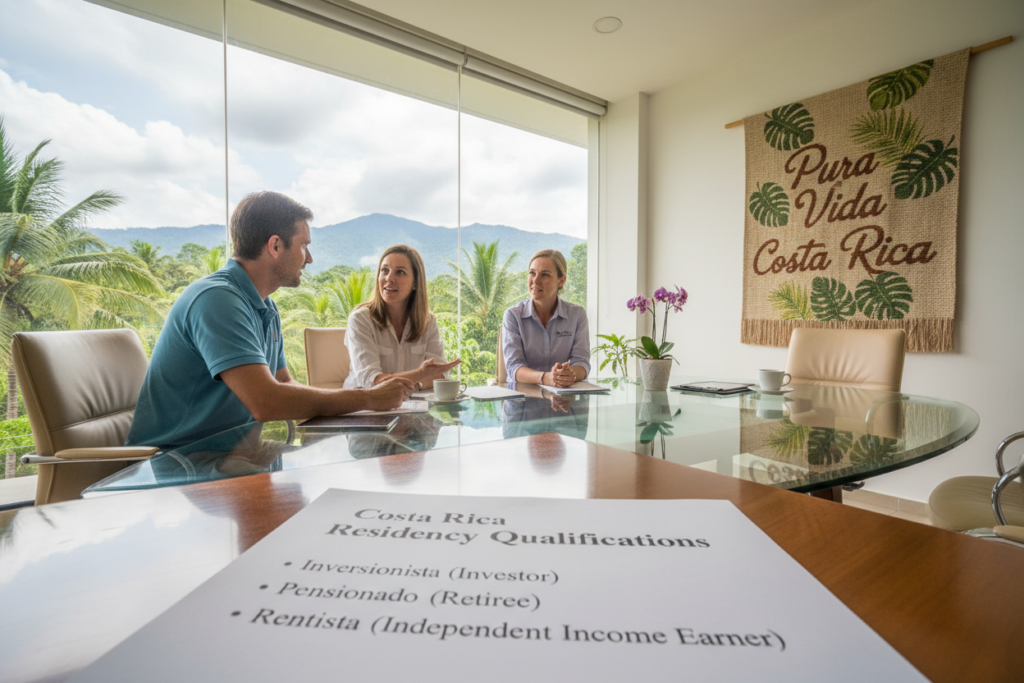
Your route to Costa Rica residency hinges on your financial situation—whether from pension, stable income, or investment capital. We outline the three primary pathways for foreign nationals and U.S. expats.
Eligibility Criteria and Financial Thresholds
The Pensionado (Pensionado) visa is designed for retirees. It requires proof of at least US$1,000 per month in lifetime pension income. This can come from Social Security, government pensions, or private retirement accounts. There is no minimum age to qualify.
The Rentista (Rentista) category suits those with guaranteed income. Applicants must show US$2,500 per month for two years. This is often met by depositing US$60,000 in a local bank.
The Inversionista (Inversionista) visa requires a US$150,000 minimum investment. This capital can be in real estate, local corporate shares, or approved financial instruments.
All three options grant temporary residency for two years, renewable if requirements are met. After three years of legal residence, you can apply for permanent residency. Each application can include your spouse and dependent children.
Step-by-Step Guidance for Preparing Your Application
Preparing your residency documents before you move to Costa Rica is a strategic step that saves time and avoids stress. We guide you through a methodical approach to ensure your submission is complete and compliant from the start.
Gathering Apostilled Documents and Required Translations
Your first task is collecting essential papers. You need a valid passport, birth certificate, police clearance, and proof of income or investment.
All documents must be issued within six months of your filing date. For U.S. citizens, the criminal background check must come from the FBI. Canadian applicants need an RCMP record.
Every document not in Spanish requires a certified translation. Then, both the original and translation must be apostilled by a Costa Rican consulate.
Outlining the Application Process from Home
You can submit your complete package through a Costa Rican consulate in your home country. Alternatively, file directly with the DGME in Costa Rica.
Processing for temporary residency typically takes 4 to 12 months. We advise patience and careful planning, as rushing causes delays.
Always verify current procedures on the official migracion.go.cr website. This ensures your application follows the latest rules.
Essential Requirements and Documentation
Submitting the correct proof of funds is the cornerstone of a successful Costa Rica residency application. Authorities need certified evidence you meet the financial thresholds.
Proof of Income and Financial Stability
Pensionado applicants must provide official letters. These show a lifetime pension of at least US$1,000 per month. Social Security or private retirement statements work.
Rentista applicants have two options. They can show 24 months of bank statements proving US$2,500 monthly income. Alternatively, deposit US$60,000 in a Costa Rican bank.
A certificate from that bank confirms the deposit. It must outline the formal withdrawal plan for two years.
Property Ownership and Personal Name Requirement
Inversionista applicants prove a US$150,000 investment. This is often through a property title, or escritura.
The title must be in your personal name. Property held by a corporation does not qualify for this visa. This rule is strict and non-negotiable.
All financial documents need certification from the issuing institution. They then require a certified Spanish translation and an apostille from a Costa Rican consulate.
Once approved, you contribute about 9-10% of your stated income to the CAJA social security system. This is a mandatory monthly fee for healthcare access.
Mapping the Timelines and Application Process
A clear roadmap of the application process helps manage expectations and avoid surprises. We outline realistic timeframes based on typical cases, but actual processing times vary.
Submission Schedules and Processing Times
The document preparation phase often takes 2-3 months. This includes gathering, translating, and apostilling your paperwork from abroad.
Once submitted, the initial administrative review by immigration typically takes 1-2 months. The entire processing time for temporary residency usually spans 4 to 12 months.
This timeline depends on application volume and the completeness of your file. Always check migracion.go.cr for the most current processing estimates.
Milestones from Application to Residency Approval
After submission, your file enters substantive review. Authorities may request additional information, which is a normal part of the process.
In some cases, a provisional permit is issued, allowing legal stay during processing. Final approval leads to the issuance of your physical residency card.
Your initial card is valid for one to two years. Maintaining status requires spending about four months per year physically in Costa Rica.
Identifying and Avoiding Common Mistakes
Even with thorough preparation, many applicants encounter avoidable pitfalls during the Costa Rica residency process. These errors often cause delays of several months or force a complete resubmission. Learning from common missteps is far less costly than discovering them through personal experience.
Pitfalls in Document Preparation and Apostille Errors
The most frequent mistake involves document expiration. Police clearances and birth certificates must be issued within six months of your filing date. Submitting older papers results in rejection.
U.S. applicants often provide state-level background checks. You’ll need an FBI report. Canadians require an RCMP document. Substitutions are not accepted.
Apostille procedures are another common error. Documents must be apostilled specifically through Costa Rican consular channels. Simple notarization in your home country will not suffice.
For Investor visa applicants, a critical error is using corporate-owned property. The investment must be titled in your personal name. This rule is strict and non-negotiable.
Financial documentation must clearly meet the minimum thresholds. Provide certified translations for all statements. Also, include all family members in your initial application. Adding them later is a more complex process.
We recommend seeking professional guidance to navigate these specific requirements. This helps you avoid costly mistakes in your immigration process.
Starting Your Journey from Home: A Pre-Arrival Checklist
A meticulously prepared file, assembled at home, is your single greatest advantage for a smooth residency application in Costa Rica. Proper preparation before arrival can streamline your entire immigration process significantly.
Essential Documents to Prepare Before Arrival
Your checklist starts with vital records. You’ll need a valid passport with over six months’ validity for every applicant.
Also gather original birth certificates and a marriage certificate if applicable. These establish family relationships for your application.
Secure the correct criminal background check. U.S. citizens require an FBI report, while Canadians need an RCMP document. These must be issued within six months of filing.
Next, compile your financial proof. This includes pension letters, bank statements, or property titles, depending on your visa category.
All documents require certified Spanish translations and an apostille from a Costa Rican consulate. This legalization is a mandatory step. For a detailed list of required paperwork, see our guide here.
Complete your application forms and get passport photos. Having everything organized before you travel is crucial. It makes for a much smoother relocation process to Costa Rica.
Navigating Residency Options: residency-types-in-costa-rica-expert-immigration-guides
Your financial profile determines which of Costa Rica’s three main residency categories fits you best. We provide this expert comparison to help expats make an informed choice.
Comparing Pensionado, Rentista, and Inversionista Paths
The Pensionado (Pensionado) visa requires proof of US$1,000 in lifetime pension income monthly. It has no minimum age and suits retirees. You contribute about 9-10% of this income to the CAJA healthcare system.
The Rentista (Rentista) category needs US$2,500 monthly for two years. This can come from investments or a US$60,000 bank deposit. It offers flexibility for those with savings but not a formal pension.
The Inversionista (Inversionista) option demands a minimum US$150,000 investment. This can be in real estate or a business. It allows you to work in your investment and has no CAJA percentage fee.
All three visas grant two-year temporary residency, renewable. They include your spouse and children. You must spend about four months per year in Costa Rica.
After three years, you can apply for permanent residency. This removes most work restrictions. Understanding these options is key to planning your Costa Rica visa process for U.S.
Digital Nomad Visa Considerations Versus Residency Paths
Costa Rica’s Digital Nomad program offers a temporary solution for remote professionals, yet it doesn’t pave the way to permanent residency. We must clarify a common point of confusion for those planning to work in this country.
Why Digital Nomad Status Does Not Lead to Permanent Residency
This visa allows remote work for foreign companies. It requires proof of $3,000 monthly income, or $4,000 with dependents. The permit is valid for one year and renewable once.
Benefits include tax exemptions on foreign income and local bank access. However, it is a special temporary permit, not a residency category. Time spent under this visa does not count toward permanent residency or citizenship requirements.
After a maximum of two years, you must leave or apply for a standard residency from scratch. For digital nomads seeking long-term stability, the Rentista visa is often the closest fit. It requires a guaranteed $2,500 monthly income for two years.
If your goal is eventual citizenship, we advise starting with a formal residency path like Rentista, Inversionista, or Pensionado from day one. This ensures every year in Costa Rica counts toward your permanent future.
Additional Tips for a Successful Application
Your application’s success can be significantly enhanced by adopting a proactive and organized approach from the very beginning. Beyond checking boxes for core requirements, strategic management of the process is key.
Preparing for Consulate Interviews and Follow-Ups
If your route involves a consulate interview, thorough preparation is essential. Review your entire application and be ready to clearly explain your financial sources or investment plans.
Prompt responses to any information requests from immigration are critical. Authorities typically allow 5-10 business days for a reply. Delays or vague answers can extend your processing time unnecessarily.
Staying Updated with migracion.go.cr
Regulations and procedures can change. We recommend regularly checking the official migracion.go.cr website for updates. This ensures you follow the latest rules and fee structures.
Throughout the process, maintain your financial qualifications. Keep accounts at required levels and track your physical presence in Costa Rica from day one. For complex situations, professional legal services can provide invaluable guidance.
For personalized assistance with your Costa Rica immigration process, contact us. Reach CRIE via WhatsApp at +506 8706 3888 or email info@crie.cr.
Embracing the Pura Vida Lifestyle and Next Steps
Beyond the paperwork, Costa Rica residency grants you access to a country celebrated for its safety, natural beauty, and high quality of life. This is the essence of the Pura Vida lifestyle—a philosophy prioritizing balance and well-being.
As a resident, you gain entry into the CAJA healthcare system through social security contributions. This system ranks among the world’s best. You’ll join a welcoming community of expats and enjoy a stable, peaceful country.
Your path is clear. After three years of temporary status, you qualify for permanent residency. Following seven years as a permanent resident, you can apply for Costa Rican citizenship, which allows dual nationality.
Your next step is to determine which residency category fits your situation. Begin gathering your documents. For personalized guidance, contact CRIE via WhatsApp at +506 8706 3888 or email info@crie.cr. Visit crie.cr for resources and migracion.go.cr for official updates.
FAQ
What is the minimum investment for the Costa Rica Investor Visa?
What are the main residency options for expats moving to Costa Rica?
FAQ
What is the minimum investment for the Costa Rica Investor Visa?
The minimum investment for the Inversionista residency is 0,000 USD. This capital must be invested in a project approved by the government, such as a business, property development, or certain tourism ventures. It’s a significant commitment, so we always advise clients to conduct thorough due diligence with local legal counsel before proceeding.
What are the main residency options for expats moving to Costa Rica?
The three primary paths are Pensionado, Rentista, and Inversionista. The Pensionado visa is for retirees with a guaranteed lifetime pension of at least
FAQ
What is the minimum investment for the Costa Rica Investor Visa?
The minimum investment for the Inversionista residency is $150,000 USD. This capital must be invested in a project approved by the government, such as a business, property development, or certain tourism ventures. It’s a significant commitment, so we always advise clients to conduct thorough due diligence with local legal counsel before proceeding.
What are the main residency options for expats moving to Costa Rica?
The three primary paths are Pensionado, Rentista, and Inversionista. The Pensionado visa is for retirees with a guaranteed lifetime pension of at least $1,000 per month. The Rentista visa requires proof of a $2,500 monthly income for two years. The Inversionista, or investor visa, requires a minimum $150,000 investment. Each has distinct financial requirements and benefits suited to different lifestyles.
Can I start the residency application process from my home country?
Yes, you can and should begin the process from home. The first critical step is gathering and apostilling all required documents—like birth certificates and marriage licenses—and having them officially translated into Spanish. Initiating this abroad saves considerable time and avoids complications once you arrive in Costa Rica.
How long does the residency application process typically take?
A> From submission to approval, the process generally takes between 6 to 12 months. Timelines can vary based on the Migración department’s caseload and the completeness of your application. Key milestones include submitting your dossier, receiving a file number, and finally getting your *cédula de residencia* (resident ID). Patience and precise documentation are crucial.
What is the most common mistake applicants make?
The most frequent and costly errors involve document preparation. This includes failing to get original documents apostilled, using non-certified translations, or submitting paperwork that is expired or doesn’t match your passport name exactly. A single oversight here can delay your application by months, so meticulous attention to detail is non-negotiable.
Does the Digital Nomad Visa lead to permanent residency?
No, it does not. The Digital Nomad Visa is a temporary, one-year status (renewable for an additional year) designed for remote workers. It does not count toward the three-year requirement for permanent residency. If your long-term goal is to stay in Costa Rica, you will need to transition to a formal residency category like Pensionado, Rentista, or Inversionista.
What should I do to prepare for my consulate interview?
Preparation is key. Organize all your original apostilled documents and translations in a clear file. Be ready to confidently discuss your financial proof, your reasons for moving, and your ties to Costa Rica. Practice answering questions clearly and honestly. Treat it as a formal review of your eligibility, not just a casual conversation.
How do I stay updated on changing immigration rules?
The official source is the Dirección General de Migración y Extranjería website at migracion.go.cr. Regulations and fees can change, so we recommend checking this site periodically. For nuanced interpretation of rules, consulting with a licensed Costa Rican immigration attorney is always the safest course of action.
,000 per month. The Rentista visa requires proof of a ,500 monthly income for two years. The Inversionista, or investor visa, requires a minimum 0,000 investment. Each has distinct financial requirements and benefits suited to different lifestyles.
Can I start the residency application process from my home country?
Yes, you can and should begin the process from home. The first critical step is gathering and apostilling all required documents—like birth certificates and marriage licenses—and having them officially translated into Spanish. Initiating this abroad saves considerable time and avoids complications once you arrive in Costa Rica.
How long does the residency application process typically take?
A> From submission to approval, the process generally takes between 6 to 12 months. Timelines can vary based on the Migración department’s caseload and the completeness of your application. Key milestones include submitting your dossier, receiving a file number, and finally getting your *cédula de residencia* (resident ID). Patience and precise documentation are crucial.
What is the most common mistake applicants make?
The most frequent and costly errors involve document preparation. This includes failing to get original documents apostilled, using non-certified translations, or submitting paperwork that is expired or doesn’t match your passport name exactly. A single oversight here can delay your application by months, so meticulous attention to detail is non-negotiable.
Does the Digital Nomad Visa lead to permanent residency?
No, it does not. The Digital Nomad Visa is a temporary, one-year status (renewable for an additional year) designed for remote workers. It does not count toward the three-year requirement for permanent residency. If your long-term goal is to stay in Costa Rica, you will need to transition to a formal residency category like Pensionado, Rentista, or Inversionista.
What should I do to prepare for my consulate interview?
Preparation is key. Organize all your original apostilled documents and translations in a clear file. Be ready to confidently discuss your financial proof, your reasons for moving, and your ties to Costa Rica. Practice answering questions clearly and honestly. Treat it as a formal review of your eligibility, not just a casual conversation.
How do I stay updated on changing immigration rules?
The official source is the Dirección General de Migración y Extranjería website at migracion.go.cr. Regulations and fees can change, so we recommend checking this site periodically. For nuanced interpretation of rules, consulting with a licensed Costa Rican immigration attorney is always the safest course of action.
Can I start the residency application process from my home country?
How long does the residency application process typically take?
What is the most common mistake applicants make?
Does the Digital Nomad Visa lead to permanent residency?
What should I do to prepare for my consulate interview?
How do I stay updated on changing immigration rules?
Article by Glenn Tellier (Founder of CRIE and Grupo Gap)
Don't wait, contact us right now!
Call or WhatsApp Costa Rica +506 8373 2085 or +506 8706 3888
Call USA/Canada +1 305-906-6784