

If you dream of living in this beautiful country with major financial advantages, time is of the essence. A special window of opportunity is closing in July 2026.
This chance comes from Law No. 9996. It was created to boost the economy by attracting new foreign residents. The legislation offers significant incentives for qualified individuals.
It specifically targets three main groups. These are the Inversionista (Investor), Rentista (Rentier), and Pensionado (Retiree) categories. Each has its own financial requirements.
The potential benefits are substantial. They can include exemptions on importing vehicles and household goods. Reduced real estate transfer taxes and income tax breaks are also possible.
We specialize in Costa Rica residency and immigration. Our role is to be your expert guide through this process. We provide clear, step-by-step support without unrealistic promises.
The application typically takes 6 to 12 months. Starting your document preparation from home now is crucial. Proper apostilles and translations form the foundation for success.
Understanding Law No. 9996 and Its Economic Impact

Costa Rica’s government introduced this legislation as a strategic tool for post-COVID economic recovery. We see its purpose clearly in its official title: “Ley para la Atracción de Inversionistas, Rentistas y Pensionados.”
Background and Purpose of the Law
Enacted in July 2021, Law No. 9996 was a direct response to unprecedented challenges. Its goal was economic reactivation by attracting foreign capital and residents. The law targets three key groups—Investors, Rentiers, and Retirees—each bringing distinct benefits.
These fiscal incentives were designed to motivate relocation, not just investment. The resulting regulations, published in 2023, streamlined the entire process.
Temporary Nature and Strategic Objectives
This was always a time-limited economic stimulus. Article 12 establishes a firm five-year validity period, concluding in 2026.
The strategic objectives are multifaceted. They aim to attract investors to boost the construction and real estate sectors. Another goal is to bring stable foreign income into the local Costa Rican economy.
Ultimately, the law seeks to enrich the country’s social and cultural landscape. It positioned Costa Rica as a competitive destination for international residents during a critical period.
Eligibility Criteria: Investor (Inversionista), Rentista (Rentista), and Pensionado (Pensionado)
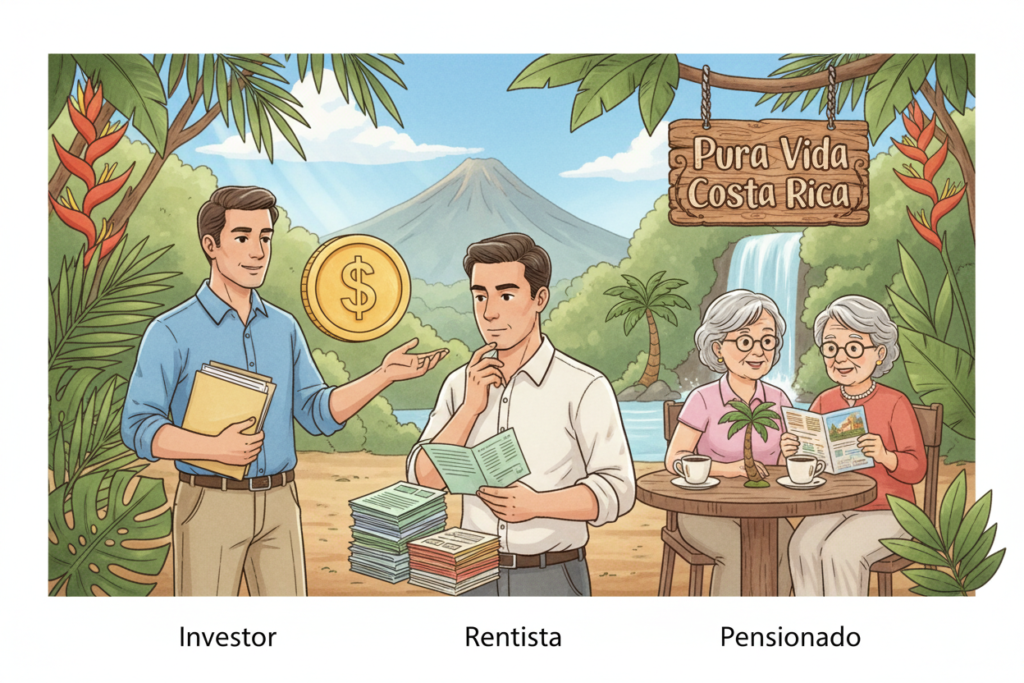
The law establishes clear financial benchmarks across three applicant categories. You must qualify under one profile to access these residency benefits.
Qualifying Financial Thresholds
Three specific dollar amounts determine eligibility. Pensionados (Retirees) need $1,000+ monthly pension income.
Rentistas (Rentiers) must show $2,500 monthly from foreign sources for two years. Inversionistas (Investors) face a $150,000 minimum investment requirement.
Specific Requirements for Each Category
For investors, qualifying assets include real estate, shares, or productive projects. Crucially, property must be in your personal name, not a corporation.
We often clarify that Costa Rica’s Digital Nomad visa doesn’t lead to residency. The Rentista category serves as the closest actual pathway.
All categories demand continuous maintenance of your investment or income. Failing this could mean losing your status, with consequences for your residency plans.
Preparing Your Documents and Mapping the Timeline
A successful residency application hinges on meticulous document preparation and a clear understanding of the timeline. You can and should begin this process from your home country before traveling.
We guide you through each step to build a strong case for the immigration authorities.
Step-by-Step Document Checklist
All applicants need core paperwork. This includes a valid passport, an apostilled birth certificate, and a police background check.
If applying with a spouse, your marriage certificate also requires an apostille. This international certification, done in your home country, validates documents here.
Once apostilled, every foreign document must be officially translated into Spanish by a Costa Rican authorized translator.
Category-specific proof is also required. Investors show property titles, Rentistas provide income contracts, and Pensionados submit pension statements.
Application Timelines and Key Milestones
The General Directorate of Immigration typically processes files in 6 to 12 months. This timeframe varies based on case complexity.
Key stages include gathering and apostilling documents, completing translations, and submitting your full application.
Given the final deadline in 2026, starting immediately is crucial to secure your residency benefits. Timely preparation avoids last-minute stress.
Meeting the costa-rica-ley-9996-tax-exemption-deadline: Strategies and Considerations
Acting before the expiration of this law can translate into significant savings on major expenses. The financial advantages are substantial and time-bound.
We help clients understand what is truly at stake. The potential savings often exceed $50,000 for a typical applicant.
Benefits of Applying Before the Deadline
Qualifying applicants gain full exemptions on importing household goods and up to two vehicles. Vehicle import taxes alone can surpass 50% of the car’s value.
You also receive an income tax break on the funds used to qualify. A 20% reduction on the real estate transfer tax applies to property purchases.
Professionals can import their equipment without the standard import taxes. These are the core benefits available during the law’s validity period.
Consequences of Missing the Cutoff
After July 2026, these specific tax exemptions will not be available to new applicants. The minimum investment requirement is expected to rise from $150,000.
Certain investment categories may also no longer qualify. However, Article 12 offers crucial protection.
If your complete application is submitted before the final date, you lock in eligibility for all benefits. Your submission date, not the approval date, is what matters.
Avoiding Common Pitfalls in Your Residency Application
Many applicants encounter avoidable setbacks due to misunderstandings about documentation and eligibility rules. We see these errors delay applications for months, even when intentions are good.
Frequent Documentation Errors
One major error is incorrect apostille certification. Each country has specific authorities for this, and using the wrong one invalidates your documents.
Translation mistakes are also common. You must use a translator officially registered with Costa Rican authorities, not just any bilingual person.
For the investor category, property must be in your personal name. Using a corporate holding is a frequent mistake. Financial statements must be current and clearly show your required income or investment level.
Misinterpretations of Eligibility Criteria
A common confusion is between temporary visas and actual residency. The Digital Nomad authorization, for example, does not lead to permanent residency.
Not every $150,000 investment qualifies. It must fit specific categories like real estate or approved projects. Rentista applicants must prove stable future income, not just past earnings.
Finally, your application submission date locks in your benefits eligibility, not the approval date. Understanding this rule is crucial for your planning.
Starting at Home: How to Prepare and Partner with Immigration Experts
Taking control of your residency future means starting the groundwork now, from the comfort of your home. A significant portion of the process involves gathering and certifying documents in your country of origin.
Organizing Your Documents from Home
You do not need to be in Costa Rica to begin. In fact, starting remotely is often more efficient. Key steps like obtaining apostilles must be completed through authorities in your home country.
Create a dedicated folder for your application. Gather financial statements, pension letters, or property deeds. Research how to get a police background check, as it has a validity period.
This organized approach provides a solid foundation. It helps avoid future consequences for your residency plans due to incomplete paperwork.
Leveraging Professional Guidance from CRIE
We specialize in Costa Rican residency. Our role is to provide expert guidance through this complex process. We review your situation and provide a specific checklist.
We coordinate with certified translators and prepare your formal application for submission to the General Directorate of Immigration. We follow up throughout the processing period for your security.
We are transparent: we cannot guarantee approval outcomes. Final decisions rest with the authorities. Our goal is to ensure your application is complete and compliant.
Reach out early for a consultation. Contact us via WhatsApp at +506 8706 3888, email info@crie.cr, or visit www.crie.cr. Let’s discuss your eligibility and timeline.
Taking the Next Steps to Secure Your Costa Rican Residency Benefits
The window to access substantial financial incentives for residency is closing rapidly. You now understand the significant benefits available under Law No. 9996.
These include exemptions on import taxes for vehicles and household goods for personal family use. You also gain reductions on real estate transfer tax and income tax incentives.
Article 12 protects your eligibility if your application is submitted before the final date. The General Directorate of Immigration then processes your file.
Costa Rica remains a stable destination with strong property rights. However, these specific tax advantages will not return after the validity period ends.
We provide expert guidance to secure your residency and its benefits. Contact us for a personalized assessment of your situation.
Reach Costa Rica Immigration Experts (CRIE) via WhatsApp at +506 8706 3888, email info@crie.cr, or visit www.crie.cr.
This information is for educational purposes. Always verify current requirements with official sources or qualified professionals.
FAQ
What is the final deadline to apply for the tax benefits under Law 9996?
Who qualifies for the real estate transfer and import tax exemptions?
What are the key tax benefits if my application is approved?
How long does the application process typically take?
What happens if I miss the December 2025 deadline?
What is the most common mistake people make in their application?
Can I start the process from my home country before moving?
Article by Glenn Tellier (Founder of CRIE and Grupo Gap)
Don't wait, contact us right now!
Call or WhatsApp Costa Rica +506 8373 2085 or +506 8706 3888
Call USA/Canada +1 305-906-6784