

Dreaming of life in Costa Rica? You’re not alone. Nearly 70,000 Americans now call this peaceful nation home. That community grows by about 14% each year.
This guide provides clear, practical steps for your journey. We’ll help you navigate the residency process with realistic expectations from the start.
The entire application typically takes 3 to 12 months. Total costs generally range from $1,500 to $4,000. We believe in transparency—these are estimates, not guarantees.
US citizens have four main pathways: Pensionado, Rentista, Inversionista, and Digital Nomad. Each has specific financial requirements. Success often depends on starting your document preparation while still in the United States.
We’re immigration specialists at CRIE. Our role is to provide factual information and guidance based on extensive experience. We help you make informed decisions.
Ready to explore your options? Contact us to begin your planning: WhatsApp +506 8706 3888 | info@crie.cr | www.crie.cr.
Overview of Costa Rica Residency Options
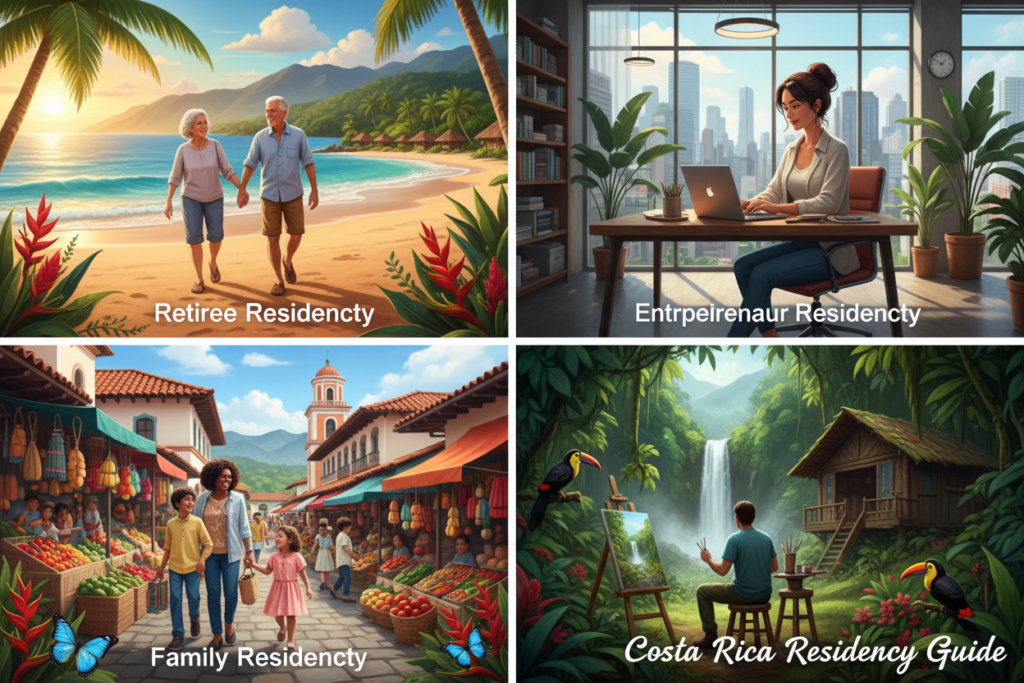
Costa Rica provides several distinct pathways for foreigners seeking long-term residence. Your choice depends primarily on your financial profile and goals. We guide you through the three main categories that lead to permanent legal status.
Introducing Pensionado (Pensionado), Rentista (Rentista), and Inversionista (Investor)
The Pensionado (Pensionado) option requires a guaranteed pension of at least $1,000 US dollars per month. This income must come from an official source like Social Security.
Rentista (Rentista) residency targets those with stable passive income. You need proof of $2,500 US dollars per month for two years, or a $60,000 deposit in a local bank.
The Inversionista (Investor) pathway demands a minimum $150,000 US dollars investment in approved assets. Remember, the Digital Nomad visa is a temporary permit, not a residency category.
Highlighting Costa Rica’s Lifestyle and Benefits
Beyond the paperwork, this country offers a compelling quality of life. The cost of living is often 30-50% lower than in major U.S. cities.
Many couples live comfortably on $2,000 to $3,000 per month. You gain access to stunning nature and the famous “pura vida” lifestyle. These benefits make the residency process a worthwhile investment in your future.
Step-by-Step Guide to the Residency Application Process

Your path to permanent residence in Costa Rica begins long before you submit any paperwork to immigration authorities. We guide you through each phase of this official process. Proper preparation from your home country is essential for success.
Preparing Documents: Apostilles, Translations, and Authentication
Start by gathering your birth certificate, marriage certificate, and FBI background check. These documents require authentication with an apostille from the U.S. Department of State.
Once in Costa Rica, you’ll need official Spanish translations. Only translators authorized by the government can complete this step. Meeting these documentation requirements early prevents delays.
Application Submission and Timeline Expectations
Submission happens at the Dirección General de Migración y Extranjería (DGME). Schedule your appointment 3-4 weeks in advance due to current backlogs.
After filing, you’ll receive proof your application is in process. Realistic processing time varies: Pensionado takes 8-12 months, Rentista 6-10 months. We help you track status and avoid common mistakes.
Who Qualifies for Costa Rica Residency?
Not everyone qualifies for permanent status in Costa Rica. The pathways are defined by specific financial or family criteria. We help you assess which category fits your situation before you begin the process.
Eligibility Criteria Based on Income and Investment
The Pensionado category requires proof of a lifetime pension. This must be at least $1,000 US dollars per month from sources like Social Security. Investment or business income does not qualify here.
Rentista residency has two options. You need guaranteed monthly income of $2,500 for two years. Alternatively, a $60,000 deposit in a local bank meets the requirements.
The Inversionista pathway demands a minimum $150,000 investment. This must be in Costa Rican real estate or a government-approved project. The investment must be in your personal name.
Family connections offer other routes. Marriage to a Costa Rican citizen or being a parent of one creates eligibility. A first-degree relative can also sponsor your application.
Meeting the financial threshold is just the first step. Providing the proper documentation to prove it is where many applications face challenges. We guide you through both aspects.
Detailed Requirements for Pensionado (Pensionado) Residency
Securing Pensionado residency hinges on demonstrating a guaranteed, lifelong income stream. This popular pathway for retirees has clear, but strict, documentation rules.
We’ll guide you through the essential proof and common pitfalls.
Proof of $1,000+ Monthly Pension Income and Necessary Documents
The core requirement is proof of permanent income of at least $1,000 US dollars per month. Qualifying sources include Social Security, government pensions, and company retirement plans.
Investment income or IRA withdrawals do not count. You must provide an official verification letter.
Essential documents include a valid passport, a birth certificate with an apostille, and an FBI criminal background check. This retired residency visa also requires a marriage certificate apostille if applying with a spouse.
Avoiding Common Mistakes in the Pensionado Application
The most frequent error is submitting an expired FBI background check. It is only valid for six months from its issue date.
Time this document carefully. Another major delay comes from name inconsistencies across your paperwork.
You must prove the income is permanent, not just a recent bank deposit. For more on life planning, see our guide on retiring in Costa Rica.
We recommend a specialist review to catch these issues early. This saves months of processing delays.
Detailed Requirements for Rentista (Rentista) Residency
For those under retirement age with reliable passive earnings, the Rentista (Rentista) pathway offers a viable route to Costa Rican residency. This category is designed for individuals with significant income from sources like investments or rental properties.
Meeting the $2,500 Monthly Income or Alternative Deposit Requirement
You must prove stable passive income of at least $2,500 US dollars per month. This income must be guaranteed for a two-year period.
Alternatively, you can deposit $60,000 into a Costa Rican bank. Immigration authorities then authorize monthly withdrawals of $2,500 from this account.
Organizing Bank Statements and Financial Proof
Financial documentation here is more rigorous. You need source contracts, like rental agreements, plus six months of bank statements.
The most common hurdle is proving the income will continue. Authorities want to see a clear, sustainable source, not just recent deposits.
We recommend organizing your proof into a clear narrative. Start with the income source, show the money flow, and prove its longevity. For the deposit method, coordinate with the bank early in your budget planning.
Detailed Requirements for Inversionista (Investor) Residency
For investors seeking a direct path to residency, the Inversionista option requires a substantial capital injection into the local economy. This pathway demands a minimum investment of $150,000 US dollars.
The funds can be allocated to qualifying Costa Rican real estate, a business operation, or a government-approved project. This offers flexibility in how you contribute to the country’s growth.
Understanding the $150,000 Minimum Investment Threshold
Purchasing property valued at or above this threshold is the most common route. You must provide the official property deed and a certified appraisal.
Investing in a business requires a detailed plan showing economic benefit. You’ll also need proof of registration and operational status.
Ensuring Investments are in the Applicant’s Personal Name
Here’s the critical rule many applicants miss. The qualifying asset must be registered in your personal name, not through a corporation.
This requirement ensures the investment is directly tied to you for residency purposes. Authorities will thoroughly verify the source of your funds and the official transfer into Costa Rica.
We help structure your purchase correctly from the start. This meets immigration rules while exploring other legal protections for your asset.
Clarifying Digital Nomad Status and Exploring Residency Alternatives
A critical distinction exists between temporary work authorization and actual residency status in Costa Rica. The Digital Nomad visa, refined in 2023, is a popular tool for remote work but is not a residency category.
Why Digital Nomad is Not Considered Residency
This visa allows a 12-month stay with one possible extension. It requires proof of $3,000 monthly income for remote work with foreign clients.
Unlike true residency, this status does not lead to permanent residence. Time under it does not count toward the seven years required for citizenship.
Recommended Alternatives for Long-Term Residency
For those committed to Costa Rica long-term, the Rentista category is the closest alternative. It requires documenting $2,500 in stable monthly income.
This grants temporary residency that leads to permanent status after three years. We often recommend using the Digital Nomad visa as a trial period while preparing your Rentista application.
Comprehensive Checklist of Required Documents Pre-Arrival
A well-organized pre-arrival document checklist is your most powerful tool for a smooth residency process. We help you build this checklist from your home country to prevent costly delays.
Essential Documents: Passport, Birth Certificate, and Criminal Background Check
Every residency application starts with core paperwork. You need a valid passport with over six months’ validity and your original birth certificate.
The FBI criminal background check is critical. It’s only valid for six months, so time this as your final step before submission.
Apostilles and Official Spanish Translations Explained
An apostille is a certificate that authenticates your documents for use abroad. For U.S. citizens, you get it from the State Department or your Secretary of State.
After arriving in Costa Rica, an official translator must convert these documents into Spanish. Using an unauthorized translator will invalidate your entire application file.
We recommend creating separate folders for originals, apostilled copies, and translations. This simple system keeps your residency journey on track from day one.
In-Depth Analysis: understanding-costa-rica-residency-cost-pricing
A realistic budget for Costa Rica residency must account for both mandatory government charges and often-overlooked ancillary expenses. We provide a transparent breakdown so you can plan effectively.
Breaking Down Government Fees and Hidden Costs
Government fees form your baseline. Expect roughly $50 for filing, $100 for approval, and $123 for your DIMEX card. A refundable guarantee deposit of about $361 is also required.
Document preparation creates significant costs. Apostilles cost $50-$100 per document. Official Spanish translations run $30-$60 per page. Courier services add another $100-$200.
Attorney fees vary widely. Basic assistance starts around $600. Comprehensive services managing the entire process typically range from $1,500 to $3,000.
Travel expenses are frequently underestimated. Multiple trips to San José for appointments can add $500-$1,000 to your total budget.
Consider a real-world example. One couple spent $482 on government fees, $1,800 on legal services, and $745 on document preparation. Their total reached $4,277.
Ongoing maintenance includes CAJA monthly payments ($60-$300) and annual card renewal. We advise budgeting for the upper end of all estimates to handle unexpected delays smoothly.
Timeline Management and Avoiding Common Pitfalls
Effective timeline management separates successful residency applications from frustrating, delayed cases. We guide you through realistic expectations for each residency category. This helps you plan your move based on actual processing times, not optimistic estimates.
Key Milestones from Document Collection to Approval
Current processing times vary by pathway. As of 2024, Pensionado takes 8-12 months, Rentista 6-10 months, and Inversionista 4-8 months. Digital Nomad visas process faster, in about 2-3 months.
The clock starts long before submission. Gathering and authenticating documents often takes 2-3 months. You must account for state-level delays and FBI background checks.
After you arrive in Costa Rica, official Spanish translations and scheduling your DGME appointment are key steps. Expect a 3-4 week wait for an appointment due to current backlogs.
Practical Tips for Staying Organized and On Schedule
The top cause of delay is incomplete documentation. Missing one apostille or having a name inconsistency can send your file to the back of the queue. Submitting a criminal check older than six months is another common error.
We recommend creating a master checklist for your specific residency category. Use a spreadsheet to track document dates and expiration. Always build buffer time into every stage of the process. Do not make major life changes based on the fastest possible timeline.
Understanding the Renewal Process for Your Residency
Your journey in Costa Rica doesn’t end with initial approval. It transitions into a phase of maintaining your legal status through timely renewals.
Steps for Renewing Your DIMEX Card and Maintaining Status
Your DIMEX card is typically valid for two to three years. Start the renewal process at least 60 days before it expires.
You can renew at Banco de Costa Rica branches or select post offices. You’ll need your current card, proof of ongoing income, and updated CAJA enrollment.
To keep your status active between renewals, stay current with CAJA payments. You must also visit Costa Rica at least once per year if you travel abroad.
After three years of temporary residency, you can apply for permanent status. This removes work restrictions and simplifies the renewal system for long-term residents.
Navigating U.S. Tax Implications and Legal Considerations
A crucial aspect of your move involves navigating the tax systems of both the United States and Costa Rica. We help you understand the obligations that come with maintaining U.S. citizenship while becoming a resident abroad.
Managing Dual Taxation and Filing Obligations
The United States taxes based on citizenship. This means you must continue filing U.S. tax returns, reporting worldwide income, even after moving.
Thankfully, tools like the Foreign Earned Income Exclusion (FEIE) offer relief. For 2024, this can exclude up to $120,000 of foreign-earned income from U.S. taxes if you meet specific tests.
Costa Rican tax obligations are more limited. The country uses a territorial system, taxing only income earned within its borders.
Your U.S. pension or Social Security is generally not taxed here. However, reporting requirements like the FBAR for foreign bank accounts over $10,000 are critical and catch many by surprise.
FATCA rules can also complicate opening local bank accounts. Your mandatory CAJA healthcare enrollment acts as another form of taxation, with payments based on your declared income.
We strongly advise consulting with a cross-border tax professional. Proper planning prevents double taxation and ensures full compliance with both nations.
Final Takeaways and Next Steps for Securing Your Residency
Your journey toward making Costa Rica your permanent home culminates with decisive action and informed planning. We’ve outlined the main pathways—Pensionado, Rentista, Inversionista, and Digital Nomad—along with the detailed process, costs, and timelines. The key takeaway is realistic planning. This process requires patience, a defined budget, and meticulous attention to your documents.
Your next steps begin at home. Gather and authenticate your core paperwork before you travel. Choosing the right residency category is crucial for your long-term goals. Living in Costa Rica offers a compelling lifestyle, with a lower cost of living and diverse options from San José to beach communities.
At CRIE, we provide Costa Rica residency and immigration services only. We don’t make promises or guarantees, but we offer experienced guidance through every step. Ready to begin? Contact us for professional services: WhatsApp +506 8706 3888 | info@crie.cr | www.crie.cr.
FAQ
What are the main types of residency in Costa Rica for foreigners?
The primary categories are Pensionado, Rentista, and Inversionista. The Pensionado visa is for retirees with a guaranteed lifetime pension. The Rentista option is for those with stable passive income. The Inversionista category requires a significant financial investment in the country, such as in real estate.
How much does the Costa Rica residency process actually cost?
Beyond government fees, total costs include document apostilles, certified translations, legal fees, and mandatory insurance. A realistic budget for a single applicant often ranges between ,000 to ,000, depending on your chosen residency category and whether you use professional services.
Can I use my remote work income to qualify for residency?
Traditional residency categories like Rentista require passive, verifiable income—not active employment salary. While the Digital Nomad visa allows remote work, it is a separate legal status with different rules and is not a path to permanent residency. For long-term status, the Pensionado or Investor routes are more stable.
What is the single most common mistake in the application process?
Failing to get documents properly apostilled and translated into Spanish before arrival is a major hurdle. Every critical document, like your birth certificate and FBI background check, must have an apostille from the issuing authority and an official translation from a Costa Rican colegio (association) of lawyers.
Do I need to pay taxes in both the United States and Costa Rica?
U.S. citizens must file U.S. taxes regardless of residency. In Costa Rica, you are taxed only on income sourced within the country. You typically won’t pay income tax on foreign pensions or passive income brought into the country, but consulting a cross-border tax specialist is essential to manage dual obligations.
How long does it take to get residency approved?
A> From document preparation to holding your physical DIMEX card, the process usually takes 6 to 12 months. Timelines depend on the efficiency of Costa Rican government agencies. Using a reputable immigration lawyer can help navigate delays and keep your application on schedule.
Is private health insurance mandatory for residency?
Yes. Proof of enrollment in the national healthcare system (CCSS), known as “Caja,” or an approved international policy is a strict requirement for application submission. This proof of medical coverage is non-negotiable for all main residency categories.
What happens after my temporary residency is approved?
You will renew your DIMEX card annually for three years before applying for permanent status. It’s crucial to maintain your qualifying income or investment and keep your local address updated with immigration to avoid lapses in your legal status.
Article by Glenn Tellier (Founder of CRIE and Grupo Gap)
Don't wait, contact us right now!
Call or WhatsApp Costa Rica +506 8373 2085 or +506 8706 3888
Call USA/Canada +1 305-906-6784