

That sense of relief when your DIMEX card finally arrives is real. You’ve navigated the initial process. Now, as the expiration date draws near, a new concern can surface.
Maintaining valid legal status is far more than a formality. It’s your key to uninterrupted access to CCSS healthcare, your local bank accounts, and work permits. It also preserves vital tax benefits on foreign-source income.
The reality of an expired status hits daily life hard. Data shows over 90% of such cases face penalties, with monthly fines starting at $200. Banking becomes restricted, and proving your legal standing to authorities gets difficult.
Costa Rica’s main residency categories—Pensionado, Rentista, and Inversionista—each have specific renewal rules. Missing these can lead to escalating fines or even deportation.
We understand both the technical immigration requirements and the practical challenges expats face. Starting early with your documents prepared is the best strategy for a smooth renewal.
This guide provides clear, actionable steps based on current regulations. We’ll outline timelines, required paperwork, and how to minimize penalties if your expiration date is approaching or has passed.
Understanding the Consequences of an Expired Residency in Costa Rica
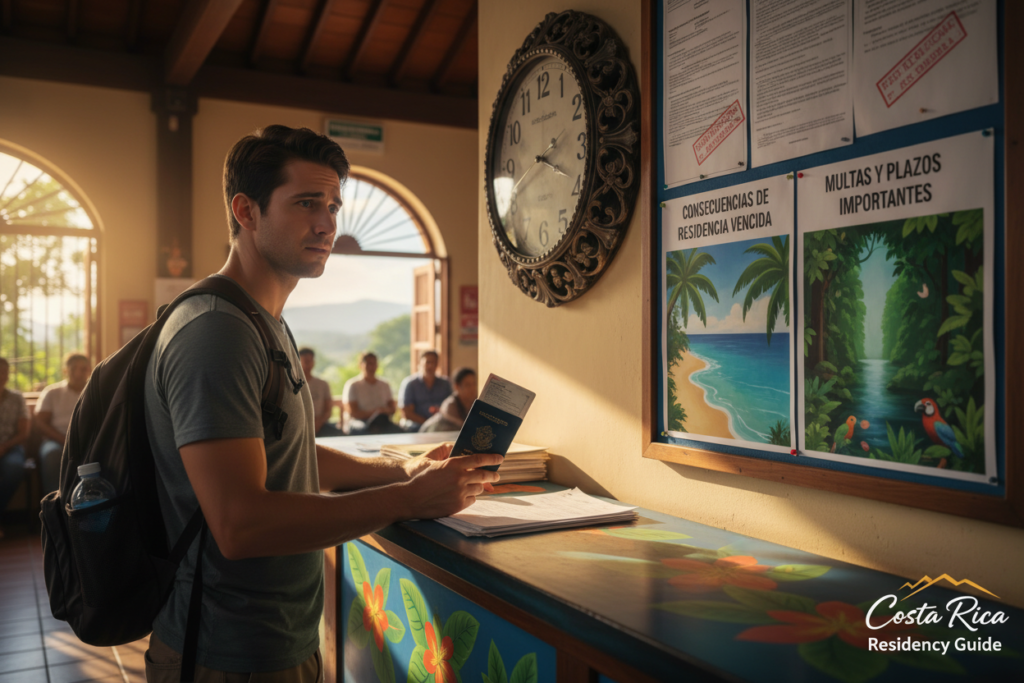
An expired DIMEX card triggers a series of legal and practical challenges that impact daily life. The effects are immediate, financial, and can jeopardize your long-term standing in the country.
Legal Risks and Penalties
Costa Rican immigration law provides a 30-day grace period for late renewals. However, you’ll face a 15% penalty surcharge on all government fees during this window.
After this period ends, monthly fines from the DGME begin. These start at $100 and can escalate to $500 based on how many months you remain out of compliance.
Impact on Daily Life and Services
Your access to the CCSS healthcare system is suspended immediately. Any legal work permit becomes void, creating risks for you and employers.
Banking services are severely restricted. Data shows 78% of accounts face freezing after approximately 90 days of expired status. Your driver’s license also loses validity.
The most serious risks involve deportation and reentry bans. In 2023, 43% of deportations involved lapsed residency holders. Article 81 of Migration Law allows for 5-year reentry bans.
Maintaining valid status is crucial for preserving tax benefits on foreign-source income. We’ve seen cases where expired status complicated property rights for investors.
Timely action is essential to avoid these cascading problems. For clear guidance on the renewal process, we recommend starting early.
Step-by-Step Guide for Renewing Your Residency

A successful residency renewal hinges on meticulous preparation and understanding the sequential steps involved. We guide you through this process to ensure you maintain continuous legal status.
Initial Document Preparation and Eligibility
Begin your document collection 3 to 6 months before your expiration date. You can file for renewal up to three months early.
Gather an updated criminal background check from your home country. It must be apostilled, translated into Spanish by a certified translator, and remain valid for six months. You also need current proof of continued eligibility for your category, like income for Rentista (Rentista) or investment proof for Inversionista (Investor).
Pay the required fees at Banco de Costa Rica. The $123 renewal fee and ₡7,910 processing charge must be deposited into account #242480-0 before submission.
Scheduling Appointments and Submitting Forms
The core application form is DGM-05. File it within 30 days of your card’s expiration to avoid late penalties. Submissions after this require a notarized justification letter.
Schedule your appointment at a Banco de Costa Rica branch or Correos de Costa Rica post office. Book 1-2 weeks in advance using their online portal.
Complete applications have a 98% approval rate. Processing times vary: Rentista renewals averaged 11.2 months in 2023, while Inversionista cases took 8.9 months. If you are over three months late, an attorney’s letter is mandatory.
Qualifying Categories Explained: Pensionado, Rentista, and Inversionista
Costa Rica offers three primary temporary residency pathways, each tailored to different financial profiles. Understanding which category fits your situation is crucial for a successful application.
Pensionado (Pensionado) Requirements and Proof of Income
The Pensionado category is for retirees. You must prove a guaranteed monthly pension of at least $1,000 US dollars. This proof requires official letters from your pension administrator.
These documents must be apostilled and translated into Spanish. Bank statements showing consistent deposits strengthen your case.
Rentista and Inversionista Thresholds
Rentista (Rentista) residency suits those with stable investment income. You need to demonstrate $2,500 US dollars per month for two years. This typically involves a $60,000 deposit and monthly transfers.
Inversionista (Investor) residency requires a one-time investment of $150,000 US dollars. The investment must be in your personal name, not a corporation. This is a common pitfall for real estate buyers.
Note: The Digital Nomad visa is not a residency pathway. For remote workers, Rentista is the closest option. Temporary residents cannot work for Costa Rican employers but can own a business.
After three years in any temporary category, you can apply for permanent residency. This offers more flexibility and simplifies future renewals.
Preparing Essential Documents at Home (Apostilles and Translations)
Proper document preparation begins in your home country, not after you arrive in Costa Rica. We emphasize starting this process early to prevent stressful delays. Every government-issued paper from your nation requires an apostille stamp for international use.
After apostilling, all documents must be translated into Spanish by a certified translator. This step is non-negotiable for Costa Rican authorities.
Checklist of Required Paperwork
Your valid passport needs at least six months’ validity. Provide notarized copies of every page. You must obtain a national criminal record certificate from your country of origin.
This certificate cannot be older than six months at submission. You also need a recently issued birth certificate from your home country.
Draft a formal application letter stating your reason for the residence permit. Include your full personal and contact details. Gather financial proof—like pension statements or bank records—specific to your category.
Remember to get three passport-sized photos with a white background. Time your requests carefully, as apostille and translation add weeks. Always verify the latest requirements at migracion.go.cr for a smooth visa renewal process.
Timelines and Deadlines: Starting Early for a Smooth Process
Effective timeline management separates stressful renewals from seamless ones. We advise starting your document collection three to six months before your DIMEX expiration date. This lead time is crucial for navigating apostilles and translations.
You can submit your renewal application up to 90 days early. Taking advantage of this window protects your legal status even if reviews take longer than expected.
When to Begin Your Renewal Process
Begin the official process by gathering documents at home. This initial phase typically takes about eight weeks. Submit everything well before the 30-day grace period after your card’s date to avoid penalties.
Understanding Processing Times and Potential Delays
After submission, the DGME’s formal approval is the longest phase. It averages nine months. Category times vary: Rentista renewals averaged 11.2 months in 2023, while Inversionista cases took 8.9 months.
Officially, most permits take 9 to 24 months to process. Plan for the full range. After approval, DIMEX card delivery adds roughly one month, though delays of two months occur.
Complex cases need a six-month lead. We also recommend aligning this process with your home country’s tax deadlines to ensure you have valid documentation.
Avoiding Common Mistakes in the Renewal Process
Renewal rejections and delays frequently stem from a handful of recurring oversights that applicants can easily avoid. We see the same documentation and timing errors derail many expats each year.
Missing or Incorrect Document Submissions
The most common error is submitting an expired criminal record. It must be valid for six months from your submission date. Non-apostilled documents cause 38% of all processing delays.
Authorities also require copies of every passport page, including blanks. Using a translator not certified by Costa Rica’s Ministry of Foreign Affairs will get your application returned.
Financial Proof and Documentation Pitfalls
For Rentista expats, income must show consistent $2,500 monthly deposits. Sporadic transfers raise red flags. Inversionista applicants must ensure their $150,000 investment is held in a personal name, not a corporation.
Active CCSS healthcare coverage is mandatory. Lapsed payments will block your renewal. Dependent spouses need a current, apostilled marriage certificate. These documentation mistakes can create gaps affecting your tax status.
Managing Penalties and Fines Associated with Overstays
Late renewals in Costa Rica come with a defined schedule of escalating fines and surcharges. Immigration law provides a 30-day grace period after your card expires.
During this window, you can still file but incur a 15% surcharge on all government fees.
Surcharge Details and Late Submission Consequences
If you miss the grace period, penalty tiers apply. For overstays of one to three months, a 15% surcharge is added to your renewal fees.
This increases to 30% for four to six months out of status. Cases spanning seven to twelve months require a special review.
Monthly fines from authorities start at around $200 and can reach $500. Data shows over 90% of expired residency cases face these charges.
After ninety days, most local banks freeze accounts to comply with identification laws. You must submit Form DGM-05 and a notarized justification letter for late filings.
Standard renewal fees are $123 plus a ₡7,910 processing charge. These must be paid into a specific Banco de Costa Rica account.
If your residency lapses for over a year, you must reapply from scratch. This process costs more than $1,800 in fees alone.
These penalties accumulate each month, increasing the total cost. Keep all payment receipts for your tax documentation. These records help clarify your tax status and any implications.
what-happens-if-my-costa-rica-residency-expires-our-expert-help: Actionable Next Steps
Your next move depends entirely on where you are in the renewal timeline. A clear, tailored plan is essential for a smooth outcome.
Contacting CRIE for Expert Assistance
Our team specializes exclusively in Costa Rica residency and immigration services. We resolve 85% of complex renewal issues applicants face alone.
We expedite form filings, reducing rejections by 94%. Our bilingual consultants handle all government correspondence directly with the immigration office.
Contact us via WhatsApp at +506 8706 3888, email info@crie.cr, or visit www.crie.cr.
Planning Your Renewal from Home
Start gathering your documents today, regardless of your timeline. This includes your criminal background check and birth certificate.
For a clear starting point, take our free residency assessment. Proper preparation protects your access to banking, healthcare, and favorable tax status.
We guide expats through every step of this process.
Final Thoughts on Securing Your Future in Costa Rica
Looking ahead, the path from resident to citizen offers profound freedom and security. After three years of temporary status, you can apply for permanent residency. This grants greater stability and fewer renewal requirements.
Maintaining legal status for seven years opens the door to citizenship through naturalization. Costa Rica permits dual nationality, letting you keep your original passport.
While U.S. and Canadian citizens can stay up to 180 days as tourists, relying on this is increasingly unreliable. The government now encourages formal residency.
Valid status ensures access to CCSS healthcare, local bank accounts, and tax advantages on foreign income. It also protects your property rights.
We recommend starting your renewal process early with thorough document preparation. With proper planning and expert guidance when needed, you can build a secure life in this beautiful country.
FAQ
What are the immediate consequences if my residency card expires?
When your residency expires, your legal immigration status lapses. You revert to a tourist visa status, which is limited to 90-day stays. This can disrupt access to essential services like opening a local bank account, signing long-term contracts, or using your cédula for official transactions. You may also face difficulties re-entering the country if you travel abroad.
How far in advance should I start the renewal process?
We strongly advise initiating your renewal at least 90 days before your card’s expiration date. Immigration processing times can be unpredictable, and starting early provides a crucial buffer for gathering documents—like apostilled proof of income or bank statements—and navigating any unexpected delays in the system.
What are the main financial requirements for the Rentista and Inversionista categories?
The Rentista category requires proof of a guaranteed, stable income of at least ,500 per month for two years, typically demonstrated through a bank deposit or letter. The Inversionista category requires a minimum investment of 0,000 in Costa Rican property, a business, or projects approved by the government, which must be formally documented.
What is the most common mistake people make during renewal?
A frequent and costly error is submitting documents that are incomplete or incorrectly prepared. This includes using outdated forms, providing financial proof without the proper apostille or official translation, or missing notarizations. These oversights can lead to a rejection of your application, requiring you to restart the entire process and incurring additional government fees.
Are there penalties for letting my residency lapse?
Yes. If your residency expires, you are technically in an irregular status. To regularize, you must pay a surcharge on top of the standard renewal fees. The amount can vary, but it’s an avoidable expense. More critically, a significant overstay could complicate your future applications or even lead to entry restrictions.
Can I begin the renewal process from outside Costa Rica?
Absolutely. A significant portion of the work can and should be done from your home country. This includes obtaining recent criminal background checks, having financial documents apostilled, and getting official translations. Preparing these essential papers ahead of your arrival or appointment streamlines the entire procedure significantly.
What is the role of an expert immigration service like CRIE?
We act as your guide and processor through a complex system. Our team ensures your application package is complete and compliant with current laws, manages communications with immigration authorities, helps schedule appointments, and provides clarity on timelines. This expertise minimizes stress and maximizes the chance of a smooth, successful renewal.
Article by Glenn Tellier (Founder of CRIE and Grupo Gap)
Don't wait, contact us right now!
Call or WhatsApp Costa Rica +506 8373 2085 or +506 8706 3888
Call USA/Canada +1 305-906-6784