
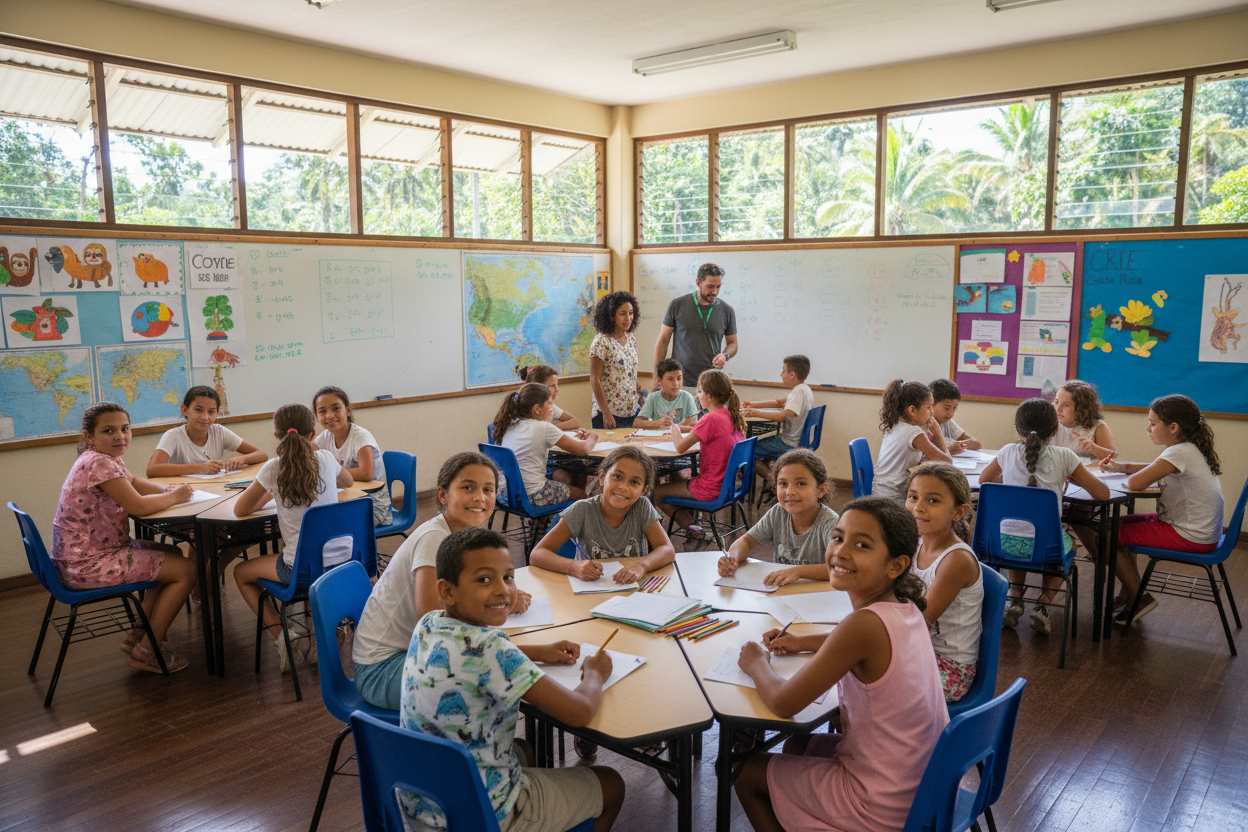
Costa Rica has a strong reputation for education and high literacy. Families moving from the United States face practical choices that shape daily life and language learning.
The right school depends on your timeline, your child’s age, and language goals. This guide previews five main routes: public Spanish-immersion, private, bilingual, international, and alternative programs so parents can narrow options fast.
School choice affects friendships, commute, routines, and how at home kids feel. Read the system overview first, then jump to school types and regions such as the Central Valley or coastal areas to match your life.
This is a practical lifestyle and education guide, not legal or financial advice. If residency matters for enrollment, the guide points readers to CRIE for category choices later.
Quick reality check: calendars and schedules can differ from the U.S., so plan early to avoid mid-year moves. A short checklist and FAQ follow in the next section.
How the Costa Rica education system works for foreign families
Knowing how schools run in Costa Rica makes the first months much easier for newcomers. This short guide explains levels, the school year, daily cycles, and grading in plain terms so parents can plan moves and routines.
School levels by age
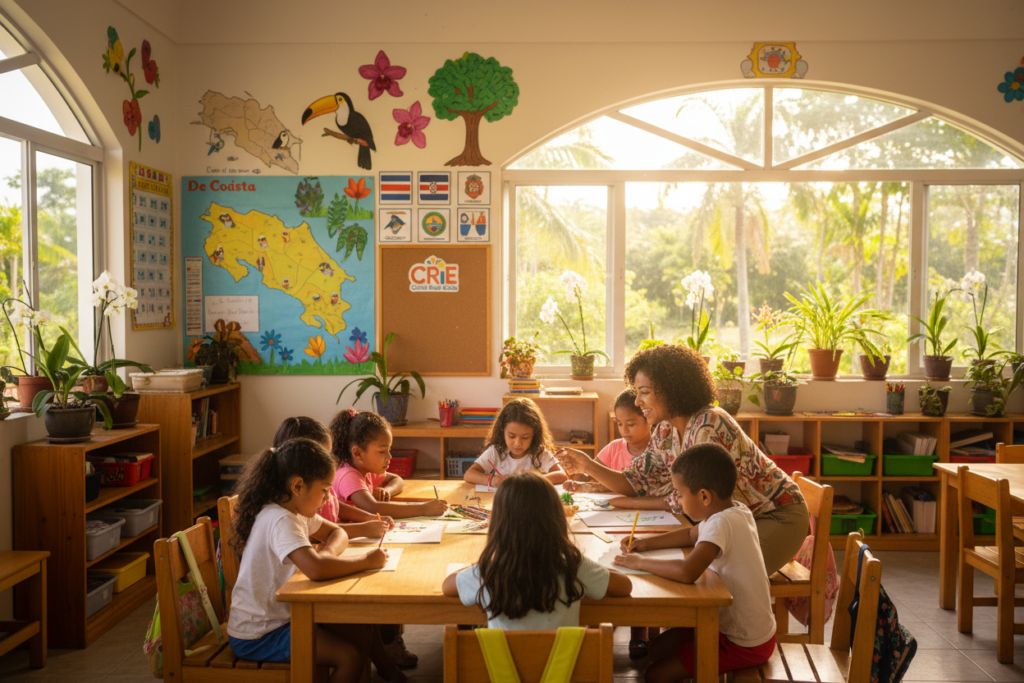
The costa rican system has three clear levels: preschool (including a transition year), primary (roughly grades 1–6), and secondary (roughly 7–12). Map your child’s current grade to these years to pick the right classroom and expectations.
School year timing
The typical school year runs from February to late November or early December. Most schools split the year into two semesters, so February and July are natural transfer points. Private schools sometimes end slightly earlier.
Daily schedules and grading
Many public schools use morning (about 7:00–13:00) and afternoon (about 13:00–17:00) cycles. If a student is placed in the afternoon, after-school sports or tutoring may need rescheduling because of daylight and traffic.
Grades appear on a 100- or 10-point scale and may also use marks like S/N/Suf/I (Outstanding/Notable/Sufficient/Insufficient). At your first parent meeting, ask staff to show a sample report card and explain the scale in plain terms.
What’s normal varies by region and school type, so use tours and classroom observations later in the guide to confirm fit for your family.
where-do-american-kids-go-to-school-in-costa-rica: the main school options
Parents face five common options for enrolling children. Each path trades language exposure, curriculum continuity, and community fit. Read the quick comparison below to match goals with likely outcomes.
Public schools: Spanish immersion and local integration
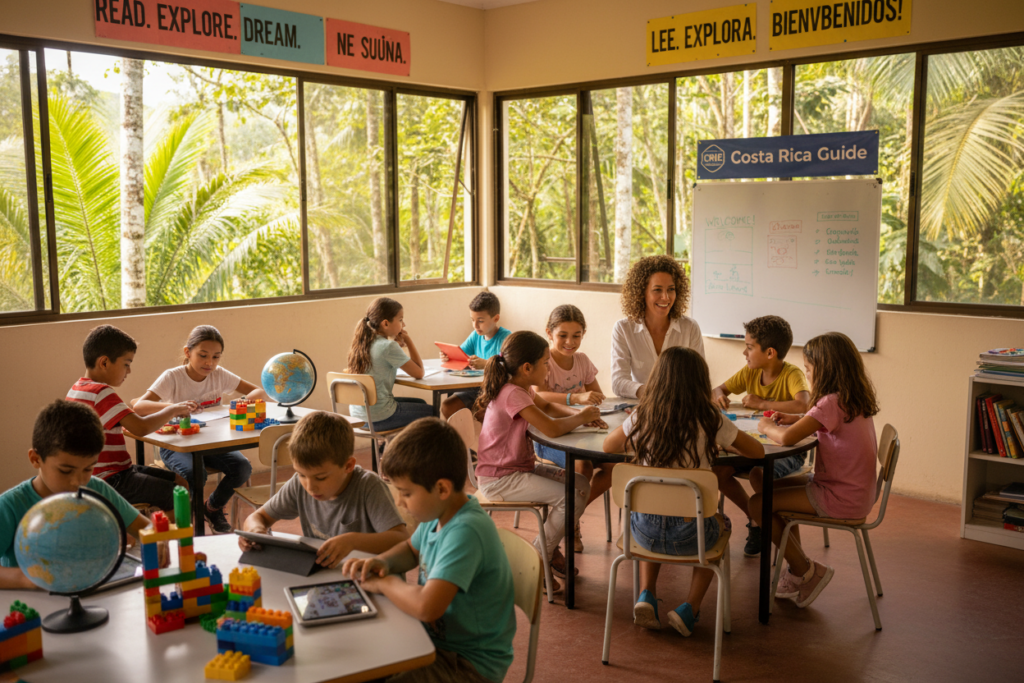
Public schools provide strong Spanish immersion and local community ties. They work well for younger children who adapt quickly to a new language.
Private Costa Rican schools and bilingual models
Private schools follow the national curriculum but often offer smaller classes and more English. Bilingual private schools sit between local and international models; verify classroom language balance before enrolling.
International schools and alternative paths
International schools use American, British, or IB curricula and ease transfers abroad. Alternative options include online U.S. programs, homeschool pods, and hybrid schedules used in smaller towns.
| Option | What you gain | What you give up | Best fit |
|---|---|---|---|
| Public schools | Full Spanish immersion, local friendships | Less English instruction, larger classes | Younger kids, families wanting deep local ties |
| Private Costa Rican | Smaller classes, predictable schedule | Still locally focused curriculum | Families wanting local anchor with more support |
| International schools | English instruction, transfer continuity | Less total local immersion, smaller local peer group | Frequent movers or those needing U.S./IB alignment |
| Bilingual private | Balanced english spanish exposure | “Bilingual” varies; verify in-class reality | Families wanting both language skills and local culture |
| Alternative | Flexible pacing, custom curriculum | Fewer formal support services | Small towns, blended online + local activities |
Example scenario: in a smaller beach town with limited secondary options, families often pair online U.S. classes with a local bilingual program for Spanish practice and socialization.
Next, look inside each type for language reality, uniforms, class size, support for new foreign students, and commute safety.
Public schools in Costa Rica: what American parents should expect
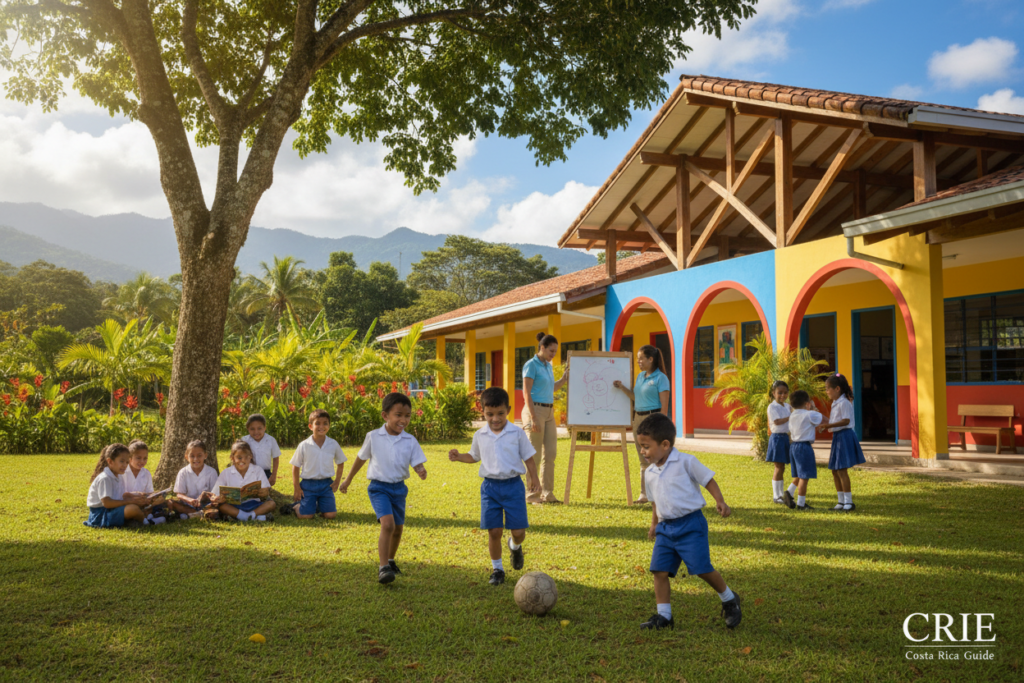
Public schools introduce children to daily life in the local community more quickly than other options. Families should plan for a Spanish-first environment, larger groups, and simple daily routines when considering enrollment.
Language reality: instruction is primarily in Spanish
Most classroom instruction happens in Spanish. English lessons are limited, so newcomers often experience a steep learning curve at first.
Ask about newcomer support: buddy systems, extra help, or informal tutoring can ease the transition and set realistic home expectations.
Uniform culture and why it matters day-to-day
Uniforms are mandatory in public schools to reduce visible wealth differences. Parents will buy, wash, and label sets, and uniforms help siblings blend into the community.
Do not send flashy electronics or expensive accessories early on; keep valuables at home until you know storage and school norms.
Class size and extracurricular expectations
Classes can be large, so classroom management and pacing may differ from U.S. norms. Teachers focus on whole-group instruction more often than one-on-one support.
Extracurriculars are limited in many public settings. If sports, music, or clubs are important, look for local community programs to fill those needs.
When public school can be a great fit (and when it’s not)
| Good fit | When to avoid | Quick tip |
|---|---|---|
| Families aiming for deep community ties | Short-term stays needing U.S. credit continuity | Test the commute during rush or rain |
| Younger children who adapt to new language | Teens requiring strict course alignment | Ask about morning/afternoon cycles |
| Households ready to support language at home | Families needing frequent English instruction | Check newcomer support before enrolling |
- Do ask staff about Spanish support for newcomers.
- Do label uniforms and plan laundry routines.
- Don’t assume extracurriculars are available on campus.
- Don’t send valuable items until you know school storage rules.
For families weighing private options alongside public community benefits, see a short guide to the best private schools to compare models and meet specific family needs.
Private and bilingual schools: how “school costa rica” differs from back home
Private schools often follow local standards while offering steadier schedules and more English than public options. Visitors may find the structure familiar, but language allocation and curriculum rules can differ from U.S. routines.
Common bilingual models
Dual language: both languages are used across subjects so students practice both daily.
Transitional: more English early, then the program shifts toward Spanish over time.
Content-based: specific subjects (like science or math) are taught in one language to deepen vocabulary.
How to verify the english spanish balance
- Do sit in a class and time which language the teacher uses most.
- Do check samples of tests and student work to see the written language of instruction.
- Don’t accept “bilingual” without a clear subject-by-subject breakdown.
Questions about teachers, learning support, and student services
Ask about teacher credentials, turnover rates, and in-class assistant support.
Request details on learning support for reading, attention, or language needs and on counseling or anti-bullying service practices.
| Model | Language focus | Who it suits |
|---|---|---|
| Dual language | Balanced English and Spanish across subjects | Students who will stay several years and need true bilingual fluency |
| Transitional | English-heavy early, shifts to Spanish | Young students needing fast English continuity with local integration |
| Content-based | Selected subjects in one language | Students needing curriculum alignment with other countries |
Fit example: a bilingual private school often works well for families who want students to gain Spanish while keeping strong academics in English for future moves.
Final check: ask to see a weekly timetable and one sample assignment for your child’s grade to confirm language use and curriculum quality.
International school Costa Rica: who it’s best for and why
When continuity and English-first instruction matter, international schools often top the list for relocating families. They help reduce academic disruption and keep records compatible with schools back home.
Common curriculum pathways
Three pathways dominate: American-style programs, British/Cambridge (IGCSE) tracks, and the International Baccalaureate (IB). Each emphasizes different skills and assessment styles.
- American: credit-based classes, AP options, familiar grading for U.S. students.
- British/Cambridge: subject exams and IGCSEs that focus on depth and exam preparation.
- IB: inquiry-led learning with global university recognition.
Accreditation and transfer continuity
Ask about accreditation, sample transcripts, and how the school issues credits if a student returns home mid‑stream. Schools in the Central Valley commonly support credit transfer and an Aug–Jun calendar.
| Who benefits | Typical fit | Example schools |
|---|---|---|
| Short stays or frequent movers | Teens needing smooth credit continuity | American International School of Costa Rica (Heredia) |
| Families wanting English-first academics | Students aiming for U.S. or international universities | Country Day School (Central Valley/Escazú area) |
Practical do/don’t and final fit note
Do ask how new students are integrated socially. Don’t assume an expat-heavy campus guarantees deeper local experience.
Fit example: a child planning to return home for high school graduation may favor an international school for transcript continuity over full Spanish immersion.
Choosing by region: where families find the most school options
Region shapes daily school life just as much as curriculum choices. Families should weigh commute, rainy-season roads, and local community before picking a school.
Central Valley and San José area
The Central Valley, including san josé, hosts the widest selection of international and premium schools costa offers. That concentration means more program options and easier access to specialists.
Traffic at drop-off and pickup can add large delays. Plan routes and test them during peak time.
Guanacaste coast
Guanacaste has growing bilingual and international choices, especially near larger towns. Schools here often form tight parent networks that support activities and tutoring.
Smaller beach towns
Smaller towns have fewer formal schools costa families expect. Many combine local classrooms with online coursework, tutors, or homeschool hybrids to cover secondary years.
- Do test the commute at the actual drop-off time and ask parents about September–October rains.
- Don’t choose without checking pickup policies, late fees, and after-school supervision.
- Community tip: ask where classmates live—long distances can affect playdates and group work.
| Region | Typical options | Daily reality |
|---|---|---|
| Central Valley | International, bilingual, specialized programs | More choices, heavier traffic |
| Guanacaste | Bilingual and growing international schools | Tighter community, fewer specialists |
| Smaller beach towns | Local schools, hybrid/online options | Limited secondary choices, creative solutions |
Real-life examples of schools American families consider
Families often choose specific schools to match how long they plan to live abroad and each child’s learning needs.
Costa Rica International Academy (Guanacaste): a bilingual, U.S.-accredited option
Costa Rica International Academy (CRIA) offers bilingual instruction and U.S. accreditation on the Gold Coast since 2000. That history gives families stability and continuity across years.
U.S.-accredited means familiar transcripts, clearer grade expectations, and smoother re-entry for students returning to U.S. schools. CRIA notes enrollments open for the 2026-27 school year, so ask about waitlists early.
American-style schools near San José: why families pick them
American International School of Costa Rica and Country Day School are often cited for their familiar culture and wide course options. Parents like steady routines and peer groups made of internationally mobile students.
These schools can act as a bridge for children anxious about change, though they may offer less automatic Spanish immersion than local options.
What a “good fit” looks like
A social, adaptable 7-year-old may thrive in full Spanish immersion. A 15-year-old often benefits from an English-first curriculum and structured support for language and credits.
Practical do: ask where recent graduates go next. That reveals how the program supports different pathways and long-term quality.
| School | Strength | Best for |
|---|---|---|
| CRIA (Guanacaste) | Bilingual, U.S. accredited, long-standing | Families seeking stability and credit continuity |
| American-style (San José) | Familiar U.S. culture, wide electives | Frequent movers and teens needing transfer ease |
| Local/bilingual options | Stronger daily Spanish immersion | Younger children and families prioritizing local experience |
Your best choice can change over the years; switching from international to bilingual (or vice versa) is a common family strategy.
Language planning for children: English Spanish success without stress
A simple plan for English and Spanish makes the first school year manageable for children and parents. This short section gives a practical lens for age differences, school supports to seek, quick red flags, and easy home habits that fit busy lives.
Younger children vs. teens: who adapts fastest
Younger children usually pick up conversational Spanish fast through play and routine. They will often start speaking after a few months and gain confidence quickly.
Teens can learn conversational Spanish, too, but they need more structured support to reach academic levels for essays or science. For older students, plan for extra help in subject vocabulary during the first school year.
ESL / Spanish support to look for (and red flags)
- Seek small-group Spanish help, a clear onboarding plan, and teachers who check comprehension.
- Good signs: buddy systems, modified assignments, and regular progress goals for the first 8–12 weeks.
- Red flags: “We don’t do support,” no plan for new foreign students, or staff blaming the child for normal adjustment.
At-home routines and community practice
Easy habits help without turning evenings into drills. Read a short Spanish children’s book together, label common items at home, and set one weekly playdate with Spanish-speaking peers.
Join a local sports or arts group so children hear Spanish in low-pressure settings. Ask teachers for specific 8–12 week goals and an update schedule. Balance works: keep English strong at home while giving school Spanish time to grow.
Enrollment process for students: documents, timing, and communication
A clear plan for paperwork and communication makes the move and school start smoother for most families. Start by building one checklist that travels with you and your child.
Typical paperwork schools request
Most schools ask for recent transcripts or report cards, passports or parent IDs, and vaccination records. Some private and international schools also want copies of birth certificates or local IDs.
Translation and record-keeping tips
Scan every document into a single digital folder and label files by student and year. Keep printed copies in a waterproof envelope and bring duplicates to visits.
When to apply and residency notes
Apply well before February for main intake and consider July for mid-year entry. Public schools may request residency proof more strictly; private schools sometimes accept status-in-process. For residency questions contact CRIE: WhatsApp +506 8706 3888 | info@crie.cr | www.crie.cr.
Communication realities
Expect schools to use email and WhatsApp for most updates. Provide a reliable phone number and enable notifications to avoid missed deadlines.
| Document | Why it matters | Quick tip |
|---|---|---|
| Transcripts / report cards | Shows grade placement and subjects completed | Scan PDFs and bring originals to enroll |
| Passports / IDs | Required for identity and emergency contact setup | Keep photocopies and one original handy |
| Vaccination record | Used for health records and immunization checks | Translate if school requests Spanish versions |
| Residency proof (if asked) | May be required by public schools for enrollment | Ask admissions early about acceptable documents |
Do ask the admissions office for a written checklist. Don’t assume the same list works for siblings or different grades.
Do’s and don’ts when touring schools and interviewing administrators
Seeing a classroom in action is the fastest way to judge a school’s day-to-day fit. Tours should focus on flow, not just facilities.
Sit quietly in a class to observe instruction, how teachers manage behavior, and whether students produce work in the promised language. Note teacher-student interactions and how different age groups handle transitions.
Do: ask about new-student support
Request the written plan for the first 30–90 days for foreign students. Ask who monitors progress, how updates are shared, and what extra lessons the child will receive.
Don’t: assume bilingual means the same everywhere
Ask what percentage of the day is in English versus Spanish and which subjects use each language. Verify with a quick sample assignment or timetable.
Don’t: overlook commute and weather realities
Tell administrators where you live and ask how families manage drop-off in rush hour and during the rainy season. Check pickup security, visitor sign-in, and where children wait if a parent is late.
- Smart questions: class size caps, homework expectations, device rules, discipline policy, and bullying response.
- Tour like a local: watch hallways, recess, and dismissal to judge real routines and comfort.
| Check | Why it matters | Quick action |
|---|---|---|
| Instruction clarity | Shows teaching quality | Sit in a class |
| New-student plan | Reflects support needs | Request written steps |
| Commute & safety | Affects daily time | Test route at peak time |
Decision tip: visit at least two top options in the same region to compare what “good” looks like for your child’s needs and schedule.
Safety and daily logistics for school life in Costa Rica
Practical routines — from commute timing to pickup rules — make school days predictable for parents and students. Planning a few simple systems ahead of time saves time and reduces stress during the rainy season or heavy traffic.
Transportation basics
Common options include school buses, carpools with trusted families, and driving your child. Each option has different reliability when roads flood or traffic worsens.
- School buses: convenient if offered, but confirm routes and backup plans for cancellations.
- Carpools: build a small, trusted network and rotate drivers to share time and cost.
- Self-driving: time your route during actual drop-off hours and add a buffer for weather delays.
Drop-off and pickup routines
Many schools use specific lines, windshield signs, or a designated pickup adult list. Routines can change for events, so print and carry current rules in the first month.
Do create a pickup authorization list and share it with the office early. Include a second adult contact and clear phone numbers for emergencies.
Communication and emergency contact tips
WhatsApp groups are common for fast updates about closures, delays, or schedule changes. Parents should mute non-essential chats but check them during key times.
Don’t rely on children to relay important messages in the first months, especially if they are still learning Spanish. Request bilingual notices or a parent liaison when possible.
Student safety habits and after-school boundaries
Keep valuables minimal, label uniform items, and teach students what to do if plans change after school. Agree on where a child may go, who they can ride with, and how they confirm plans before leaving campus.
| Option | Strength | Quick tip |
|---|---|---|
| School bus | Low parent time cost | Confirm route and rain-day plan |
| Carpool | Community ties and flexibility | Use trusted families and rotate drivers |
| Self-drive | Control over timing | Test route at peak time, add buffer |
Do: set clear after-school boundaries, share emergency contacts, and test commutes before the first week. Don’t: assume the same routines work across regions — adapt for local traffic and weather.
Helping children settle in: community, culture, and a smooth first semester
Settling into a new school and town is a series of small steps that add up over the first semester.
In week one, introduce yourself to the homeroom teacher, learn WhatsApp norms, and plan one low-pressure social activity. These moves speed social comfort and ease language transitions.
Use short daily routines: set a homework time, read a little in English and Spanish, and hold one weekly check-in so the child can share what’s hard without pressure.
Encourage at least one bilingual friend and one local peer to build community. If stress lasts several weeks, ask the school about support or tutoring.
Quick checklist: confirm school type and curriculum, observe classroom language, test commute, scan documents, request the new-student plan, and set emergency contacts.
If residency or enrollment paperwork is unclear, contact CRIE: WhatsApp +506 8706 3888 | info@crie.cr | www.crie.cr.
FAQ
Where do American children typically attend school after moving to Costa Rica?
How does the Costa Rican education system work for foreign families?
What are the main school options available in Costa Rica?
What should American parents expect from public schools in Costa Rica?
How do private and bilingual schools in Costa Rica differ from U.S. schools?
Who benefits most from international schools in Costa Rica?
Where in Costa Rica do families find the widest range of school choices?
Can you name some schools American families commonly consider?
How do children adapt to bilingual learning in Costa Rica?
What documents are typically required for school enrollment?
When should families apply to align with the Costa Rican school year?
What should parents do during school tours and administrator interviews?
What are common safety and daily logistics for school life in Costa Rica?
How can families help children settle in during the first semester?
Article by Glenn Tellier (Founder of CRIE and Grupo Gap)
Don't wait, contact us right now!
Call or WhatsApp Costa Rica +506 8373 2085 or +506 8706 3888
Call USA/Canada +1 305-906-6784