
Benefits of Costa Rica Residency
On this page, you will see the real-world benefits of becoming a legal resident, why many long-term expats decide residency is worth it, and which categories are most commonly used to make that transition. We can also confirm your eligibility on WhatsApp before you start collecting documents.
Why Residency Matters More Than Most People Expect
A lot of people think residency is mainly about immigration paperwork. In real life, it affects much more than that.
When you stay in Costa Rica on tourist status long-term, everyday life can become harder than it needs to be. Entry stamps can vary. Border runs become part of your schedule. Driving depends on your stamp validity. Banking can be inconsistent. Healthcare access is limited. Even simple administrative tasks can feel more difficult than they should.
Residency changes that. It gives you a recognized legal status and a more stable foundation for living here long-term.
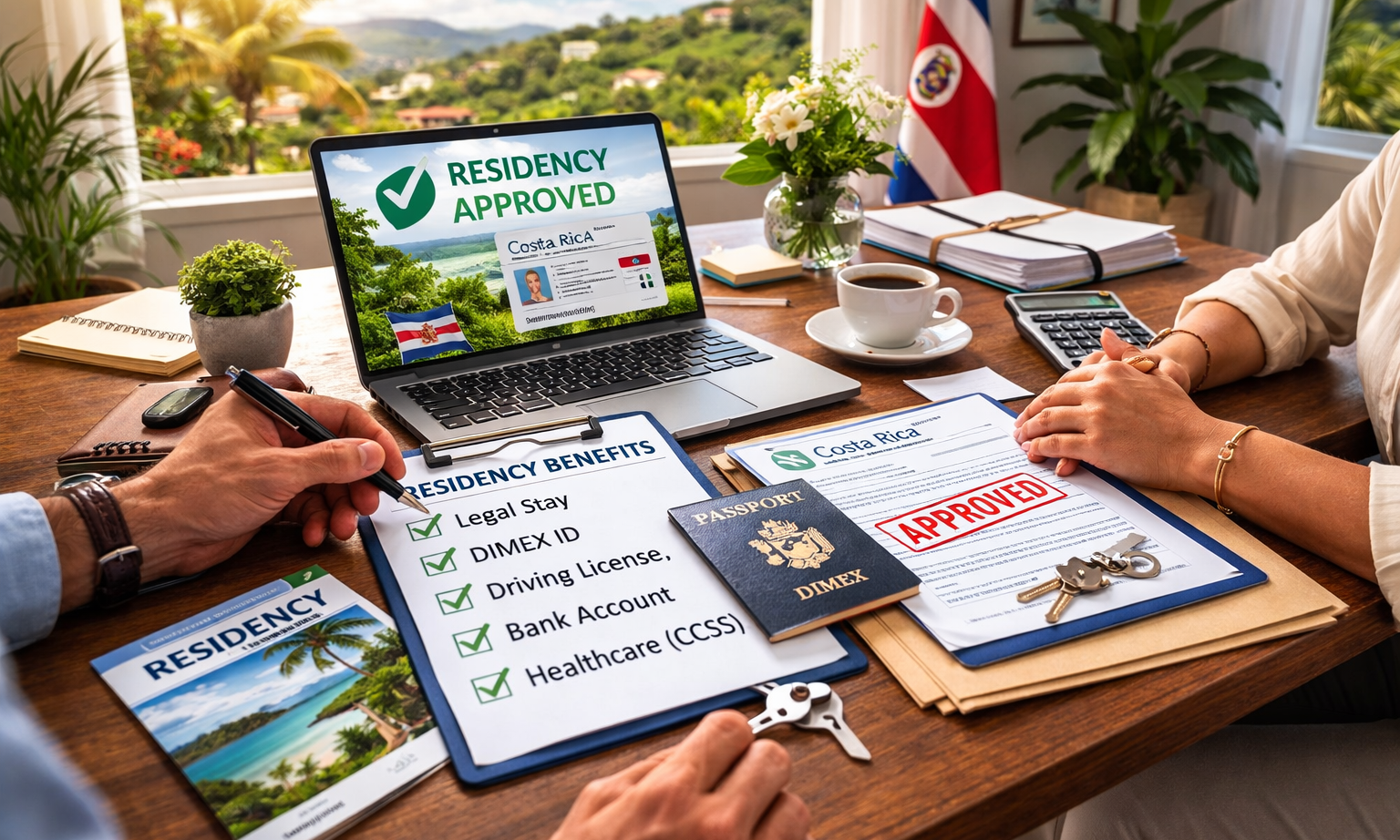
Benefits of Residency at a Glance
- Less uncertainty than living on tourist status
- A DIMEX resident ID card for everyday identification
- More predictable driving rules and long-term planning
- Access to Caja as part of residency life
- Easier banking and day-to-day financial activity
- No more border runs as a lifestyle
- A real path toward permanent residency and, later, citizenship
7 Real Benefits of Costa Rica Residency

1) Less uncertainty than tourist status
Tourist status may work for short stays, but it creates built-in uncertainty for long-term living. Entry stamps can vary, immigration officers have discretion, and repeated border runs can become stressful and inconvenient.
Residency changes the tone of your life here because your legal basis is no longer temporary visitor status. You have a defined immigration category and a more stable foundation to build around.
2) A DIMEX card for daily life
After approval, most residents receive a DIMEX resident ID card. In day-to-day life, this is one of the biggest practical upgrades.
Instead of carrying your passport everywhere, you usually have local identification that makes appointments, administrative tasks, and routine transactions much easier.
3) Driving becomes simpler and more predictable
When you are in Costa Rica as a tourist, your ability to drive on a foreign license is tied to your authorized stay. That creates uncertainty and forces many people to keep planning around stamp validity.
Residency gives you a much more stable legal foundation for driving and long-term planning. If driving matters to you, this is one of the most practical benefits of doing residency properly.
4) Access to Caja as part of residency life
For many people, healthcare is one of the biggest reasons residency is worth it. Most residency categories require enrollment in Costa Rica’s social security healthcare system, known as CCSS or Caja, as part of maintaining legal status.
Caja requirements and contribution amounts vary by category and declared income, but the bigger point is that residency moves you into a structured healthcare system instead of leaving you with tourist limitations.
5) Easier banking and everyday payments
Banking is one of the areas where many residents feel the difference quickly. Non-resident banking can be limited, inconsistent, and heavily dependent on the bank, the branch, and the person reviewing your file.
Residency usually gives institutions a more consistent way to validate your status and profile. For many expats, that makes local banking, bill payments, and normal day-to-day financial activity much easier.
6) No more border runs as a lifestyle
Border runs cost time, money, and energy. They also create uncertainty because future entry is never something you want to build your whole life around.
Residency replaces that cycle with a legal status that is much more manageable and predictable when handled correctly.
7) A real long-term pathway
Temporary residency is often the beginning of a bigger plan. Many residents later move to permanent residency once they become eligible, and citizenship may later become possible as a separate process with its own rules.
If your goal is to build a real life in Costa Rica, it helps to start with the right category and the right long-term view from the beginning.
Start Your Residency Process From Home First
If possible, start your residency process before you travel to Costa Rica. That gives you time to gather the right documents and send them to us on WhatsApp so we can review them early.
This helps avoid one of the biggest causes of delay: incorrect documents, missing apostilles or other authentication, expired records, and documents prepared in the wrong format.

Can I Work With This Status?
That depends on your immigration category. Many temporary residency categories allow you to live in Costa Rica but do not allow local employment as an employee. Permanent residency generally provides broader work rights, and specific work permit rules can apply in some situations.
If working locally is important to you, it is much better to plan that issue early rather than assume all residency categories work the same way.
See: Work Permit in Costa Rica
Common Mistakes That Delay Approval or Reduce the Benefits
- Choosing the wrong residency category
- Ordering documents too early and missing validity windows
- Missing apostille or using the wrong authentication method
- Using translations that are not done in the correct official format
- Name or date inconsistencies across documents
- Assuming Digital Nomad status counts as residency time
- Not planning ahead for Caja enrollment and renewal timing
Who This Is Best For
- People living in Costa Rica who are tired of border runs and tourist limitations
- Expats who want easier banking, driving, and everyday administration
- Retirees considering Pensionado residency
- Families who want a more stable long-term legal status
- Property owners or long-term renters who want more predictability
- Anyone planning to stay long-term and wanting to do it properly
Quick Comparison
If your main goal is more stability and fewer day-to-day complications, these are the most common residency categories to compare first:
- Pensionado – US$1,000 per month lifetime pension
- Rentista – US$2,500 per month for two years
- Investor – US$150,000 qualifying investment
- Permanent Residency – long-term status after qualifying time or family ties
How CRIE Helps
The benefits of residency only happen once your category is correct and your application is approved. CRIE helps you choose the right residency path, prepare the correct documents, and avoid preventable delays that waste time and money.
What we do
- Confirm eligibility and help identify the best category for your goals
- Provide a document plan based on your category and timing
- Flag authentication and translation issues before they become delays
- Check identity consistency across your documents
- Guide the process so your file stays organized and trackable
What you do
- Share your background, goals, and timeline
- Collect documents using the timing guidance we provide
- Provide category-specific proof such as pension, income, investment, or family relationship documents
- Respond promptly to appointments and requests as the case moves forward
Frequently Asked Questions
Is Costa Rica residency worth it if I only visit part of the year?
If your stays are short, tourist status may be enough. Residency becomes much more valuable when you want stability, fewer restrictions, and a more normal day-to-day life while you are here.
Does residency mean I can work in Costa Rica?
Not automatically. Work rights depend on your category. Many temporary categories do not allow local employment as an employee.
Do I need to speak Spanish to get residency?
Usually not for residency itself, although Spanish helps in everyday life. Citizenship is a separate process with separate requirements.
How long does residency take?
Timelines vary by category, document readiness, and case flow. The cleanest way to reduce delays is choosing the right category and preparing documents correctly from the beginning.
Can I start the residency process while I am in Costa Rica as a tourist?
Many people do. The key is planning your documents and timing correctly so you do not create avoidable delays.
What is the biggest benefit most people feel right away?
Usually it is the sense of stability. Less uncertainty, fewer workarounds, and a clearer legal foundation for living in Costa Rica.
Does Digital Nomad count as residency time?
No. Digital Nomad status is not residency and does not count toward permanent residency timelines.
What happens after temporary residency?
Many people later move on to permanent residency once they become eligible under the applicable rules.
What if I am not sure which category fits me?
That is exactly what we help with. We can review your situation on WhatsApp and tell you which path looks strongest.
Message CRIE on WhatsApp
If you want to stop living like a tourist and start building a more stable life in Costa Rica, the first step is choosing the right residency category and planning your documents properly.
Send us a WhatsApp message and we will help you review your options before you start collecting documents.
WhatsApp: +506 8706 3888
Email: info@crie.cr
Professional Disclaimer
This page is provided for general informational purposes only. Immigration rules, internal criteria, and required documentation can change. Information on this page is based on, and checked against, Costa Rica’s official immigration authority (Migración/DGME): https://migracion.go.cr/.