
Plan the legal paperwork before booking a wedding in Costa Rica. The documents and appointment process depend on whether you use the Registro Civil’s ceremony service or a qualified notary. A ceremony, its registration and an immigration application are separate steps.
A civil ceremony through the Registro Civil
The TSE’s civil-marriage checklist applies specifically to ceremonies before Registro Civil authorities. Couples apply together. Costa Rican applicants provide a valid cédula; the checklist asks foreign applicants for valid DGME-issued identification, an apostilled birth certificate and an apostilled civil-status certificate, with official Spanish translations where required. The civil-status certificate follows its stated validity; without one, it must have been issued within one month of presentation.
Applicants supply two witnesses’ names and identification numbers, email and telephone details, and arrange the required La Gaceta notice. The ceremony service is free, but applicants pay for that publication. The checklist estimates four to six months after requirements are completed, depending on the agenda. Couples and witnesses bring valid identification on the ceremony day. Confirm current availability with the office.
Do not treat this government-service checklist as a universal list for every notarial wedding. In particular, a visitor holding only a foreign passport should ask the intended officiant which lawful route and documents apply before planning around the Registro Civil service.
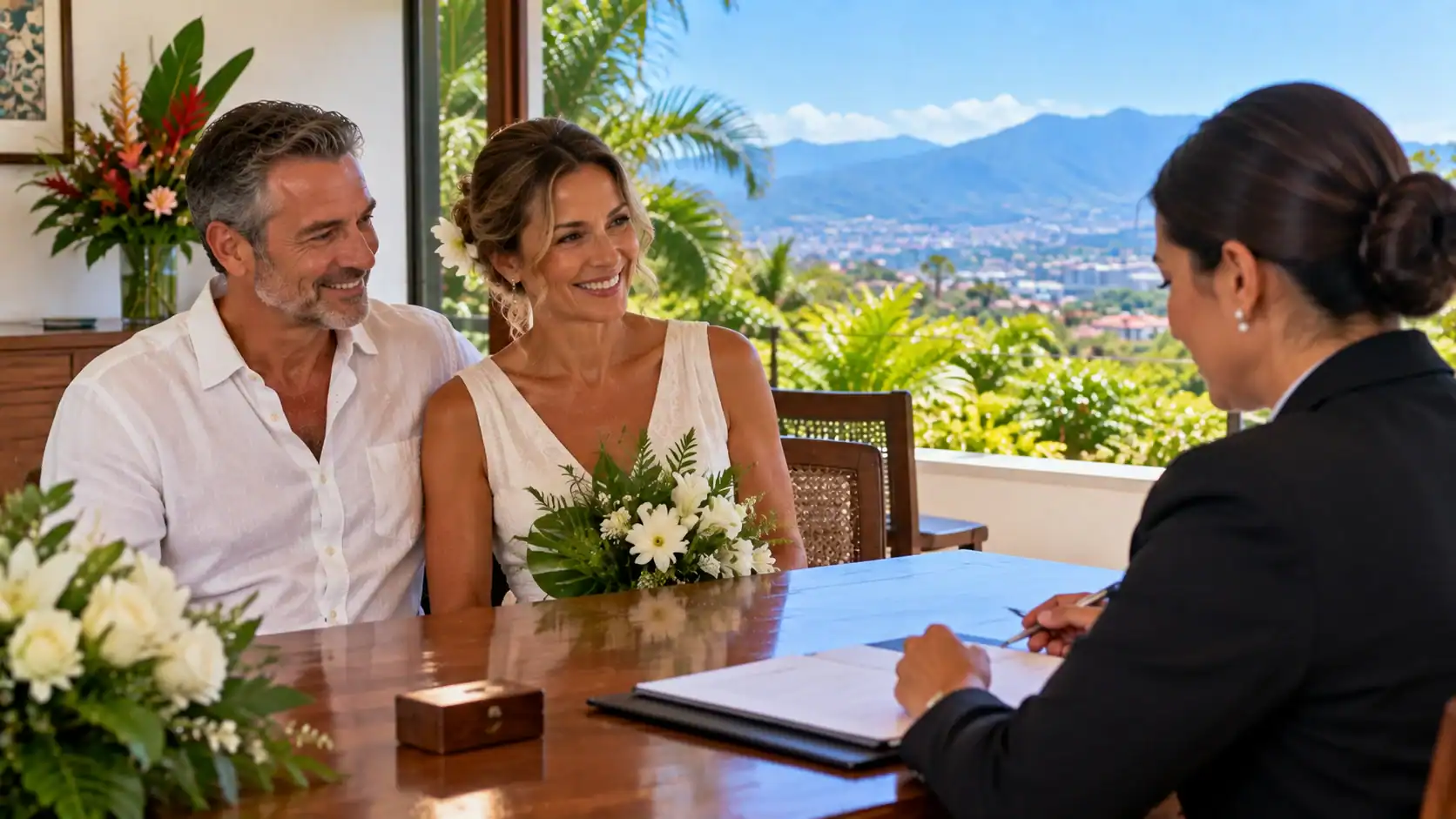
Documents when marrying a Costa Rican
Ask the officiant for a written checklist covering each partner’s nationality, identity document, current civil status and any previous marriage. Explain any divorce, widowhood, name change or discrepancy between documents at the start. Obtain the exact form of certificate requested rather than ordering documents from a generic wedding checklist.
- Check names, birth dates and identification numbers across all records.
- Ask which documents require an apostille or legalization and an official translation.
- Order time-sensitive civil-status evidence close enough to the appointment to remain usable.
- Clarify which originals will be retained and keep readable copies.
- Confirm the witnesses’ eligibility, documents and availability with the officiant.
Previous marriages can require additional proof that the earlier marriage ended and that the relevant records are updated. The correct document depends on where the event occurred and the route being used. Do not assume an informal copy of a divorce order resolves every registry question.

Using a notary and checking registration
The TSE’s Matrimonio en Línea service is a filing tool for notaries. It does not waive the marriage requirements in the Family Code. Its immediate automated registration feature is described for qualifying couples who are both Costa Rican by birth; it should not be advertised as a guaranteed instant certificate for every international couple.
Before paying, verify the notary’s current professional status with the Dirección Nacional de Notariado. Agree the scope of the service, document review, ceremony, filing, certificate follow-up and itemized costs. Ask when and how you will receive proof that the marriage was registered, not merely that the ceremony took place.
If the wedding took place abroad
The TSE has a separate foreign-marriage registration procedure when at least one spouse is Costa Rican. It requires the original certificate from the issuing country’s registry, authenticated or apostilled as applicable, and a complete official Spanish translation when needed. One spouse requests registration; a third party needs the specified authenticated authorization or public-deed special power. Contact and identification details are also required.
Ask the Registry to confirm that this is the appropriate procedure for your marriage. Registration in Costa Rica does not replace checking how another country records or recognizes the event.

After the marriage
Obtain the registered certificate and check its details before using it for banking, insurance or another application. Tell each organization about a name or civil-status change using its own process; one registry filing does not update every account.
For residency questions, use DGME’s current requirements and the CRIE guide to residency through marriage. This wedding guide does not promise automatic residency, citizenship or permission to work.
Reviewed 8 September 2026 using the TSE and DNN resources linked above. The Registro Civil checklist describes that service’s requirements and estimated scheduling, not a guaranteed wedding date.
Thinking of moving to Costa Rica?
Get a free residency assessment. Tell Johanna, our immigration expert, about your situation, and she will tell you which residency fits you and what you need.
WhatsApp Johanna: +506 8373 2085Free assessment
Or email info@crie.cr